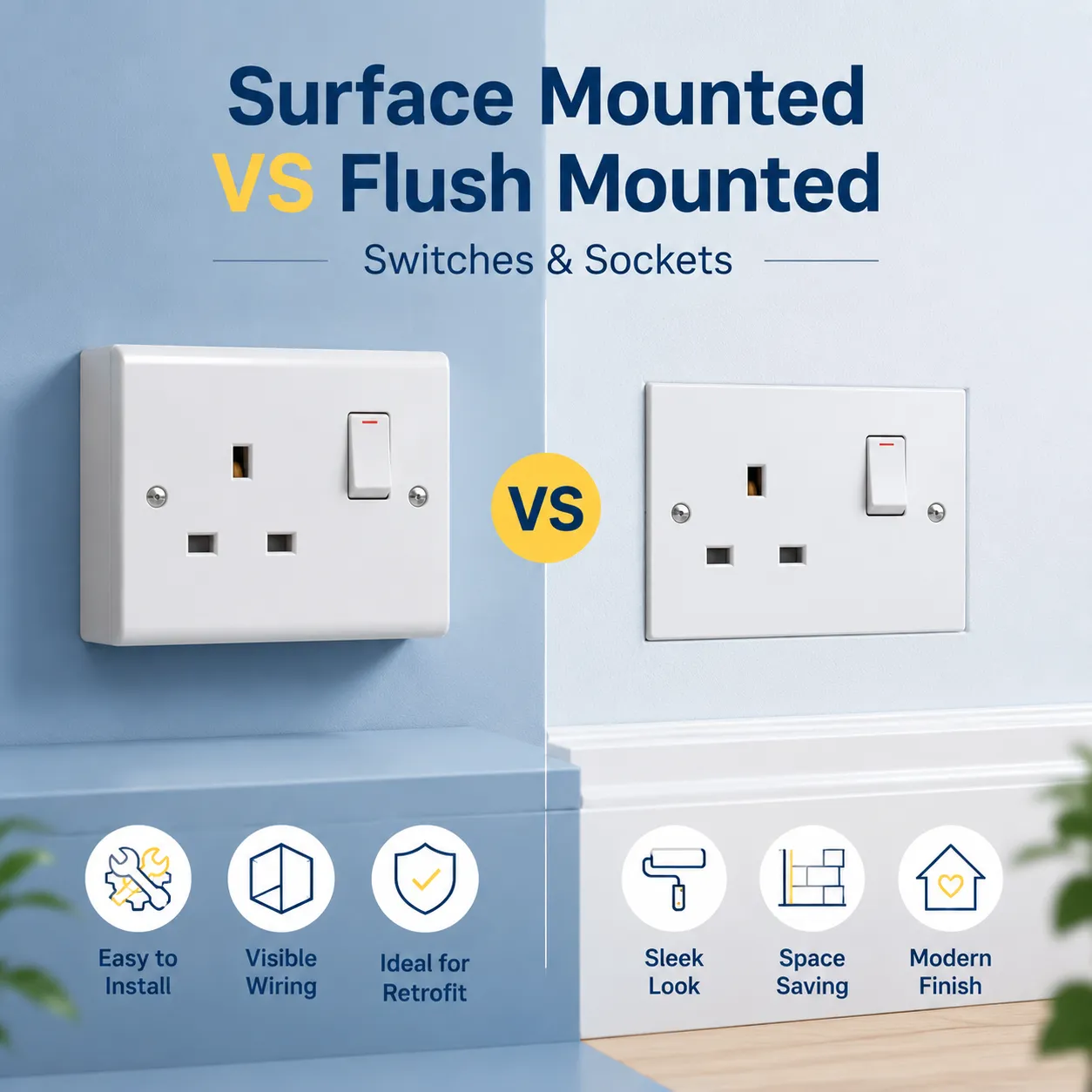
If you are working on an extension project, rewiring a workshop, or doing a garage up, the electrician will ask whether you want to go for surface or flush wiring. If you haven’t previously encountered these terms, you might think about it as a stylistic choice. However, the reality is that the choice has to do with how surfaces are connected to the wall, which may influence everything from chasing channels in masonry to how the finished product looks like. Making the wrong choice means that you will either need to spend days doing dusty wall work or end up with the switches protruding by a centimeter.
This guide looks into the issue of surface wiring versus flush wiring with regards to wall sockets and switches, their advantages and disadvantages, the ways they are installed, and when it is appropriate to use one type over the other.
In brief, flush-mounted refers to the type of switch/socket install where the box mount is located inside the wall and the faceplate is even with the wall surface, meaning that all wiring is hidden inside the wall. Surface-mounted switch/socket on the other hand has the box mount attached to the wall and wiring inside the wall. In this case, flush and surface are not interchangeable terms as flush requires embedding the box into the wall that happens at the first-fix stage of construction/renovation while surface mount is simply attached to the finished wall with no interruption.
What Do Flush-Mounted and Surface-Mounted Mean?
The terminology here refers to the position of the mounting box on the wall surface:
- Flush-mounted (concealed): The mounting box is sunk into the wall (inserted into the masonry wall or mounted between the studs in a stud wall), with the switch/socket body positioned inside the wall. Only the faceplate can be seen — it is flat with the wall surface. The wiring runs through the wall cavity or through hidden channels in the wall.
- Surface-mounted: The mounting box is mounted on the wall and protrudes from the wall surface. The wiring can either run through the surface box or surface-mounted conduit/trunking.
Both mounting options allow the use of the same switches and sockets.
Is Flush-Mounted the Same as Surface-Mounted?
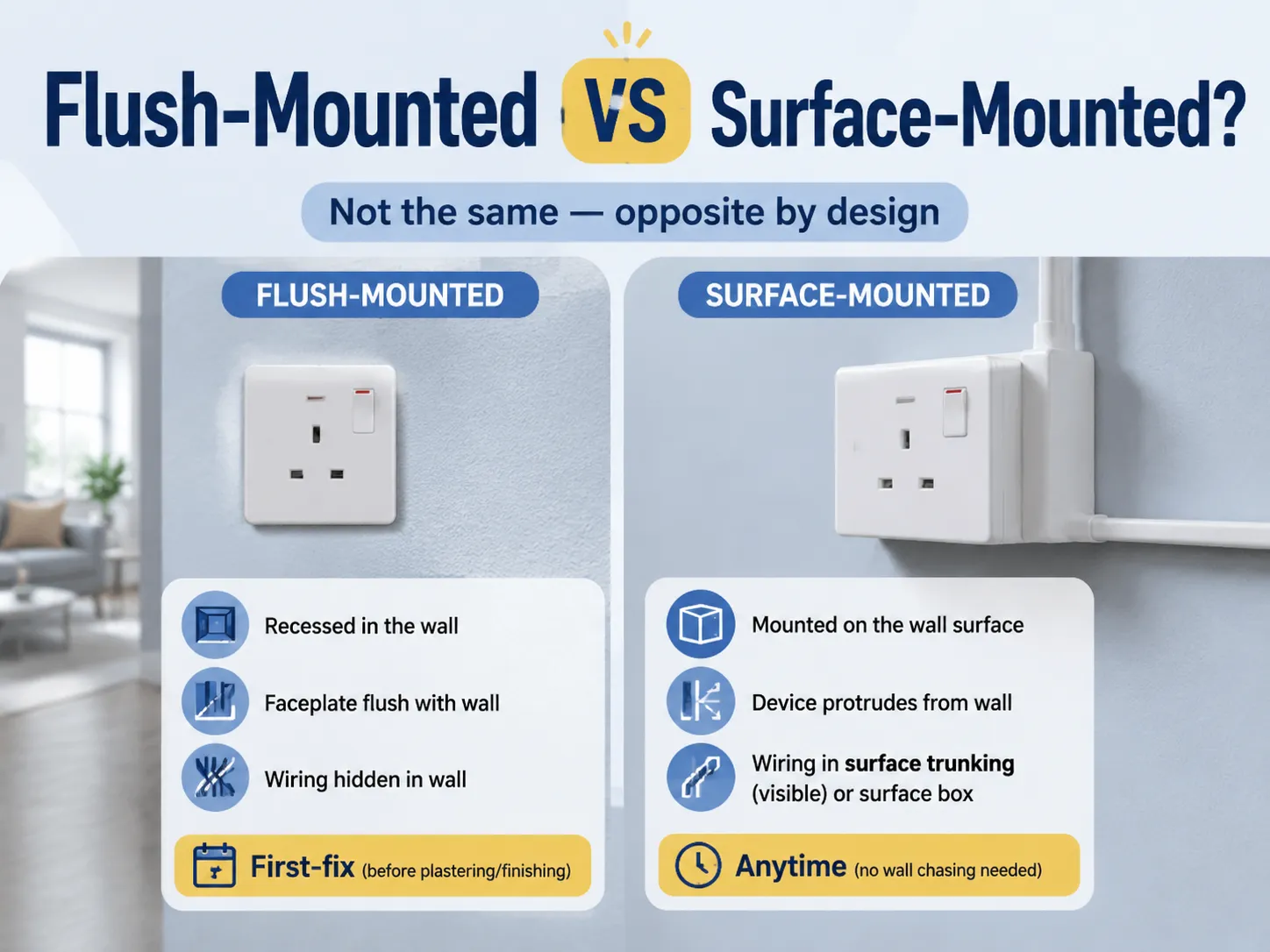
Not at all – they are radically different types of installations. Flush installation is when the appliance is set into the wall; surface installation is when the appliance is placed on top of the wall. The differences come forth in three aspects:
| Aspect | Flush-Mounted | Surface-Mounted |
|---|---|---|
| Box position | Inside the wall | On the wall face |
| Device protrusion | Faceplate flush with wall | Device protrudes from wall |
| Wiring visibility | Hidden in wall | In surface trunking/conduit (visible) or surface box |
| Installation timing | First-fix (before plastering/finishing) | Anytime — no wall chasing needed |
In the final room, flush is typically used for the unseen standard and surface for the visible option.
How Each Type Is Installed: Wiring & Mounting
Flush-mounted installation
- Initial installation: when building or redoing an electrical system, the cables make their way through walls by inserting them in channels cut out in masonry walls or placed behind wall panels — and the boxes go in places where switches/sockets have to be located.
- Final installation: once the plastering/top coats are applied, the switch/socket is connected to the box and the front panel is attached, fitting flush against the wall.
- Box depth should be considered: conventional boxes are approximately 25 mm deep, but smart/dimmer switches require boxes deeper than 35 mm.
Surface-mounted installation
- Use screws or plugs to attach the surface box to the wall at the specified location.
- Run any wire, including cavity wiring, into the surface-mounted wiring box.
- Install the appropriate device on the surface-mounted box with a faceplate that created a neat cover for the box and protrudes very little from the wall.
The inverted surface door doesn’t require cutting making it a popular option for remodelling or work in a new building.
Pros and Cons Compared
| Factor | Flush-Mounted | Surface-Mounted |
|---|---|---|
| Appearance | Clean, seamless, invisible wiring — the modern standard | Visible box and trunking — utilitarian look |
| Installation cost | Higher (chasing, plastering, finishing) | Lower — quick screw-on install |
| Retrofit difficulty | High — needs chasing into finished walls (dust, mess, redecorating) | Low — can add to finished walls anytime |
| Flexibility | Fixed positions once walls are finished | Easy to add/move later |
| Protection | Wiring protected inside wall | Trunking provides physical protection; still visible |
| Rough environments | Less common (garages/shops often surface anyway) | Preferred in garages, workshops, basements, outbuildings |
| Value perception | Adds to finished-home appeal | Can look temporary/industrial in living spaces |
When to Choose Flush vs Surface
Choose flush-mounted when:
- Whether new construction or major renovation — first fix always precedes plastering
- Finished living spaces, offices, shops and any other spaces where looks are important
- If re-plastering is planned, it is sensible to do the chasing first
- In case you want the standard modern finish together with hidden wiring
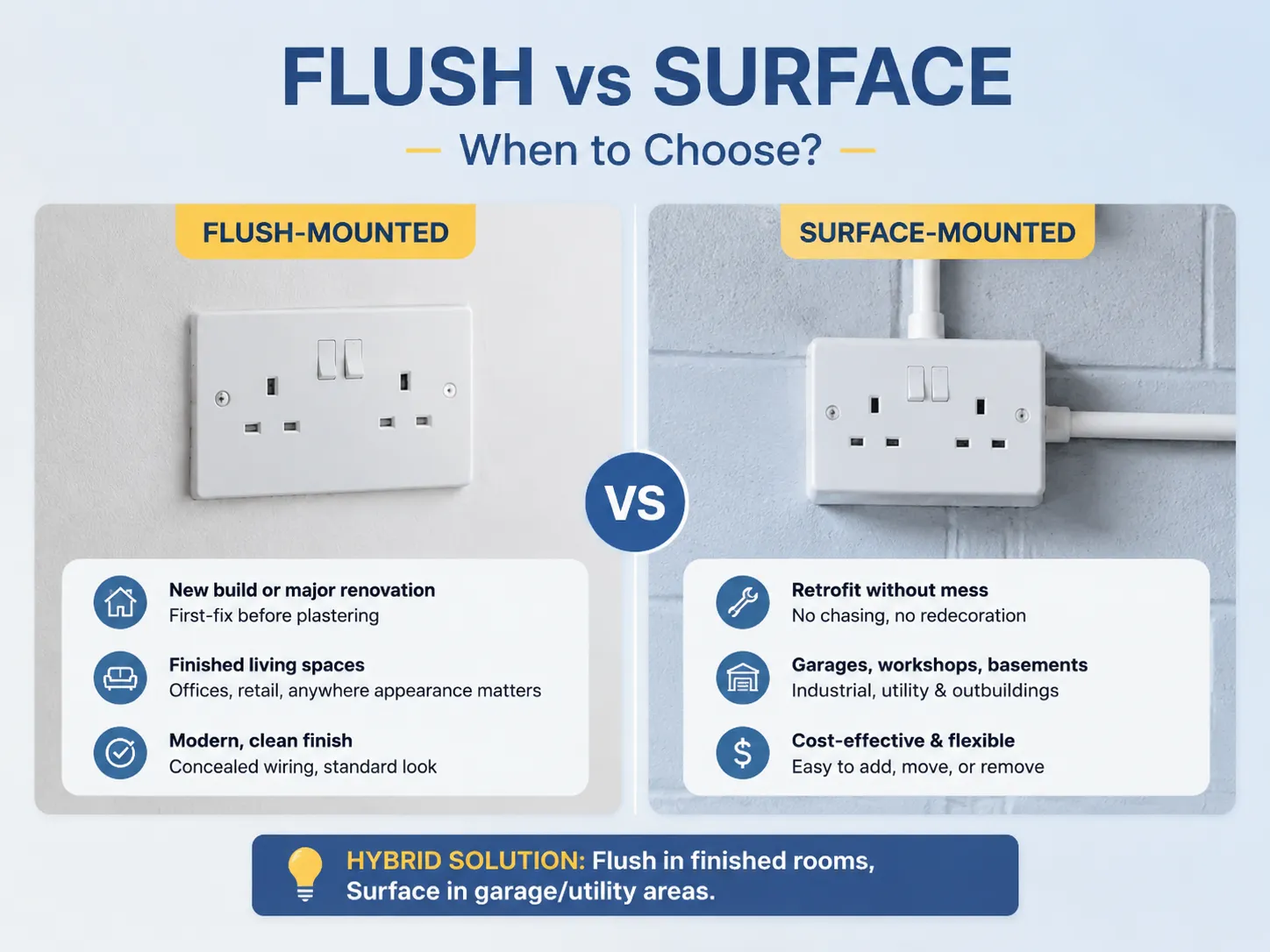
Choose surface-mounted when:
- Retrofitting inside finished walls without dust and renovation is the biggest reason
- Garages, shops, basements, attics, outdoor buildings, industrial environments
- Rental or temporary locations where devices may need to be uninstall/move later on
- Concrete/masonry walls where chasing is costly (blockwork, poured concrete)
- Adding an outlet when there was no plan to do so — going surface-mounted is much cheaper than chasing
A common hybrid: flush-mount in the finished rooms, surface-mount in the garage/utility areas of the same property. And if you’re mixing switch types across those rooms, our article on the four types of light switches helps you pick the right control for each location.
Appearance & Finish Differences
With flush mounting, it is possible to have the plate flush against the wall, which makes the use of any designer faceplate with no apparent screws the ideal option. Additionally, surface mounting on the other hand shows the outline of the box and trunking making it look more industrial compared to the flush mounting. Although surface trunking today comes in white and is neatly done in the modern world, certain metal-clad surfaces allow for a clinic-style appearance in certain rooms, for example, lofts and interior spaces that are industrial-styled.
When it comes to the installation of sleek screwless plates in a finished room then flush mounting is the most ideal choice. However, when it comes to installation in a garage, surface metal is not just acceptable, but it also may prove to be the best solution for durability.
What About Surface vs Flush Electrical Panels?
The flush/surface differentiation also applies to distribution boards and electrical panels.
- Flush panels: Are previously installed on the wall with surfaces level to wall. Flush panels are common in finished apartments or offices.
- Surface panels are installed on the wall face, which is typical for garages, industrial and commercial buildings.
Flush panels are preferable because they are installed and maintained with little effort. Though flush panels are aesthetically more pleasing, the basic electrical features of the panel are the same in both cases.
Side Note: “Flush Mount” Ceiling Fans
Pay attention to the term “flush mount” because it means something completely different in the ceiling fan world. The term refers to a ceiling fan that is attached directly to the ceiling without any downrod. This refers to the fans for low ceilings that will be mounted without the use of a downrod.
The Practical Recommendation
Here’s a simplified version for most people:
- Are you constructing or refurbishing? Get yourself any flush system. As long as the wall is open, chasing is inexpensive and you will have a flawless end look that will fit all spaces.
- Want to install a socket on a finished wall? Choose surface-wiring. It costs much less than chasing and redecorating, while still being convertible to flush down the road.
Is it a garage, workshop, or some commercial or industrial space? Then surface wiring is a good go-to choice as it’s the wise standard and will always look good.
Of course, mixing both is pretty common: flush in the living spaces and surface in utility rooms.In any case, make sure to buy devices that are approved and check if the depth of your back box is proper for the device — this is especially true for dimmers and smart switches that have to be placed in deeper back boxes.
Frequently Asked Questions
Is flush mounted the same as surface mounted?
No, they are different from each other, in fact, Flush mounted is the term used when the installation box is recessed into the wall such that the faceplate of the device is at the same level as the wall and is hidden inside otherwise while the surface mounted type is when the box is mounted outside the wall on the face of the wall where the device is getting out of the wall and the wires are being run through wire trunking or conduit or behind a surface mounting box visible. Flush installation is however more neat and is considered the norm for completed rooms. Surface installation may not be very neat but it is quick to execute and often used to retrofit in garages, workshops, and industrial sites.
Is it better to have a flush mount ceiling fan?
For short ceilings (e.g., 8 feet or less), flush mount ceiling fans are ideal because they mount directly onto the ceiling as opposed to using a downrod, so there are no headroom complications, while still allowing airflow. For ceilings that are higher than average (e.g., greater heights than 8 feet), downrod fans tend to be the better option since they lower the fan down enough in a way that allows for better airflow. When ceiling height is a problem, flush mount fans works best; downrod fans are better in cases where the ceiling can accommodate room. (Note that “flush mount” in this case refers to the ceiling fixture itself, not to options for switches.)
What does flush mounted mean?
“Flush mounted” defines an item or a device installed in such a way that its visible surface is flush with the surface of its surroundings. That means nothing is elevated from the surrounding wall. For wall switches and electrical outlets, a flush-mounted device sits inside the wall and shows only its faceplate at the level of the wall. For ceiling fans, a flush mount is when the fan is installed without elongation rod to the ceiling. For panels and cabinets, flush mount is used when an item is placed within the wall or enclosure.
What is the main difference between surface mount and flush mount electrical panels?
The mounting position is the primary distinction: a flush-mounted (recessed) panel is installed in the wall, making its door/cover level with the surface of the wall so that it becomes concealed – this type is widely used in completed houses and offices. Surface-mounted panels are directly affixed to the wall surface and hence protrude out of it – this method is used generally in garages, commercial and industrial buildings. The functionality of both types is similar (all these panels have the same breakers, busbars, and wiring systems).
References
- IET — BS 7671 Wiring Regulations: installation methods and boxes
- NFPA 70 — National Electrical Code: box fill and mounting requirements
- BSI — BS 1363 (sockets) and switch box standards
- House of Electricals — surface vs flush mounting guide
- UK Energy Support — electrical installation methods reference
Conclusion
Flush-mounted and surface-mounted systems represent different modes of installation for the same equipment with the only principal difference being the treatment of the box. Flush mounting involves introducing the box partially into the wall for a more finished look while surface mounting means fixing the box on the wall itself which makes it easier and quicker to carry out the installation. However, in practice, the two systems cannot be utilized interchangeably because flush mounting requires first-fix chasing which is what is typically done in finished rooms; surface mounting does not require any chasing which facilitates installations in retrofitted buildings.
Make sure to choose the appropriate method for your project — use flush for new construction work; use surface for additions to finished walls; and don’t hesitate to combine the methods in one property. The same logic applies to electrical panels, speaking of which flush mount has a different meaning when it comes to ceiling fans: it means that the fan is attached to the ceiling without a downrod.