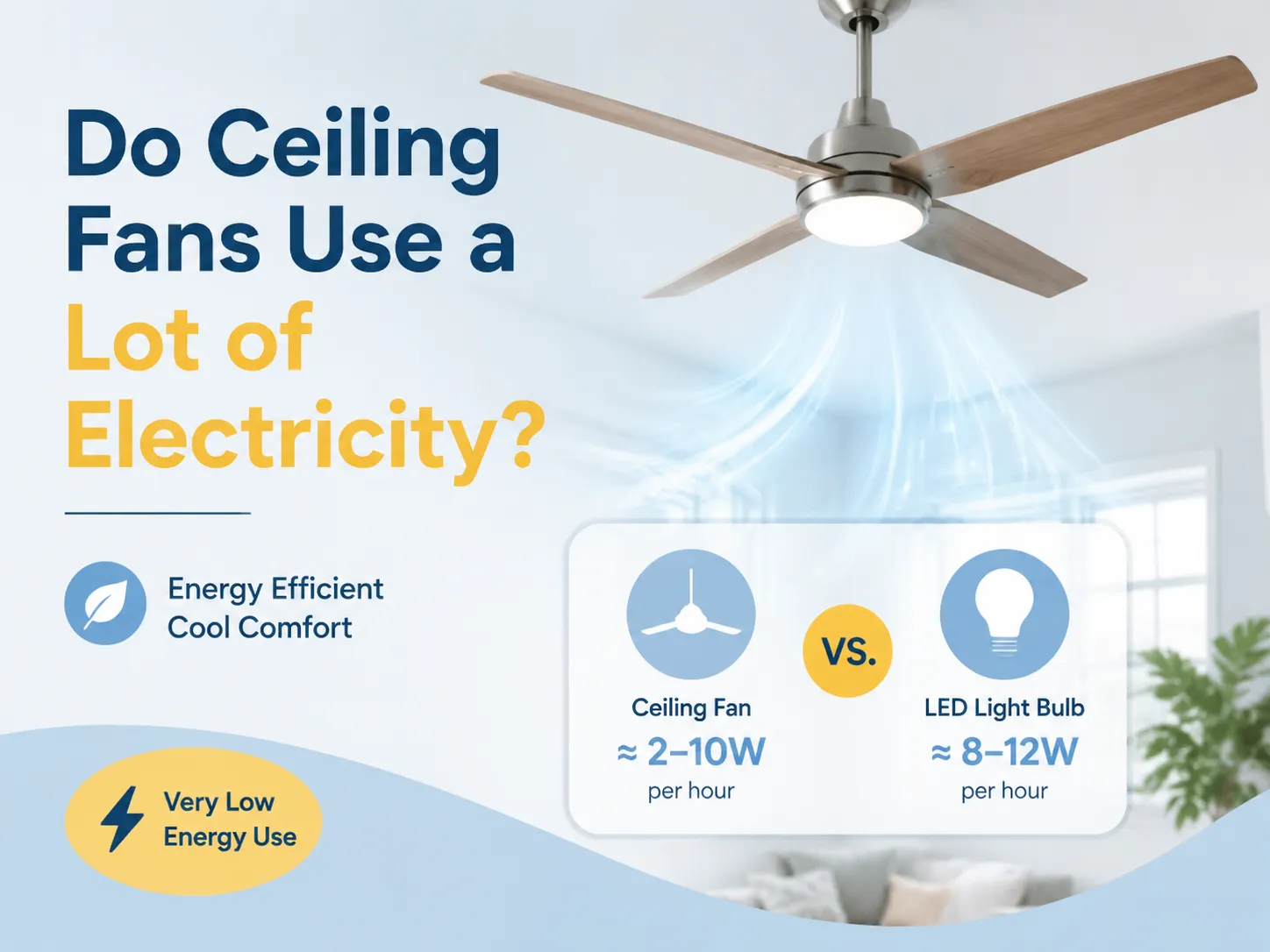
Es una noche calurosa de verano, y hay un ventilador de techo funcionando en la habitación desde que los niños se fueron a dormir. La pregunta que viene a la mente es si el ventilador aumenta la factura de energía. La respuesta es afirmativa, ya que los estudios muestran que los ventiladores de techo están entre los electrodomésticos más económicos de la casa. Sin embargo, el principio de los costos operativos de un ventilador de techo es más complicado que simplemente decir que es barato de usar. El tipo de motor, el nivel de velocidad, el kit de luz y la frecuencia de uso también juegan su papel.
Respuesta: Eso es un no. Los ventiladores de techo normales usan entre 15 y 90 vatios, que es menos que la mayoría de otros equipos. Un ventilador de 52” usa alrededor de 40-70 vatios, mientras que los ventiladores nuevos producen el mismo flujo de aire usando solo 15-40 vatios (30-70% menos). Suponiendo que el precio de la electricidad en EE.UU. es de aproximadamente 16 centavos por kWh, usar un ventilador así equivale a 1 centavo por hora (0.6-1.2 centavos, para ser precisos), 12-29 centavos por 24 horas (3-9 dólares por mes) y aproximadamente 5-35 dólares por un uso diario de 8 horas durante el verano.
¿Cuántos vatios consume un ventilador de techo?
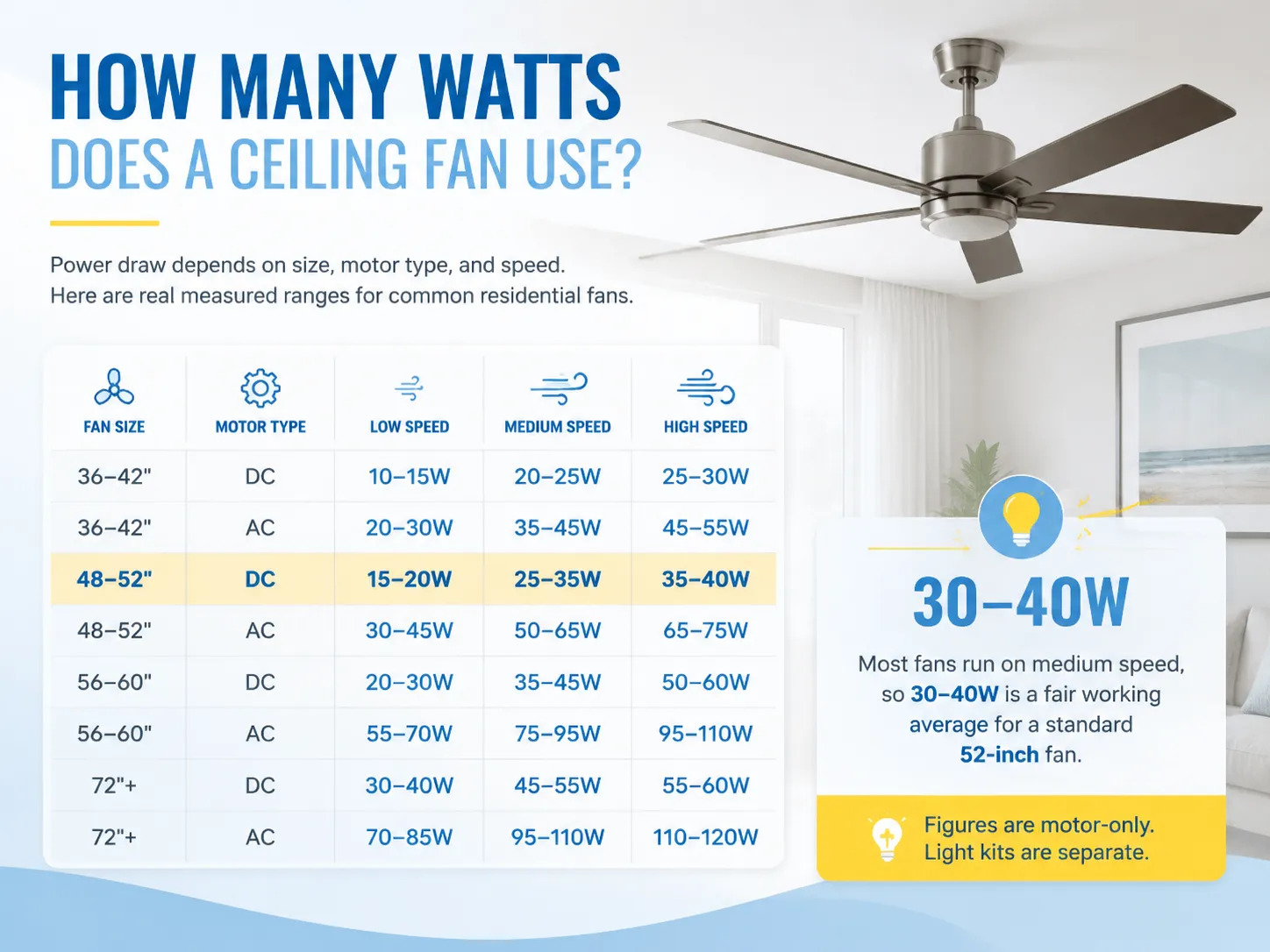
La cantidad de electricidad que usa un ventilador de techo está determinada por factores como la altura, el tipo de motor y la velocidad. Las especificaciones eléctricas de ventiladores de techo de diferentes tamaños son las siguientes:
| Tamaño del ventilador | Tipo de motor | Velocidad baja | Velocidad media | Velocidad alta |
|---|---|---|---|---|
| 36-42″ | CC | 10-15W | 20-25W | 25-30W |
| 36-42″ | CA | 20-30W | 35-45W | 45-55W |
| 48-52″ (más común) | CC | 15-20W | 25-35W | 35-40W |
| 48-52″ (más común) | CA | 30-45W | 50-65W | 65-75W |
| 56-60″ | CC | 20-30W | 35-45W | 50-60W |
| 56-60″ | CA | 55-70W | 75-95W | 95-110W |
| 72″+ (gran sala) | CC | 30-40W | 45-55W | 55-60W |
| 72″+ (gran sala) | CA | 70-85W | 95-110W | 110-120W |
Como la mayoría de los tipos de ventiladores funcionan en modo medio, un ventilador típico de techo de 52” consumirá alrededor de 30 a 40 vatios de energía. Tenga en cuenta que estos números se refieren solo al motor del ventilador y no a las luces.
Ventiladores con motor AC vs DC: La mayor diferencia
El tipo de motor es el factor más significativo que afecta el consumo de energía del ventilador.
| Característica | Motor AC (tradicional) | Motor DC (moderno) |
|---|---|---|
| Potencia típica (ventilador de 52″) | 40-75W en medio | 15-40W en medio |
| Consumo de energía vs AC | Línea base | 30-70% menos |
| Consumo a velocidad más baja | ~25-30W | Tan bajo como 5-6W |
| Configuraciones de velocidad | 3-5 velocidades | 6-9 velocidades, control continuo |
| Ruido | Zumbido moderado | Silencioso como un susurro |
| Modo inverso de invierno | Sí (respuesta más lenta) | Sí (más suave) |
| Vida útil | 10-15 años | Más de 20 años |
| Costo inicial | $50-$200 | $150-$400 |
| Ahorros anuales (uso 24/7) | — | $35-$49 vs ventilador AC |
Los ventiladores con motores DC típicamente recuperan su mayor costo de compra en 2-4 años cuando se usan regularmente, además ofrecen variación de velocidad y operación relativamente más silenciosa. Si planea usar un ventilador solo ocasionalmente, un modelo AC sería suficiente, pero si va a usar el ventilador todos los días durante el verano, optar por el modelo DC es mucho más económico.
Números reales de costo: por hora, día, mes, año
La facturación de electricidad se realiza en kilovatios-hora (kWh), con la tarifa residencial promedio en América en 2026 siendo aproximadamente $0.16/kWh. Los cálculos para un ventilador de 52 pulgadas son los siguientes:
| Escenario | Ventilador AC (75W med) | Ventilador DC (30W med) |
|---|---|---|
| Por hora | 075 kWh ≈ $0.012 | 03 kWh ≈ $0.005 |
| Por noche de 8 horas | 6 kWh ≈ $0.10 | 24 kWh ≈ $0.04 |
| Por día de 24 horas | 8 kWh ≈ $0.29 | 72 kWh ≈ $0.12 |
| Por mes (24/7) | 54 kWh ≈ $8.64 | 6 kWh ≈ $3.46 |
| Por temporada de enfriamiento (4 meses, 8 hrs/día) | ~73 kWh ≈ $11.70 | ~29 kWh ≈ $4.70 |
| Por año (24/7) | 657 kWh ≈ $105 | 263 kWh ≈ $42 |
El uso promedio en un hogar es de 8 horas diarias (el período de verano) y cuesta menos de 3 dólares para un ventilador AC y aún menos para un ventilador DC, lo que representa aproximadamente 1 dólar por mes. Este precio es similar a lo que se pagaría por un café cada semana. A pesar de que el precio por kWh puede llegar a 0.25 dólares, haciendo que el costo diario de un ventilador de 40 vatios sea aproximadamente 26 centavos.
El factor del kit de luz que no puede ignorar
Aquí hay un concepto erróneo que muchos no reconocen: el kit de luz del ventilador puede costar más operar que el motor del ventilador.
- Usando dos bombillas de 60 vatios: +120 vatios, que es incluso más que el consumo del motor y aumenta el consumo total del ventilador considerablemente.
- Usando dos bombillas LED de 9 vatios: +18 vatios, lo cual no es algo significativo.
- Kits de luz LED integrados: alrededor de +10-15 vatios.
- Kits de luz incandescentes antiguos: +100-250 vatios.
Si tiene un ventilador de techo con bombillas incandescentes, cambiarlas por LEDs le permite ahorrar más energía en comparación con lo que puede hacer con el motor, ya que la diferencia es de más de 100 vatios en total.
Múltiples ventiladores: una visión completa del hogar
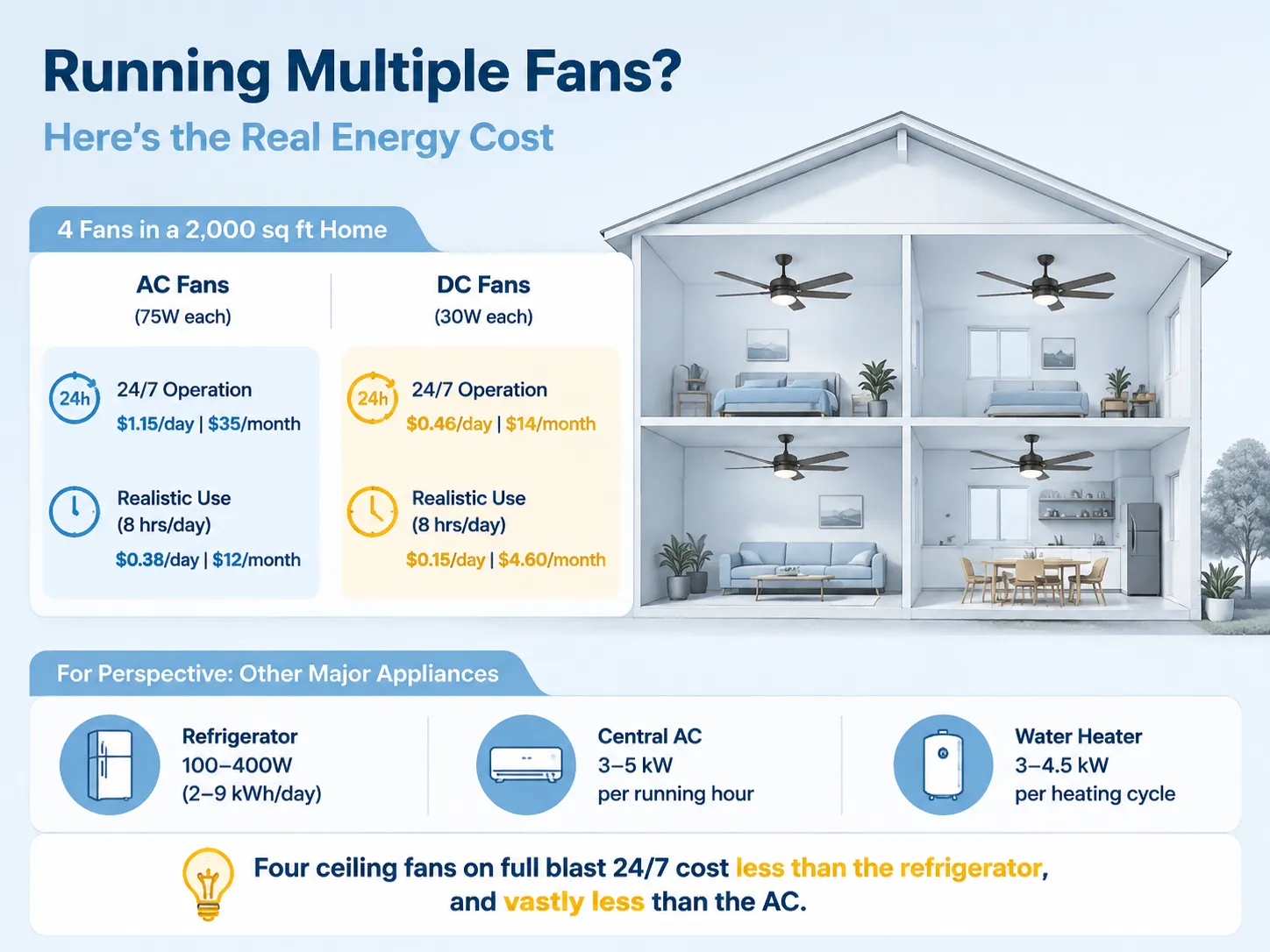
¿Qué pasaría si un hogar promedio utilizara varios ventiladores, digamos, cuatro ventiladores en una casa estándar de 2,000 pies cuadrados? Operación 24/7 a velocidad media:
- Cuatro ventiladores AC (75W cada uno): 300W en total → 7.2 kWh/día → alrededor de $1.15/día, $35 al mes.
- Cuatro ventiladores DC (30W cada uno): 120W en total → 2.9 kWh/día → alrededor de $0.46/día, $14 al mes.
- Uso pragmático de cuatro ventiladores AC por 8 horas/día equivale a aproximadamente $0.38/día ($12/mes), y lo mismo para el modelo DC que cuesta alrededor de $0.15/día ($4.60/mes).
Para una mejor comprensión: Un refrigerador en el mismo hogar consume constantemente entre 100W y 400W (2-9 kWh/día). Un aire acondicionado central puede usar de 3 a 5 kW por hora, igual que un sistema de calentamiento de agua que opera entre 3 y 4.5 kW por ciclo. Por lo tanto, tener cuatro ventiladores funcionando 24 horas al día cuesta menos que hacer funcionar un refrigerador, y considerablemente menos que el aire acondicionado. Si está reduciendo su factura eléctrica, los ventiladores de techo son casi lo último en lo que tocar — mientras que actualizar la iluminación que funciona junto a ellos es una de las primeras, como nuestro Guía de compatibilidad de atenuadores LED muestra.
Ventilador de techo vs Aire acondicionado
Los datos comparativos que permiten emitir un juicio:
| Dispositivo | Potencia típica | Costo por 1 hora | Costo por 24 horas |
|---|---|---|---|
| Ventilador de techo (DC) | 15-40W | $0.003-$0.006 | $0.06-$0.15 |
| Ventilador de techo (AC) | 40-90W | $0.006-$0.014 | $0.15-$0.35 |
| Unidad de aire acondicionado de ventana | 500-1,500W | $0.08-$0.24 | $1.90-$5.75 |
| Aire acondicionado central | 3,000-5,000W | $0.48-$0.80 | $11.50-$19.20 (en funcionamiento) |
El ventilador de techo consume aproximadamente 1-3% de lo que consume el aire central. Un ventilador puede funcionar sin interrupción durante todo un día gastando menos dinero que los costos de veinte minutos de trabajo del compresor. Por eso el ventilador es el equipo que permite usar de manera más económica el dispositivo costoso.
¿Realmente los ventiladores de techo reducen su factura eléctrica?
Aquí es donde el ventilador demuestra su valor. Un ventilador no enfría el aire, sino a usted, gracias al efecto de enfriamiento por viento, haciéndole sentir aproximadamente 4°F más fresco (con estimaciones que varían de 3 a 8°F). Como resultado, puede ajustar el termostato 4°F más alto y aún sentirse cómodo, porque por cada grado que baja el termostato ahorra alrededor de 3% en costos de enfriamiento; así que un ventilador de 40W permite que una unidad de aire acondicionado de 4,000W funcione menos y usted termina pagando un centavo para ahorrar un dólar. Para lograr esto, considere las siguientes recomendaciones:
- Use los ventiladores solo en las habitaciones ocupadas. Los ventiladores solo enfrían personas; en habitaciones vacías, un ventilador no aporta beneficios y desperdicia dinero.
- Ajuste el termostato cuando el ventilador esté encendido. El ahorro de dinero depende de la configuración del aire acondicionado, no del ventilador.
- Apague los ventiladores al salir de la habitación. Use temporizadores, interruptores inteligentes o sensores de ocupación si tiende a olvidarlo.
- En invierno, usar el modo inverso (rotación en sentido horario a baja velocidad) puede ayudar a circular el aire caliente y ahorrar en costos de calefacción.
Cómo calcular el costo de su propio ventilador
Si necesita valores específicos en lugar de promedios, utilice la fórmula a continuación:
Costo = (Vatios × Horas ÷ 1,000) × $/kWh
Ejemplo: ventilador de 75W × 8 horas ÷ 1,000 = 0.6 kWh × $0.16 = $0.096 por noche.
Para determinar el vataje, consulte el manual o el exterior del ventilador; el vataje generalmente está indicado en el dispositivo en vatios o amperios (vatios = voltios × amperios). Encuentre su tarifa energética en la factura eléctrica, que debería indicar $/kWh, con un promedio de $0.16 en EE. UU., pero podría variar de $0.10 a $0.35. En caso de que el ventilador esté cableado directamente, un medidor de vatios enchufable puede no proporcionar la cifra exacta; deberá confiar en la etiqueta o usar un medidor de corriente de pinza.
Comprar el ventilador más eficiente
Cuando compre un ventilador nuevo, asegúrese de verificar lo siguiente:
- Motor DC (BLDC): el factor más importante para la eficiencia del ventilador; consume entre 30% y 70% menos electricidad que un motor AC pero ofrece el mismo rendimiento.
- Calificación ENERGY STAR: los ventiladores que tienen esta marca han sido probados de forma independiente y se ha comprobado que producen más aire por vatio de energía utilizada; verifique el indicador CFM/W (pies cúbicos por minuto por vatio). Según ENERGY STAR, debería estar en el rango de ~2.5-3.7+ dependiendo del tipo de ventilador.
- Kit de luz LED integrado: estas luces usan 10-15 vatios en contraste con los kits tradicionales de incandescencia que requieren 100-250 vatios.
- Control remoto de múltiples velocidades: tener más niveles de velocidad permite que el ventilador funcione en el nivel aceptable más bajo; la velocidad baja requiere aproximadamente un 30-40% menos de energía.
- Controles inteligentes: tener un temporizador y sensor de ocupación o usar una aplicación para controlar el ventilador elimina el desperdicio de energía; tener un interruptor de pared inteligente combinado con un ventilador permite una operación automática. Nuestra guía de interruptores inteligentes mejor valorados cubre las opciones de control, las ventajas del interruptor de atenuación explica cómo los controles modernos gestionan las cargas de iluminación de manera eficiente, y la guía de interruptores inteligentes con y sin neutro te ayuda a verificar si tu caja de pared puede soportar control inteligente antes de comprar.
Preguntas frecuentes
¿Deja mucho consumo eléctrico tener un ventilador de techo encendido toda la noche?
No. Un ventilador de techo normal de 52 pulgadas, que usualmente consume entre 40-75W (AC) o 15-40W (DC), cuesta aproximadamente entre 0.04-0.10 USD en una sola noche (es decir, 8 horas) de operación al promedio de tarifa eléctrica en EE. UU. Esto se traduce en 0.12-0.29 USD para un período completo de 24 horas, y puede verse desde la perspectiva de que la electricidad consumida para operar un ventilador de techo durante una noche cuesta menos que la consumida por una sola bombilla incandescente durante la misma noche.
¿Qué es lo que más incrementa tu factura eléctrica?
La calefacción y refrigeración (HVAC) usualmente representan entre el 40% y 50% de tus costos totales de servicios para operar un hogar. El calentamiento de agua ocupa el segundo lugar con aproximadamente el 15% de estos costos. Los electrodomésticos de refrigeración funcionan constantemente; las secadoras, lavandería y costos de iluminación también pueden ser significativos, especialmente si las luces usadas son incandescentes. Es interesante notar que los ventiladores de techo solo usan entre el 1% y 3% de la energía.
¿Es mejor dejar un ventilador de techo encendido todo el tiempo o apagarlo?
Si no hay personas en la habitación, el ventilador no debería estar funcionando. Los ventiladores son para personas, no para habitaciones; usar el ventilador en una habitación vacía consume electricidad y no beneficia a nadie. Asegúrate de apagar el ventilador antes de salir, o usa un temporizador, sensor de ocupación o interruptor inteligente para ayudarte. Tener el ventilador funcionando en habitaciones ocupadas es una gran solución, ya que permite subir el aire acondicionado 3-4 grados.
¿Los ventiladores de techo reducen la factura eléctrica?
Correcto, cuando se usan notablemente con una estrategia de termostato. El ventilador de techo da la sensación de reducción en la temperatura de la habitación alrededor de 4° F, haciendo posible subir el termostato 4 grados manteniendo el nivel de confort en la habitación. Por cada grado que se sube el termostato se puede ahorrar aproximadamente un 3% del total de la factura de enfriamiento, lo que significa que la función misma del ventilador de enfriamiento de 40W puede inducir ahorros varias veces mayores que el consumo actual del ventilador. Las ideas básicas son asegurar que el termostato se ajuste hacia arriba cuando el ventilador esté funcionando y que el ventilador se apague en habitaciones vacías.
Referencias
- D&G Floors — Cuánta energía consume un ventilador de techo (vatios reales y costos)
- Seus Lighting — ¿Los ventiladores de techo consumen mucha electricidad? Guía de costos 2026
- Cuántos vatios — Calculadora de consumo y costo de ventiladores de techo por tamaño/motor
- KBS Ceiling Fans — Consumo de energía según tipo de motor (AC vs DC vs EC)
- ENERGY STAR — Requisitos del programa para ventiladores de techo (CFM/W)
- US EIA — Datos de precios de electricidad por región
Conclusión
Los ventiladores de techo son eficientes en su consumo energético; se encuentran entre los dispositivos que menos energía consumen en nuestro hogar. Un ventilador de techo típico utiliza entre 15 y 90 vatios dependiendo del tipo de motor, costando menos de un centavo por hora de funcionamiento. Podría usar su ventilador durante todo un día y pagar entre 0.12 y 0.29 en total. Incluso en el improbable caso de que use varios ventiladores de techo en cada habitación de su casa, gastará más dinero en una hora de calefacción central que usando varios ventiladores durante todo el día. Algunos puntos importantes a considerar son: un motor DC ahorra entre un 30% y un 70% de energía; el dispositivo de iluminación podría en algunos casos costar más que el motor del ventilador (las bombillas LED son mejores); y la estrategia del termostato puede hacer que su ventilador de techo le genere ganancias en lugar de costos (cuesta alrededor de 0.05 para generar 1 de retorno).
Por lo tanto, es recomendable seguir algunos consejos prácticos: elegir un ventilador de techo con motor DC; reemplazar cualquier bombilla incandescente que tenga en las luces del ventilador por LEDs; usar ventiladores de techo solo en las habitaciones donde esté presente; subir el termostato del aire acondicionado aproximadamente 3-4 grados; y emplear un sistema inteligente/temporizador durante la calefacción. Y si está reemplazando los controles de pared del ventilador mientras lo hace, nuestro guía de reemplazo de interruptores de luz guía el cableado de forma segura.