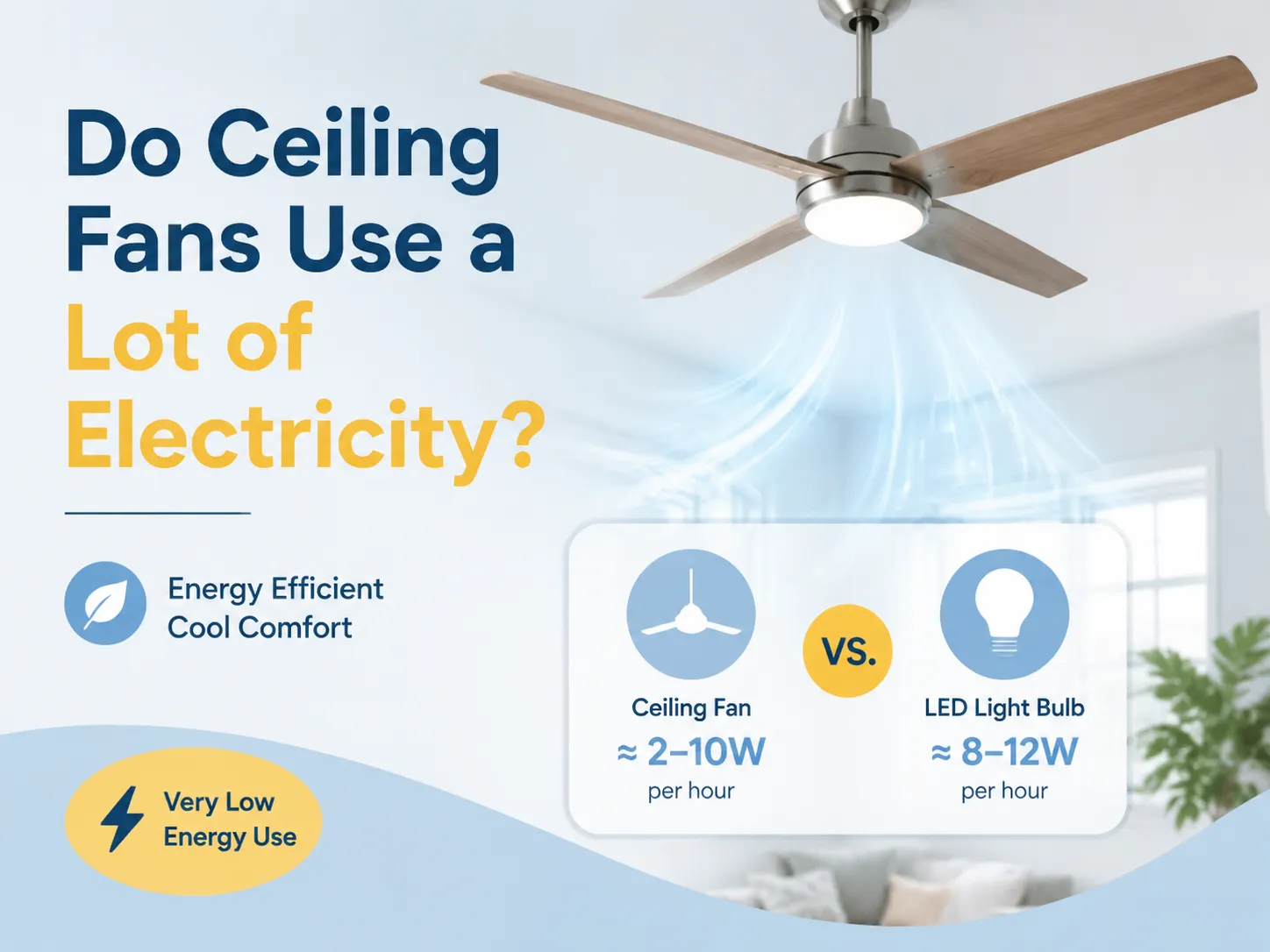
It is a hot night in the summer, and there is a ceiling fan running in the room ever since the children went to sleep. The question that comes to the mind is about whether the fan increases the energy bill. The answer is in affirmative as the studies show that ceiling fans are among the most affordable appliances in the house. However, the principle of ceiling fan operating costs is more complicated than just saying that it is cheap to run. The type of motor, level of speed, light kit, and frequency of usage play their part as well.
Answer: That is a no. Normal ceiling fans use 15-90 watts, which is less than most other equipment. A 52” fan uses around 40-70 watts, while new fans produce the same airflow using only 15-40 watts (30-70% less). Assuming that the electricity price in the USA is about 16 cents per kWh, using such a fan equals to 1 cent per hour (0.6-1.2 cents, to be precise), 12-29 cents per 24 hours (3-9 dollars per month) and approximately 5-35 dollars for 8-hour daily run during summer.
How Many Watts Does a Ceiling Fan Use?
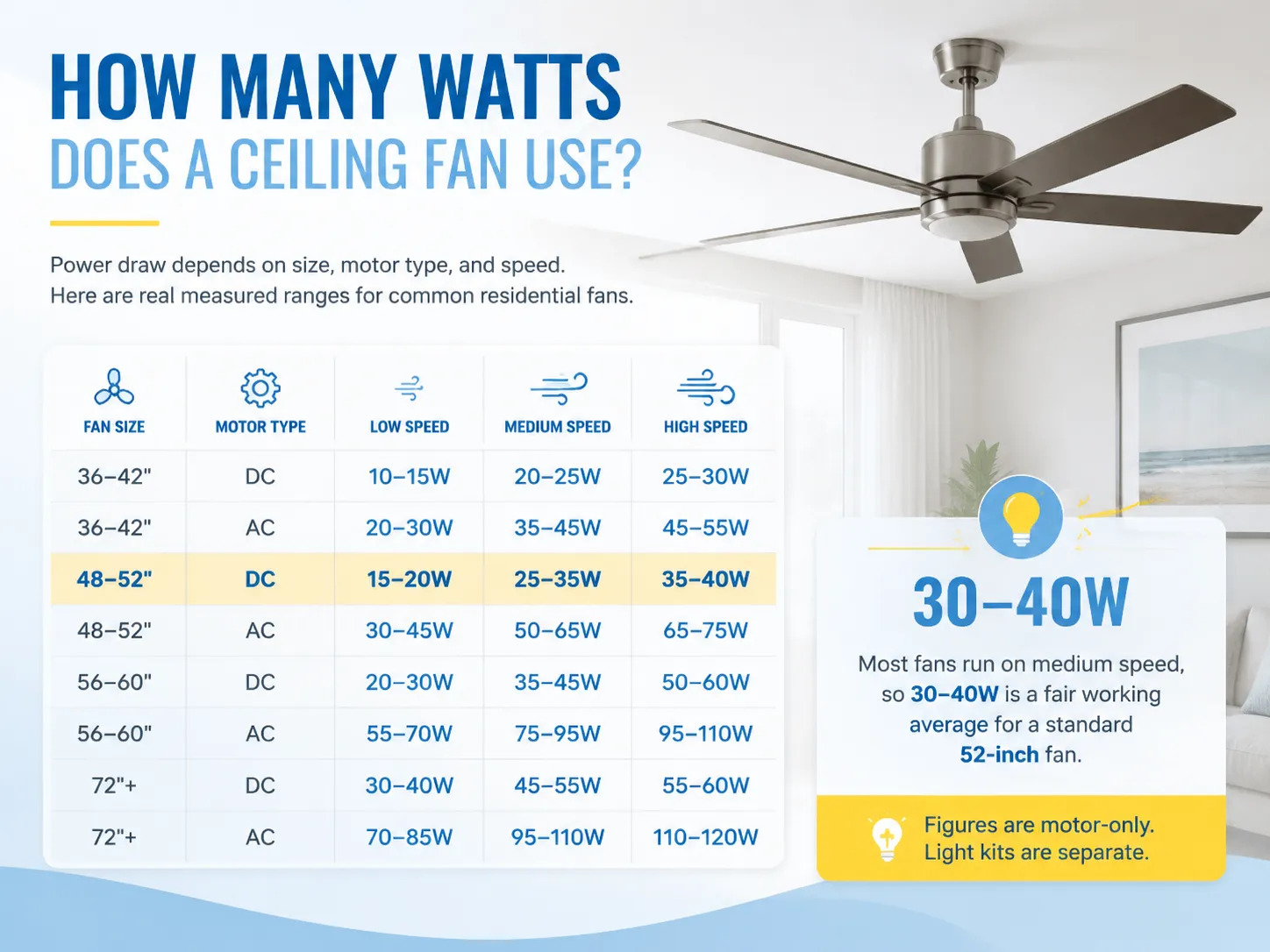
The amount of electricity a ceiling fan uses is determined by factors such as height, type of motor and speed. The electric ratings of ceiling fans with different sizes are as follows:
| Fan Size | Motor Type | Low Speed | Medium Speed | High Speed |
|---|---|---|---|---|
| 36-42″ | DC | 10-15W | 20-25W | 25-30W |
| 36-42″ | AC | 20-30W | 35-45W | 45-55W |
| 48-52″ (most common) | DC | 15-20W | 25-35W | 35-40W |
| 48-52″ (most common) | AC | 30-45W | 50-65W | 65-75W |
| 56-60″ | DC | 20-30W | 35-45W | 50-60W |
| 56-60″ | AC | 55-70W | 75-95W | 95-110W |
| 72″+ (great room) | DC | 30-40W | 45-55W | 55-60W |
| 72″+ (great room) | AC | 70-85W | 95-110W | 110-120W |
As most fan types are run on medium mode, a typical 52” ceiling fan will consume around 30 to 40 watts of energy. Note that these numbers refer only to the fan motor and not the lights.
AC vs DC Motor Fans: The Biggest Difference
The motor type is the most significant factor affecting fan power consumption.
| Feature | AC Motor (traditional) | DC Motor (modern) |
|---|---|---|
| Typical power (52″ fan) | 40-75W on medium | 15-40W on medium |
| Energy use vs AC | Baseline | 30-70% less |
| Lowest speed draw | ~25-30W | As low as 5-6W |
| Speed settings | 3-5 speeds | 6-9 speeds, stepless control |
| Noise | Moderate hum | Whisper quiet |
| Winter reverse mode | Yes (slower response) | Yes (smoother) |
| Lifespan | 10-15 years | 20+ years |
| Upfront cost | $50-$200 | $150-$400 |
| Annual savings (24/7 use) | — | $35-$49 vs AC fan |
Fans with DC motors typically recoup their higher purchase cost within 2-4 years when used regularly, plus they offer speed variation and relatively quieter operation. If you intend to use a fan only occasionally, an AC model would be just fine, but if you’re going to run the fan every day throughout the summer, going for the DC model is much more economical.
Real Cost Numbers: Per Hour, Day, Month, Year
The billing of electricity is done in kilowatt-hours (kWh), with the average residential rate in America in 2026 being approximately $0.16/kWh. The calculations for a 52-inch fan go as follows:
| Scenario | AC Fan (75W med) | DC Fan (30W med) |
|---|---|---|
| Per hour | 0.075 kWh ≈ $0.012 | 0.03 kWh ≈ $0.005 |
| Per 8-hour night | 0.6 kWh ≈ $0.10 | 0.24 kWh ≈ $0.04 |
| Per 24-hour day | 1.8 kWh ≈ $0.29 | 0.72 kWh ≈ $0.12 |
| Per month (24/7) | 54 kWh ≈ $8.64 | 21.6 kWh ≈ $3.46 |
| Per cooling season (4 months, 8 hrs/day) | ~73 kWh ≈ $11.70 | ~29 kWh ≈ $4.70 |
| Per year (24/7) | 657 kWh ≈ $105 | 263 kWh ≈ $42 |
The average household usage is 8 hours daily (the summer period) and costs below 3 dollars for an AC fan and even less than that for a DC fan, which accounts for approximately 1 dollar per month. This price is similar to what one would pay for a coffee each week. In spite of the fact that the price per kWh can go up to 0.25 dollars, thus making the price paid for the working 40-watt fan approximately 26 cents daily.
The Light Kit Factor You Can’t Ignore
Here’s a misconception that many fail to recognize: The light kit of the fan can cost more to operate than the fan’s motor.
- Using two 60-watt light bulbs: +120 watts, which is even more than the motor’s consumption and increases the total consumption of the fan manifold.
- Using two 9-watt LED bulbs: +18 watts, which is nothing too significant.
- Integrated LED light kits: about +10-15 watts.
- Old incandescent light kits: +100-250 watts.
If you have the ceiling fan with incandescent bulbs, switching them into the LEDs allows you to save more energy in comparison with what you can do with the motor since the difference is more than 100 watts in total.
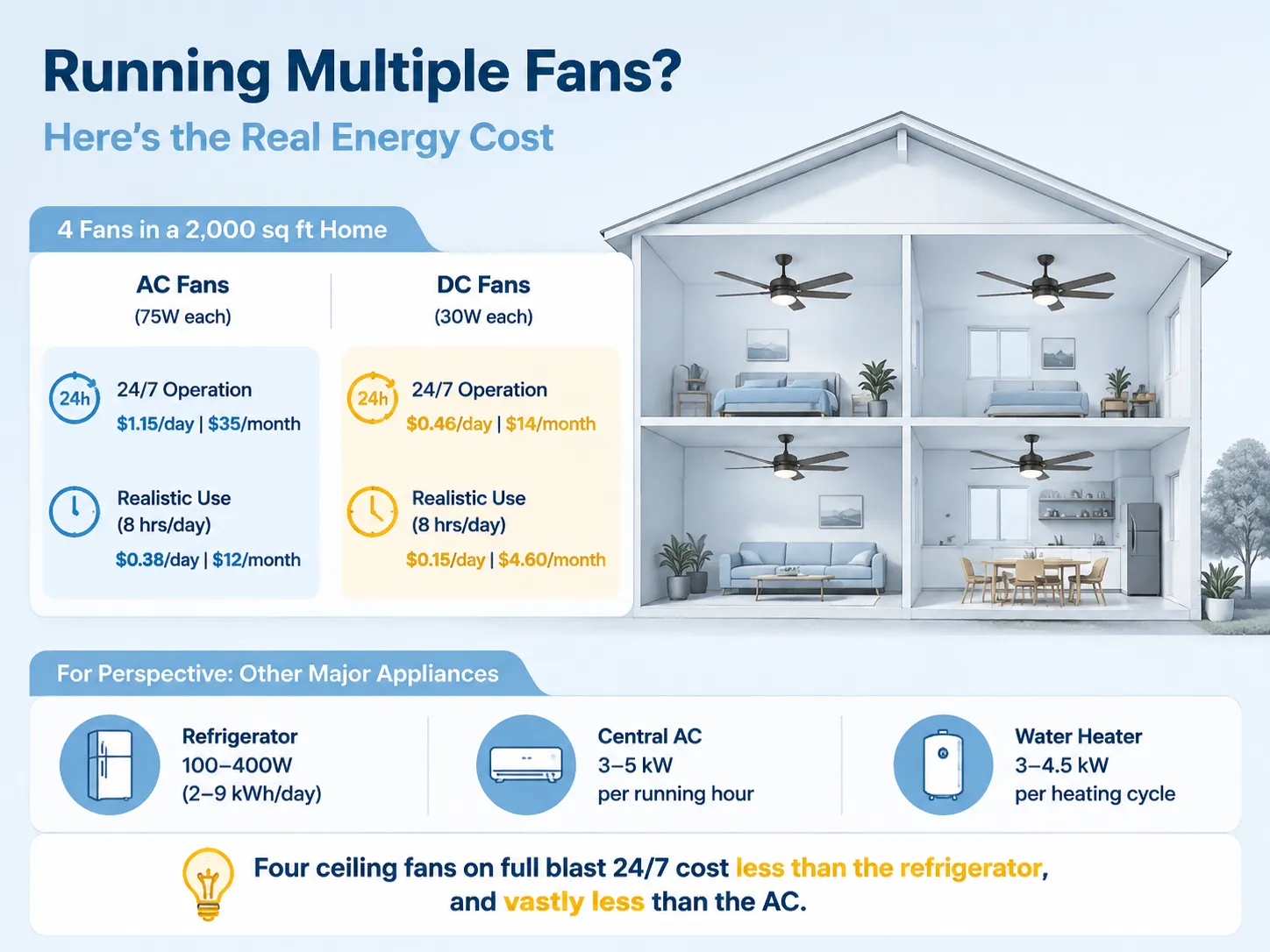
Multiple Fans: A Whole-Home Picture
What if an average household utilized a number of fans, say, four fans in a standardized 2,000 sq ft house? 24/7 operation at medium speed:
- Four AC fans (75W each): 300W in total → 7.2 kWh/day → around $1.15/day, $35 in a month.
- Four DC fans (30W each): 120W in total → 2.9 kWh/day → around $0.46/day, $14 in a month.
- Pragmatic usage of four AC fans for 8 hours/day equals about $0.38/day ($12/month), and the same goes for the DC model which costs about $0.15/day($4.60/month).
For better understanding purposes: A refrigerator at the same household draws from 100W to 400W constantly (2-9 kWh/day). A central air-conditioner may use from 3 to 5 kW per hour, same as a water heating system that operates between 3 to 4.5 kW per cycle. Thus, having four fans running 24 hours per day costs less than running a refrigerator, and considerably less than the air conditioning. If you are trimming your electric bill, the ceiling fans are nearly the last thing to touch — while upgrading the lighting that runs alongside them is one of the first, as our LED dimmer compatibility guide shows.
Ceiling Fan vs Air Conditioner
The comparative data that allow for making a judgment:
| Device | Typical Power | 1 Hour Cost | 24 Hours Cost |
|---|---|---|---|
| Ceiling fan (DC) | 15-40W | $0.003-$0.006 | $0.06-$0.15 |
| Ceiling fan (AC) | 40-90W | $0.006-$0.014 | $0.15-$0.35 |
| Window AC unit | 500-1,500W | $0.08-$0.24 | $1.90-$5.75 |
| Central AC | 3,000-5,000W | $0.48-$0.80 | $11.50-$19.20 (running) |
The ceiling fan consumes about 1-3% of what central air consumes. A fan can be operated without interruption for a whole day for spending less money than the costs of twenty minutes of compressor work. That is why fan is the equipment which allows in using more economically the expensive device.
Do Ceiling Fans Actually Reduce Your Electric Bill?
This is where the fan earns its value. A fan does not cool off the air — it cools you, thanks to the wind-chill effect, making you feel about 4°F cooler (with estimates varying from 3 to 8°F). As a result you can set the thermostat 4°F higher and still feel comfortable — because for every degree that you turn down the thermostat you save around 3% on cooling costs — so a 40W fan allows for a 4,000W AC unit to work less and you end up paying a nickel to save a dollar.To make this happen, consider the following recommendations:
- Use the fans only in the occupied rooms. Fans only cool people — in empty rooms, a fan does not bring any benefits and wastes money.
- Adjust the thermostat when the fan is on. The money-saving relies on the AC settings not on the fan.
- Switch off the fans when leaving the room. Use timers, smart switches or occupancy sensors if you tend to forget.
- In winter, using the reverse mode (clockwise rotation at low speed) can help circulate warm air and save on heating costs.
How to Calculate Your Own Fan’s Cost
If you need specific values rather than averages, utilize the formula below:
Cost = (Watts × Hours ÷ 1,000) × $/kWh
Example: 75W fan × 8 hours ÷ 1,000 = 0.6 kWh × $0.16 = $0.096 nightly.
To determine wattage, check the manual or exterior of the fan – wattage is typically noted on the device in watts or amps (watts = volts × amps). Find your energy rate on the electric bill which should state $/kWh, with an average of $0.16 in the US but it could range from $0.10 to $0.35.In case the fan is hardwired, a plug-in watt meter may not provide the accurate figure; you would have to rely on the label or use a clip-on current meter.
Buying the Most Efficient Fan
When you buy a new fan, make sure that you check for the following:
- DC motor (BLDC): the most important factor for the fan’s efficiency; it consumes between 30% and 70% less electricity than an AC motor but gives the same performance.
- ENERGY STAR rating: fans that have this mark have been tested independently and have been found to produce more air per watt of energy used; check for the CFM/W indicator (cubic feet per minute per watt). According to ENERGY STAR, it should be in the range of ~2.5-3.7+ depending on the fan type.
- LED integrated light kit: these lights use 10-15 watts in contrast to traditional incandescent kits requiring 100-250 watts.
- Multiple-speed remote controller: having more speed levels allows the fan to work at the lowest acceptable level; low speed requires about 30-40% less energy.
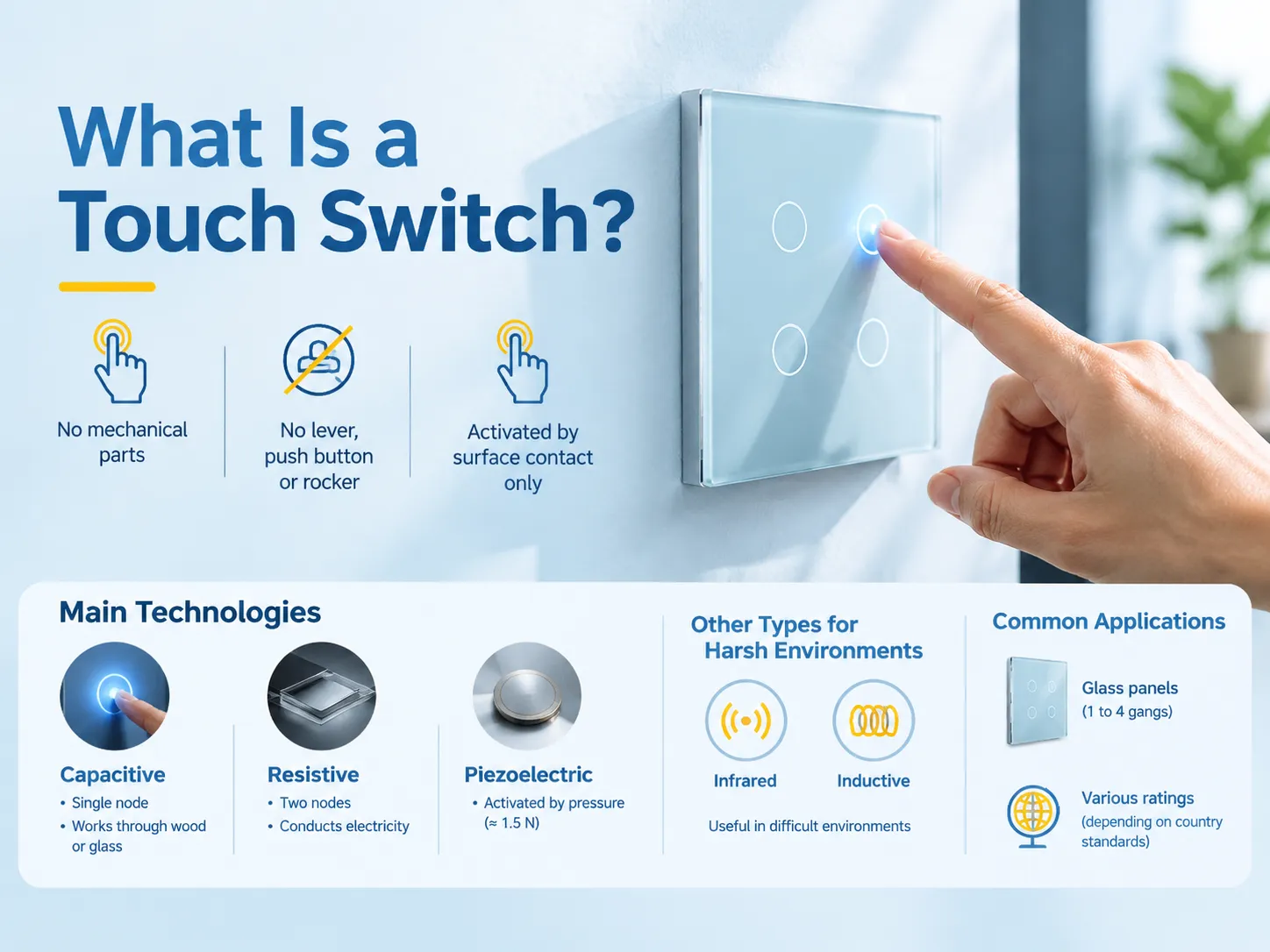
- Smart controls: having a timer and occupancy sensor or using an app to control the fan eliminates energy waste; having a smart wall switch combined with a fan allows for automatic operation.Our guide to top-rated smart switches covers the control options, the dimming switch advantages explain how modern controls manage lighting loads efficiently, and the neutral vs non-neutral smart switch guide helps you check whether your wall box can support smart control before buying.
Frequently Asked Questions
Does leaving a ceiling fan on all night use a lot of electricity?
No. A normal ceiling fan of 52-inch size, which usually draws a power consumption of about 40-75W (AC) or 15-40W (DC), costs roughly in the range of $0.04-0.10 in a single night (i.e., 8 hours) of operation at the average utility rate in the US. This translates to $0.12-$0.29 for a complete 24-hour period, and can be viewed in the perspective that the electricity consumed for running a ceiling fan for one night costs lesser than that consumed by a single incandescent bulb for the same night.
What runs up your electric bill the most?
Heating and Cooling (HVAC) usually account for about 40% to 50% of your total utility costs to operate a home. Water heating comes in second with about 15% of these costs. Refrigeration appliances run constantly; clothes driers, laundry, and lighting costs can also be significant especially if the lights used are incandescent ones. It is interesting to note that ceiling fans only use 1% or 3% energy.
Is it better to leave a ceiling fan in all the time or turn off?
If there are no people in the room, the fan should not be working. Fans are for people, not rooms — using the fan in an empty room consumes electricity and helps no one. Make sure to turn the fan off before you leave, or use a timer, occupancy sensor, or smart switch to support you. Having the fan working in occupied rooms is a great solution, as it allows you to turn up your AC by 3-4 degrees.
Do ceiling fans reduce the electric bill?
Correct, when used notably with thermostat strategy. The ceiling fan gives the sensation of reduction in room temperature by around 4° F, hence making it possible to crank the thermostat up by 4 degrees maintaining the level of comfort in the room. For every degree on the thermostat turned up one can save about 3 percent of the total cooling bills, which means that the very function of the cooling fan of 40W can induce savings several times higher than that of the current consumption of the fan. The basic ideas are to ensure that the thermostat is adjusted up when the fan is working and the fan should be switched off in vacant rooms.
References
- D&G Floors — How much power does a ceiling fan use (real watts and costs)
- Seus Lighting — Do ceiling fans use a lot of electricity? 2026 cost guide
- How Many Watts — Ceiling fan wattage and cost calculator by size/motor
- KBS Ceiling Fans — Energy consumption by motor type (AC vs DC vs EC)
- ENERGY STAR — Ceiling fan program requirements (CFM/W)
- US EIA — Electricity price data by region
Conclusion
Ceiling fans are good with their energy use; they rank among the least energy-consuming devices in our home. A typical ceiling fan uses anywhere from 15-90 watts depending on the type of its motor, costing less than one cent an hour to run. You could run your fan for an entire day and pay between $0.12-0.29 in total. Even in an improbable case that you use several ceiling fans in each room of your house, you will spend more money for one hour of central heating than for using several fans during the whole day. Some important points to consider are: a DC motor saves anywhere between 30% to 70% of energy; illumination device might in some cases cost more than the motor in the fan (LED bulbs are better); and thermostat strategy can make your ceiling fan something that brings you profit rather than costs you money (cost about $0.05 to make $1 back).
Thus, it is advisable to follow some practical tips: choose a ceiling fan with a DC motor; better replace any incandescent bulbs that you have in your fan lights with LEDs; using ceiling fans only in the rooms where you are present; raise your A.C. thermostat by about 3-4 degrees; and employ a smart system/timer while heating.And if you are replacing fan wall controls while you are at it, our light switch replacement guide walks through the wiring safely.