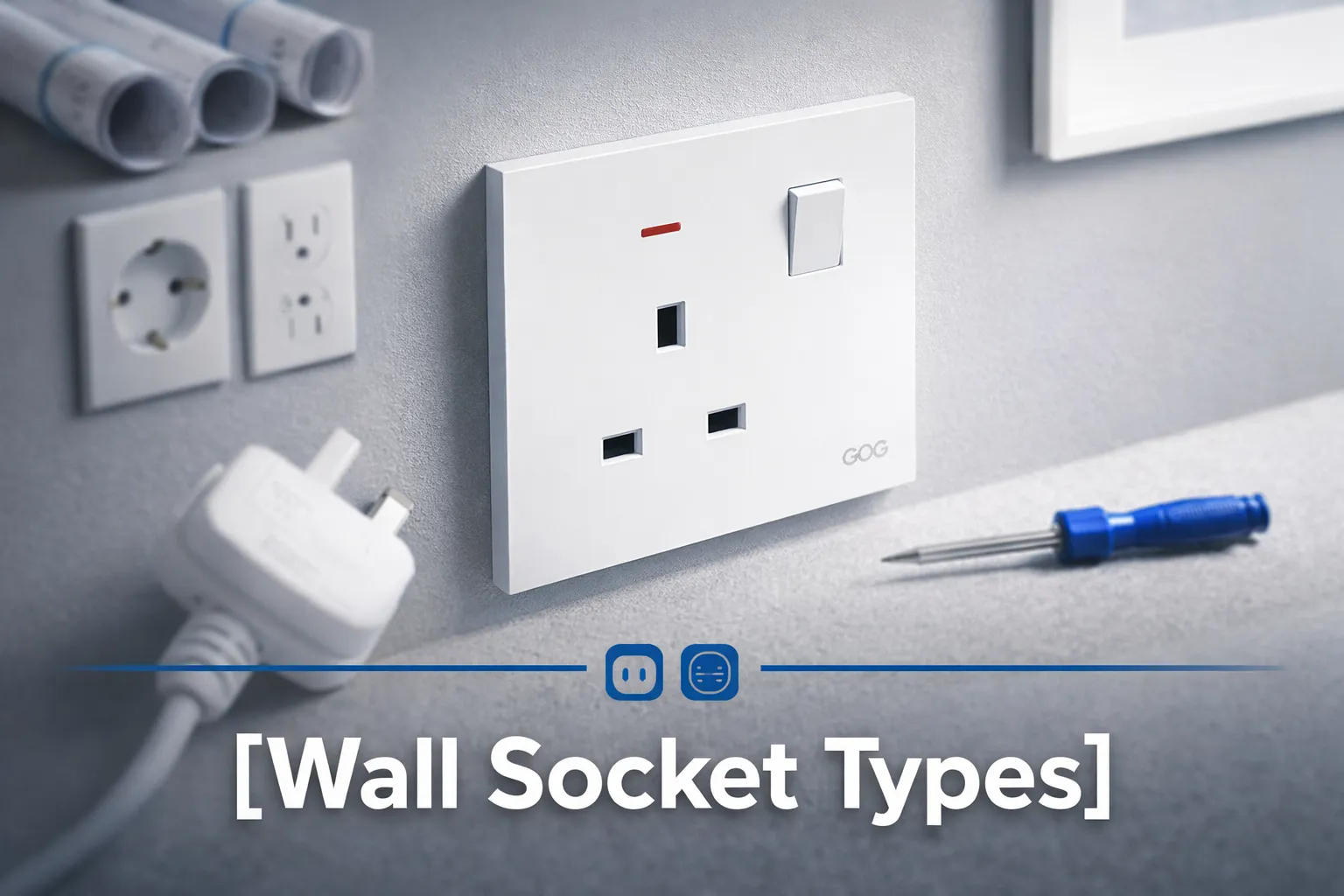
Que vous refassiez le câblage de votre maison, changiez une prise ou soyez simplement curieux des différentes prises électriques dans la pièce, vous pourriez être intéressé de connaître les deux types différents de prises électriques. Bien que cela puisse ressembler à une question de quiz, il est important de connaître cette information lors de l'achat de prises électriques, la planification de la rénovation d'une maison ou la détermination de la sécurité de votre vieille maison. En général, toutes les prises électriques appartiennent à deux familles de base, et une fois que vous comprenez ces familles, il vous sera assez facile de naviguer dans l'univers complexe des prises électriques. En d'autres termes, ce document répondra aux questions courantes concernant la classification des deux types différents de prises électriques, leur apparence, leur prix relatif et d'autres facteurs importants.
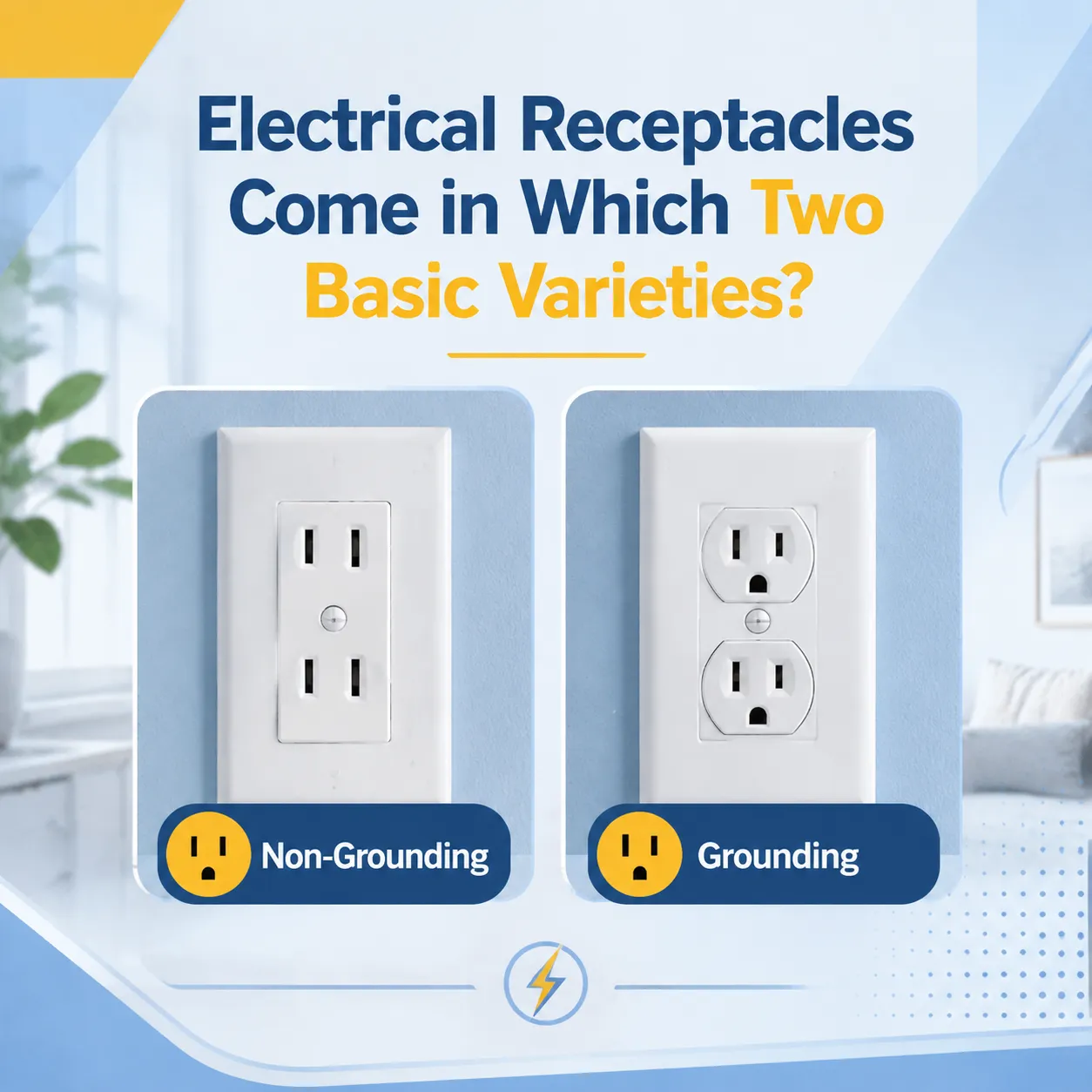
Réponse rapide : Les prises électriques (souvent appelées points électriques, prises murales ou socles) sont disponibles en seulement deux types principaux : prise avec terre et prise sans terre. Une prise deux broches sans terre est appelée type Nema 1-15, et la prise trois broches avec terre est appelée type Nema 5-15. Les prises avec terre sont des prises standard à trois broches qui possèdent une broche de terre ronde supplémentaire. Les prises avec terre se divisent en plusieurs catégories basées sur la tension et l'ampérage, telles que les prises 120V (15A et 20A).
Les deux variétés de base des réceptacles électriques
La question “ les réceptacles électriques existent en quelles deux variétés de base ” reçoit deux réponses courantes, toutes deux correctes selon le contexte :
Réponse 1 : Par la mise à la terre — Sans terre vs. Avec terre
| Variété | Broches | Type NEMA | Statut dans les maisons modernes |
|---|---|---|---|
| Réceptacle sans terre | 2 broches | NEMA 1-15 | Obsolète — trouvé uniquement dans les vieilles maisons |
| Réceptacle avec terre | 3 broches | NEMA 5-15 (et 5-20) | Standard — requis pour les nouvelles constructions |
Il possède deux fentes plates, c’est pourquoi la prise deux broches sans terre est connue sous le nom de prise de type A. La prise trois broches avec terre, également appelée prise de type B, possède une broche de terre ronde en plus des deux fentes plates pour une connexion sécurisée au système de mise à la terre du bâtiment. Dans le cadre des codes du bâtiment récents, il est obligatoire d’avoir des prises avec terre partout dans les nouveaux bâtiments ainsi que de mettre à niveau toute prise sans terre lors de rénovations dans une pièce en cas d’inspection.
Réponse 2 : Par la tension — 120V vs. 240V
| Variété | Tension | Utilisations courantes | Ampérage typique |
|---|---|---|---|
| Standard / usage général | 120V | Lampes, téléviseurs, téléphones, ordinateurs, petits appareils de cuisine | 15A ou 20A |
| Usage intensif / appareils électroménagers | 240V | Sèche-linge, cuisinières, unités de climatisation, chargeurs VE, postes à souder | 15A–50A |
Les prises 120 volts alimentent la grande majorité des appareils domestiques. Les prises 240 volts (avec leurs configurations de broches distinctives) alimentent les gros appareils nécessitant une puissance double. Si vous souhaitez comprendre la différence en détail, notre guide sur la différence entre les prises 120V et 240V l’explique avec des exemples.
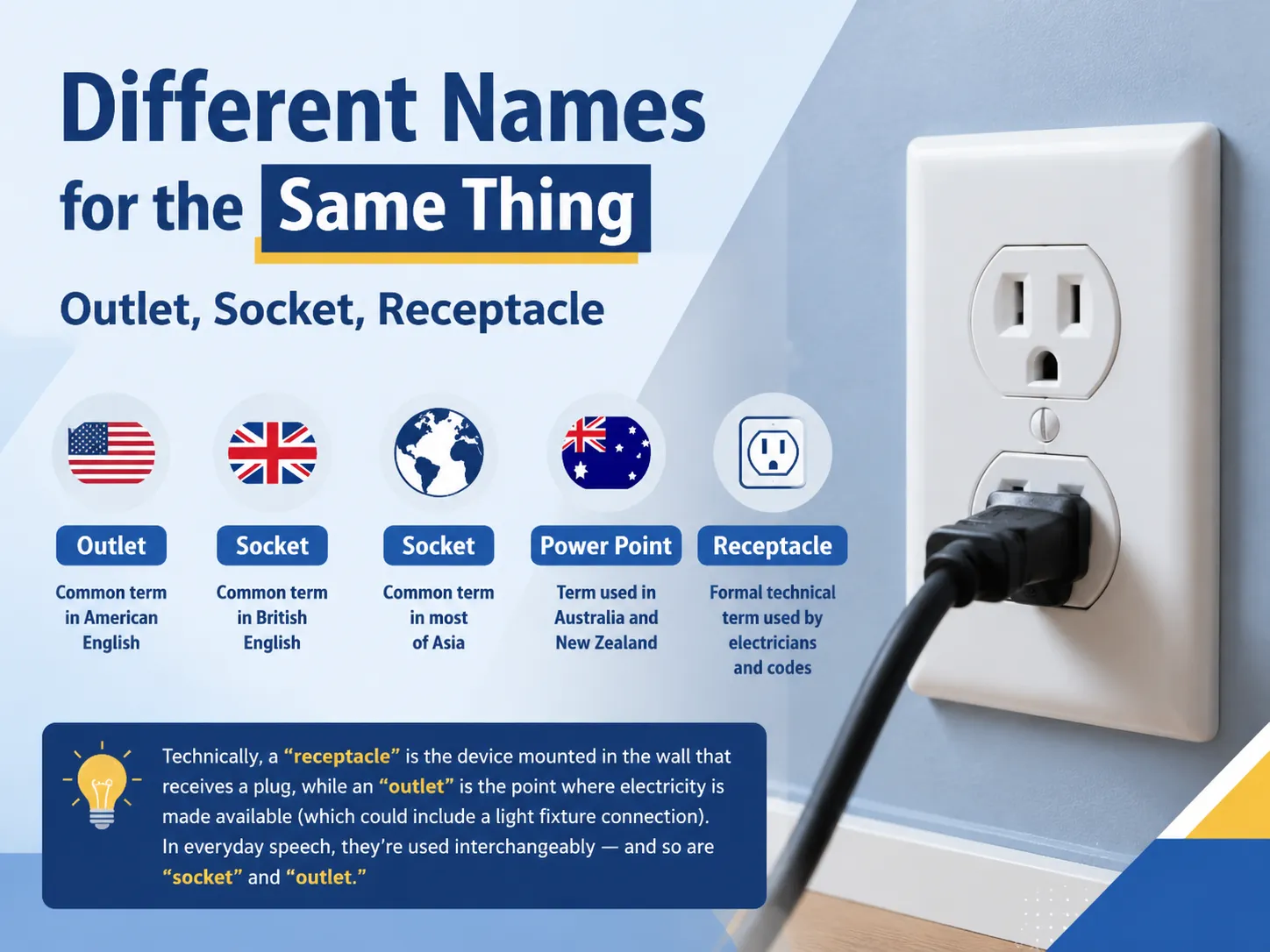
Différents noms pour la même chose : prise, socle, réceptacle
Avant de poursuivre notre discussion, clarifions certains termes car un même dispositif porte plusieurs noms — tous corrects :
- Réceptacle électrique — le terme technique officiel utilisé par les électriciens et dans les codes écrits
- Prise de courant ou prise électrique — le terme courant en anglais britannique et dans la plupart de l’Asie
- Prise murale ou simplement prise — le terme utilisé en anglais américain pour désigner cet appareil
- Point d’alimentation — un terme utilisé par les Australiens et Néo-Zélandais
- Prise de courant — un autre terme populaire utilisé en anglais britannique
Strictement parlant, “ réceptacle ” désigne l’appareil fixé dans un mur qui reçoit la fiche, tandis que “ prise ” signifie l’emplacement de l’alimentation électrique (ce qui peut aussi inclure le luminaire). Cependant, dans le langage courant, ils sont utilisés de manière interchangeable ainsi que “ socket ” et “ outlet ”. Pour un examen plus détaillé de la terminologie et de l’anatomie, voir notre article sur ce qu’est un réceptacle électrique.
Comment les réceptacles sont classés : le système NEMA
Le système de classification utilisé pour tous les réceptacles nord-américains a été développé par la National Electrical Manufacturers Association (NEMA) et possède un code de classification. Par exemple, le code 5-15R se décompose comme suit :
- Le premier chiffre (c’est-à-dire 5) indique le type de famille de configuration et montre la tension et la mise à la terre.
- Le deuxième chiffre (c’est-à-dire 15) définit la capacité en ampères.
- La lettre désigne le type de réceptacle (R) par opposition à la fiche (P).
| Code NEMA | Tension | Ampérage | Broches | Usage courant |
|---|---|---|---|---|
| 1-15R | 120V | 15A | 2 | Anciennes prises non mises à la terre (obsolètes) |
| 5-15R | 120V | 15A | 3 | Prise domestique standard |
| 5-20R | 120V | 20A | 3 | Cuisines, salles de bains, buanderies |
| 6-15R | 240V | 15A | 3 | Climatiseur de fenêtre, petits équipements |
| 6-20R | 240V | 20A | 3 | Compresseurs d’air, outils électriques |
| 14-30R | 120/240V | 30A | 4 | Sèche-linge électriques |
| 14-50R | 120/240V | 50A | 4 | Cuisinières, raccordements pour VR, chargeurs VE |
Si vous souhaitez en savoir plus sur les différents styles utilisés dans les prises, consultez notre article sur les types de prises électriques qui traite à la fois des types NEMA utilisés en Amérique du Nord et d’autres types de fiches internationales.
Réceptacles 120V : Les prises du quotidien
Ce sont les prises que vous utilisez tous les jours. Toutes sont mises à la terre (sauf le type obsolète à 2 broches) et sont évaluées pour 120 volts.
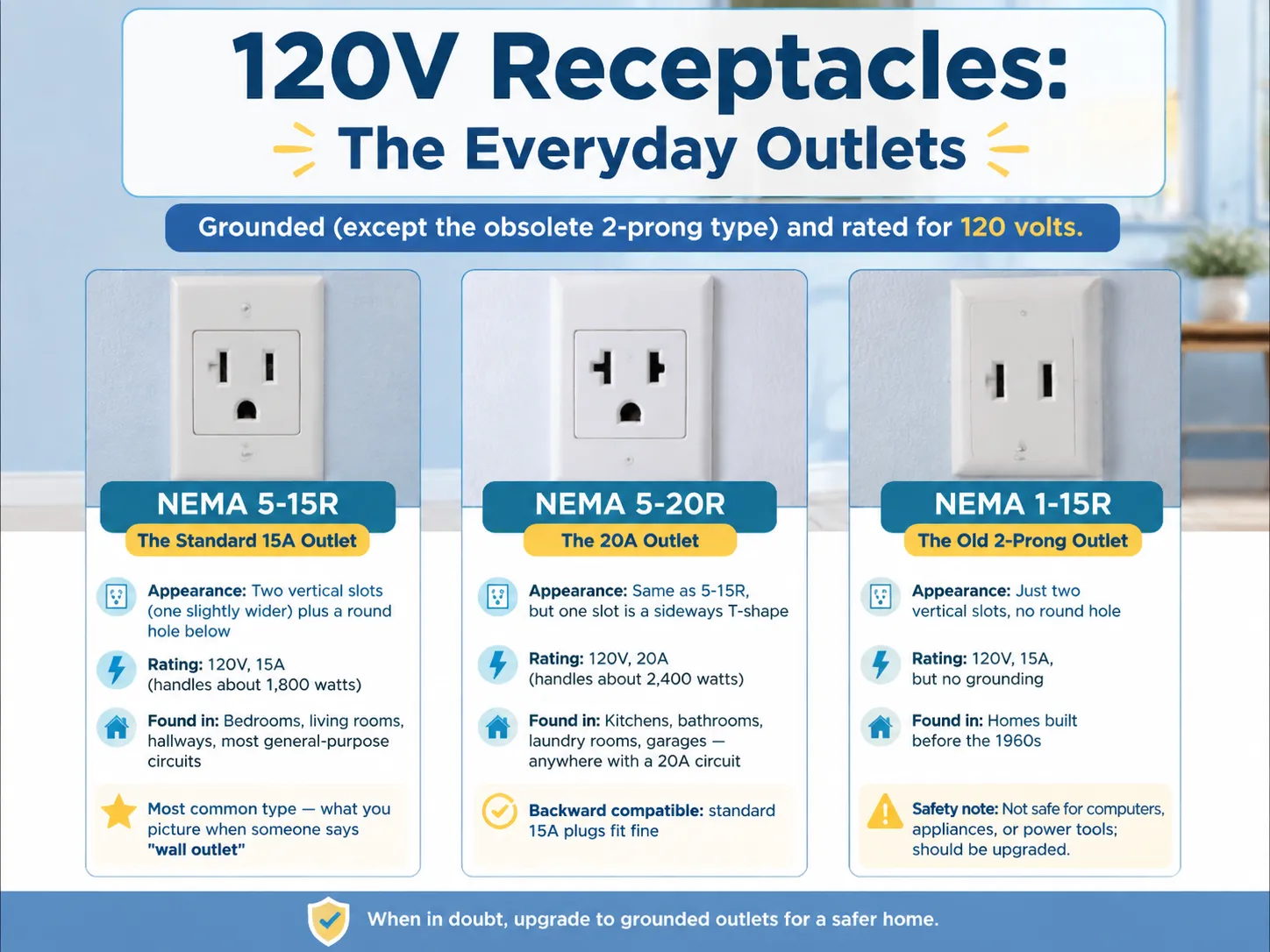
NEMA 5-15R — La prise standard 15A
- Apparence : Deux fentes verticales (dont une un peu plus large) et un trou rond en dessous
- Caractéristiques électriques : 120 volts, 15 ampères (consommation d’environ 1800 watts)
- Application : Généralement installée dans les chambres, salons, couloirs et autres circuits à usage général
- Type : Ce type de prise est le plus courant, celui auquel on pense habituellement en imaginant une prise murale
NEMA 5-20R — La prise 20A
- Apparence : Semblable à la 5-15R, sauf qu’une des fentes a la forme d’un T couché.
- Évaluation : Évaluée pour 120 volts, 20 ampères (supporte environ 2400 watts).
- Installation : Utilisée dans les cuisines, salles de bains, buanderies, garages ou partout où un courant de 20 ampères est nécessaire.
- Compatibilité : Compatible avec 15 ampères.
NEMA 1-15R — L’ancienne prise à 2 broches
- Caractéristique : Simplement deux ouvertures verticales, sans aucune ouverture circulaire.
- Capacité : 120V ; minimum 15A, mais sans mise à la terre.
- Présente dans : Maisons construites avant les années 60.
- Précaution : Non sécuritaire pour connecter des ordinateurs, gadgets ou machines, et doit être remplacée.
Notre comparaison de prises à 2 broches vs. prises à 3 broches explique en détail les différences de sécurité.
Réceptacles 240V : Les prises haute puissance
Les prises 240 volts fournissent le double de tension pour les gros appareils. Elles ont des configurations de broches distinctives qui empêchent de brancher accidentellement un appareil 120V.
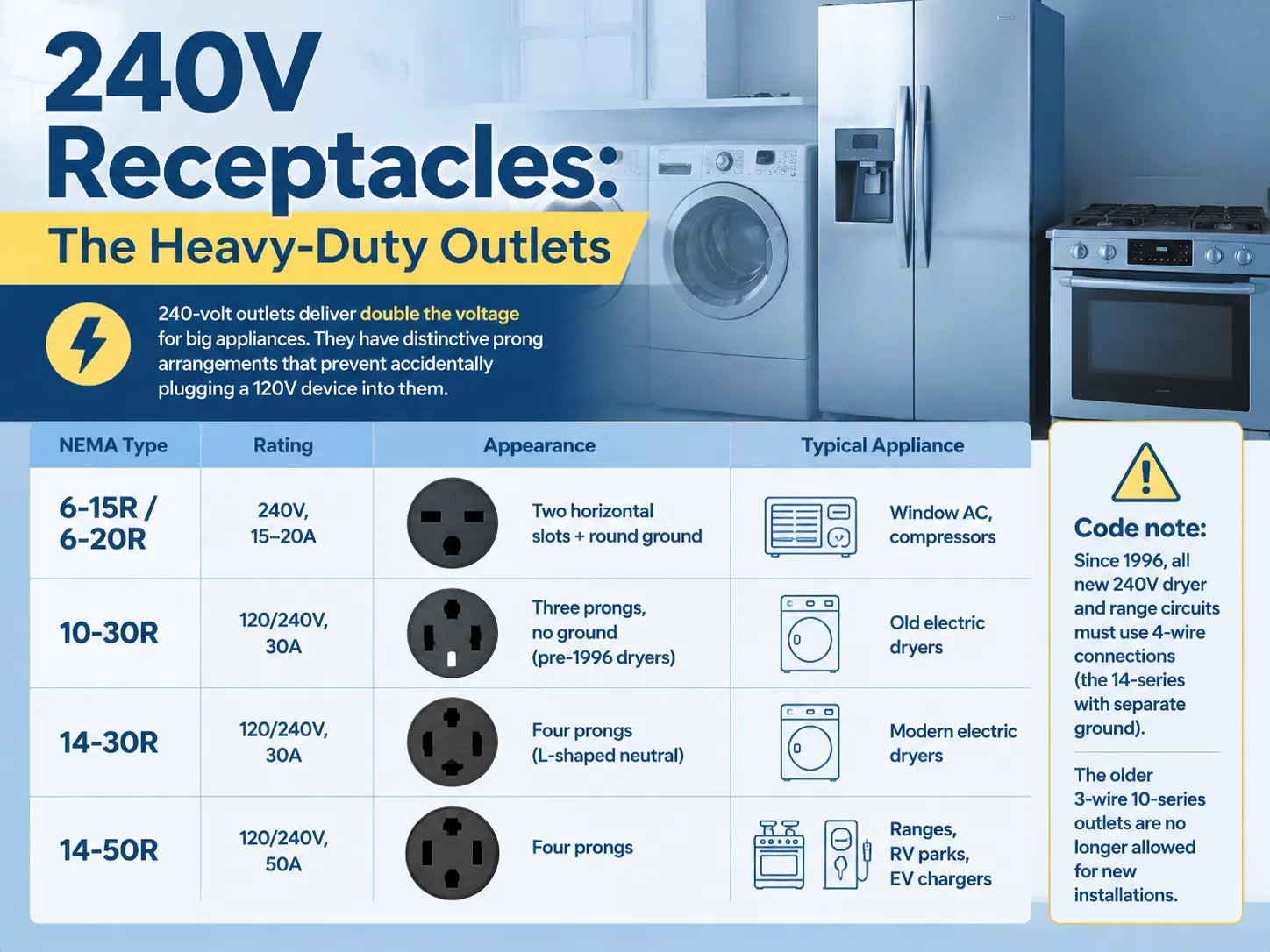
| Type NEMA | Cote | Apparence | Appareil typique |
|---|---|---|---|
| 6-15R / 6-20R | 240V, 15–20A | Deux fentes horizontales + terre ronde | Climatiseur de fenêtre, compresseurs |
| 10-30R | 120/240V, 30A | Trois broches, sans terre (sèche-linge pré-1996) | Anciens sèche-linge électriques |
| 14-30R | 120/240V, 30A | Quatre broches (neutre en forme de L) | Sèche-linge électriques modernes |
| 14-50R | 120/240V, 50A | Quatre broches | Cuisinières, parcs pour VR, chargeurs EV |
Points clés dans le contexte du code : Le code a rendu obligatoire que tous les nouveaux circuits de sèche-linge et de cuisinière fonctionnant en 240V doivent être équipés de connexions à 4 fils ou du type série 14 dont la connexion est mise à la terre. L’alternative à 3 fils de la série 10 ne peut plus être utilisée dans les nouvelles installations.
Différences d’apparence en un coup d’œil
Voici comment distinguer les variétés de base simplement en les regardant :
| Réceptacle | Fentes | Caractéristique distinctive |
|---|---|---|
| 2 broches non mises à la terre (1-15R) | 2 fentes verticales | Pas de trou rond du tout |
| 3 broches 15A (5-15R) | 2 verticales + 1 ronde | Les deux fentes sont verticales, la terre ronde en dessous |
| 3 broches 20A (5-20R) | 1 verticale + 1 en forme de T + 1 ronde | Fente en T horizontale à gauche |
| 240V lame droite (6-15R/6-20R) | 2 horizontales + 1 ronde | Les deux fentes sont horizontales |
| Sèche-linge (14-30R) | 3 fentes + 1 ronde | Fente neutre en forme de L |
| Cuisinière/EV (14-50R) | 3 fentes + 1 ronde | Neutre plus grand en forme de L |
Examinez la plaque frontale : les boutons TEST et RESET sont présents sur une prise GFCI ; la prise anti-intrusion (tamper-resistant) possède des volets coulissants dans les ouvertures et une prise USB a des ports USB sur la plaque frontale.
Réceptacles à usage spécial : GFCI, TR, USB
Au-delà des deux variétés de base, les réceptacles modernes ajoutent des fonctions de sécurité et de commodité :
| Type | Ce qu'il fait | Là où c’est requis | Prix |
|---|---|---|---|
| Détecte les défauts de terre — courant fuyant vers la terre à travers une personne ou de l'eau — et se déclenche à 5 milliampères en quelques millisecondes. Identifiée par les boutons TEST et RESET. | Coupe le circuit s’il détecte une fuite de courant à la terre (prévention des chocs) | Salles de bains, cuisines, garages, extérieurs, sous-sols | $10–$25 |
| Anti-intrusion (TR) | Volets internes bloquent les objets insérés par les enfants | Obligatoire dans toutes les nouvelles constructions résidentielles | $2–$5 |
| Réceptacle USB | Ports de charge intégrés USB-A / USB-C | Optionnel — bureaux, tables de nuit, cuisines | $15–$45 |
| Détecte la signature électrique unique d'un arc et se déclenche avant que l'arc ne puisse provoquer un incendie. La protection AFCI peut être fournie au disjoncteur ou à la première prise du circuit. | Détecte les arcs dangereux dans le câblage | Chambres et espaces de vie (au niveau du circuit) | $15–$30 |
| Combiné interrupteur/réceptacle | Interrupteur et réceptacle dans un seul appareil | Là où une prise commutée est nécessaire | $4–$12 |
Pour un aperçu complet des quatre principales catégories de prises utilisées dans les habitations, notre article sur les 4 types de prises électriques est une référence rapide et visuelle.
Quel réceptacle pour quelle pièce ?
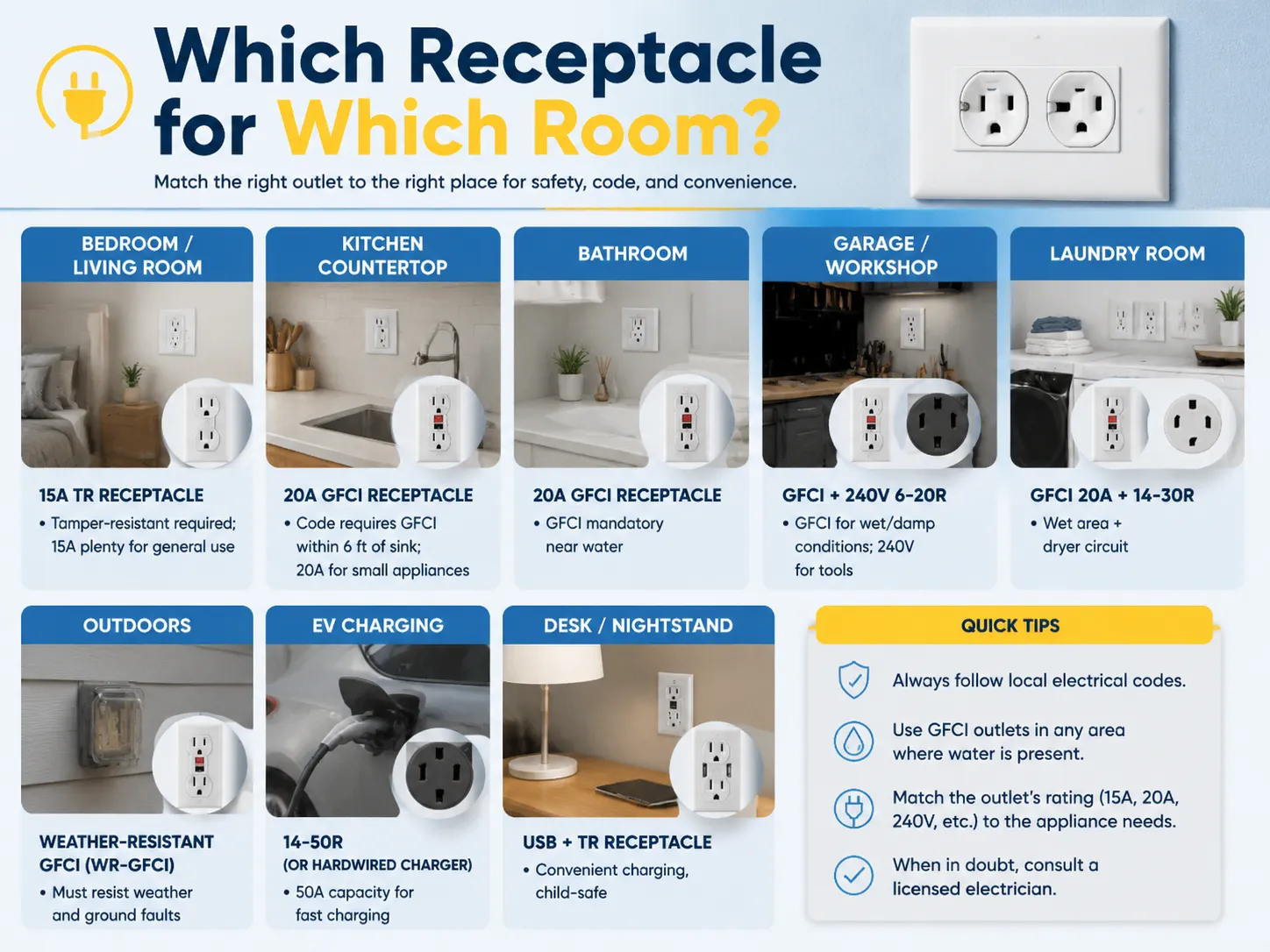
| Emplacement | Réceptacle recommandé | Pourquoi |
|---|---|---|
| Chambre / salon | Réceptacle 15A TR | Résistance aux manipulations requise ; 15A suffisant pour usage général |
| Plan de travail de cuisine | Réceptacle 20A GFCI | Le code exige un GFCI à moins de 6 pieds de l’évier ; 20A pour petits appareils |
| Salle de bain | 20A GFCI | GFCI obligatoire près de l’eau |
| Garage / atelier | GFCI + un 240V 6-20R | GFCI pour conditions humides ; 240V pour outils |
| Buanderie | GFCI 20A + prise sèche-linge 14-30R | Zone humide + circuit sèche-linge |
| Extérieur | GFCI résistant aux intempéries (WR-GFCI) | Doit résister aux intempéries et aux défauts de terre |
| Recharge VE | 14-50R (ou chargeur câblé) | Capacité 50A pour charge rapide |
| Bureau / table de chevet | Réceptacle USB + TR | Chargement pratique, sécurité enfant |
Guide des prix : coût des prises
| Type | Prix de détail | Prix de la marque |
|---|---|---|
| Réceptacle basique 15A à 3 broches | $1–$3 | $2–$5 |
| Réceptacle 20A | $2–$5 | $4–$8 |
| 15A résistant aux manipulations | $2–$4 | $3–$6 |
| Détecte les défauts de terre — courant fuyant vers la terre à travers une personne ou de l'eau — et se déclenche à 5 milliampères en quelques millisecondes. Identifiée par les boutons TEST et RESET. | $10–$18 | $15–$25 |
| Réceptacle USB (double port) | $12–$25 | $20–$45 |
| Détecte la signature électrique unique d'un arc et se déclenche avant que l'arc ne puisse provoquer un incendie. La protection AFCI peut être fournie au disjoncteur ou à la première prise du circuit. | $15–$25 | $20–$30 |
| Réceptacle sèche-linge (14-30R) | $8–$15 | $12–$20 |
| Réceptacle cuisinière/VE (14-50R) | $10–$20 | $15–$30 |
Il existe des différences entre les marques, les finitions (comme blanc, ivoire, noir, laiton) et les certifications (certifié UL vs générique non listé) qui influencent le prix. De plus, l’installation par des professionnels peut coûter entre 50 et 150 USD par prise selon le lieu d’installation et l’état du câblage.
Principales marques de réceptacles
| Marque | Country | Gamme de prix | Réputé pour |
|---|---|---|---|
| Leviton | États-Unis | Moyenne | Ligne design Decora, large sélection, fiable |
| Eaton / Cooper Wiring | États-Unis | Moyenne | Durabilité de qualité commerciale, installations commerciales |
| Legrand (Pass & Seymour) | France/USA | Moyen-Haut | Finitions design, prises intelligentes |
| Hubbell | États-Unis | Élevé | Prises de qualité industrielle, fiabilité extrême |
| GE (Current) | États-Unis | Budget-Moyen | Prises quotidiennes, largement disponibles |
| Kopp / Belanko | Allemagne | Moyenne | Prises de qualité style européen |
| IGOTO | Chine | Valeur | Interrupteurs et prises intelligents, OEM pour marques mondiales |
| Schneider Electric | France | Moyen-Haut | Lignes Unica et Clipsal, normes mondiales |
Pour un usage résidentiel quotidien, Leviton et Eaton sont les marques les plus installées en Amérique du Nord. Si vous souhaitez des finitions premium ou des fonctionnalités intelligentes, Legrand et Schneider sont en tête. Notre guide sur 10 meilleures marques de dispositifs de câblage dans le monde approfondit les points forts de chaque fabricant.
Questions fréquemment posées
Quels sont les différents types de prises électriques ?
Les prises électriques appartiennent à deux catégories principales, à savoir les prises non mises à la terre (avec deux broches) et les prises mises à la terre (avec trois broches). D’autres classifications peuvent être faites verticalement. Les types de prises électriques courantes aujourd’hui incluent : NEMA 1-15 (maintenant obsolète, 2 broches), NEMA 5-15 (prise standard 15 ampères à 3 broches), NEMA 5-20 (20 ampères avec trou en T), NEMA 6-15/6-20 (outils 240 volts), NEMA 14-30 (pour sèche-linge électriques) et NEMA 14-50 (pour cuisinière électrique et véhicule récréatif). L’utilisation de types spéciaux de prises offre des avantages supplémentaires.
Quels sont les deux types de prises que l’on trouve dans un système électrique ?
Dans les systèmes électriques, il existe deux principales variétés de prises : les prises 120 volts (prises électriques à usage général utilisées pour alimenter de petits appareils tels que lampes, gadgets électroniques et autres équipements domestiques) et les prises 240 volts (prises haute puissance pour appareils ménagers tels que sèche-linge, fours, climatiseurs et chargeurs VE). L’autre manière d’identifier les deux types de prises peut se faire par la mise à la terre, qui distingue deux types de prises, à savoir les prises non mises à la terre à deux broches (présentes dans les anciennes habitations, désormais considérées comme obsolètes) et les prises mises à la terre à trois broches (norme actuelle). Elles correspondent essentiellement aux deux façons distinctes dont les appareils consomment l’électricité à partir de différents types de prises.
Quels sont les deux types de systèmes électriques ?
Presque tout le monde parle de deux types de systèmes électriques, à savoir les systèmes monophasés et triphasés. Les systèmes monophasés (généralement 120/240 volts) sont utilisés dans la plupart des résidences. Ils comportent deux conducteurs actifs et un fil neutre. Les systèmes triphasés (208 volts ou 480 volts) sont utilisés dans les environnements industriels et commerciaux pour fournir des puissances plus élevées de manière plus efficace et faire fonctionner des moteurs lourds. Les installations résidentielles reposent presque toujours sur l’électricité monophasée. Il peut y avoir quelques cas où un foyer utilise un équipement électrique triphasé, comme une pompe de puits, un atelier ou un onduleur solaire.
Quelles sont les deux catégories de base des interrupteurs électriques ?
Les interrupteurs électriques se classent en deux catégories principales : l'interrupteur unipolaire qui permet de contrôler une charge électrique depuis une seule position et l'interrupteur va-et-vient qui offre un contrôle d'une charge électrique depuis deux emplacements. D'autres classifications existent, parmi elles l'interrupteur télérupteur (utilisé pour contrôler une lumière depuis trois ou plusieurs emplacements) et des types spéciaux d'interrupteurs tels que les interrupteurs intelligents, les minuteries et les variateurs. Cependant, les interrupteurs unipolaires et va-et-vient restent les deux types d'interrupteurs électriques les plus importants. L'interrupteur unipolaire se compose de deux bornes, tandis que l'interrupteur va-et-vient est composé de trois bornes.
Références
- NEMA (Association Nationale des Fabricants Électriques) — L'organisme de normalisation qui définit le système de configuration des prises NEMA (1-15, 5-15, 6-15, 14-30, 14-50, etc.) utilisé en Amérique du Nord.
- NFPA 70 (Code électrique national) — Le code qui régit les exigences des prises, y compris les emplacements de protection GFCI, les prises résistantes à la manipulation et les circuits 240V à 4 fils.
- Normes UL pour les fiches et prises — UL 498 couvre les exigences de sécurité pour les fiches et prises vendues aux États-Unis.
- Sécurité électrique OSHA — Directives de sécurité au travail aux États-Unis concernant les prises, la mise à la terre et les exigences GFCI.
- Département de l'Énergie des États-Unis — Prises GFCI — Guide pratique sur le fonctionnement des prises GFCI et leur test.
- Catalogue de prises Leviton — Référence fabricant montrant la gamme de types de prises, des prises basiques 15A aux modèles GFCI, TR et USB.
Conclusion
Alors, quels sont les deux types généraux de prises électriques ? La réponse simple est non mises à la terre (2 broches) et mises à la terre (3 broches), ou plus simplement, 120V usage général et 240V usage intensif. Cela rend la conclusion très claire :
- Pour un usage quotidien, optez pour des prises mises à la terre de 15 ou 20 ampères, car elles sont peu coûteuses, sûres et conformes.
- Pour les emplacements humides (salle de bain, cuisine, garage, extérieur), vous devez utiliser des prises GFCI, car elles peuvent vous sauver la vie et sont exigées par le code.
- Pour les machines lourdes, utilisez une prise NEMA 240V appropriée au lieu de modifier une prise 120V pour ces appareils.
- En cas de rénovation d'un bâtiment ancien, assurez-vous de remplacer les anciennes prises non mises à la terre à 2 broches par des prises mises à la terre (ou protégées par GFCI).
Ainsi, peu importe où vous souhaitez acheter une prise, vous avez une idée par où commencer.