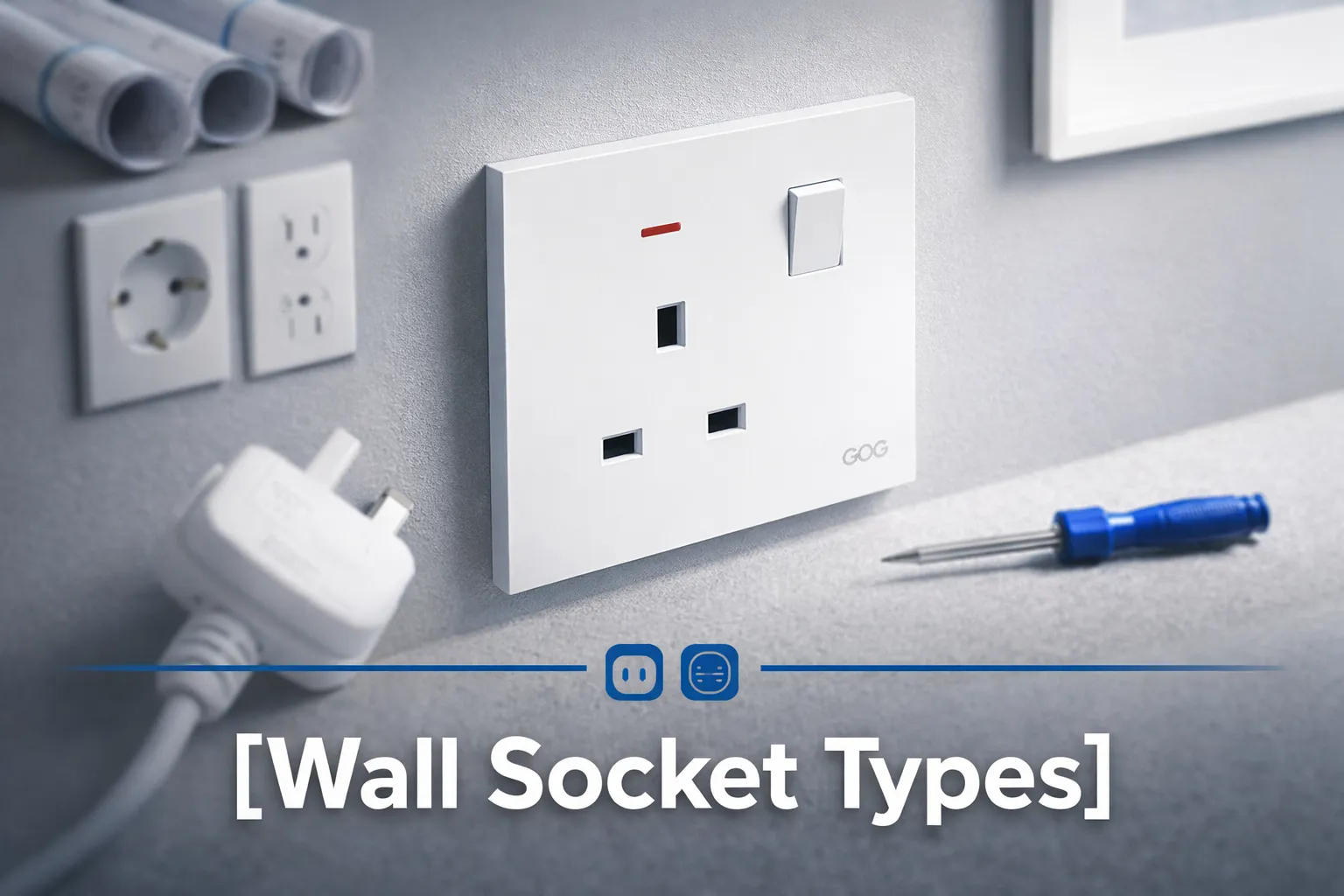
Whether you are rewiring your house, changing an outlet, or just curious about the various electrical outlets in the room, you might be interested in knowing about the two different kinds of electrical outlets. While it may sound like a quiz question, it is important to know this information when buying electrical outlets, planning house remodeling, or determining the safety of your old house. Generally speaking, all the electrical sockets belong to two basic families, and so once you understand those families, it will be pretty easy for you to navigate the difficult universe of electrical outlets. In other words, the document will answer common questions regarding classification of the two different kinds of electrical power sockets, their appearance, relative price, and other factors that matter.
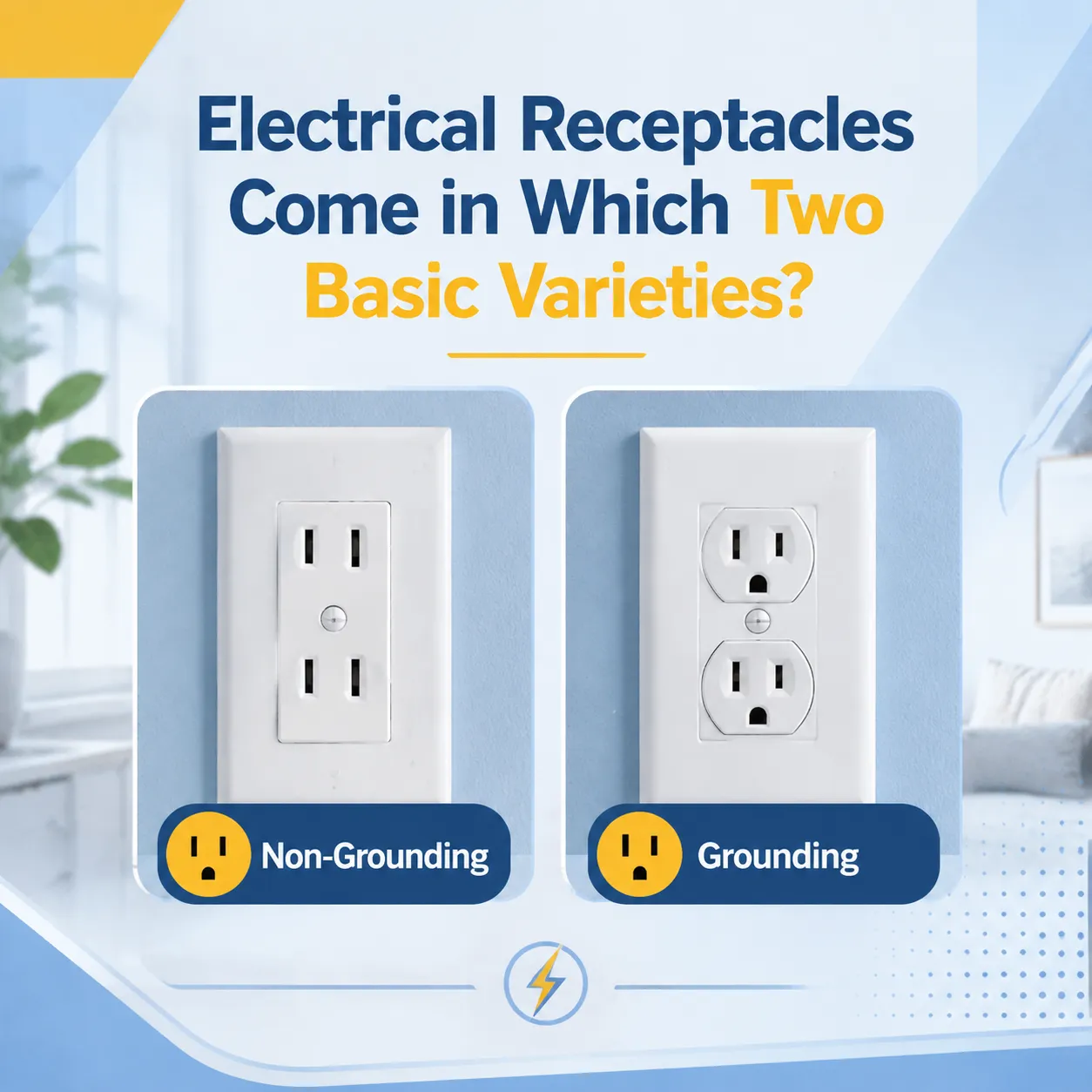
Quick answer: Electrical outlets (often referred to as electrical points, wall outlets, or sockets) are available in just two main types: ground and non-ground socket. A non-ground two-prong socket is referred to as the Nema 1-15 type, and the grounded three-prong socket is called the Nema 5-15 type. Grounded sockets are standard three-prong outlets that have an additional round grounding pin. Grounded outlets broke into several categories based on both voltage and amps, such as 120V sockets (15A and 20A).
The Two Basic Varieties of Electrical Receptacles
The question “electrical receptacles come in which two basic varieties” is answered in two common ways, and both are correct depending on the context:
Answer 1: By Grounding — Ungrounded vs. Grounded
| Variety | Prongs | NEMA Type | Status in Modern Homes |
|---|---|---|---|
| Ungrounded receptacle | 2 prongs | NEMA 1-15 | Obsolete — found only in old homes |
| Grounded receptacle | 3 prongs | NEMA 5-15 (and 5-20) | Standard — required for new construction |
It has two flat slots, which is why the ungrounded two-prong outlet is known as a Type A socket. The grounded three-prong outlet also referred to as a Type B socket, has a round grounding pin in addition to the two flat slots for safe connection to the ground system of the building. In the case of recent building codes, there is an obligation to have grounded outlets everywhere in new buildings as well as upgrading any ungrounded outlets when doing renovations in a room in case of inspection.
Answer 2: By Voltage — 120V vs. 240V
| Variety | Voltage | Common Uses | Typical Amperage |
|---|---|---|---|
| Standard / general-purpose | 120V | Lamps, TVs, phones, computers, kitchen small appliances | 15A or 20A |
| Heavy-duty / appliance | 240V | Dryers, ranges, AC units, EV chargers, welders | 15A–50A |
120-volt outlets power the vast majority of household devices. 240-volt outlets (with their distinctive prong layouts) power big appliances that need double the power. If you want to understand the difference in detail, our guide on the difference between 120V and 240V outlets breaks it down with examples.
Different Names for the Same Thing: Outlet, Socket, Receptacle
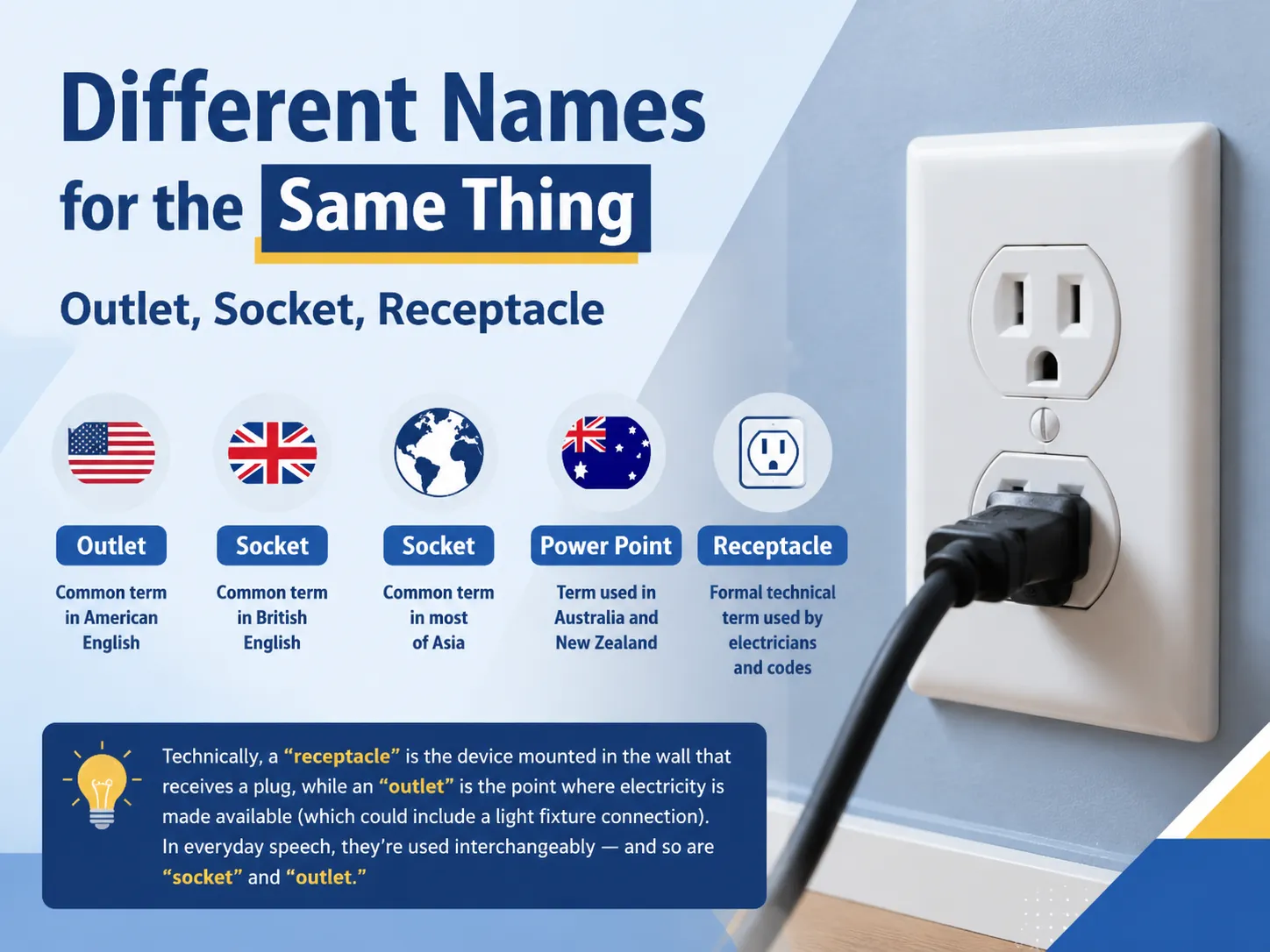
Before we proceed with our discussion, let’s straighten some of the terms as the same device has multiple names — all of them being correct:
- Electrical receptacle — the officially technical term that is used by electricians and written codes
- Power socket or electric socket — the common term in UK English and most of Asia
- Wall outlet or simply outlet — the term used in American language in talking about this device
- Power point — a term used by Australasians
- Plug socket — another popular term used in UK English
Strictly speaking, “receptacle” is the device that is fixed in a wall and receives the plug, while “outlet” means the location of the power supply (which may also imply the light fitting). However, in spoken language they are used interchangeably as well as “socket” and “outlet”.For a more detailed look at the terminology and anatomy, see our article on what is an electrical receptacle.
How Receptacles Are Classified: The NEMA System
The classification system used for all North American receptacles was developed by the National Electrical Manufacturers Association (NEMA) and has a code for classification. For example, code 5-15R is broken down as follows:
- The first digit (i.e., 5) tells of the type of configuration family and shows the voltage and grounding.
- The second digit (i.e., 15) defines the amperage rating.
- The letter denotes the receptacle type (R) as opposed to the plug (P).
| NEMA Code | Voltage | Amperage | Prongs | Common Use |
|---|---|---|---|---|
| 1-15R | 120V | 15A | 2 | Old ungrounded outlets (obsolete) |
| 5-15R | 120V | 15A | 3 | Standard household outlet |
| 5-20R | 120V | 20A | 3 | Kitchens, bathrooms, laundry |
| 6-15R | 240V | 15A | 3 | Window AC, small equipment |
| 6-20R | 240V | 20A | 3 | Air compressors, power tools |
| 14-30R | 120/240V | 30A | 4 | Electric dryers |
| 14-50R | 120/240V | 50A | 4 | Ranges, RV hookups, EV chargers |
If you want to learn more about the different styles used in sockets, take a look at our posting on types of electrical sockets as it discusses both NEMA types used in North America and other international plug types.
120V Receptacles: The Everyday Outlets
These are the outlets you use every day. All are grounded (except the obsolete 2-prong type) and rated for 120 volts.
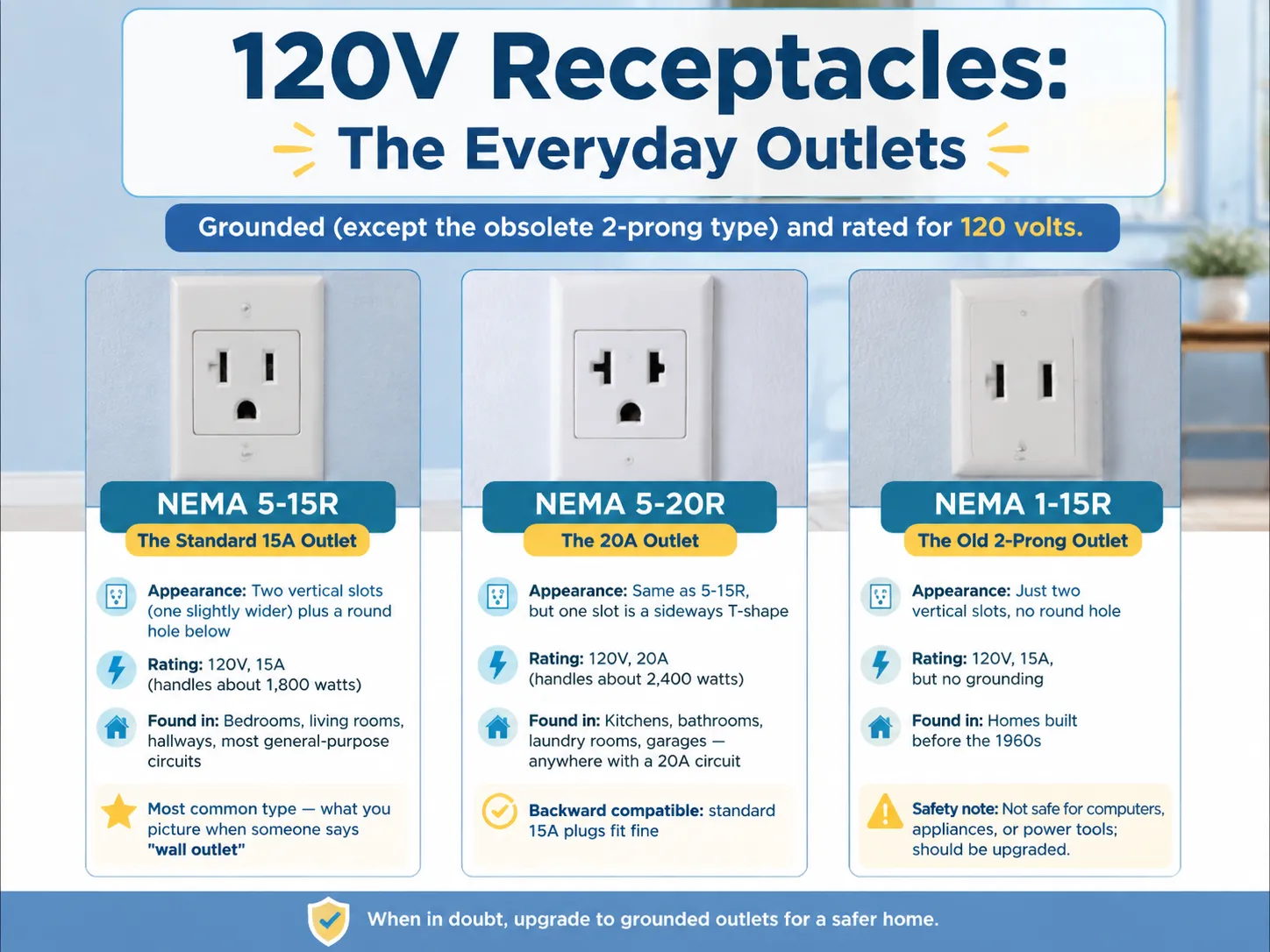
NEMA 5-15R — The Standard 15A Outlet
- Look: Two vertical slots (one of which is a bit wider) and a round hole below
- Electrical rating: 120 volts, 15 amps (power consumption approx. 1800 watts)
- Application: Typically mounted in the bedrooms, living rooms, hallways and other types of general-purpose circuits
- Type: This type of outlet is the most common one, which people usually think of when imagining a wall outlet
NEMA 5-20R — The 20A Outlet
- Appearance: Similar to 5-15R, except that one receptacle is in the shape of a sideways T.
- Rating: Rated for 120 Volts, 20 Amperes (handles around 2,400 watts).
- Installation: Used in kitchens, bathrooms, laundry rooms, garages, or anywhere else with 20 Amps of current.
- Compatibility: Compatible with 15 Amps.
NEMA 1-15R — The Old 2-Prong Outlet
- Feature: Simply dual vertical openings, without any circular aperture.
- Capacity: 120V; 15A minimum, but it does not have grounding.
- Present in: Houses constructed prior to the ’60s.
- Caution: Not safe for connecting computers, gadgets, or machinery, and it must be augmented.
Our comparison of 2-prong vs. 3-prong outlets explains the safety differences in detail.
240V Receptacles: The Heavy-Duty Outlets
240-volt outlets deliver double the voltage for big appliances. They have distinctive prong arrangements that prevent accidentally plugging a 120V device into them.
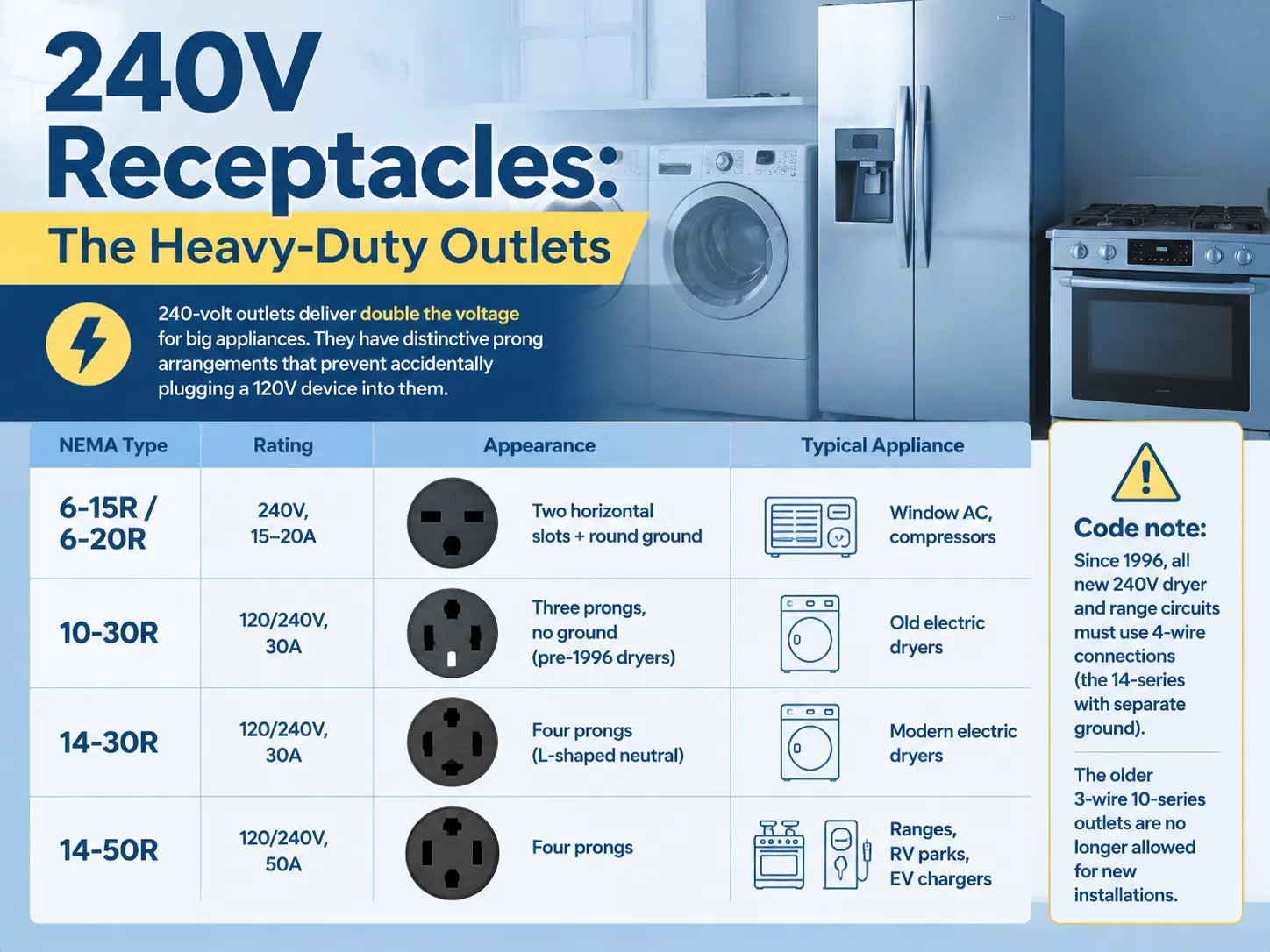
| NEMA Type | Rating | Appearance | Typical Appliance |
|---|---|---|---|
| 6-15R / 6-20R | 240V, 15–20A | Two horizontal slots + round ground | Window AC, compressors |
| 10-30R | 120/240V, 30A | Three prongs, no ground (pre-1996 dryers) | Old electric dryers |
| 14-30R | 120/240V, 30A | Four prongs (L-shaped neutral) | Modern electric dryers |
| 14-50R | 120/240V, 50A | Four prongs | Ranges, RV parks, EV chargers |
Key points in the context of code: Code has mandated that all new dryer and range circuits that operate on 240V must come with 4-wire connections or the 14-series type in which the connection is grounded. The alternate 3-wire 10-series cannot be employed in new installations anymore.
Appearance Differences at a Glance
Here’s how to tell the basic varieties apart just by looking at them:
| Receptacle | Slots | Distinguishing Feature |
|---|---|---|
| 2-prong ungrounded (1-15R) | 2 vertical slots | No round hole at all |
| 3-prong 15A (5-15R) | 2 vertical + 1 round | Both slots vertical, round ground below |
| 3-prong 20A (5-20R) | 1 vertical + 1 T-shaped + 1 round | Sideways T slot on the left |
| 240V straight-blade (6-15R/6-20R) | 2 horizontal + 1 round | Both slots horizontal |
| Dryer (14-30R) | 3 slots + 1 round | L-shaped neutral slot |
| Range/EV (14-50R) | 3 slots + 1 round | Larger, L-shaped neutral |
Examine the face plate either: the TEST and RESET buttons are present in a GFCI outlet; tamper-resistant outlet has sliding shutters in the openings and a USB outlet has USB ports on the face plate.
Special-Purpose Receptacles: GFCI, TR, USB
Beyond the two basic varieties, modern receptacles add safety and convenience features:
| Type | What It Does | Where Required | Price |
|---|---|---|---|
| GFCI receptacle | Trips the circuit if it detects current leaking to ground (prevents shock) | Bathrooms, kitchens, garages, outdoors, basements | $10–$25 |
| Tamper-resistant (TR) | Internal shutters block objects inserted by children | Required in all new residential construction | $2–$5 |
| USB receptacle | Built-in USB-A / USB-C charging ports | Optional — desks, nightstands, kitchens | $15–$45 |
| AFCI receptacle | Detects dangerous arcing in wiring | Bedrooms and living areas (circuit-level) | $15–$30 |
| Combination switch/outlet | Switch and receptacle in one device | Where a switched outlet is needed | $4–$12 |
For a full overview of the four main outlet categories used in homes, our article on the 4 types of electrical outlets is a quick, visual reference.
Which Receptacle for Which Room?
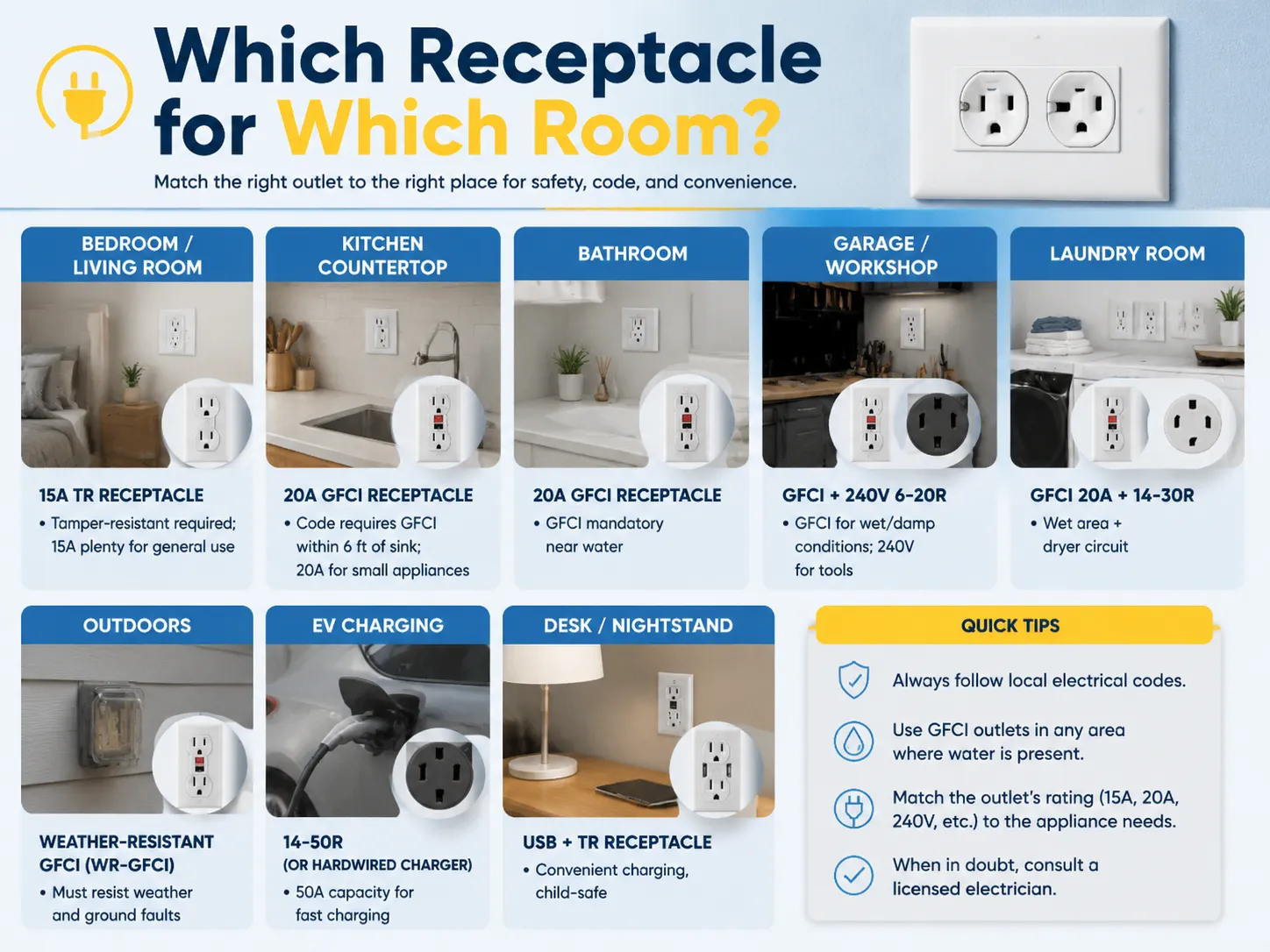
| Location | Recommended Receptacle | Why |
|---|---|---|
| Bedroom / living room | 15A TR receptacle | Tamper-resistant required; 15A plenty for general use |
| Kitchen countertop | 20A GFCI receptacle | Code requires GFCI within 6 ft of sink; 20A for small appliances |
| Bathroom | 20A GFCI | GFCI mandatory near water |
| Garage / workshop | GFCI + a 240V 6-20R | GFCI for wet/damp conditions; 240V for tools |
| Laundry room | GFCI 20A + 14-30R dryer outlet | Wet area + dryer circuit |
| Outdoors | Weather-resistant GFCI (WR-GFCI) | Must resist weather and ground faults |
| EV charging | 14-50R (or hardwired charger) | 50A capacity for fast charging |
| Desk / nightstand | USB + TR receptacle | Convenient charging, child-safe |
Price Guide: What Outlets Cost
| Type | Retail Price | Brand Name Price |
|---|---|---|
| Basic 15A 3-prong receptacle | $1–$3 | $2–$5 |
| 20A receptacle | $2–$5 | $4–$8 |
| Tamper-resistant 15A | $2–$4 | $3–$6 |
| GFCI receptacle | $10–$18 | $15–$25 |
| USB receptacle (dual port) | $12–$25 | $20–$45 |
| AFCI receptacle | $15–$25 | $20–$30 |
| Dryer receptacle (14-30R) | $8–$15 | $12–$20 |
| Range/EV receptacle (14-50R) | $10–$20 | $15–$30 |
There are differences among brands, finishes (like white, ivory, black, brass), and certification (UL certified vs. unlisted generic) that cause the price to change. Also, installation by professionals may cost from USD 50 to 150 for each outlet depending on the place of installation and the condition of wiring.
Top Receptacle Brands
| Brand | Country | Price Tier | Known For |
|---|---|---|---|
| Leviton | USA | Mid | Decora designer line, wide selection, reliable |
| Eaton / Cooper Wiring | USA | Mid | Commercial-grade durability, commercial installs |
| Legrand (Pass & Seymour) | France/USA | Mid-High | Designer finishes, smart outlets |
| Hubbell | USA | High | Industrial-grade receptacles, extreme reliability |
| GE (Current) | USA | Budget-Mid | Everyday outlets, widely available |
| Kopp / Belanko | Germany | Mid | European-style quality sockets |
| IGOTO | China | Value | Smart switches and sockets, OEM for global brands |
| Schneider Electric | France | Mid-High | Unica and Clipsal lines, global standards |
For everyday residential use, Leviton and Eaton are the most-installed brands in North America. If you want premium finishes or smart features, Legrand and Schneider lead the way. Our guide to top 10 wiring devices brands in the world goes deeper into each manufacturer’s strengths.
Frequently Asked Questions
What are the different types of electrical receptacles?
Electrical outlets belong to two main categories, namely the ungrounded outlets (with two prongs) and the grounded outlets (with three prongs). Other classifications could be made vertically. The types of electrical receptacles that are commonplace today include: NEMA 1-15 (now obsolete 2-prong), NEMA 5-15 (standard 15-amp 3-prong outlet), NEMA 5-20 (20 amps with T-shaped hole), NEMA 6-15/6-20 (240 volts tools), NEMA 14-30 (for electric dryers) and NEMA 14-50 (for electric range and recreational vehicle). Using special kinds of outlets provides additional advantages.
What are the two types of outlets that are found in an electrical system?
In electrical systems, there are two main varieties of outlets: the 120-volt outlets (the general-purpose electric outlets which are used for powering small devices such as lamps, electronic gadgets and other household equipment) and the 240-volt outlets (which are high-power outlets for home appliances such as dryers, ovens, air conditioners and EV chargers). The other way of identifying the two different types of outlets can be through grounding which refers to two types of outlets namely two-prong ungrounded outlets (found in older homes now considered obsolete) and three-prong grounded outlets (the current standard). They basically refer to the two distinct ways in which devices consume electricity from different types of outlets.
What are the two types of electrical systems?
Almost everyone talks of two kinds of electric systems namely, single-phase and three-phase systems. Single-phase systems (usually 120/240 volts) are utilized in most residences. They have two hot conductors and one neutral wire. Three-phase systems (208 volts or 480 volts) are utilized in industrial and commercial settings to deliver higher amounts of power more effectively and run heavy motors. Residential installations almost always rely on single-phase electricity. There may be a few instances where a household may use some form of three-phase electric equipment such as a water well pump, a workshop, or a solar inverter.
What are the two basic categories of electrical switches?
Electrical switches fall under two primary classifications: the single-pole switch that allows control of one electrical load from a single position and the three-way switch that gives control of an electrical load from two locations. Other classifications exist, among them the four-way switch (which is used when controlling a light from three or several locations) and special-type switches such as smart switches, timers, and dimmers. However, single-pole and three-way switches remain the two most important types of electric switch. The single-pole switch consists of two terminals, while the three-way switch is composed of three terminals.
References
- NEMA (National Electrical Manufacturers Association) — The standards body that defines the NEMA receptacle configuration system (1-15, 5-15, 6-15, 14-30, 14-50, etc.) used throughout North America.
- NFPA 70 (National Electrical Code) — The code that governs receptacle requirements, including GFCI protection locations, tamper-resistant outlets, and 4-wire 240V circuits.
- UL Standards for Plugs and Receptacles — UL 498 covers the safety requirements for attachment plugs and receptacles sold in the United States.
- OSHA Electrical Safety — U.S. workplace safety guidance on receptacles, grounding, and GFCI requirements.
- U.S. Department of Energy — GFCI Outlets — Practical guidance on how GFCI receptacles work and how to test them.
- Leviton Receptacle Catalog — Manufacturer reference showing the range of receptacle types, from basic 15A outlets to GFCI, TR, and USB models.
Conclusion
So, what are the two general types of electrical outlets? The simple answer is ungrounded (2-prong) and grounded (3-prong), or more simply put, 120V general purpose and 240V heavy duty. This makes the conclusion very clear:
- For everyday use, go for grounded 15 or 20 amp receptacles, as they are inexpensive, safe and compliant.
- For wet locations (bathroom, kitchen, garage, outdoors) you need to use GFCI outlets, as they can save your life and are required by the code.
- For heavy machinery use proper 240V NEMA outlet instead of modifying 120V outlet for those appliances.
- In case of renovation of old building, make sure you replace old 2-prong ungrounded outlets with grounded outlets (or GFCI protected).
Thus, no matter where you want to buy a receptacle you have an idea where to begin.