Deux contenants circulaires sur une étagère peuvent sembler identiques par en dessous mais contenir des quantités de câble complètement différentes. C’est pourquoi un simple échange de luminaires devient souvent une visite supplémentaire chez le grossiste. Le diamètre est généralement le même, mais c’est la profondeur qui détermine des décisions importantes. Nous avons compilé une liste des types de contenants disponibles, leurs capacités telles que définies par les réglementations NEC sur le remplissage des boîtes, et comment la situation diffère dans le reste du monde.
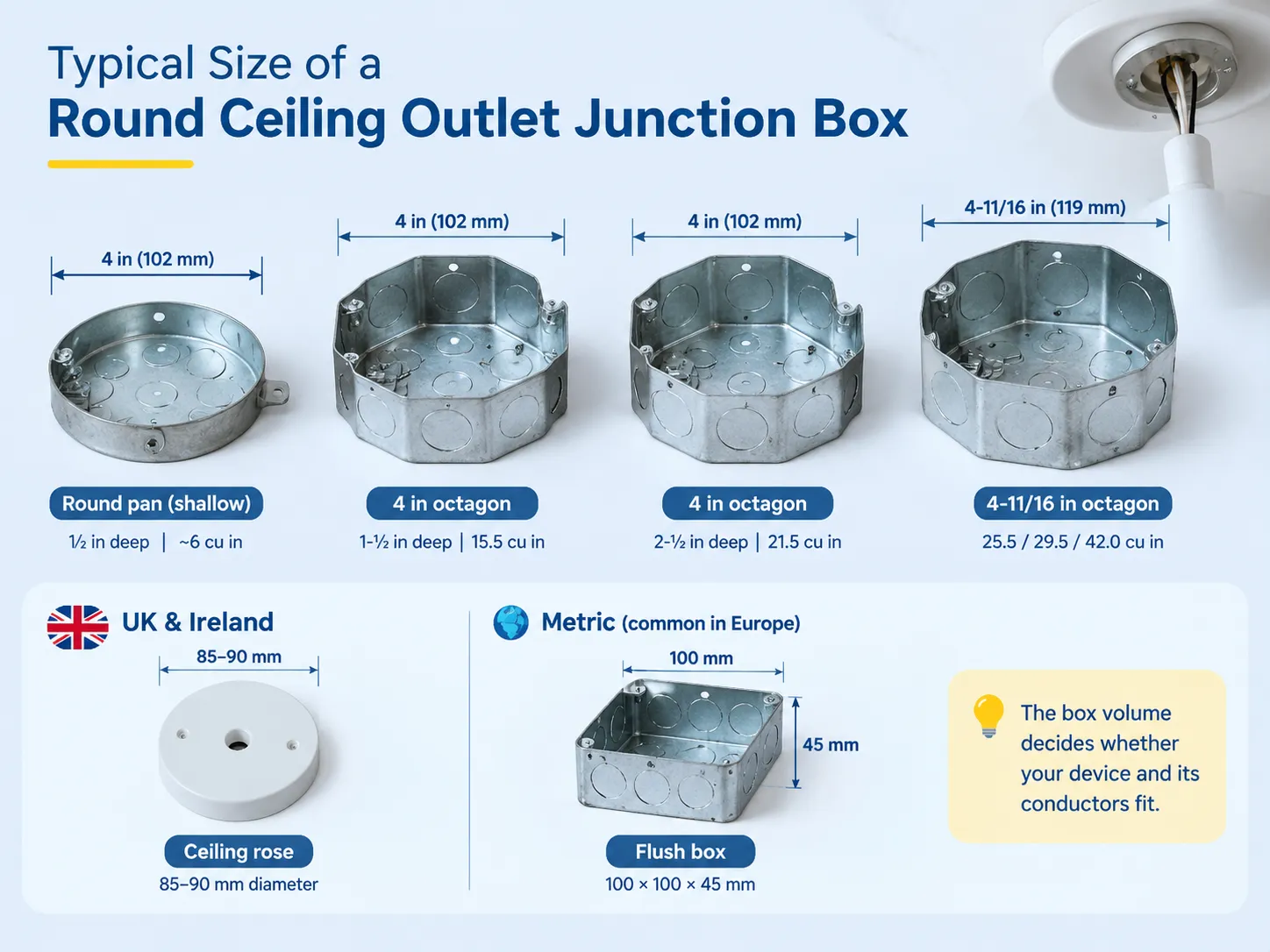
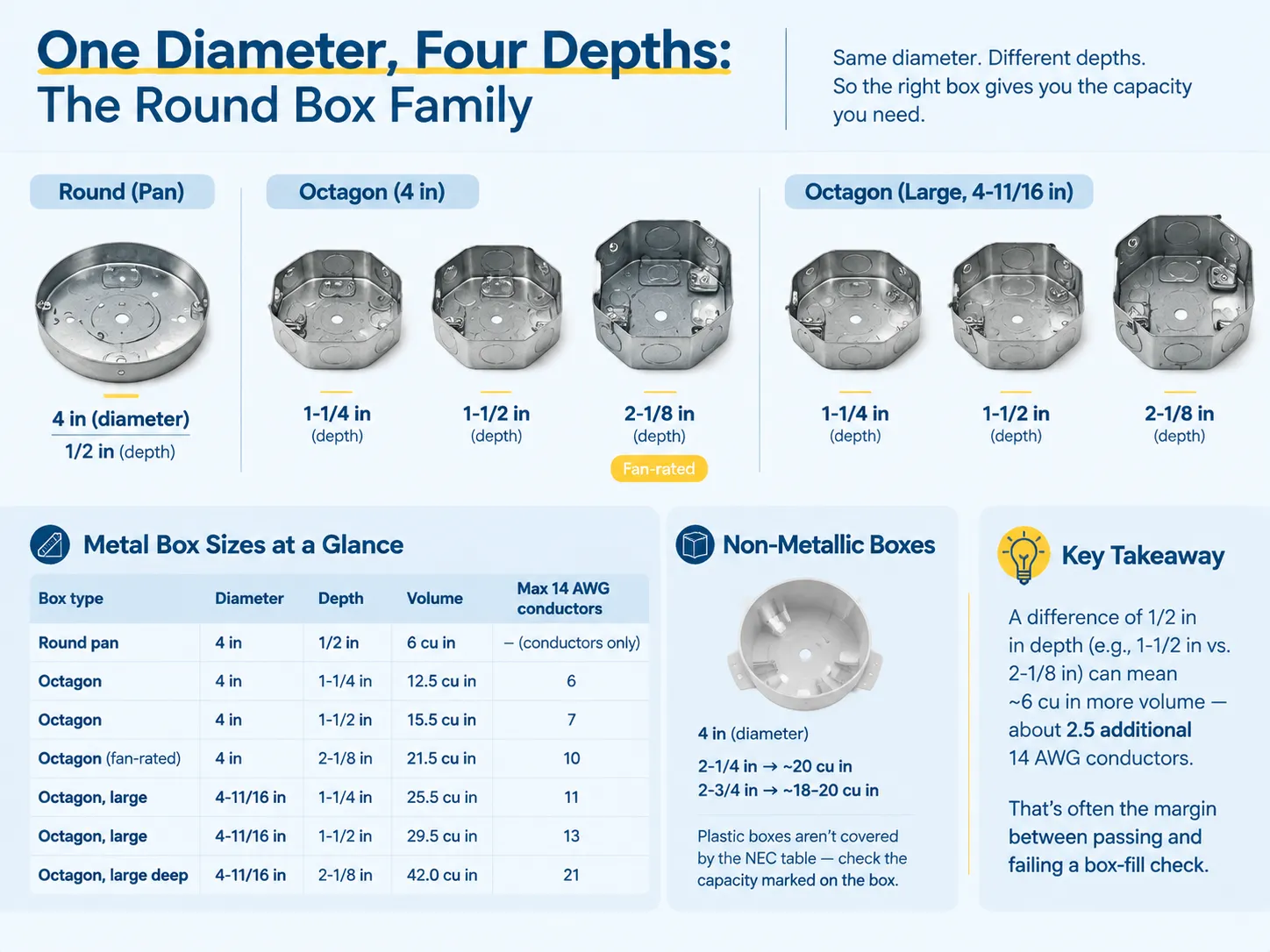
Pour faire court, une boîte de sortie de plafond ronde est généralement identifiée par la norme nord-américaine de 4” (10,2 cm) de diamètre. Cependant, les variations en termes de profondeur et de volume de la boîte peuvent être très importantes, allant de 0,5” pour la boîte ronde de 4” (qui a un volume total de 6 in3) à 1,5” ou 2,125” (octogones de 4”) pour un volume de 15,5 in3 ou 21,5 in3 respectivement. Une boîte octogonale plus grande de 4-11/16” (11,8 cm) a un volume de 25,5, 29,5 ou 42,0 in3. Des boîtes peu profondes de 3,5” (8,9 cm) sont également disponibles. Cependant, au Royaume-Uni et en Irlande, la même chose est appelée « ceiling rose » avec un diamètre allant de 85 à 90 mm, ou une boîte encastrée commune mesurant 100×100×45 mm.
Un diamètre, quatre profondeurs : la famille des boîtes rondes
Les boîtes de plafond existent en deux variantes et plusieurs profondeurs. Les types peuvent être ronds (type bac ou boîte ronde à faible profondeur) et octogonaux (type octogonal, généralement ce à quoi on fait référence quand on parle de boîtes de plafond rondes). Les diamètres en options métalliques sont de 3-1/2 pouces ou 4 pouces pour les bacs, un diamètre de 4 pouces pour les octogones, et 4-11/16 pouces pour les types octogonaux plus grands utilisés dans les applications commerciales. Viennent ensuite les boîtes pour ventilateurs de plafond et les boîtes pour luminaires qui ont un diamètre de 5 pouces et 6 pouces respectivement, car ils appartiennent à une classification différente de produits.
La profondeur est ce qui importe en termes de capacité selon le tableau NEC 314.16(A), et l’écart entre un octogone de 1-1/2 pouce et un de 2-1/8 pouces correspond à 6 pouces cubes, ce qui représente environ la capacité pour accueillir 2,5 conducteurs 14 AWG supplémentaires. En général, cet écart fait la différence entre succès et échec lors du contrôle du remplissage de la boîte.
| Type de boîte | Diamètre | Profondeur | Volume | Conducteurs 14 AWG max |
|---|---|---|---|---|
| Bac rond | 4 po (102 mm) | 1/2 po (13 mm) | 6 po³ | Conducteurs uniquement, pas de dispositif |
| Octogone | 4 po (102 mm) | 1-1/4 po (32 mm) | 12,5 cu in | 6 |
| Octogone | 4 po (102 mm) | 1-1/2 po (38 mm) | 15,5 cu in | 7 |
| Octogone (certifié ventilateur) | 4 po (102 mm) | 2-1/8 po (54 mm) | 21,5 cu in | 10 |
| Octogone, grand | 4-11/16 po (119 mm) | 1-1/4 po (32 mm) | 25,5 cu in | 11 |
| Octogone, grand | 4-11/16 po (119 mm) | 1-1/2 po (38 mm) | 29,5 cu in | 13 |
| Octogone, grand profond | 4-11/16 po (119 mm) | 2-1/8 po (54 mm) | 42,0 cu in | 21 |
À côté de ces boîtes se trouvent des boîtes non métalliques qui ont des chiffres légèrement différents du fait qu’elles sont moulées au lieu d’être embouties. Par exemple, une boîte de plafond non métallique de 4 pouces de diamètre et 2-1/4 pouces de profondeur aura un volume d’environ 20 pouces cubes tandis que celle de 2-3/4 pouces de profondeur varie entre environ 18 et 20 pouces cubes, selon la méthode de moulage et la présence de pinces intégrées. Le tableau NEC ne considère pas l’utilisation de boîtes en plastique car elles doivent avoir leur capacité indiquée.
Pourquoi les boîtes rondes et octogonales existent-elles ?
Une boîte électrique de forme rectangulaire fonctionne généralement au plafond, ce qui signifie que la forme de la boîte est davantage liée à la conception du luminaire. Pour un luminaire, une boîte ronde ou octogonale offre une surface uniforme pour que la coupole repose dessus. Lors de l'utilisation d'une boîte octogonale, la rotation de la coupole est possible et elle couvrira toujours l'ouverture de la boîte. Un autre avantage est le fait que la boîte octogonale ou ronde possède des vis de fixation 8-32 placées à l'espacement standard de 2-3/4 pouces ou 3-1/2 pouces que l'on trouve dans tout support de montage pour luminaires.
La forme octogonale présente un avantage supplémentaire : ses côtés plats permettent des découpes qui dirigent les fils dans la bonne direction lorsqu'on travaille avec une grille de plafond. Cela signifie que les fils peuvent entrer dans la boîte par le côté le plus approprié sans créer de tension dans les fils.
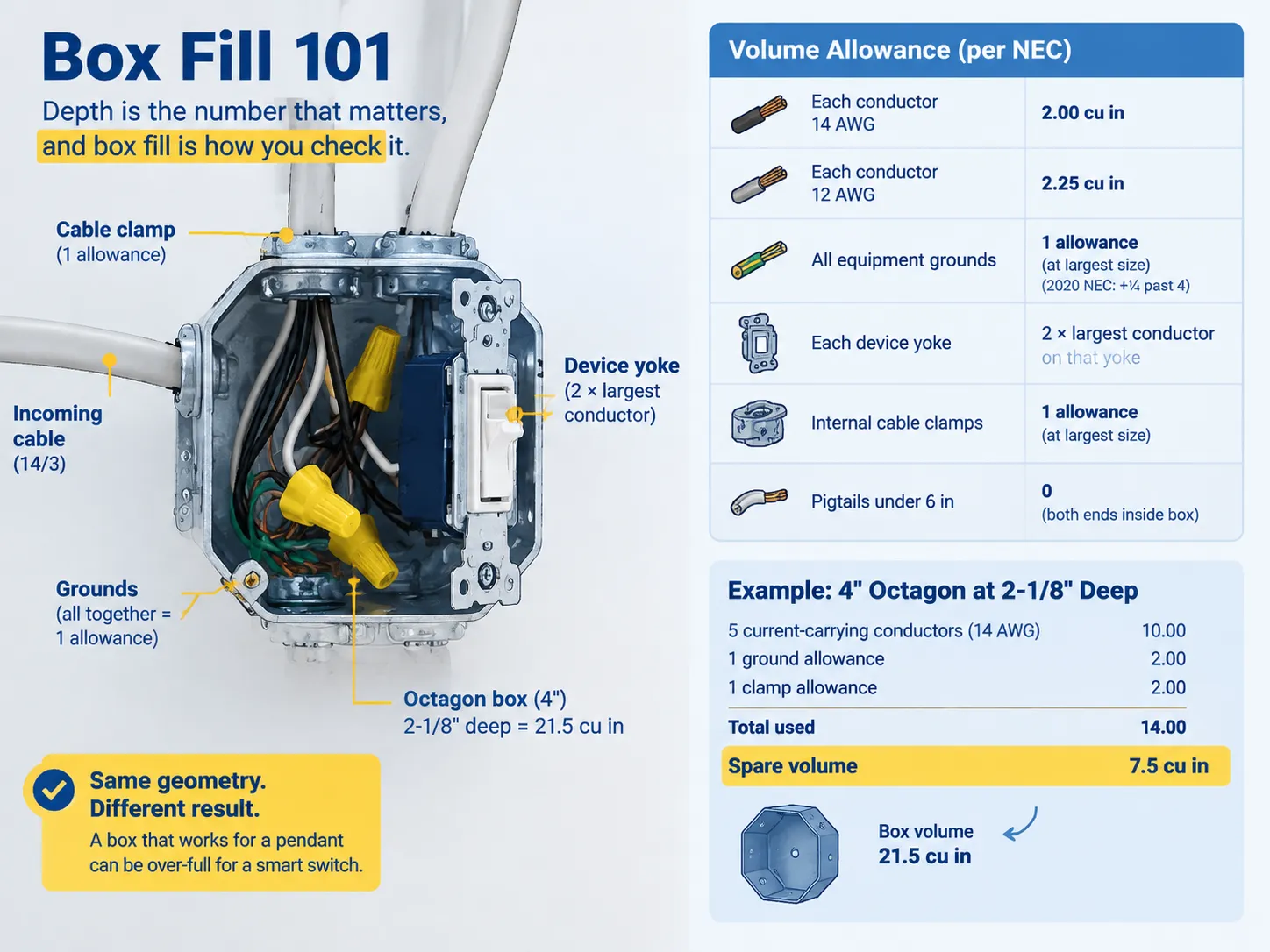
La profondeur est le chiffre qui compte, et le remplissage de la boîte est la manière de le vérifier.
Tous les fils, lorsqu'ils passent dans la boîte pour des connexions, des épissures ou des terminaisons, occupent de l'espace. En plus des fils, les dispositifs, les mises à la terre et les dispositifs de serrage utilisent également de l'espace. Un dispositif est compté par son châssis plutôt que par le nombre de prises qu'il comporte, donc un duplex prise électrique correspond à une seule allocation de dispositif, pas deux. Conformément au tableau 314.16(B), il faut prendre en compte qu'un fil 14 AWG occupe 2,00 pouces cubes, tandis qu'un fil 12 AWG occupe 2,25 pouces cubes. Le châssis compte pour deux fils de la plus grande taille utilisée, tous les fils de mise à la terre ensemble comptent pour un seul fil, et les dispositifs de serrage comptent pour un autre.
Prenons maintenant une vraie boîte de plafond. Une boîte octogonale de 4 pouces par 2-1/8 pouces a un volume de 21,5 pouces cubes. Avec un seul câble 14/3 entrant et seulement un câble 14/2 sortant pour une ligne d'interrupteur. Ainsi, vous avez cinq conducteurs qui transportent le courant à 2,00 chacun, une mise à la terre à 2,00, et un dispositif de serrage à 2,00, totalisant 14 pouces cubes, vous laissant 7,5 pouces cubes. Mais que se passe-t-il si vous utilisez un fil 12 AWG et ajoutez un variateur sur le châssis ? Alors tout le volume disponible sera rapidement utilisé. Les mêmes calculs, adéquats pour un pendentif, peuvent ne pas suffire pour un interrupteur intelligent si la boîte s'avère insuffisante pour le câblage utilisé.
Juste à côté de cette considération se trouve une autre question, se référant à la section suivante du vocabulaire. Le terme “ gang ” fait référence aux dispositifs et non aux ouvertures, ce qui signifie que même s'il y a de nombreux fils dans la boîte, une boîte avec un variateur est déjà comptée comme un gang.
| Élément compté | Allocation de volume | Notes |
|---|---|---|
| Chaque conducteur 14 AWG | 2,00 pouces cubes | Compté s'il se termine ou s'épisce dans la boîte |
| Chaque conducteur 12 AWG | 2,25 pouces cubes | Même règle, allocation plus grande |
| Toutes les mises à la terre de l'équipement | 1 allocation à la plus grande taille | Le NEC 2020 et les versions ultérieures ajoutent un quart d'allocation au-delà de quatre |
| Each device yoke | 2 × largest conductor on that yoke | A dimmer or GFCI counts as one yoke |
| Internal cable clamps | 1 allocation à la plus grande taille | External connectors need no allowance |
| Pigtails under 6 in | 0 | Both ends inside the box |
Octagon, round or square: telling them apart on sight
Study the corners carefully. A true octagonal structure features eight straight edges and angular breaks in angles; however, a round shape is called a circle featuring a shallow flange for not having any flat edges; a square box has four corners and is usually of size 4 × 4 inches. The square shape is the one very often confused with ceiling box, and it should not be neglected because the volume of the 4-inch square box is equal to 30.3 cubic inches, which is actually one and half times bigger than in octagon with the same diameter and height.
The mounting hardware also makes the distinction clearer. The octagons and pans made for ceilings are supplied with brackets or captive nails for mounting onto a beam or between the beams. The square boxes are installed usually through the sides and are mostly used as junction boxes or junction device boxes along with the mud ring that is also the method of converting square box to round mounting point for the fixture in case of need.That is where the single-gang and multi-gang distinction starts to bite, because a two-gang ring will not fit a 4 in octagon no matter how the wiring is arranged.
Fixture-rated versus fan-rated: the weight numbers
The fixture box must be capable of supporting the weight, and there are weight ratings that apply as well. Standard ceiling light fixture pans and octagonal boxes are rated only to support a 50 lb (22.7 kg) load, and they are explicitly not designed for ceiling fan use unless labeled otherwise. A ceiling fan installation box is either securely fastened to a joist or securely mounted and rated for fan support, usually at a maximum weight of 35 lb (15.9 kg) for fan weight plus 50 lb for fixture weight.
This is one of the most common mistakes in ceiling work: putting a fan in a box that was designed for a light fixture. The box may look the same and be the same size, but its classification is not the same, and careful wiring does not make up for the fact that the support weight rating was never assigned to the box.
Outside North America: metric sizes and the ceiling rose
In the United Kingdom and Ireland, they utilize the same device known as a ceiling rose. The standard size of loop-in is 85 or 90 mm in diameter and is made of white plastic material. It is regulated by BS 67, which takes care of the arrangement mechanism of terminals and strain relief, and it is rated with a 6 A capacity at 250 V — a sum that is suitable for a domestic light circuit heavily served by LEDs. Decorative ceiling roses made of brass, chrome, or plaster come with diameter ranging from 150 mm to 250 mm and are selected based on design and appearance rather than capacity.
There is another family of boxes that are characterized as metric flush boxes. One of the European round boxes can be marked with 100 mm of diameter and depth measurement of 46 mm having ten entrances for 25 mm conduit and are labeled as complying with BS EN 60670-1 and BS EN 60670-22. Such square boxes usually measure 100 x 100 x 45 mm. It is the same constraint that shapes UK wall socket and switch plate formats, which are built to a shallow back profile precisely because the boxes behind them are shallow.
| Région | Typical part | Diameter / size | Profondeur | Norme |
|---|---|---|---|---|
| US / Canada | Octagon ceiling box | 4 po (102 mm) | 1-1/2 in or 2-1/8 in | NEC 314.16, NEMA OS-1 |
| US / Canada | Non-metallic ceiling box | 4 po (102 mm) | 2-1/4 in or 2-3/4 in | NEMA OS-2, marked capacity |
| Royaume-Uni / Irlande | Loop-in ceiling rose | 85-90 mm | Approx. 25-30 mm | BS 67, 6 A / 250 V |
| Royaume-Uni / Irlande | Decorative ceiling rose | 150-250 mm | Fixture-dependent | Angled as decorative |
| Europe | Round flush connection box | Ø 100 mm | 45-46 mm | BS EN 60670-1 / -22 |
Brands, and why the dimensions differ anyway
All companies that we are familiar with, RACO (Hubbell), Carlon (Thomas & Betts), Steel City (Eaton), Arlington, Appleton and Southwire are happy to provide dimensional data, and for the case of steel octagons their dimensions are virtually in line with the above table since this box must fit the standard fitting canopies. The exception is with the moulded boxes since a 4 inch PVC ceiling box developed by one company can have a volume of 20 cu in at a depth of 2.5 in while another will have volume of 18 cu in, where the variation will depend not on the standard, but on the thickness of the box walls, integral clamps and knockout count.
This is the reason why the marked capacity is more important than the nominal size, and that is the reason NEC 314.16(A) dictates the necessity for marking boxes of less than 100 cu in by their volume. If the marking has been covered with paint use measuring tools instead: the internal diameter, the internal depth to the back of box should be measured and then compared against the values published in the manufacturer’s catalog.
How to size the replacement before you buy
The best way of achieving a successful installation is to perform four measurements and then make one verification. Begin by measuring the hole opening at the ceiling. This will give you the required size diameter for the fixture canopy. Next, measure the depth of the hole, using either a ruler or a stiff piece of wire. Next, have a count of electrical conductors that are already exiting the junction box, along with the wire gauge. Lastly, check the volume or the catalog volume. Based on this information, you can decide if you are dealing with a light or a fan, and it is essential to know this, as the choice will depend on the device type rather than its size.
In case of replacing the shallow pan with one that requires increased space for wiring, a 4 in octagon at 2-1/8 in provides 21.5 cu in of space while preserving the standard fixture spacing. If more space is actually required, a 4-11/16 box with a plaster ring will do the job.
Why we care about box sizes when we make switches and sockets
An important context about the position of GOG. We produce wiring devices i.e. switches, sockets, dimmers and smart switches in wholesale and OEM quantities, but we don’t manufacture junction boxes. Nevertheless, we are interested in the dimensions of junction boxes, because the majority of complaints of installers refer not to the device malfunction, but to the fact that the device does not fit the box. Smart switches are deeper than mechanical ones, and the dimmers are deeper than smart switches as they have rather large heat sinks. A 12 AWG installation occupies the box space faster than a 14 AWG one.
Hence, when someone asks us which dimmer to choose for a room with shallow ceiling boxes, we begin the answer with the volume.Pick the enclosure first, then the device that fits it — the same order we would suggest when la sélection des dispositifs de câblage across a whole building, where box depths are rarely uniform from floor to floor.
FAQ
What are the standard sizes for ceiling junction boxes?
The recognized standard for steel boxes is the 4 in round pan box that is half an inch deep (approximately equal to 6 cubic inches), the 4 in octagon box that can be 1-1/2 in, 2-1/8 in and finally, the 4-11/16 in octagon box which could have dimensions from 1-1/4 in, 1-1/2 in and then finally 2-1/8 in (having capacities of 25.5, 29.5 and 42.0 cubic inches) Non-metallic equivalents exist, which around 20 cubic inches in size while being 2-1/4 inch deep.
What is the diameter of a round junction box?
4 in (102 mm) is most frequently found in home and light commercial ceiling electromagnetic induction systems. Flattop lighting plates are also available in sizes of 3-1/2 in (89 mm). Larger commercial octagonal boxes measure 4-11/16 in (119 mm), while heavier installations can utilize boxes sized at 5 in and 6 in. The metric standard for circular boxes is Ø 100 mm.
What are the standard dimensions of a ceiling box?
The dimension corresponds to the product of diameter and depth, but depth would be variable. Thus, a 4 x 1.5″ octagon, a 4 x 2.125″ octagon, as well as a 4.6875 x 2.125″ octagon do exist to hold 15.5, 21.5, and 42.0 cubic inches correspondingly. Siempre provide both figures, because saying that it “is a 4 inches box” does not tell you how much wire it is able to hold.
Can you mount a ceiling fan in a round ceiling box?
Provided the rated box is used. Standard octagon boxes and the currently standard models are rated for fixtures up to 50 lbs (22.7 kg), which means they are not suitable for fan installations. The fan-rated boxes are designed to be braced and carry their own ratings for fans and fixtures, so be sure to check the labels first before attaching any ceiling fixture.
How do I find the volume if the box is not marked?
You can take a reading of the internal diameter and of the internal depth and then look this up in the manufacturer’s catalogue; it is the same 4 in diameter, which is present in several depths, and the volumes do not result from the measurements done from the outside. Non-metallic boxes are normally marked so a missing mark usually suggests paint, and then a quick scrape on the inside surface shows it usually.
Références
- NFPA — NFPA 70 National Electrical Code, Article 314 Outlet, Device, Pull and Junction Boxes
- NEMA — OS-2 Nonmetallic Outlet Boxes, Device Boxes, Covers and Box Supports
- NEMA — OS-1 Sheet-Steel Outlet Boxes and Box Supports
- UL Solutions — UL 514A Metallic Outlet Boxes
- BSI — BS 67 Specification for ceiling roses
- Hubbell RACO — Steel boxes and covers catalogue data
- Carlon — Non-metallic box capacity tables
Conclusion
Regular round ceiling outlet boxes measure 4 inches in diameter and the key to this is their depth. Half Inch pan makes adjustments for only lighting fixtures and items of minor importance; 1 1/2 Inch octagon has volume of 15.5 cubic inches and is appropriate for pendant and downlight installations; standard octagon measuring 2 1/8 inches is good for 21.5 cubic inches and is usually applied when installing a fan and possibly any IoT-device and 4-11/16 boxes with a maximum volume of 42.0 cubic inches are needed when a ceiling outlet turns into a junction.Select a box to get started, determine the number of wires inside of it, state whether you have a fixture or a fan at hand and only then pick an appropriate box. Performing these steps in such order is the reason why some ceiling installations last not more than 20 minutes while others require three attempts.