Você comprou um ótimo poste de luz e conjunto de iluminação – um poste de 25 pés de altura feito de aço para seu estacionamento com quatro luzes LED. No entanto, o poste não desempenha sua função adequada. Quando o poste é instalado ao ar livre, ele atua como uma grande alavanca e sofre força devido ao movimento do vento. A base do poste de luz (que é uma construção de concreto embutida no solo) deve combater essa força, e caso a base não seja feita corretamente, o poste fica inclinado.
O artigo que você está prestes a ler será altamente útil para empreiteiros, gerentes de instalações, proprietários de imóveis quando se trata de fundações de postes de luz – o que são, que tipos de fundações existem, quão profundo deve ser instalado, projeto de engenharia das instalações, quais são os custos e o processo de instalação.
Resumo breve: Uma fundação de iluminação (base do poste de luz) é um pilar de concreto armado que facilita a montagem de uma luminária de rua externa. Existe uma regra de ouro: a profundidade deve ser de pelo menos 3 pés com largura de 2 pés no caso de postes de até 18 pés de altura, com profundidades adicionais de 1 pé para cada 5 pés de altura.
O que é uma Fundação de Iluminação?
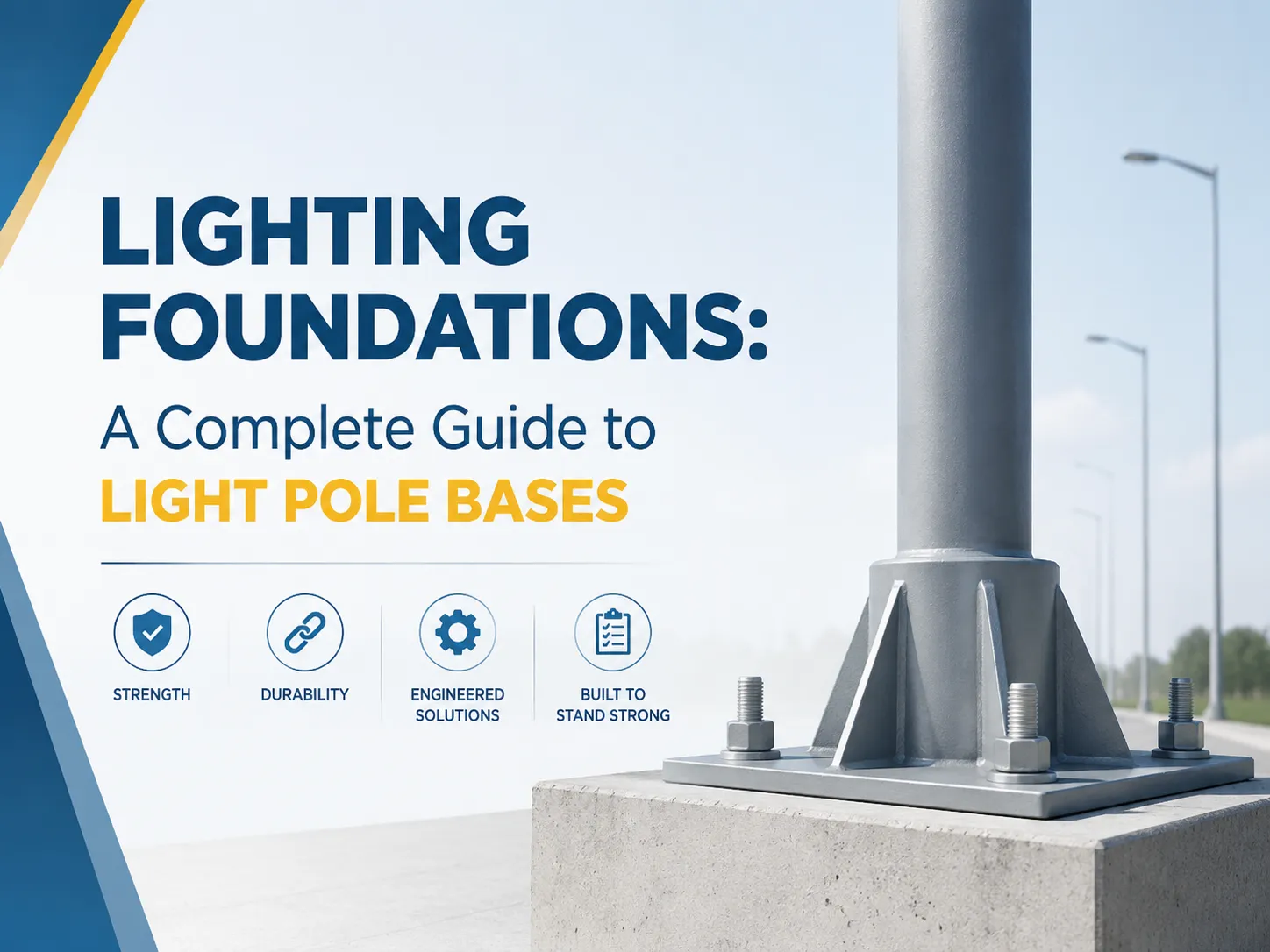
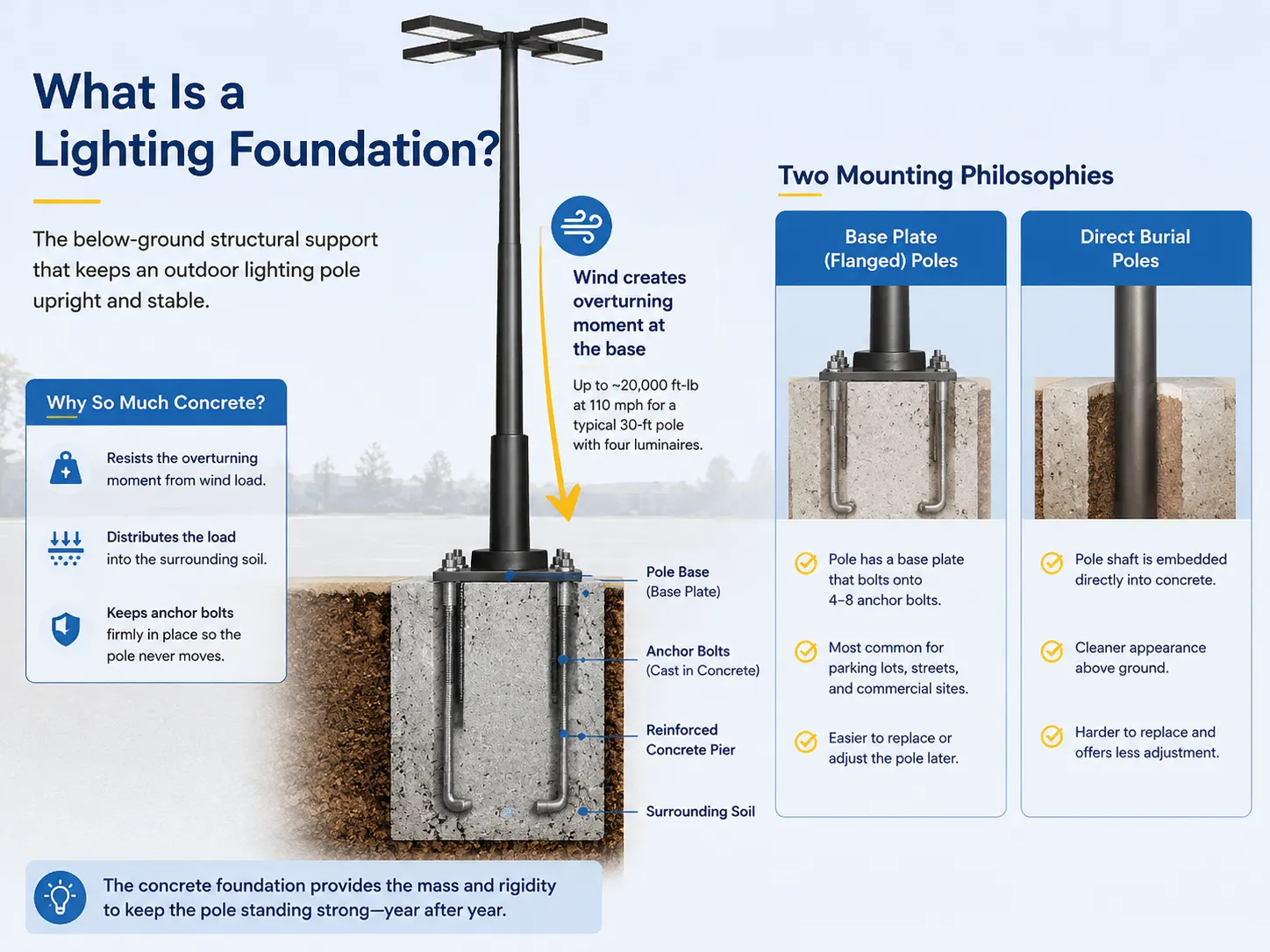
Uma fundação de iluminação (também referida como base de poste de luz, sapata de poste ou fundação de poste) serve como a estrutura de suporte estrutural subterrânea para um poste de iluminação externo. Normalmente, uma fundação de iluminação é um pilar de concreto armado que é colocado em um buraco escavado e possui parafusos de ancoragem (ou uma luva de poste) fixados no concreto.
Por que é necessário uma quantidade tão significativa de concreto apenas para suportar um poste simples? A razão é que o poste atua como uma alavanca. O vento atuando em um poste de 30 pés e seu acessório causa um momento de tombamento na base do poste — no caso de um poste de iluminação comum com 4 luminárias a 110 mph, esse momento pode chegar a cerca de 20000 ft-lbs. A sapata de concreto fornece peso e rigidez suficientes para resistir ao momento de tombamento, transferir a carga para o solo ao redor e fixar os parafusos de ancoragem no lugar.
São empregadas duas abordagens para montagem de postes:
- Poste montado em placa base (com flanges) – este tipo de poste tem uma base plana que é fixada a 4 a 8 parafusos de ancoragem embutidos em um pilar de concreto. Mais amplamente usado para estacionamentos e outras aplicações comerciais, pois simplifica o processo de substituição do poste.
- Poste diretamente enterrado em concreto – este tipo de poste tem seu eixo embutido na sapata de concreto. Oferece uma aparência mais limpa, mas complica o procedimento de substituição do poste.
Para contexto sobre o lado elétrico da iluminação de postes — a fiação, disjuntores e controles que alimentam a luminária — nossos guias sobre Diferenças de voltagem Reino Unido vs EUA e tipos de tomadas elétricas cobrem os padrões relacionados que os circuitos de iluminação devem atender em diferentes mercados.
Tipos de Fundações para Postes de Luz
As fundações de iluminação vêm em várias configurações, cada uma adequada a diferentes tipos de postes e condições do local:
| Tipo | How It Works | Melhor Para | Custo Típico |
|---|---|---|---|
| Pilar de concreto moldado + parafusos de ancoragem | Buraco escavado preenchido com concreto armado; parafusos de ancoragem moldados no local com um modelo | Postes padrão para estacionamento e rua (15-40 pés) | $200-$800 (concreto), $500-$2,000+ mão de obra |
| Enterro direto | Eixo do poste embutido diretamente no concreto sem placa base | Postes residenciais, decorativos e menores | $150-$500 (concreto), menos ferragens |
| Fundação de concreto pré-moldado | Base de concreto fabricada em fábrica entregue e colocada em um buraco preparado | Instalações mais rápidas, projetos repetidos, clima frio | $400-$1,200 por base, mão de obra mais rápida |
| Estacas helicoidais / parafusos | Âncoras de aço parafusadas no solo, poste montado no topo | Solo macio, locais sem concreto, postes temporários ou portáteis | $300-$1,000 por estaca |
| Bases pesadas / portáteis | Blocos pesados de aço ou concreto, sem escavação | Iluminação temporária, canteiros de obras, iluminação de eventos | $500-$3,000 por base |
| Fundações breakaway | Base frágil projetada para se romper no impacto | Postes à beira da estrada onde há risco de impacto de veículos | +$200-$800 sobre o padrão |
A opção mais comum para iluminação comercial e municipal permanente é o píer de concreto usando bases de concreto com parafusos de ancoragem. Esta opção é a mais previsível estruturalmente e a mais conforme com os padrões exigidos.
Qual Deve Ser a Profundidade da Fundação de um Poste de Iluminação?
Esta é uma pergunta que todo instalador quer saber a resposta. Felizmente, a resposta segue a regra prática padrão da indústria.
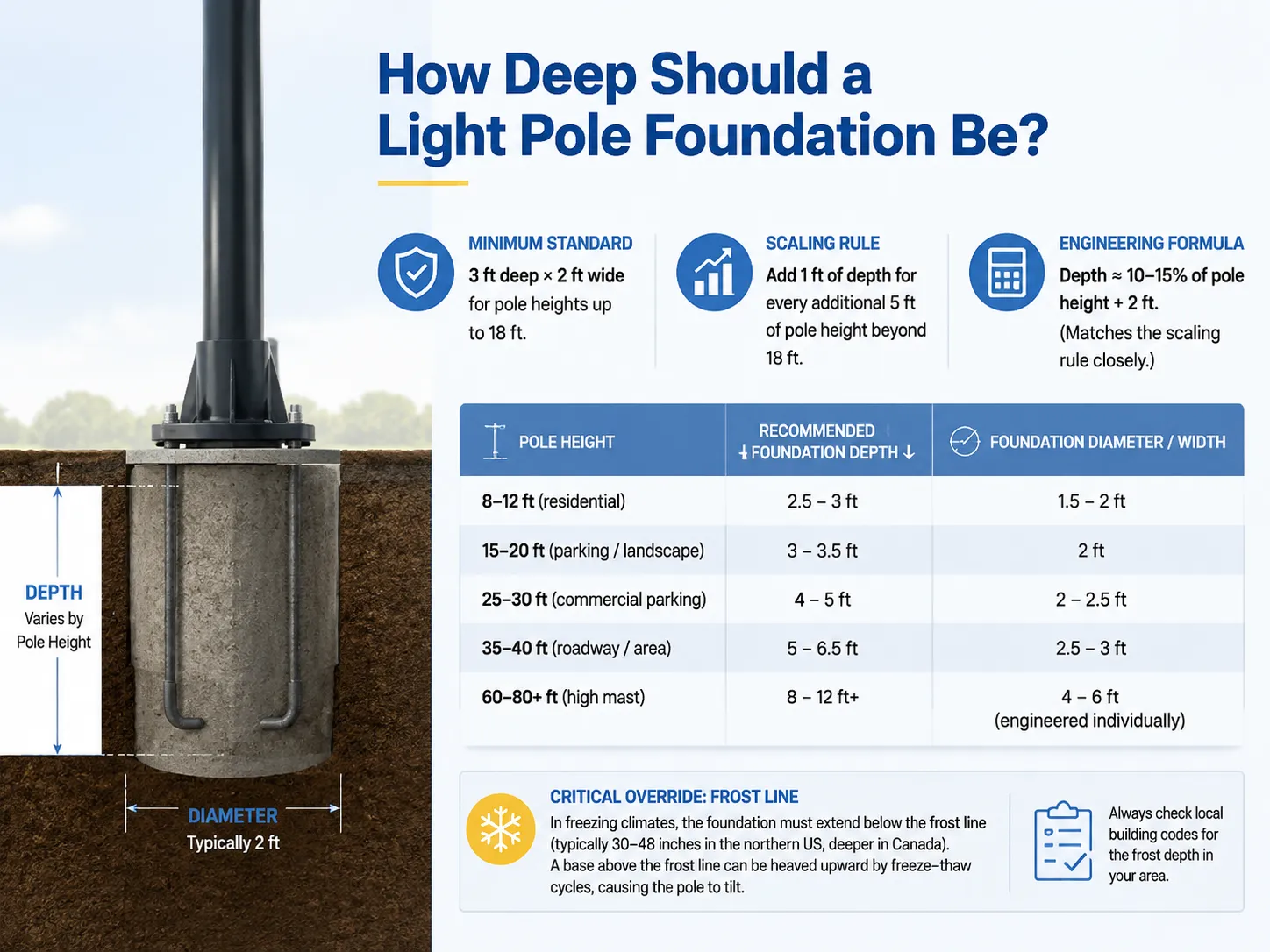
- Padrões mínimos: A proporção de profundidade para largura de 3 pés por 2 pés sempre foi usada ao lidar com postes de até 18 pés de altura. A regra de escala afirma que mais profundidade precisa ser adicionada para cada 5 pés que o poste exceder o mínimo de 18 pés. Por exemplo, se o poste tem 28 pés de altura, serão necessários 4 pés de fundação em profundidade (3 + 1), enquanto um poste de 33 pés precisaria de 5 pés de profundidade.
- Fórmula de engenharia: As fundações dos postes precisam ter cerca de 10%-15% da altura do poste mais 2 pés, praticamente a mesma profundidade da regra de escala.
- Diâmetro: O diâmetro da fundação deve ser aproximadamente dois pés para postes menores e três pés para instalações de postes altos e sujeitos a ventos fortes.
| Altura do Poste | Profundidade Recomendada da Fundação | Diâmetro / Largura da Fundação |
|---|---|---|
| 8-12 ft (residencial) | 5-3 ft | 5-2 ft |
| 15-20 ft (estacionamento / paisagismo) | 3-3,5 pés | 2 pés |
| 25-30 ft (estacionamento comercial) | 4-5 pés | 2-2,5 pés |
| 35-40 ft (via / área) | 5-6,5 pés | 5-3 ft |
| 60-80+ ft (mastro alto) | 8-12 pés+ | 4-6 ft (projetado individualmente) |
Consideração crítica: a fundação deve ser profunda o suficiente para ficar abaixo da linha de geada, que pode variar conforme sua localização. Em estados do norte, a profundidade da geada pode variar de cerca de 30 a 48 polegadas ou mais no Canadá. Se a base estiver acima da linha de geada, ela se moverá para cima devido aos ciclos de congelamento e descongelamento, o que pode levar a um poste inclinando-se lentamente para baixo, sendo este um dos casos mais comuns de falha prematura em climas frios. É muito importante verificar os códigos locais referentes à profundidade da geada em sua área.
O que determina o tamanho da fundação?
Esses números são apenas o ponto de partida. A base real será calculada pelo engenheiro estrutural para seu poste e local específicos, dependendo dos seguintes fatores:
| Fator | Efeito na fundação |
|---|---|
| Altura do poste | Poste mais alto = alavanca maior = fundação mais profunda e larga |
| Peso do equipamento e comprimento do braço | Equipamentos mais pesados ou mais largos aumentam o momento de tombamento |
| Classificação de velocidade do vento (ASCE 7) | 90 mph padrão, 110 mph costeiro, 130 mph zonas de furacão — vento mais forte = base maior |
| Capacidade de suporte do solo | Solos fracos (argila, aterro, orgânico) precisam de fundações maiores ou estacas |
| Profundidade da geada | A fundação deve alcançar abaixo da linha de geada em climas frios |
| Área projetada efetiva (EPA) dos equipamentos | Maior superfície do luminário = maior carga de vento |
| Requisitos de quebra | Postes à beira da estrada podem precisar de fundações frangíveis ou dobradiças |
Para uma aplicação típica em estacionamento, o engenheiro definirá o momento de tombamento usando a área projetada efetiva do poste para a velocidade local do vento de projeto e calculará o píer de concreto e os parafusos de ancoragem necessários para resistir ao momento de tombamento com o fator de segurança requerido. Sempre siga os desenhos da fundação do fabricante, contendo dados completos sobre o diâmetro das porcas, parafusos implementados e a quantidade de concreto.
Componentes da fundação: Parafusos de ancoragem, vergalhões e concreto
Fundações de iluminação moldadas têm três componentes estruturais básicos:
- Parafusos de ancoragem: Parafusos padrão de 4-8, com 1-1,5 polegadas, fixados no concreto através de um modelo de posicionamento (anel de parafuso). O diâmetro do círculo dos parafusos é cerca de 3-5 vezes maior que o diâmetro da base do poste. Os parafusos devem ser colocados de forma fixa, pois mesmo um pequeno deslocamento torna impossível assentar corretamente a placa base do poste.
- Reforço: Vergalhões e sua proporção que fazem o sistema de reforço equivalente a cerca de 0,3-0,5. Este material suporta cargas que o concreto simples não pode suportar.
- Concreto: É um material de construção misturado com C28 de cerca de 3000-4000 psi. A solidificação do concreto com essa classe deve ocorrer por 7-14 dias antes da instalação do poste.
Os acessórios também são cruciais — uma saída de passagem na base de concreto do poste para fiação, um terminal de aterramento conectado à base (do ponto de vista do NEC) e, em alguns casos, uma tomada para o dispositivo de controle fotográfico. A conexão do eletrodo de aterramento é um requisito do código — saiba mais em nosso artigo sobre fundamentos de tomadas elétricas e aterramento.
Processo de Instalação Passo a Passo
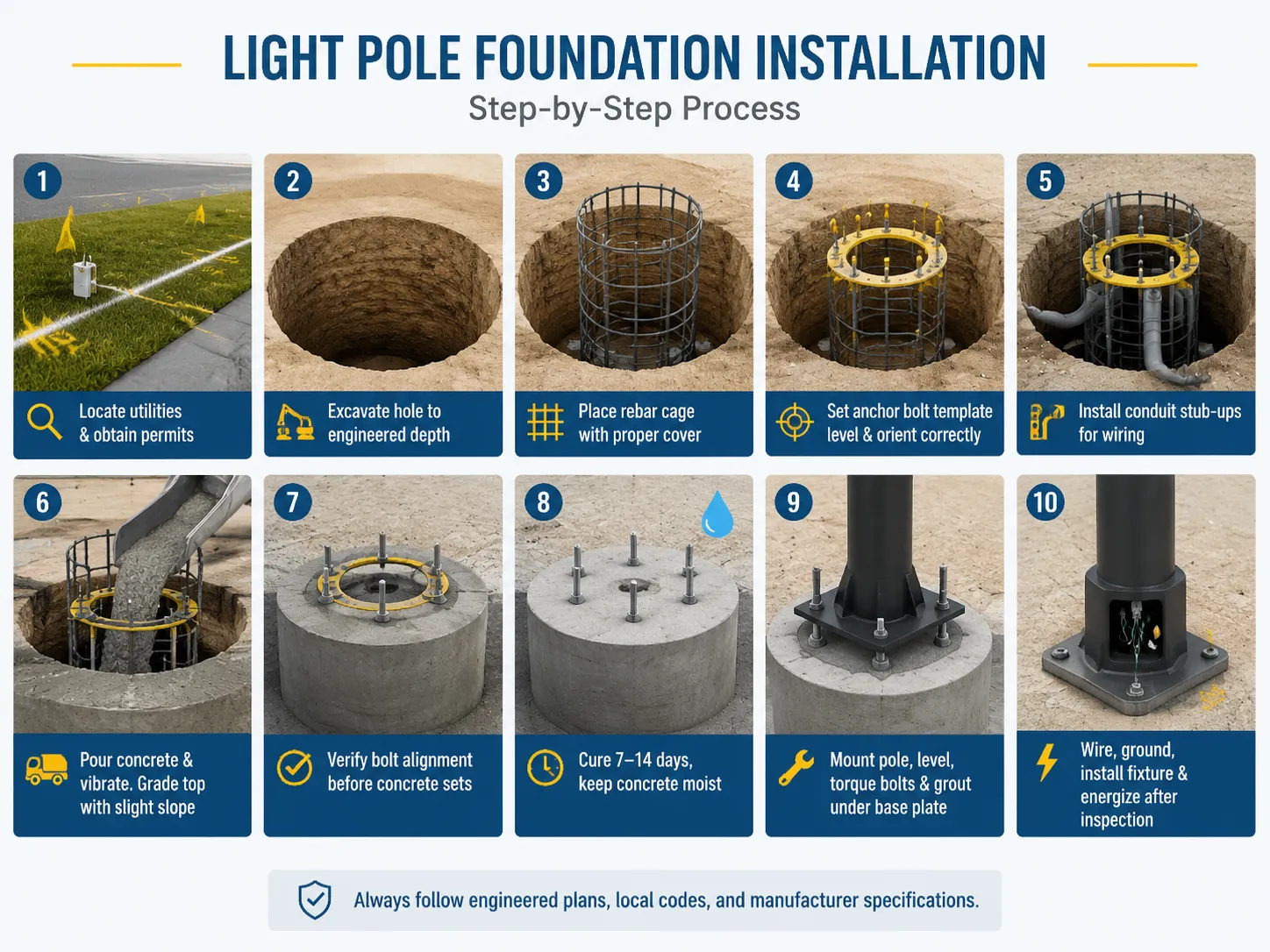
O procedimento padrão para realizar uma fundação de iluminação em concreto moldado é o seguinte, executado por equipes treinadas:
- Descubra onde passam as utilidades e obtenha as permissões. Contate o serviço local de localização de utilidades antes de qualquer escavação e assegure que todas as permissões de construção/eletricidade estejam cumpridas.
- Cave o buraco na profundidade e tamanho especificados, além de uma margem para as formas. Observe se há vazios e, caso sejam encontrados, pare e consulte um engenheiro.
- Instale a gaiola de vergalhões no buraco, mantendo-a afastada do fundo do buraco sobre blocos ou espaçadores para mantê-la no centro e na profundidade correta.
- Fixe corretamente o modelo de parafuso de ancoragem na profundidade certa, especialmente após nivelá-lo verticalmente, para garantir que os parafusos que ele segura estejam devidamente alinhados.
- Antes de despejar o concreto, instale os conduítes elétricos verticais, cuidando das curvas apropriadas e com conexões resistentes às intempéries.
- Despeje o concreto e vibre-o para remover bolhas de ar ao redor dos vergalhões e parafusos. Nivele a superfície na altura e inclinação requeridas.
- Verifique se os parafusos estão se movendo após o concreto ser despejado, enquanto o concreto ainda não endureceu.
- Cure o concreto por um período de 7 a 14 dias, mantendo-o úmido com água. Não fixe o poste muito cedo.
Se você estiver fazendo isso sozinho, seja honesto sobre seu nível de habilidade — o alinhamento dos parafusos de ancoragem e o trabalho com concreto são implacáveis. Para que uma luminária funcione corretamente uma vez energizada, as conexões elétricas também devem estar sólidas; nosso guia de substituição de interruptores de luz e Guia de compatibilidade de dimmers LED mostra o nível de cuidado que o lado elétrico merece.
Quanto Custa a Base de um Poste de Iluminação?
Os custos da fundação variam conforme a região, o solo e o tamanho do poste. Aqui estão os valores típicos para 2025-2026 por poste:
| Item | Faixa de Custo Típica |
|---|---|
| Materiais para base de concreto (mistura, vergalhão, parafusos, molde) | $200-$800 |
| Escavação e mão de obra | $500-$2,000+ |
| Projetos de fundação com carimbo / engenharia | $200-$1,000 |
| Licenças | $50-$300 |
| Fundação total instalada | $1.000-$4.000 por poste |
| Poste completo + luminária + instalação (referência) | $1.500-$7.000+ por poste |
Grandes trabalhos (mais de 10 postes) geralmente recebem descontos de 15 a 25 por cento nos custos de materiais e mão de obra por poste. Usar fundações pré-moldadas pode economizar mão de obra, mas custará mais por unidade, e portanto pode ser algo a considerar para postes idênticos.
Linha de Geada e Considerações para Climas Frios
A linha de geada desempenha um papel particularmente crítico na definição da profundidade das fundações em climas mais frios. Sem estender abaixo da linha de geada, um pilar de concreto sempre se elevará e se moverá de estação para estação conforme a geada se acumula no solo. Profundidades típicas da linha de geada:
- Sul dos EUA: 0–12 polegadas
- Meio-Atlântico: 24–36 polegadas
- Norte dos EUA: 36–60 polegadas
- Regiões extremas do norte (Alasca, Norte do Canadá): 60–120 polegadas ou mais
Pessoas nas regiões com geada profunda às vezes optam pelo enterramento direto de seus postes ou instalam os pré-fabricados e pré-moldados. De fato, é comum que os contratantes despejem fundações no final do outono porque elas secarão antes do inverno.
Alternativas ao Concreto Despejado
A técnica convencional é usar concreto despejado; no entanto, existem três alternativas que são boas para situações específicas.
- Fundações pré-fabricadas feitas de concreto — prontas para uso e boas para usar em clima frio (sem cura no local), para projetos de construção que utilizam essa tecnologia e em locais difíceis de moldar. Preço mais alto comparado às fundações despejadas, mas as instalações dessas fundações são mais rápidas.
- Estacas helicoidais — parafusos metálicos usados neste método são cravados no solo com a ajuda de máquinas. O método é adequado em solo fraco, em locais com lençol freático alto ou em locais que não podem ser escavados. Este método é frequentemente usado para iluminação temporária e canteiros de construção de painéis solares.
- Bases portáteis pesadas — construções metálicas que sustentam postes sem escavar o solo. Este método é amplamente usado em instalações de iluminação temporária em canteiros de obras.
Cada uma das abordagens oferece a possibilidade de sacrificar a firmeza da construção em favor da rapidez e conveniência; é muito importante verificar com o fabricante do poste sobre a possibilidade de tais substituições em relação ao projeto.
Erros Comuns e Como Evitá-los
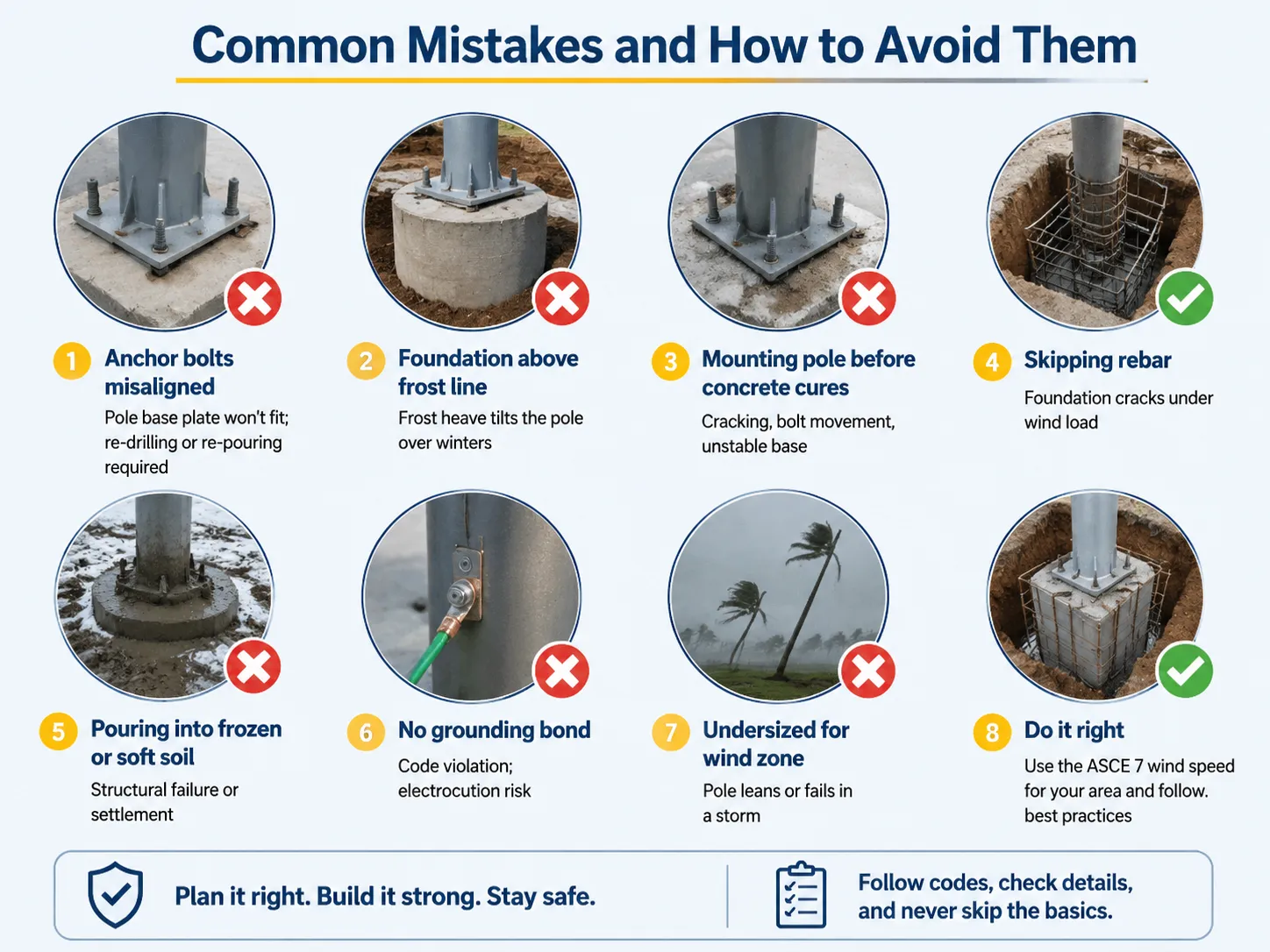
| Erro | Consequência | Prevenção |
|---|---|---|
| Parafusos de ancoragem desalinhados | A placa base do poste não encaixa; é necessário re-perfurar ou reverter a concretagem | Use um modelo rígido; verifique o alinhamento antes e depois da concretagem |
| Fundação acima da linha de congelamento | O levantamento por congelamento inclina o poste durante os invernos | Verifique a profundidade local do congelamento; estenda abaixo dela |
| Montagem do poste antes da cura do concreto | Fissuras, movimento dos parafusos, base instável | Aguarde 7-14 dias; teste a resistência da cura se estiver com pressa |
| Pular a armadura de aço | Fissuras na fundação sob carga de vento | Sempre use gaiola de armadura projetada |
| Concretagem em solo congelado ou mole | Falha estrutural ou assentamento | Verificação geotécnica; pare o trabalho se o solo for ruim |
| Ausência de aterramento | Violação do código; risco de eletrocussão | Terminal de aterramento conforme NEC |
| Subdimensionado para zona de vento | Poste inclina ou falha durante uma tempestade | Use a velocidade do vento ASCE 7 para sua área |
Inspeção e Manutenção
Após a instalação, as fundações de iluminação requerem manutenção periódica.
- Verifique anualmente postes inclinados, rachaduras ou desplacamento do concreto, parafusos de ancoragem soltos ou corroídos e ferrugem nas placas de base.
- Em áreas costeiras, realize uma inspeção a cada seis meses devido à corrosão salina do aço ancorado que ocorre muito mais rapidamente.
- Verifique o torque dos parafusos todos os anos e reaplique torque se estiverem soltos.
- Substitua as fundações se o concreto estiver completamente rachado, os parafusos corroídos a um nível inseguro ou os postes estiverem visivelmente fora de prumo.
Perguntas Frequentes
Quais são os quatro tipos de fundações?
Na construção, existem quatro tipos tradicionais de fundações, tais como: fundação em faixa (faixa contínua de concreto sob as paredes que suportam a carga), fundação em bloco (blocos de concreto separados abaixo de colunas ou postes específicos – como usado para postes de iluminação), fundação radier ou laje (laje sólida usada para distribuir o peso sobre uma área significativa) e fundação em estaca (estaca cravada ou perfurada, que transfere o peso para solo mais denso). Bases de postes de iluminação são principalmente fundações em bloco, mas podem ser melhoradas com fundações em estaca em solos fracos.
Qual deve ser a profundidade da fundação de um poste de iluminação?
De acordo com as normas padrão, a profundidade das fundações de postes deve ser de 3 pés para postes com altura até 18 pés, e mais um pé para cada 5 pés adicionais de altura do poste — o que significa que postes de 25 a 30 pés requerem profundidade total de 4 a 5 pés, e os de 35 a 40 pés precisam de cerca de 5 a 6,5 pés. Em regiões com temperaturas de congelamento, as fundações devem ser construídas abaixo da linha de geada, que normalmente tem profundidade de 30 a 48 polegadas. É sempre importante cumprir os projetos de fundação do fabricante.
Qual é o custo típico de uma base de poste de iluminação em concreto?
A faixa de preço para componentes de uma base comum de poste de iluminação comercial (como argamassa, parafusos de ancoragem, reforço de aço) geralmente é de $200-800. O custo total instalado de cada poste de iluminação, considerando escavação do solo, mão de obra, licenças e engenharia, geralmente é de $1.000-$4.000. Se instalar mais de 10 postes ao mesmo tempo, a economia pode ser de 15-25%.
Qual é o melhor tipo de fundação para um galpão com postes?
Para a construção de um galpão com postes, a regra prática é utilizar postes tratados sob pressão que são fixados em fundações de concreto ou pilares de cascalho. Utilizando a linha de geada como referência, todo o poste deve ser enterrado abaixo da linha de geada se você morar em clima frio. Se, devido ao peso do seu galpão, for necessário algo mais sólido que uma fundação de pilar, você pode montar seus postes em uma laje de concreto. Este método é diferente da fundação de um poste de iluminação porque um galpão tem telhado e estruturas de carga lateral, em vez de forças de vento que poderiam derrubar um poste alto.
Referências
- Especialista em Luz LED — Postes de iluminação: guia de seleção e instalação (regras de profundidade da fundação)
- Xinze Light Pole — Guia de engenharia para postes de iluminação em estacionamentos
- Yangming Lighting — A instalação de um poste de iluminação requer concretagem?
- Xinze Light Pole — Projeto estrutural e fotométrico de suportes verticais externos
- ASCE 7 — Cargas mínimas de projeto para edifícios e outras estruturas
- NFPA 70 — Código Elétrico Nacional (NEC)
Conclusão
A fundação usada na iluminação externa é o herói desconhecido de toda tarefa de iluminação externa. O pedestal feito de cimento é projetado para resistir à pressão do vento, levantamento por geada e muitos anos de operação. Você só precisa lembrar certas condições relativas ao seu projeto: para todos os postes com menos de 18 pés de altura, a base deve ser escavada a 3 pés de profundidade, enquanto um pé extra deve ser adicionado para cada 5 pés adicionais de altura. Em regiões frias, a fundação deve estar abaixo da linha de geada. O concreto utilizado deve ter resistência de 3.000-4.000 psi, e a estrutura deve ser reforçada com barras especiais e instalada corretamente com parafusos de ancoragem. O preço da instalação dessas bases pode variar de $1000 a $4000 e você nunca deve apressar o endurecimento do concreto.
A regra a lembrar ao despejar cimento para este tipo de fundação é simples: siga os desenhos fornecidos pelo fabricante, use dados sobre pressão do vento e geada em seu país, e verifique duas vezes a localização dos parafusos de ancoragem antes do concreto endurecer!