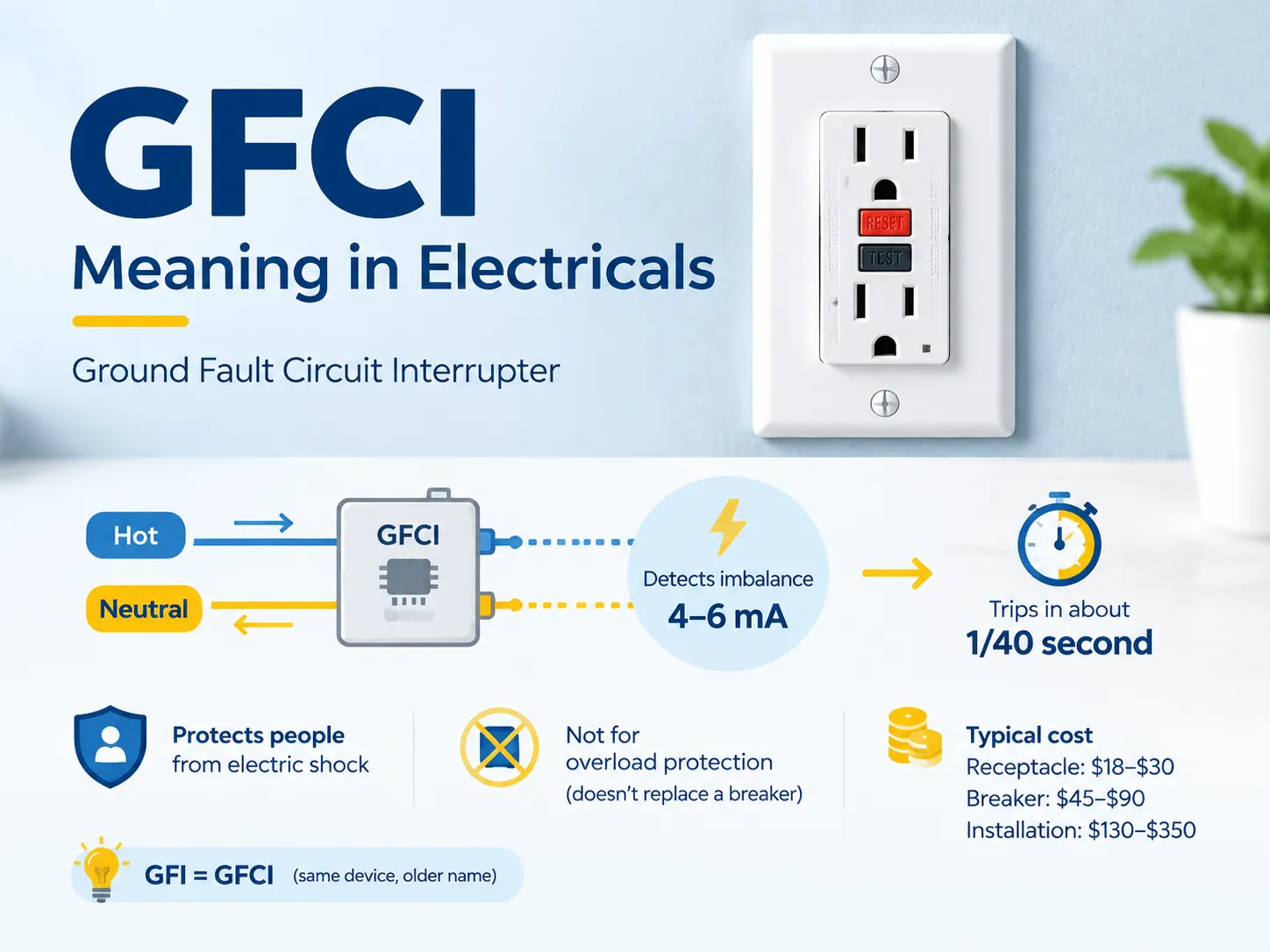
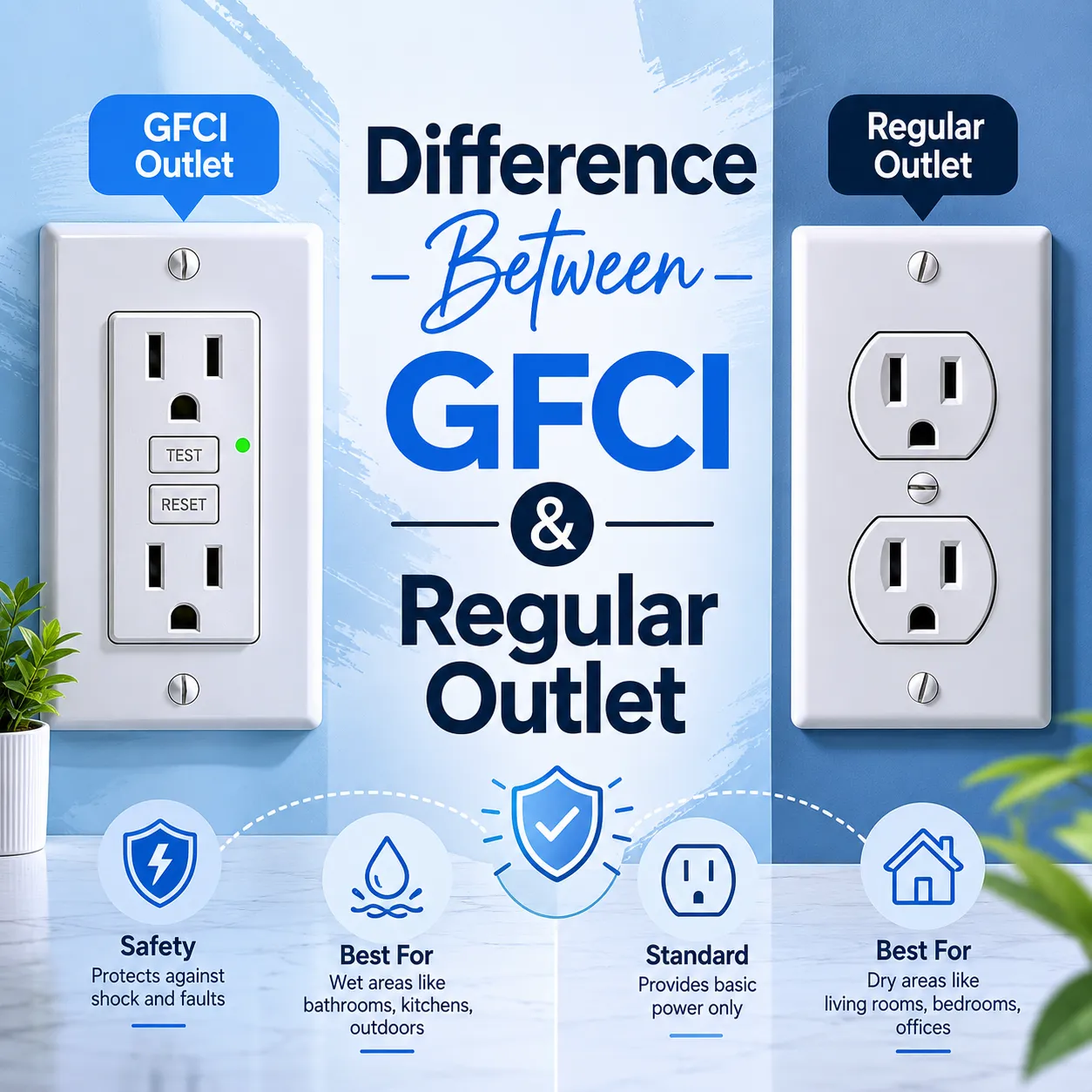
A GFCI (Ground Fault Circuit Interrupter) outlet will look just like a normal outlet, both being a standard duplex receptacle with two 3-prong slots. The difference comes when you look inside and see how they are wired differently. A normal outlet just provides electricity when you plug something into it. A GFCI outlet will constantly monitor the current in the circuit and trip as quickly as 1/30th of a second after detecting even the smallest imbalance of current (which can occur when current is flowing through someone’s body to ground) and this understanding is critical to the advancement of electrical safety in wet or outside environments.
What Is a Regular Outlet?
Regular outlets are utility voltage receptacles with grounded sockets. There are hot, neutral, and ground connections in this connection system to the circuit wiring. No electronics are housed in the regular outlet itself. Therefore, when you connect your lamp to a regular outlet to turn it on, the lamp will turn on. If an exposed wire on the lamp touches the lamp’s metallic housing and causes a ground fault, the outlet will still provide power to the lamp until enough current is flowing through the circuit to trip the circuit breaker. If the fault current has a high-resistance path to ground (such as through a human), the circuit breaker may never trip. Regular outlets are safe and comply with codes for indoor, dry locations with little risk of ground faults such as bedrooms and living rooms. For a look at the full range of standard receptacle options, our guide to the best electrical outlets and switches for modern homes covers everything from basic duplex to USB-integrated models.
What Is a GFCI Outlet?
A GFCI outlet has a mini circuit board and an electronic device that compares input/output (current) of both sides (hot and neutral) in order to determine whether or not there is a ground fault, or imbalance between the two sides. If there is no ground fault, both currents are equal as they flow back through the neutral wire after being used by an appliance. If a ground fault occurs (i.e., an appliance falls into water, a person touches an energized conductor with their feet on damp or wet concrete), some of the current will travel to the ground instead of back through the neutral wire. The GFCI detects this and creates an imbalance that exceeds 5 milliamps (0.005 amperes) causing it to trip and shut off power before enough current is flowing to the victim to produce ventricular fibrillation. The “TEST” and “RESET” buttons on the GFCI face are the only visible differences between it and a standard outlet.
Key Differences at a Glance
Here’s a side-by-side comparison to make the distinction between a GFCI and a standard receptacle clear.
| Feature | Regular Outlet | GFCI Outlet |
|---|---|---|
| Internal intelligence | None; purely mechanical connection | Electronic circuit monitors current balance |
| Ground fault protection | No | Yes; trips at ~5mA leakage |
| Shock prevention | Relies on grounding and breaker | Trips before shock becomes lethal |
| Required locations (NEC) | Dry indoor areas | Bathrooms, kitchens, garages, outdoors, crawl spaces, laundry areas |
| Cost | $1–$3 | $10–$25 |
| Downstream protection | No | Yes; can protect additional regular outlets wired to its LOAD terminals |
Can You Put a GFCI Outlet in Place of a Regular Outlet?
Typically, you can replace your standard outlet with a GFCI outlet, using the same wiring: one hot, one neutral, and one ground wire. The incoming power needs to be wired to the LINE terminals and any downstream protection outlets you want to use to the LOAD terminals; i.e., if there’s an existing box that’s shallow, then due to GFCI being deeper than standard outlets, it may require replacing (if you have no ground wire, you may actually have an installation in compliance by labeling it “No Equipment Ground”, with the GFCI providing life safety ground fault protection, but no true equipment grounding to support surge protection devices). For a detailed walkthrough of the replacement process, our article on how to replace a wall socket covers the steps safely.
What Should Not Be Plugged into a GFCI?
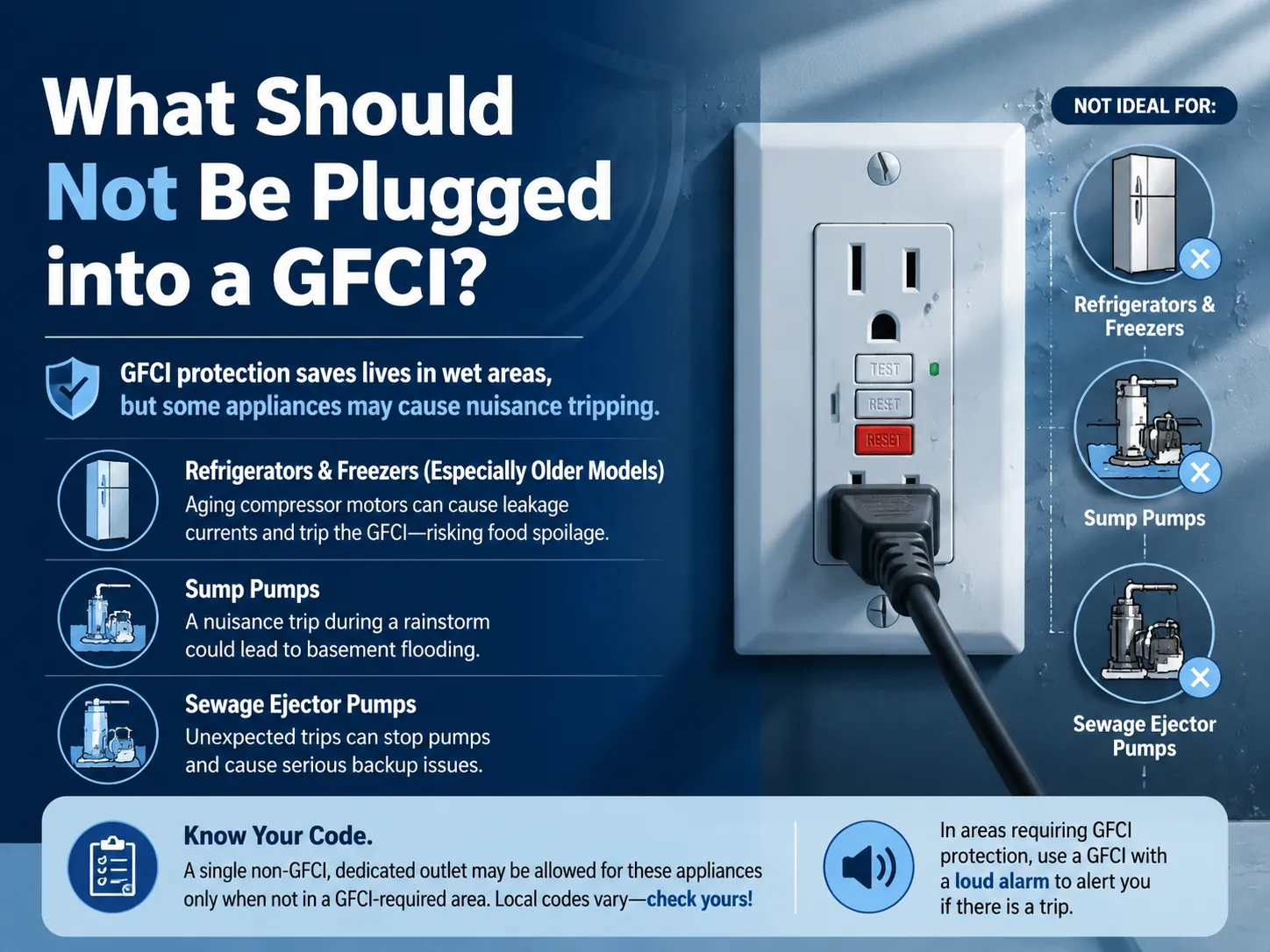
Even though GFCI (Ground Fault Circuit Interrupter) protection saves lives when used in wet places, certain types of appliances may not work great with GFCI protection. Some older-style fridges and freezers may cause nuisance tripping as their compressor motors have aged and developed minor leakage currents; thus, a tripped GFI on a garage freezer that doesn’t get discovered for days will spoil hundreds of dollars worth of food. Sump pumps and sewage ejector pumps are two more examples of poor applications of GFCIs; a nuisance trip during a rainstorm may wind up flooding an entire basement. The code allows a single, non-GFCI, dedicated outlet in these types of cases only when the outlet is not located in an area which would necessitate GCFI protection. Please always review your local codes as more jurisdictions are now requiring GCFI protection for garage fridges, and the solution if you live in those areas is a GCFI with a loud enough alarm to alert you if there is a trip.
What Happens If You Use a 20 Amp GFCI on a 15 Amp Circuit?
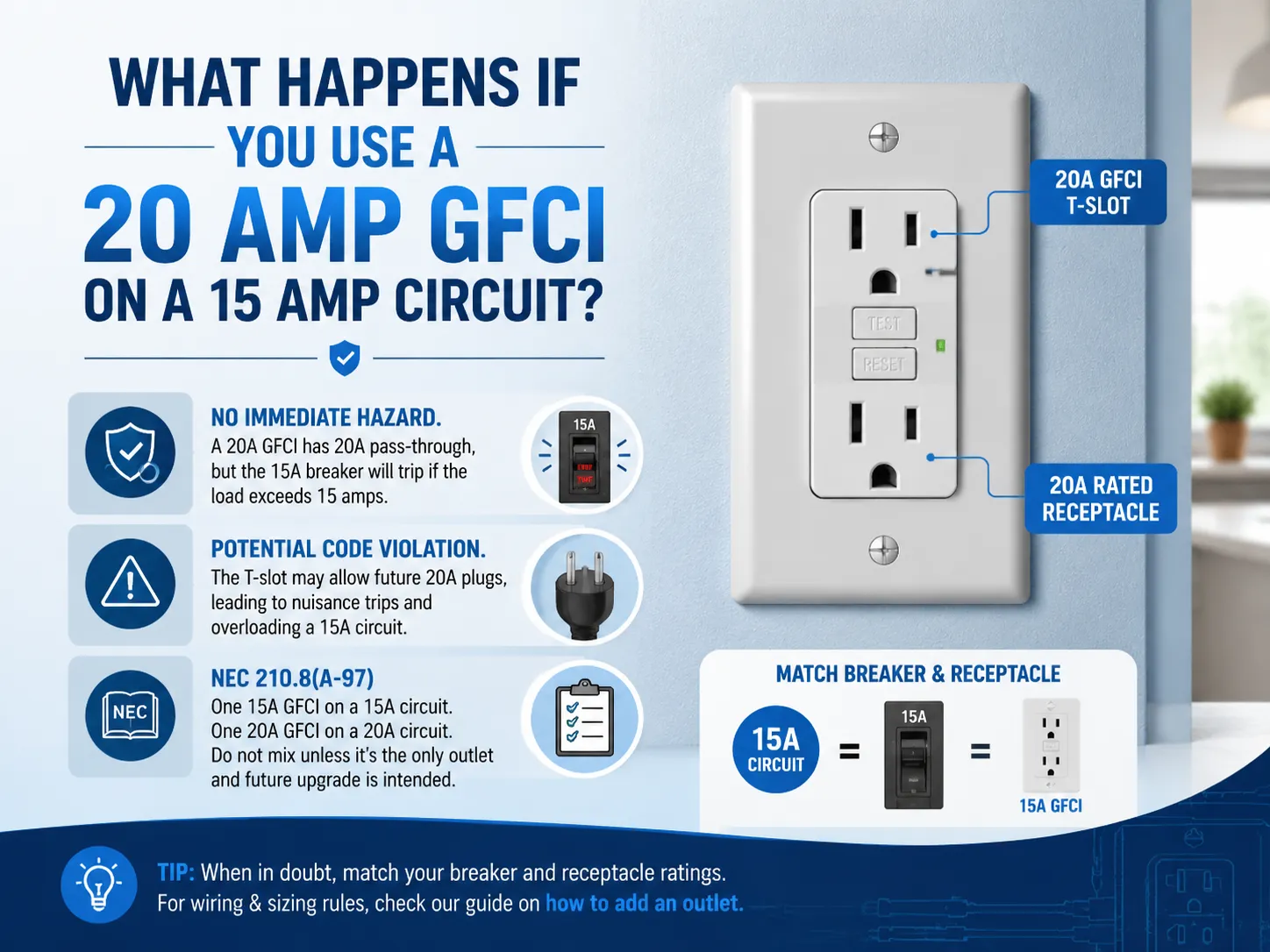
Initially, no imminent hazard arises from installing a 20 amp rated GFCI outlet (T-shaped neutral slot) onto a 15 amp circuit as it has an allowance for 20 amp pass through; however, the existing 15 amp breaker will trip if connected load exceeds 15 amps thereby protecting the circuit conductor. There could be potential code violations as the receptacle will mislead a future user into believing 20 amp receptacles are permitted which might result in nuisance tripping of breakers due to exceeding allowable load limits allowed by breaker rating. Therefore NEC Section 210.8(A-97) allows installation of one 15 amp rated GFCI receptacle on a 15 amp circuit and one 20 amp rated GFCI receptacle on a 20 amp circuit; where combining receptacles is generally discouraged unless the only outlet on the circuit is a GFCI outlet and the owner intends to have options for upgrading appliances in the future. If you’re uncertain about matching breaker and receptacle ratings, our guide on how to add an outlet explains the wire gauge and breaker sizing rules that govern every outlet installation.
GFCI Availability and Brand Considerations
GFCI outlets are made by several large electrical manufacturers, including but not limited to Leviton, Eaton, Legrand and Hubbell. GOG Electric carries a line of GFCI receptacles that comply with UL 943 and include the self-test feature which became mandatory in 2015. The self-test feature causes the outlet to automatically check itself and identify if it is functioning properly by lighting a status indicator. A standard 15-amp GFCI outlet will work for most bathrooms, while a weather-resistant (WR) rated GFCI will work well in an outside patio. A quality GFCI purchased from a reputable manufacturer is an inexpensive product that can offer you protection for many years into the future. Although Prado is not known for manufacturing GFCI outlets, there are many other manufacturers who offer high-quality GFCIs, and the experts here at GOG can assist you in selecting the appropriate GFCI outlets for your application.
Frequently Asked Questions
Can you put a GFCI outlet in a regular outlet?
In most cases, you can substitute a GFCI receptacle for a regular receptacle within the typical installation location of an electrical box. The electrical connections at each receptacle are nearly identical; hot (LINE) to hot (LINE), neutral to neutral, and ground (green screw) to ground (green screw). The only factor to consider is that GFCI receptacles are deeper than standard residential receptacles, so you might have to replace your old shallow (old-work) box for the required wiring room to accommodate the installation of a GFCI receptacle.
What should not be plugged into a GFCI?
It is not advisable to plug appliances into a GFCI that are required to operate consistently, and are at risk of causing nuisance tripping. Examples of these types of appliances include refrigerators, freezers, sump pumps, and medical equipment which cannot shut down. Thus, they would be more appropriately served by individual (non-GFCI) circuits, where permitted by code. If GFCI protection is required in the area where the appliance is located, then either choose a GFCI that has an audible alarm, or connect the appliance into a single dedicated GFCI so that the tripping of the GFCI would not affect the operation of any other loads connected to the same GFCI.
Does Prado make a GFCI outlet?
Prado is a relatively unknown producer of GFCI outlets compared to various other electrical product manufacturers. The leading GFCI manufactures are the major electrical brands; namely, Leviton, Eaton, Legrand, and Hubbell. All of these manufacturers currently provide GFCI receptors that are UL listed, and fully compliant with established codes, and also have the self-test feature. GOG Electric can provide you with GFCI outlets that are manufactured by well-known electrical manufacturers with complete documentation to ensure your NEC compliant installation.
What happens if I put a 20 amp GFCI outlet on a 15 amp circuit?
The 20 Amp GFCI outlet will work fine electrically and will still be protected by the 15 amp breaker as it will trip if the load exceeds 15 amps. A violation of code normally occurs when a 20-amp receptacle is installed on a 15-amp electrical circuit. This could allow for a 20 amp appliance to be plugged in, which can lead to nuisance trips of the breaker. A GFCI 15-amp receptacle should be used on a 15-amp circuit, or a GFCI 20-amp receptacle should be used on a 20-amp circuit with #12 AWG wiring.
The difference between a GFCI and a regular outlet is the difference between an outlet that simply delivers power and one that actively protects the people using it. A regular outlet does its job perfectly in dry, low-risk locations. A GFCI outlet brings life-saving ground fault detection to bathrooms, kitchens, outdoor patios, garages, and anywhere moisture and electricity might meet. Upgrading from regular to GFCI in code-required locations is not just about passing an inspection — it’s about installing a device that stands guard continuously, ready to trip in a fraction of a second if current ever takes an unintended path. At GOG Electric, we offer a full range of GFCI receptacles, from standard 15A bathroom units to weather-resistant outdoor models, so every outlet in your home can match the safety level its location demands.