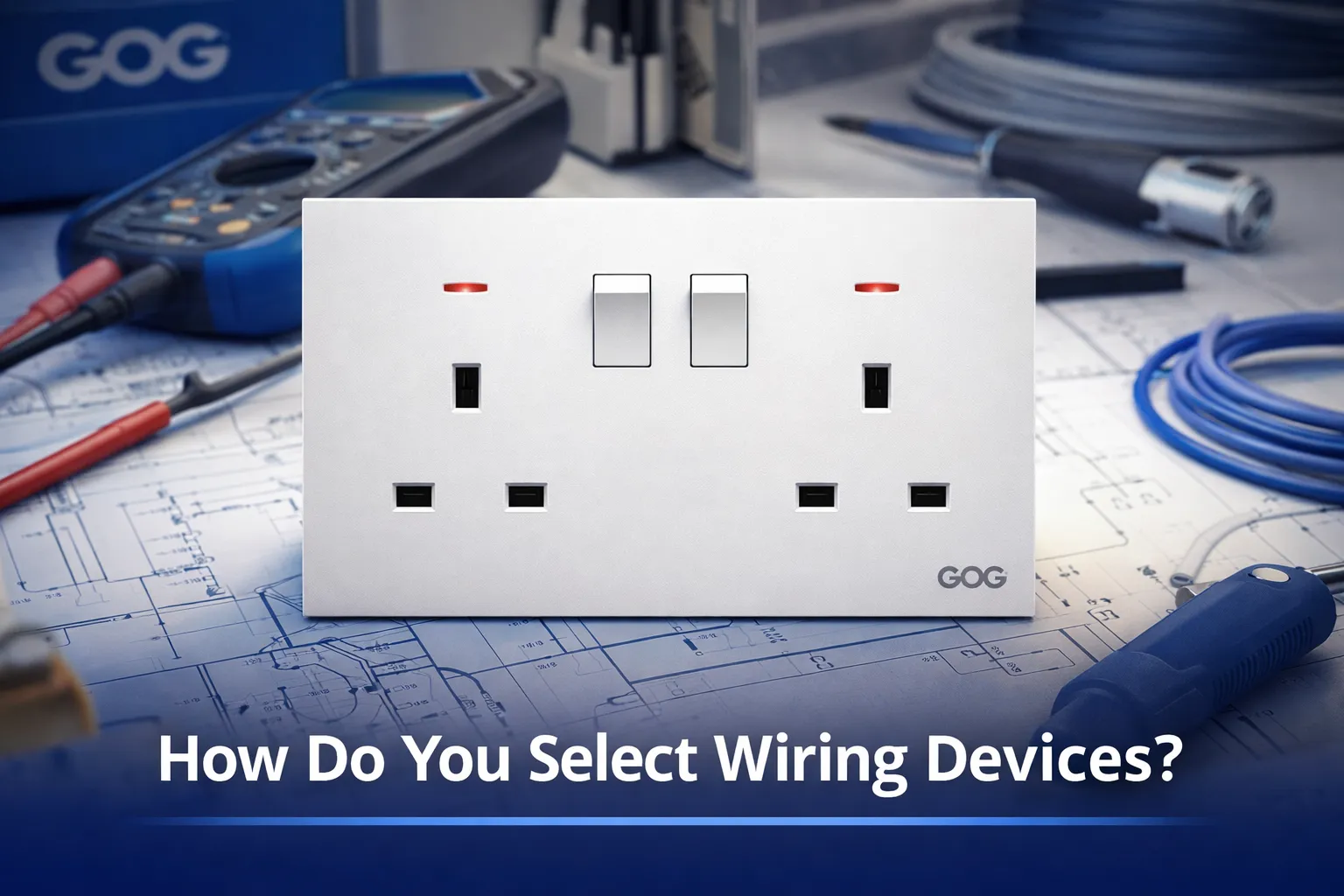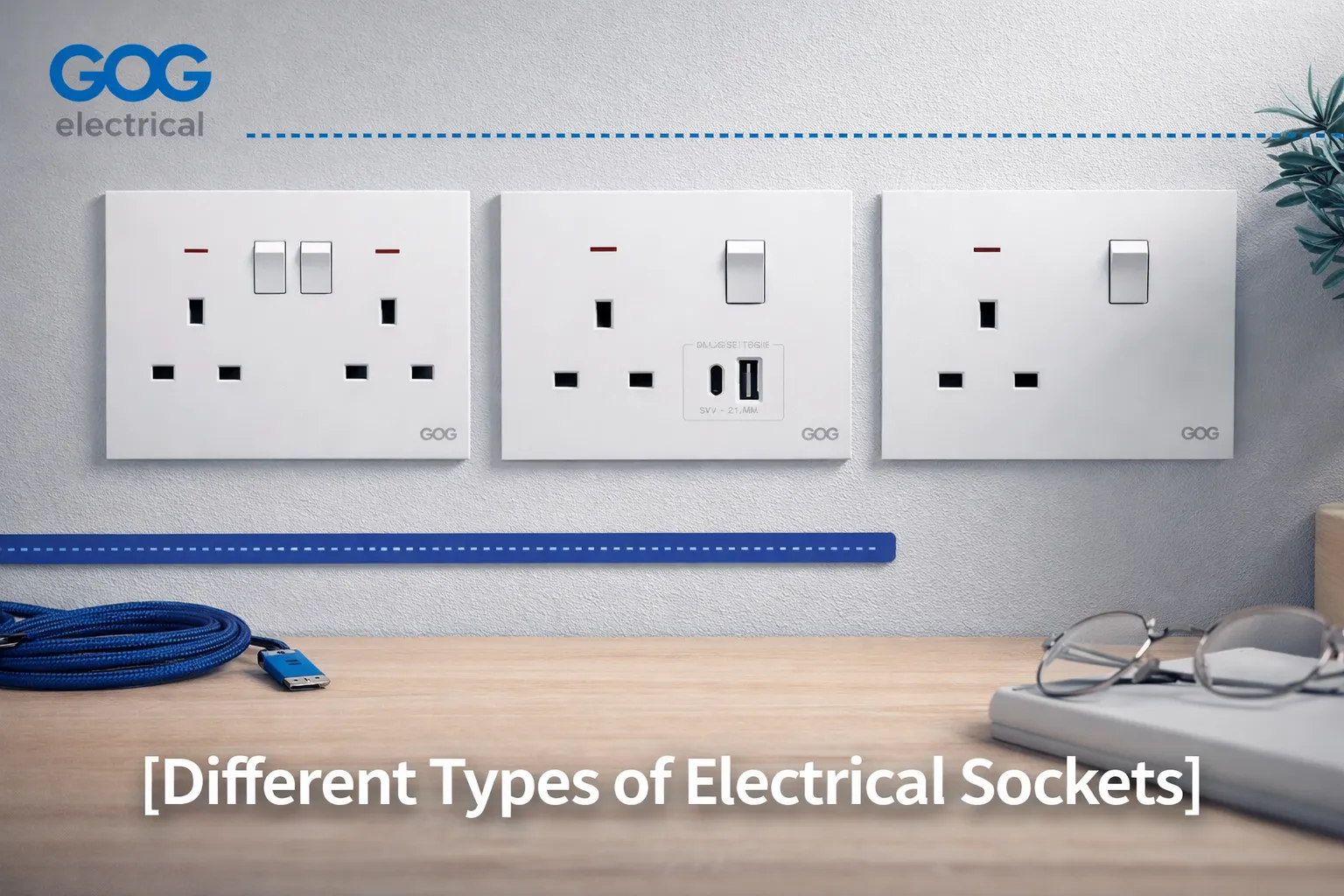
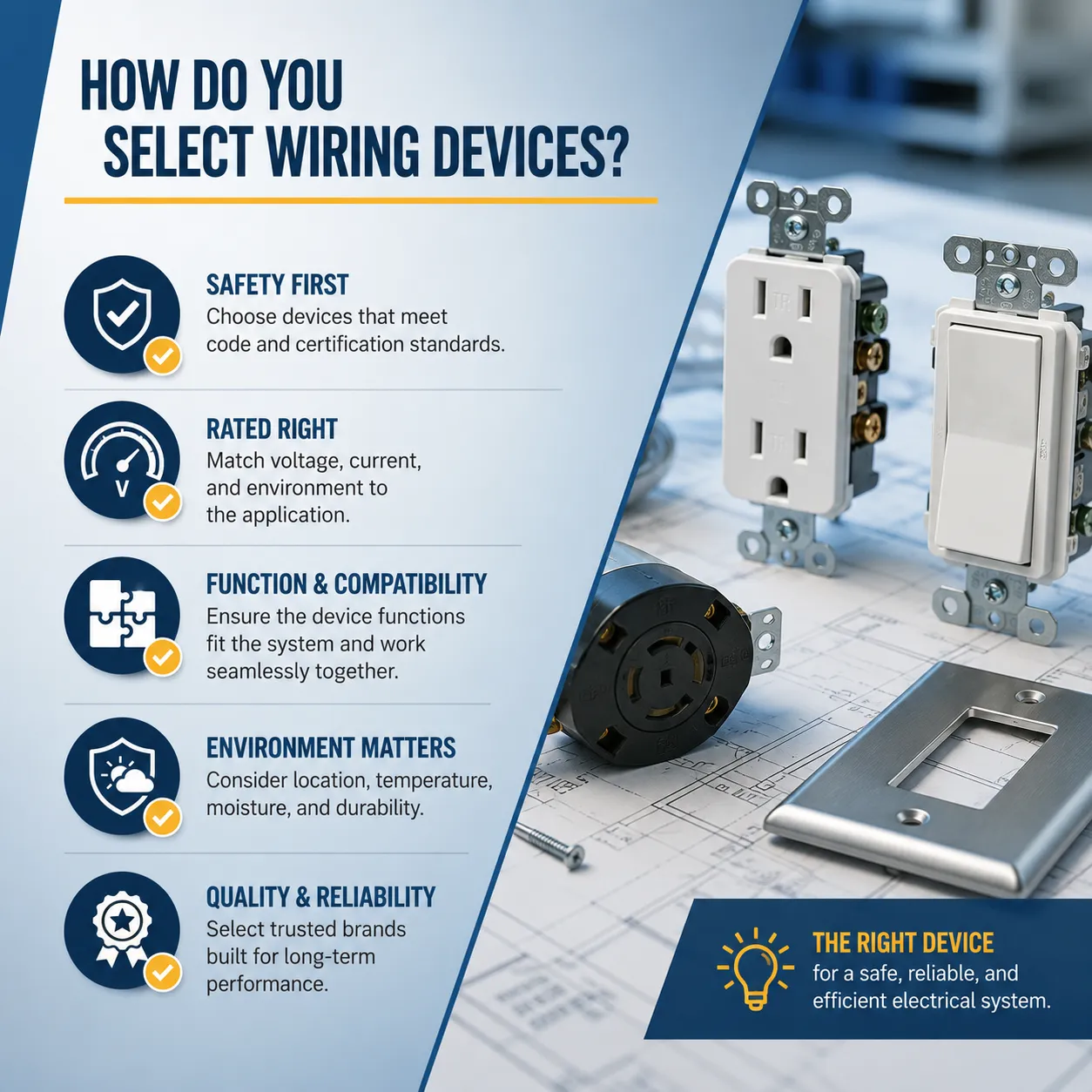
When Sarah and Tom worked on their bungalow renovation last year, they thought that electrical work would be easier. However, while standing in the electrical aisle, watching different skills of wiring devices, she realized she was mistaken – there were 15-amp receptacles and 20-amp receptacles, GFCI outlets with TEST and RESET buttons, tamper-resistant shutters, USB-A and USB-C charging ports, dimmers, rocker switches, toggles, smart switches that required a neutral wire, and other wiring devices in various forms. Sarah believed that a device was just a device, but the wide choice of new options impressed her more than any work of the past. The number of choices of devices has drastically changed, and the white-and-ivory devices have been replaced by several safety or practicality requirements. This was the only advice of her electrician: it is necessary to match a device to the room of using a device. Choosing a wiring device requires a number of decisions that guarantee the future function and durability of such devices.
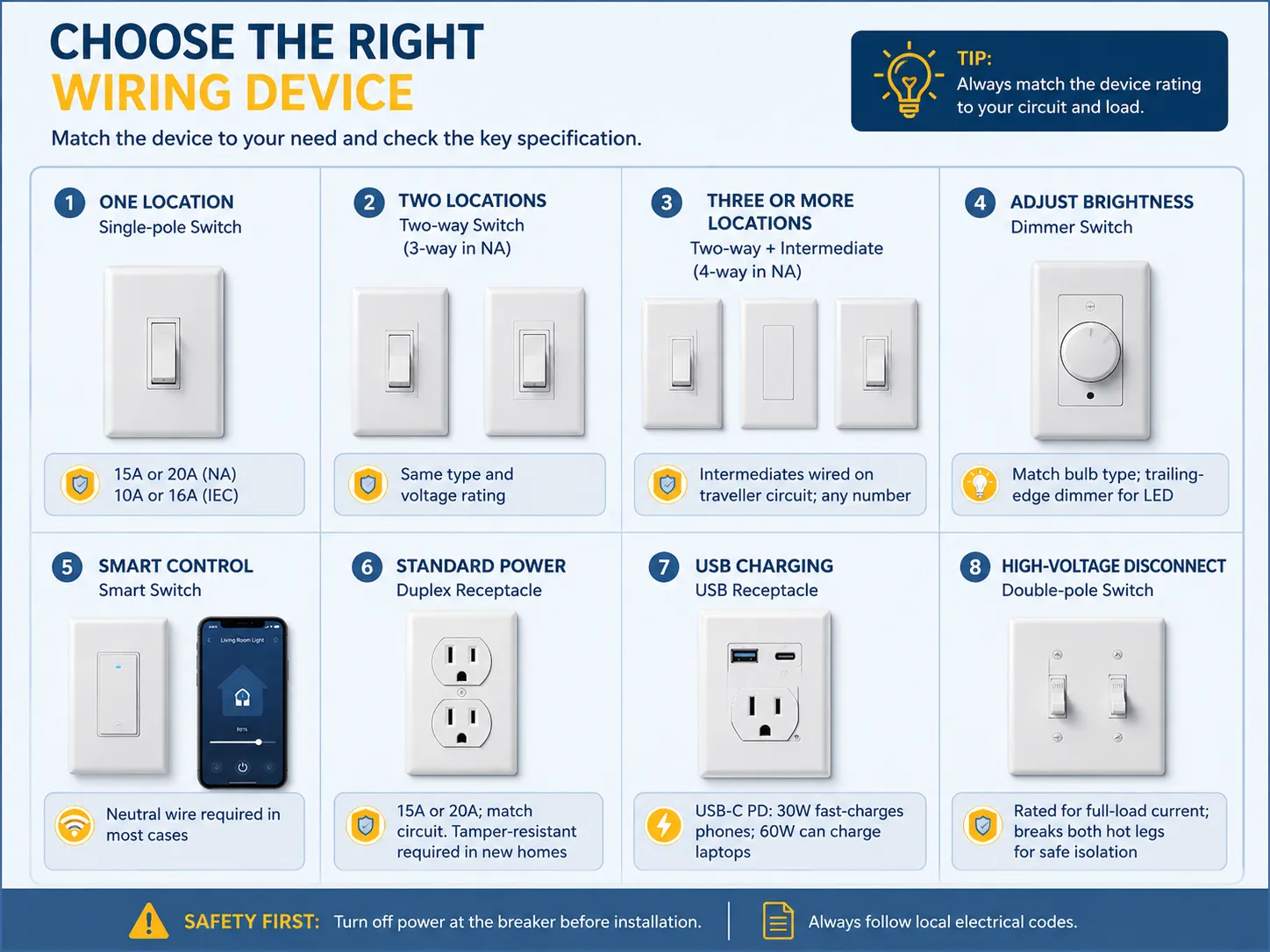
Define the Function — What Do You Need the Device to Do?
Every wiring device found on a wall has its significance, and the significance influences the type of the device. The initial consideration is whether one should purchase a switch, a receptacle, or a combination of the two – and what must be controlled by the switch or receptacle. The table below shows the most widespread requirements connected with the devices and their respective types.
| What You Need to Do | Device Type | Key Specification to Check |
|---|---|---|
| Turn a light on and off from one doorway | Single‑pole switch (one‑way in UK terminology) | Amperage rating must match or exceed the circuit breaker (15A or 20A in North America; 10A or 16A in many IEC markets) |
| Control a light from two doorways (staircase, hallway) | Two‑way switch (three‑way in North America) — a pair of SPDT switches with three terminals each | The two switches must be the same type and voltage rating. Our guide on the difference between a 2 way and 3 way switch explains the wiring and terminal identification |
| Control a light from three or more locations | Two two‑way switches plus one or more intermediate switches (four‑way in North America) | Intermediate switches are wired between the two two‑way switches on the traveller circuit. Any number of intermediates can be installed |
| Adjust light brightness | Dimmer switch — rotary, slide, or touch | Must be compatible with the bulb type (LED, incandescent, halogen). Trailing‑edge dimmers are preferred for LED loads. For the compatibility details, our guide on LED dimmer switch compatibility covers bulb matching and flicker prevention |
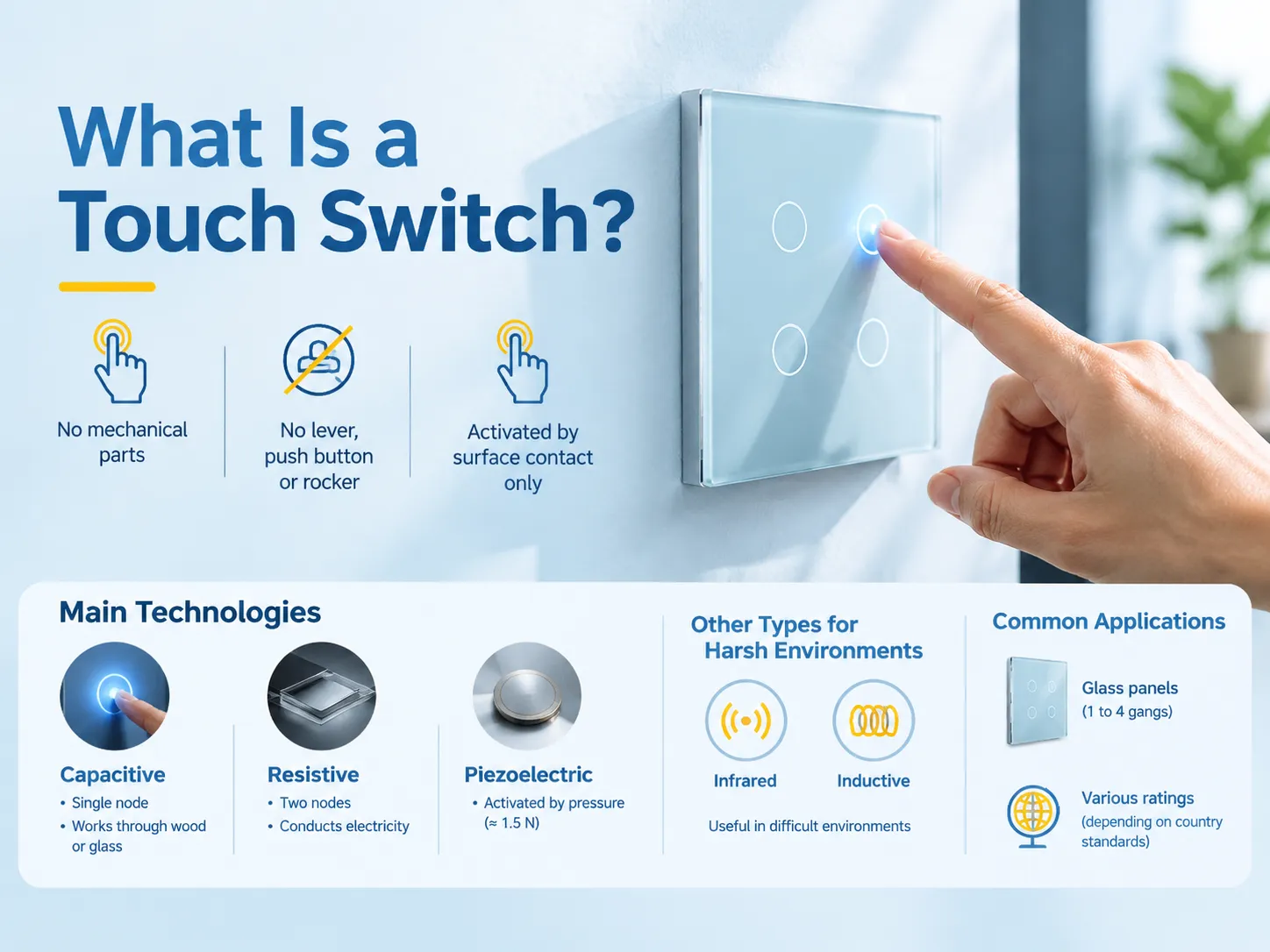
| Control lights remotely, on a schedule, or by voice | Smart switch (Wi‑Fi, Zigbee, or Z‑Wave) | Most smart switches require a neutral wire in the switch box. Homes built before the 1990s often lack a neutral; a no‑neutral smart switch is required for these installations. Our comparison of neutral vs non‑neutral smart switches explains how to identify your wiring |
| Plug in a standard appliance or device | Duplex receptacle (socket outlet) | Amperage rating (15A or 20A for general‑purpose; match the circuit breaker). Tamper‑resistant shutters are required in all new residential construction in North America |
| Plug in and charge a phone, tablet, or laptop directly — no adapter | USB‑integrated receptacle — USB‑A, USB‑C, or combination | USB‑C Power Delivery (PD) wattage determines charging speed. A 30W USB‑C port fast‑charges a modern smartphone; a 60W port can charge a laptop. Our guide on USB charger sockets covers the technology and the safety considerations |
| Disconnect a 240‑volt appliance (water heater, air conditioner) for safe maintenance | Double‑pole switch — four terminals, breaks both hot legs simultaneously | Must be rated for the appliance’s full‑load current. A double‑pole switch provides complete isolation; a single‑pole switch in the same location would leave one leg live. Our article on what a double pole switch is covers the wiring and the code requirements |
Match the Device to the Circuit’s Electrical Rating
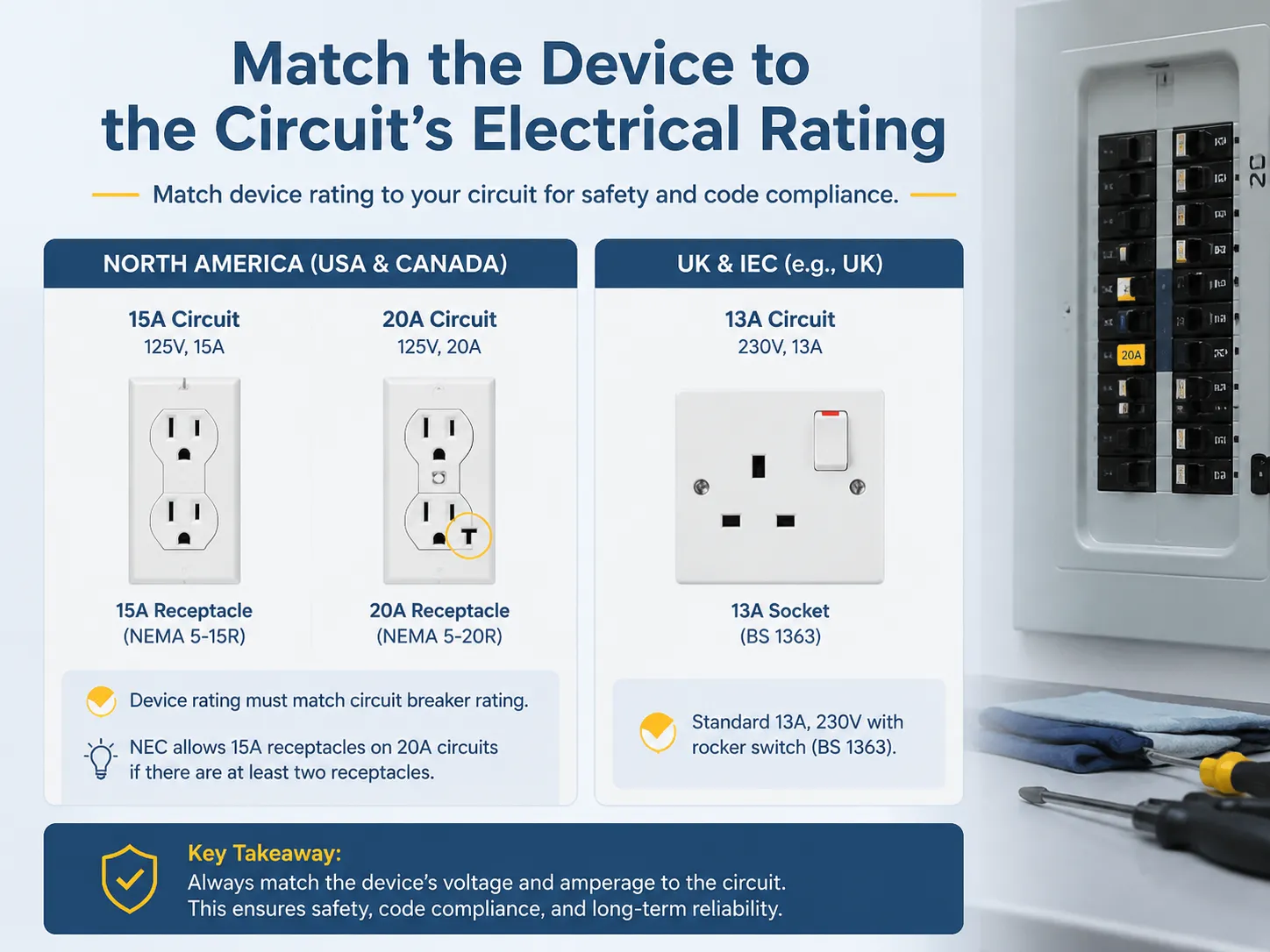
Each unit of electrical installations has both voltage and current ratings, which must be compatible with the circuit they are being mounted on. In USA and Canada, the two voltage and current ratings are either 15 amps or 20 amps. A 15-amp socket or switch has a voltage rating of 125 volts, and can be used for 15-amp circuit installations, which are most commonly used in household electrical wiring. A 20-amp electrical device can be distinguished by the T-shaped neutral connection; therefore, it can accept both 15-amp and 20-amp plugs, and can be used for installation of voltage systems rated for 20 amps operational current, which are usually found in kitchen, laundry rooms or in workshops. The rating of the installed socket must be equal to the rating of the circuit breaker; either socket with 15 amps can be used with the circuit breaker rated for 15 amps or circuit breaker rated for 20 amps with socket with 20 amps. NEC allows installation of 15-amp sockets on 20-amp circuits but only if there are at least two sockets installed on the circuit with 2 pairs considered as two sockets, and this system is called a 20 amp circuit system in household electricity consumption, and it is said that 20 amps circuit with breakers has a rating of 20 amps and 12-gauge used to complete this circuit will be equipped with 15 amps sockets and will remain tamper-resistance. For a more detailed breakdown of circuit capacity and the number of outlets that can safely share a circuit, our guide on how many outlets on a 20 amp circuit explains the NEC’s rules and the practical limits.
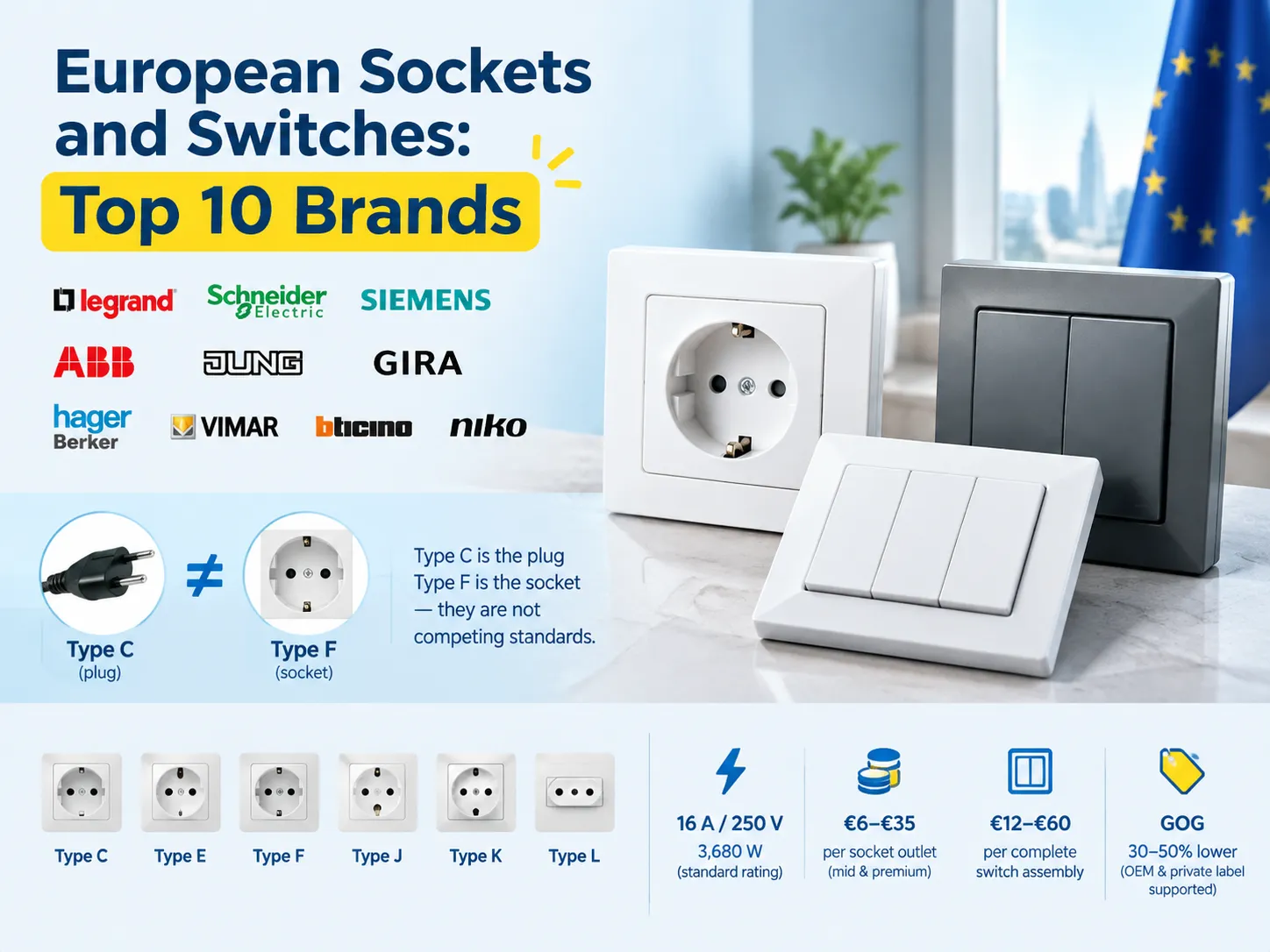
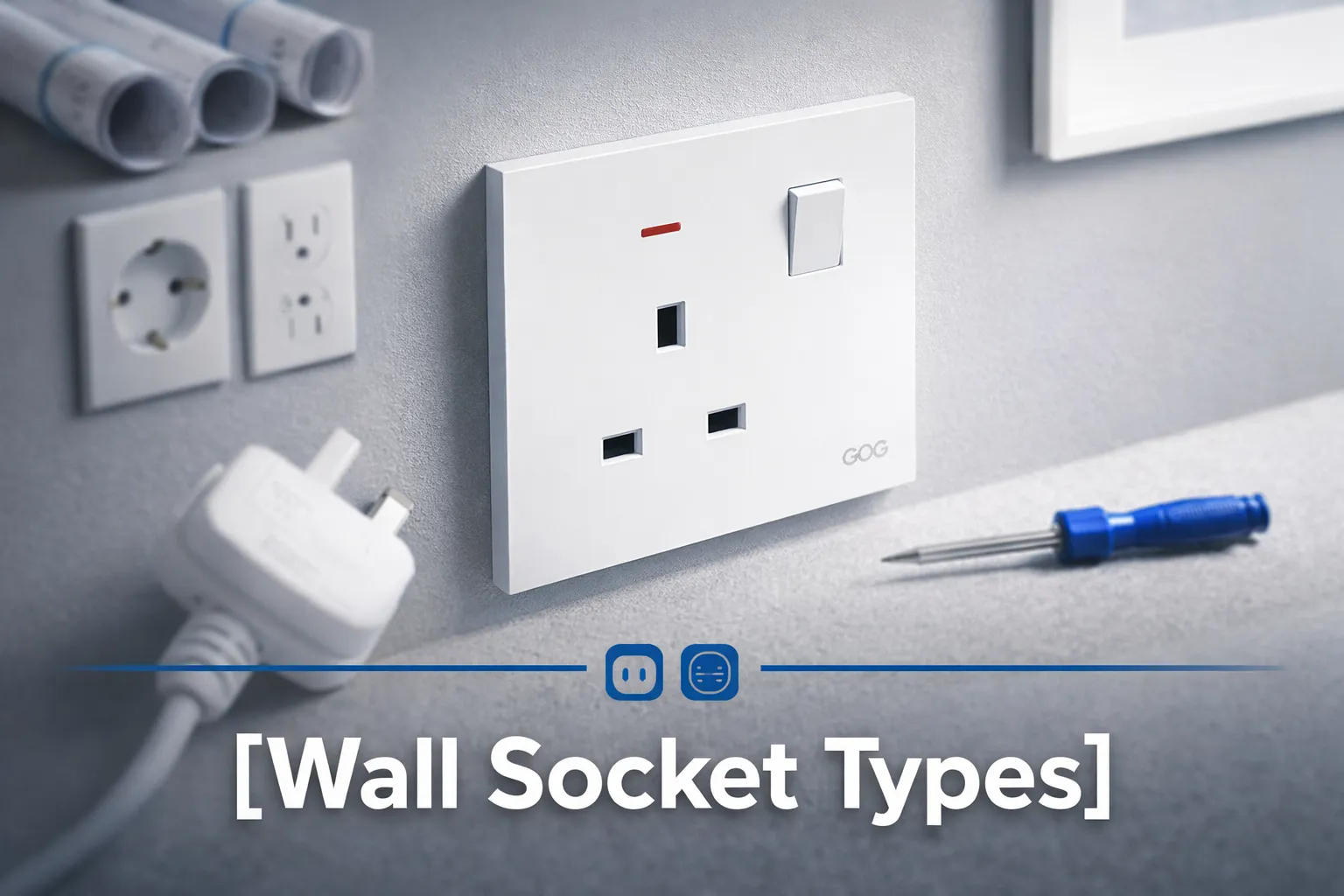
UK and IEC states have standard socket outlet with rating of 13 A, 230 V, featuring square pin BS 1363 design and integrated rocker switch. Voltage and type of the plug are set by country standard so that consumer should only choose between finish, integration of USB port or “smart” option. GOG Electric produces units conforming to both North American (NEMA) and UK/IEC (BS 1363) regulations, providing with proper voltage and amperage for every market, as well as with all the necessary protective devices, USB-C PD ports and smart switching it must have in order to meet advanced installation requirements.
Choose the Safety Features Required by Code and by Common Sense
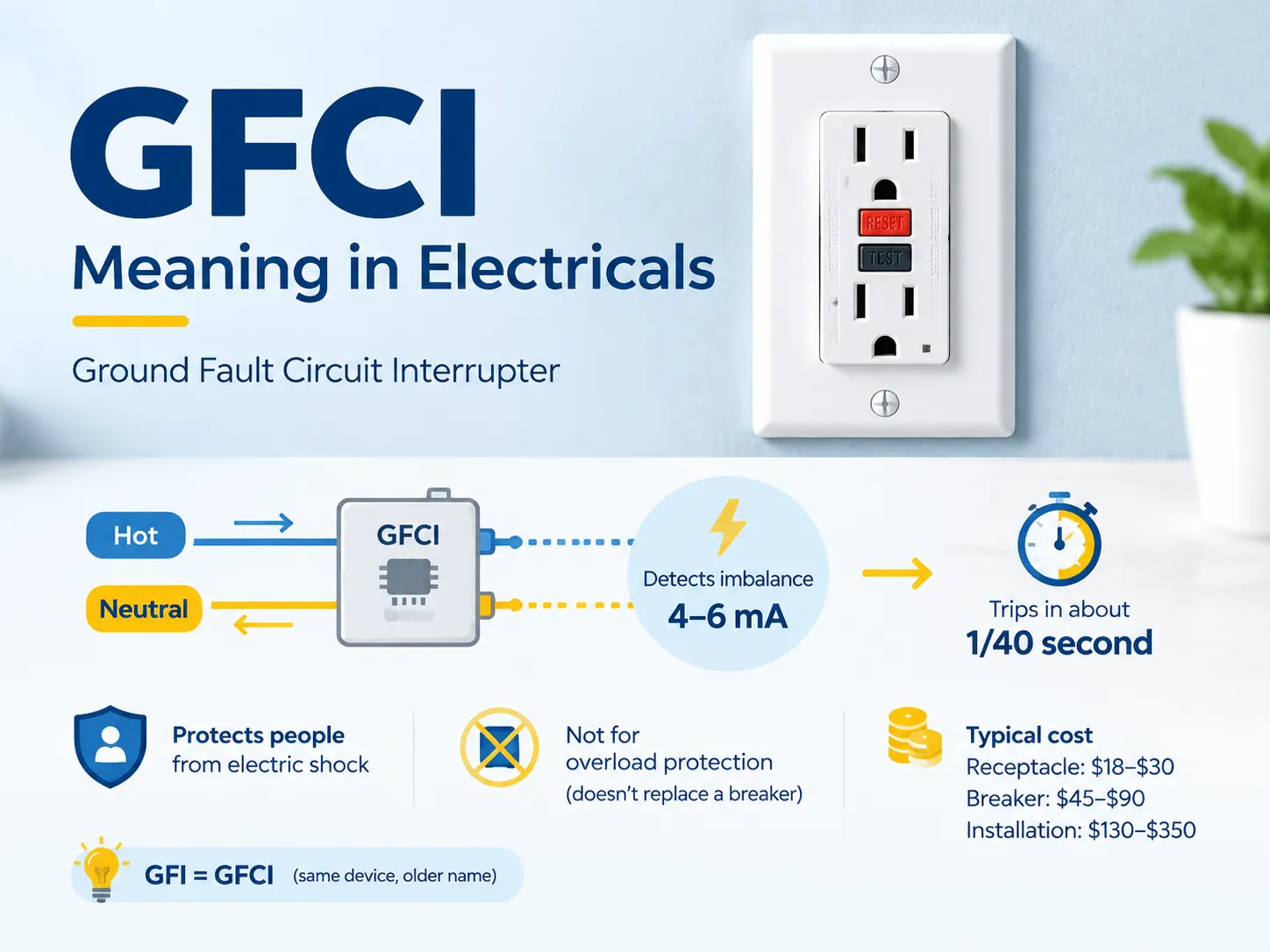
Apart from simple electrical rating, a number of wiring devices include safety features required by the National Electrical Code (NEC) for certain installation sites — and are highly recommended by common sense for other places. The main safety features of most importance are Ground Fault Circuit Interrupter (GFCI) protection (mandatory for use in bathrooms, kitchens, garages, as well as outdoors, in crawlspaces, and laundry areas — GFCI is located at the outlet where it constantly controls the electric current flowing through the hot lead and neutral lead and reacts promptly if current through the human body exceeds 5 mA), Arc Fault Circuit Interrupter (AFCI) protection (required for most residential areas of modern buildings — AFCI recognizes unique electrical arcs and promptly interrupts power supply, preventing potential fires; usually, AFCI is implemented in circuit breakers, but AFCI outlets can be installed to make old installations safe), tamper-restraint shutter mechanism (mandatory by law for residential buildings in North America — tamper-resistant outlet incorporates spring-loaded shutter behind its slots that prevents insertion of one object; it is allowed to open only when pressure is applied to both hot and neutral slots), and being weatherproof (mandatory for outdoor installation — weatherproof outlet is marked as weather resistant, has corrosion-free internal components, and needs weatherproof protective cover which is sealed around the plugged object).
A modern kitchen counter outlet might combine tamper‑resistant, GFCI, and USB‑charging in a single device. A bathroom outlet is typically a tamper‑resistant GFCI. A bedroom outlet is tamper‑resistant and may be AFCI‑protected at the breaker. Understanding the code requirements for each room is the foundation of a safe, compliant selection. The National Fire Protection Association (NFPA), through the NEC, specifies these requirements, and local amendments may impose additional obligations.
Match the Device to the Physical Environment and the Installation Location
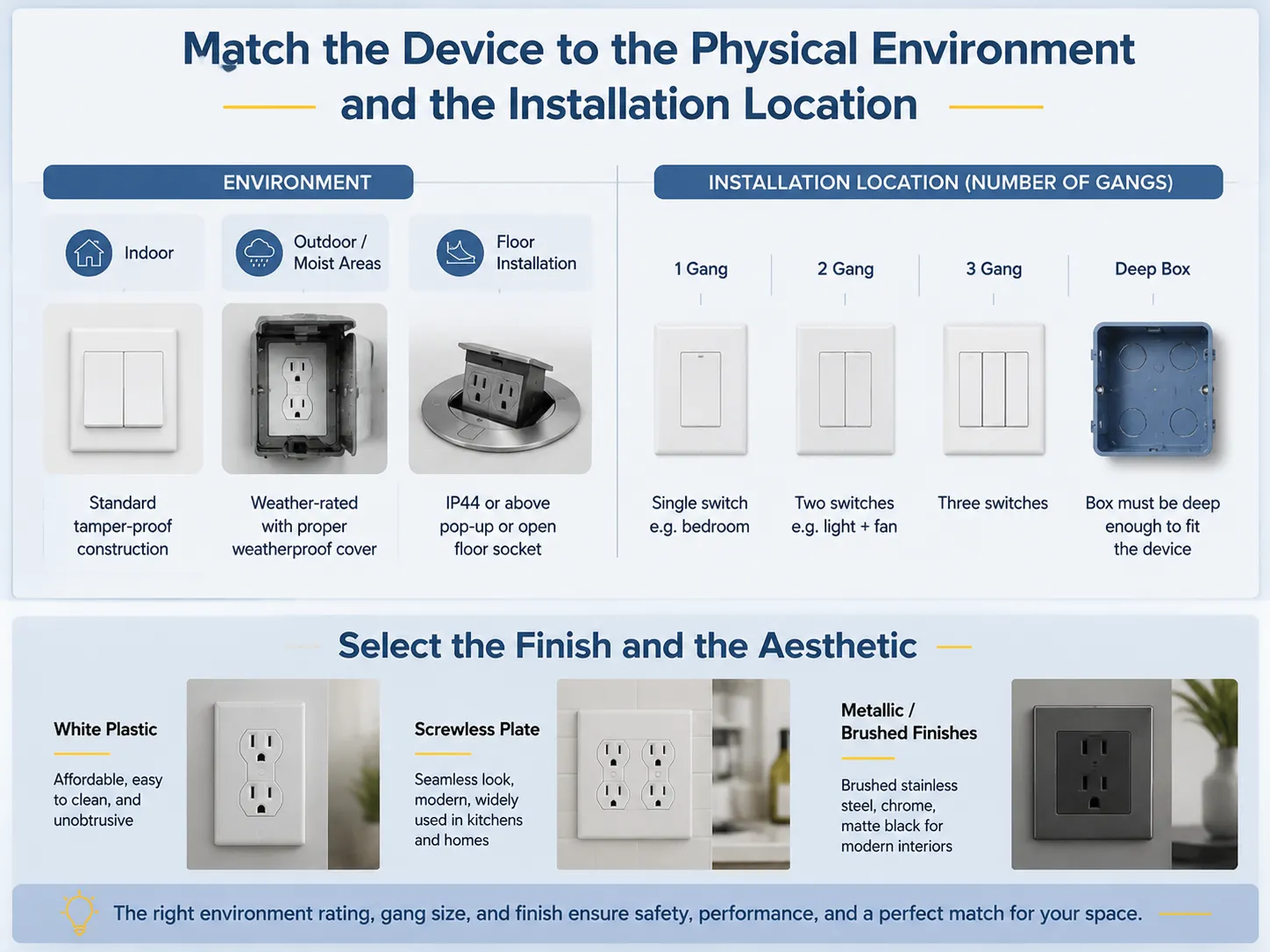
The environmental rating of a wiring device is determined by its physical placement. Indoor placement of a device does not require any special environmental rating apart from standard tamper-proof construction. A device placed outdoors or in locations prone to moisture exposure including garages or similar environments must have a weather-rated rating and a proper weatherproof cover. When placing a device on the floor e.g., in conference rooms, open areas, or living rooms, the device should be made in the form of a floor socket and be able to withstand foot traffic and humidity, in which case the product should carry an IP44 rating or above. The floor socket may be designed in the form of a pop-up socket or an open socket with several sockets built in one unit, for instance, GOG Electric pop-up floor sockets. The physical placement of the device determines the number of gangs. If it is necessary to install one switch in the bedroom, then it requires a single gang box. When there are two switches, such as the light switch and the fan switch placed next to each other, they will need a double gang box. Three switches need a three-gang box and a faceplate which corresponds to that box. Moreover, the box should be deep enough to accommodate the device. Our guide on what 1 gang, 2 gang, and 3 gang means explains the dimensions and the typical applications for each gang size.
Select the Finish and the Aesthetic
After making functional decisions regarding electrical wiring, the choice of finish and material transforms a wiring device into a design idea. A number of finishes used in the contemporary homes today include: white plastic mold (the usual in any installation due to affordable price, simplicity in cleanliness and unobtrusiveness), screwless white or colored plate (seamless face covers are utilized to construct such devices due to their cheap value, widespread use in contemporary kitchens and homes) and metallic or brushed finishes (brushed stainless steel, chromium-plated or matte black for interior spaces). GOG electric has developed extensive range of wiring devices in each of the above finish type.
Verify the Certifications and the Manufacturer’s Credentials
The last step in the selection of the devices is to check the device has been certified according to the relevant standards set for the market it will be used in. In the US, the device should be UL or ETL marked to the necessary standard — e.g. UL 20 for switching devices, UL 498 for plugs. The UL mark acts as confirmation that the device has passed independent testing and complies with the safety specifications of the National Electrical Code. In the UK and IEC markets, the device needs to have the CE mark and for the UK — comply with BS 1363 standard for socket outlets. If the device is not certifed, it cannot be used legally and it should not be purchased if it cannot be proved to be certified — there should be the appropriate certification mark logo on the device or the manufacturer should have the document with the relevant license. Certification is what proves independently that the device can carry the necessary power without overheating, that the contact elements of the device will be able to perform their firction for thousands of plug-unplug cycles, and that the plastic casing of the device does not break, melt or ignite despite the electrical and thermal limitations.
Frequently Asked Questions
What are the five types of wiring devices?
The five main kinds of wiring devices are switches (toggle, rocker, dimmer, and smart); receptacles (standard, GFCI, AFCI, USB-integrated and weather-resistant); combination devices (both switch and receptacle within the same gang); floor sockets (flush-mounted, pop-up, open-type floor receptacles); and specialty devices (doorbell switches, fan speed regulators, TV and data sockets, and appliance disconnects). Each one of the above categories includes different kinds of devices based on their electrical configuration, safety features, and the form of the devices themselves.
How to figure out which wires go where?
When changing out a wiring device, make sure to take a picture of how the wiring looks before you remove anything. You will need to remember which wire goes to which terminal once you start disconnection. On a single-pole switch, there are two brass terminals, so you can connect the hot wires to either terminal. When dealing with a receptacle, remember that the hot (black) wire gets connected to the brass screw, while the neutral (white) wire attaches to the silver screw, and the bare or green wire goes to the green screw. In the case of a double switch, you would connect the incoming live or switched live to the common (COM or dark) screw, while the two terminals used for the traveller wires would be the two brass screws (L1 and L2). Finally, a non-contact voltage tester is used to determine which wire is always live before establishing connections.
How to choose wire connectors?
Choose wire connectors (wire nuts, Wago connectors, or terminal blocks) suitable for the wire gauge, number of conductors, and circuit voltage. A yellow wire nut is rated for use with 2 or 3 conductors of 12 AWG. The Wago 221 series lever connector accommodates various wire gauges and provides for the connection or disconnection of individual conductors without having to use any tools. The wire connector has to be listed for the use (for instance UL, CSA etc.) and installed in an easily accessible junction box — never buried inside the wall. When using aluminum wiring, special connectors suitable for copper-to-aluminum connections must be used to avoid the problem of galvanic corrosion.
What are the factors to consider when choosing a wiring system?
When selecting a wiring system, the most important considerations include the load’s voltage and current requirements, the environmental conditions (indoor dry, indoor wet, outside, and hazardous), the level of protection (conduit, armored cable or non-metal sheathed cable is required), the mode of installation (surface-mounted, concealed in-wall installation, and underground laying), national and local electrical regulation, and total installation cost of the wiring system, including the wires, electrical protection equipment, electricity communicating devices, and work costs.
References
- National Fire Protection Association (NFPA) — National Electrical Code (NEC). The foundational standard for electrical installation in North America, including the requirements for receptacle spacing, GFCI and AFCI protection, and tamper‑resistant devices.
- Electrical Safety Foundation International (ESFI) — Wiring Device Safety. Consumer and professional guidance on selecting and installing switches, receptacles, and specialty wiring devices.
- Leviton — Residential Wiring Device Selection Guide. Manufacturer of North American switches, receptacles, dimmers, and smart controls, with installation guides and product specifications.
- Legrand — Wiring Devices and Smart Home Solutions. European manufacturer of switches, sockets, and smart home systems for residential and commercial applications.
How to select wiring devices is a structured process that begins with the function — what the device must do — and proceeds through the electrical rating, the safety features, the physical environment, the finish, and the certifications. A kitchen countertop needs GFCI protection, USB charging, and a tamper‑resistant shutter. A staircase needs a two‑way switch at each end. A home office needs a quad receptacle at desk height. A bathroom needs a GFCI and a weather‑resistant rating if it is near the shower. Every device on every wall in every room must match the code, the load, the environment, and the life of the people who will use it. GOG Electric manufactures the full range of wiring devices — switches, sockets, dimmers, smart controls, USB‑integrated outlets, and floor sockets — with the certifications, the finishes, and the internal engineering that turn a commodity device into a safe, durable, and reliable connection point for decades of daily use.