If you have noticed the compressor of your refrigerator turning on alongside the lights in the kitchen flickering slightly, then you have just come across one of the most important facts about electricity when it comes to refrigerators – namely, that a refrigerator does not consume constant electricity throughout its operation. It is important to know how many amps it consumes when running, and how much current is used in case of starting the refrigerator so that one can be sure whether the 15-amp circuit is safe or whether the generator is able to operate the refrigerator.
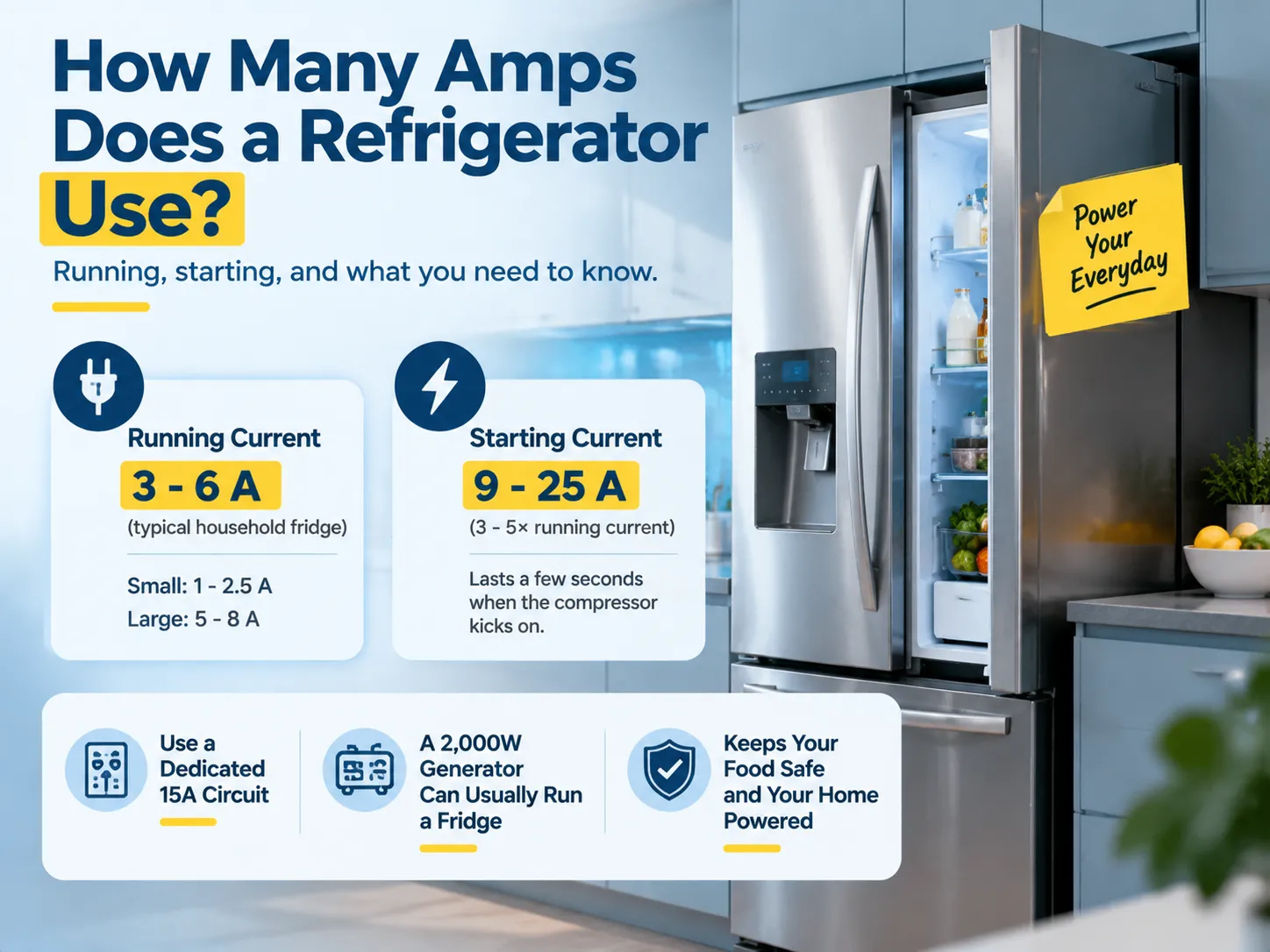
The answer is that a normal home refrigerator consumes approximately 3-6 amps when connected to a 120V circuit in North America; small units use around 1-2.5 Amps while bigger ones around 5-8 Amps. The important thing here is the starting (or inrush) current, which is 3-5 times the operating current which is used at the moment the compressor starts working. Upon activation, the compressor can deliver 9 -25 amps of current depending on its model. Modern refrigerator can work on a standard 15-amps dedicated circuit. This can be explained by the fact that even though this circuit suffices only for devices with 12A load (according to the continuous-load rule), the modern refrigerator does not use so much power. Найbest practice according to NEC is to use a separate dedicated circuit (15 or even 20 amps) that will not allow any other device in the circuit, thus preventing food spoilage. Old and large refrigerators or those with two compressors, on the contrary, require dedicating a 20-amps separate circuit with 12 AWG wire. 2000-W generator (16.6 A at 120V) is enough to power both standard refrigerator and regular freezer as long as their surge is within the limitations of the generator.
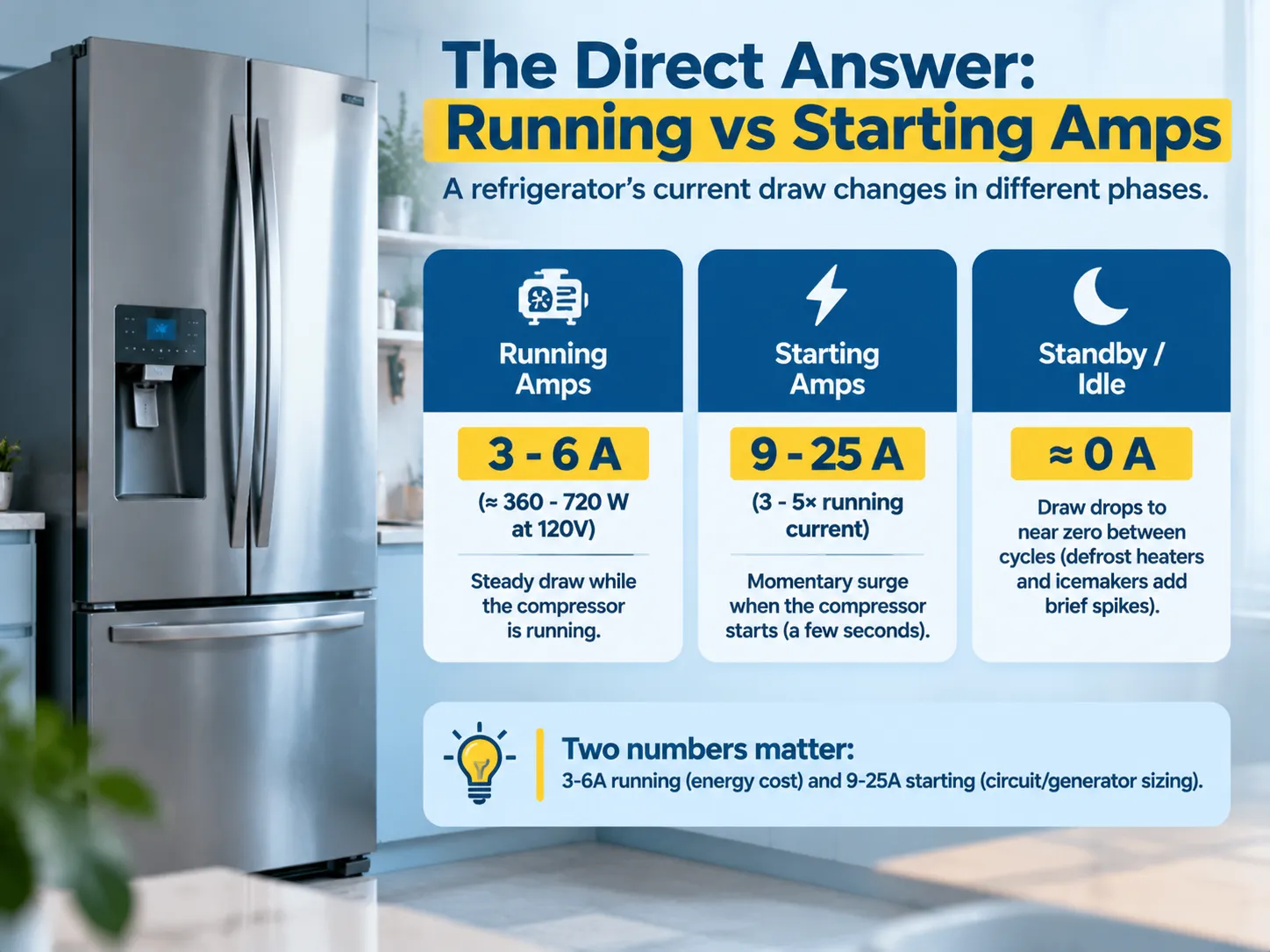
The Direct Answer: Running vs Starting Amps
A refrigerator does not pull a continuous current. Its operation involves cycles: the compressor is turned on, works, then turned off, after which the cycles repeat. The load varies greatly between different phases:
- Running amps are the current drawn while the compressor is operating, usually producing between 3–6 A for an average refrigerator at 120V (360–720 W).
- Starting amps (or inrush) denotes the instantaneous peak of electrical consumption by the device when it starts working. The typical inrush current is 3–5 times the nominal one: so the refrigerator consumes around 9–15 A for a short time after the initial startup and approximately 15–25 A for large refrigerators with dual compressors.
- Standby or idle means that the appliance draws very low current during the intervals between cycles, but during this time the frost-prevention heating circuits and ice makers may add short spikes to the total consumption.
Thus, there are two answers to the question of “how many amps does a refrigerator draw?”: the refrigerator draws 3–6 A in active mode and 9–25 when starting. The running value is the one that determines energy costs, while the starting value is the one you need to size your circuits and generators. And since the surge lasts only for a brief period of time, a circuit breaker rated for running consumption is sufficient to deal with it. The only time an overload occurs in the circuit is when other heavy devices are also used at the same time.
How Amps Vary by Refrigerator Type
| Refrigerator Type | Running Amps (120V) | Estimated Starting Peak |
|---|---|---|
| Compact / mini fridge (5-10 cu ft) | 1.0-2.5A | 3-8A |
| Standard top/bottom freezer (10-20 cu ft) | 3-5A | 9-15A |
| Large French door / side-by-side (20+ cu ft) | 5-8A | 15-25A |
There are numerous factors that affect these figures: bigger capacity means more cooling capacity and thus more amps when in operation, dual compressors (French-door fridge models with separate refrigeration and freezing systems) result in bigger running current and starting currents, ice makers and defrosting heaters give momentary spikes in current use whenever they operate, while ENERGY STAR efficiency lowers running current; currently available models can use about 1-2A less than their counterparts from ten years ago, because variable speed compressors now eliminate surge problems.
What Affects a Refrigerator’s Current Draw
Four factors of actual refrigerator use influence power consumption:
- Ambient temperatures: fridges in hot kitchens or garages require more compressor work and electricity consumption.
- How often you open the door affects temperature maintenance: less frequent door openings ensure that the compressor works less.
- Thermostat controls: colder settings require the compressor to work more.
- Voltage level: during brownouts or when using small wire diameter just to use current
If your refrigerator trips a breaker mostly in summertime or whenever other appliances are on in the same circuit, it happens due to the points mentioned above, and fixing the problem assumes you use different wiring, not just another refrigerator.
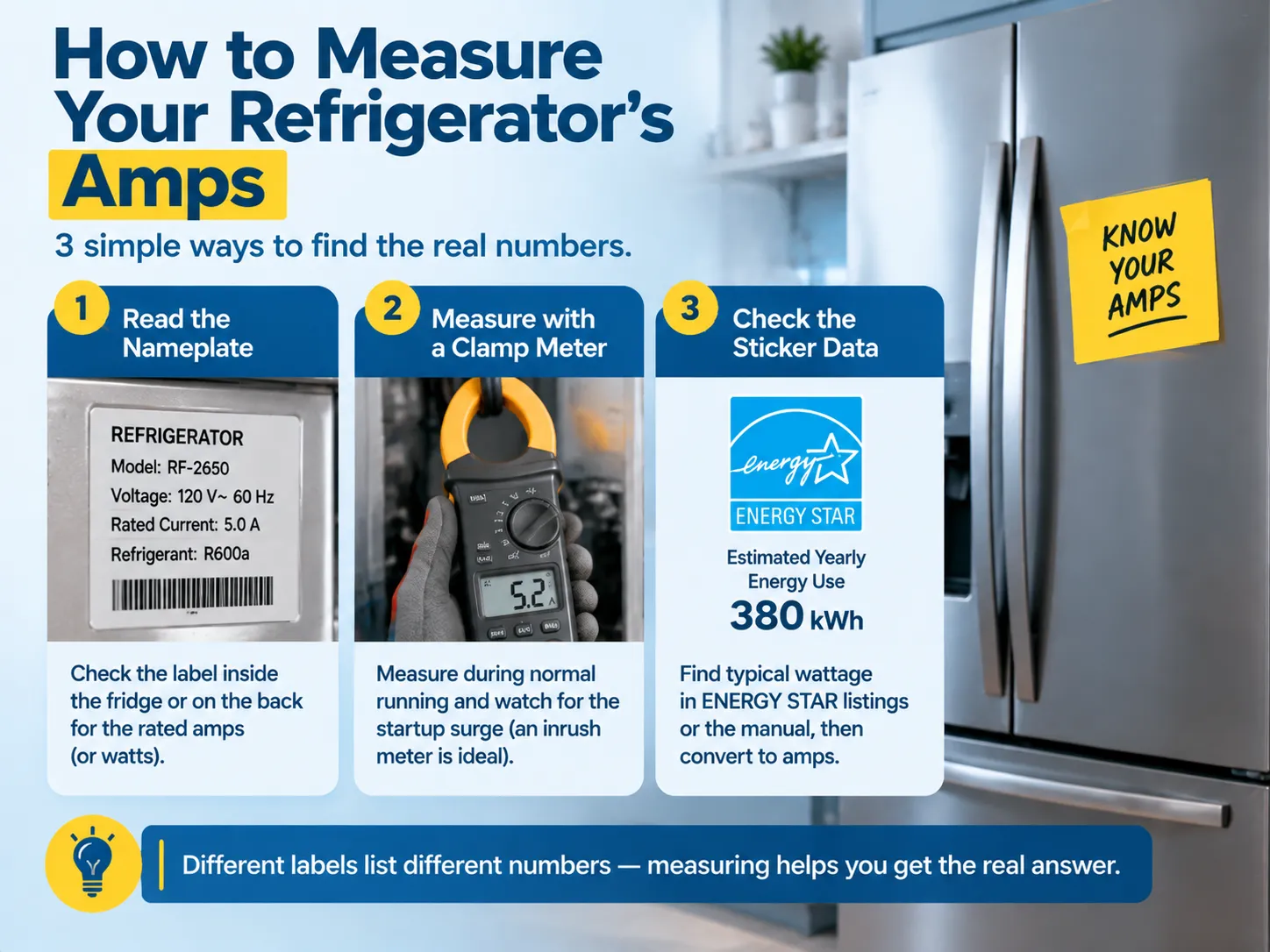
How to Measure Your Refrigerator’s Amps
There are three ways to find the actual real numbers of your unit:
- The nameplate shows rated voltage and amperage (you can find amps by dividing watts with voltage. There is a difference between UK and US voltage). The nameplate often states “rated current” which refers to the running number.
- Use the clamp meter. Place it around one hot wire to get the live current measurement during the normal cycle to get running amps out of it. If you would like to see the surge, measure during starting the compressor (choose a meter with inrush capture).
- The sticker has energy use numbers as well as kWh rating that will give you the average running amps of your unit.
Why measuring is important? It is because nameplate values differ (some show surge (maximum) rating); some values show running currents so knowing what you have helps prevent undersizing and unnecessary worries.
Circuit Requirements and Choosing the Right Outlet
The circuit issue is where the confusion of most homeowners exists, and the guidelines are quite straightforward:
- A dedicated 15-amp circuit is able to work for almost any refrigerator at home. The 80% rule of the National Electrical Code for continuous loads limits the current of a 15-amp circuit to 12 amps. Most refrigerators consume between 3 and 6 amps, which makes the surge of 15 amps not trip the circuit, meaning that nothing else connects to this circuit.
- The best practice for the National Electrical Code states that a dedicated circuit is the best option. The refrigerator must have its own branch circuit, whether it be 15A or 20A, so that it can avoid the chance of the load exceeding the electrical capacity when there is no one home. There is a good chance that you could face problems with the food getting spoiled due to the circuit being tripped and no one being around to take care of it. The guidelines of the NEC 210.52 indicate the specifications for installing outlets in kitchens and it is common in garages and basements to have a dedicated outlet for refrigerator use.
- You should choose the wire gauge according to the circuit. If you install it for a 15A, you need to use 14 AWG.
- Always avoid using an extension cord or power strip when plugging in a refrigerator. It is very dangerous. When you use long extension cords, you risk an electrical hazard of long periods and continuous power supply to the appliance. Therefore, the refrigerator must be plugged into a properly grounded outlet.
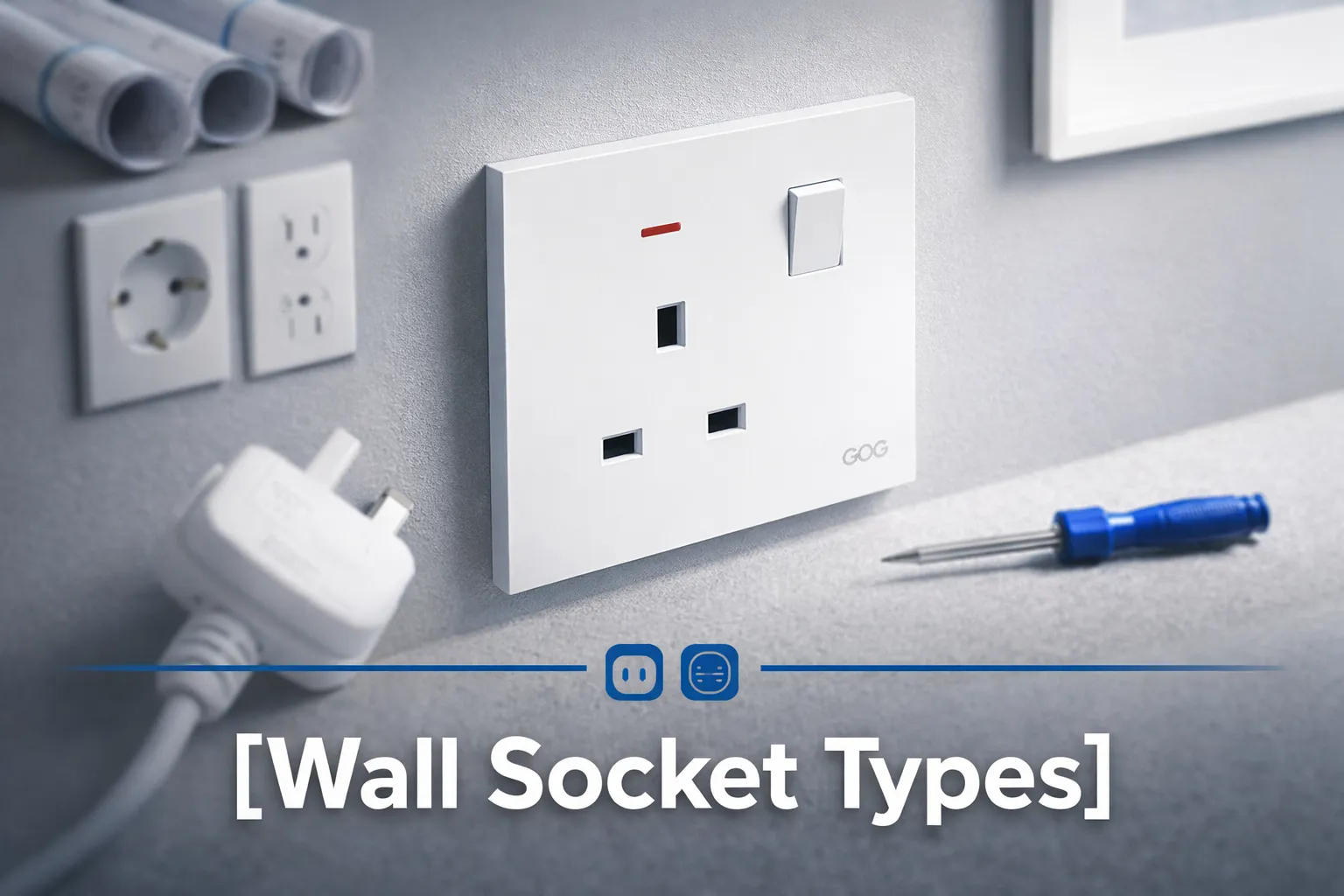
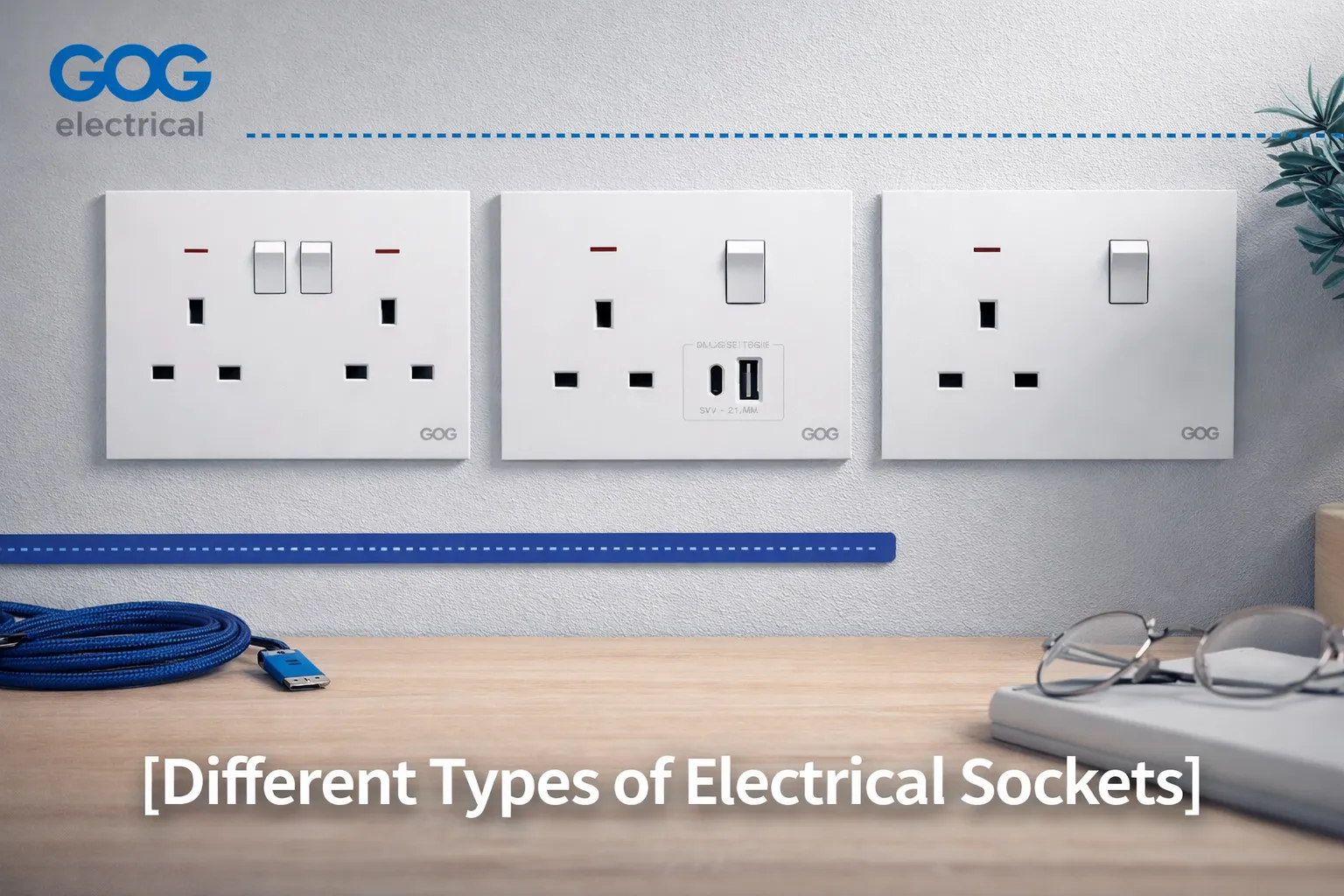
If your fridge shares a circuit and trips breakers only when other devices run, the correct fix is a dedicated circuit — and understanding the outlet types on that circuit, as explained in the wall socket types guide, prevents mismatches during installation.
Generators, Freezers, and Combined Loads
In terms of backup-power planning, the issue is always surge capacity. A 2000-watt generator is capable of delivering approximately 16.6A at 120V, thus providing enough surge capacity to run a standard fridge (around 500-700-watt worth of power) together with a small chest freezer (about 150-300-watt worth of power), provided that the surge ratings of the appliances does not exceed the surge capacity of the generator. A common advice to follow in such cases is to take into account the power consumption of every device that will be connected to the generator, as well as starting surge of the most powerful device and ensure the combined total surge does not exceed the limits of the generator.
General recommendations include starting the fridge first and waiting for the surge to dissipate before switching on the freezer.The circuit-breaker side of generator connection — how breakers behave under load — is the domain of the 120V vs 240V outlet guide when you get into higher-power backup systems.
FAQ
Can a refrigerator run on a 15 amp circuit?
Yes it is possible for common household refrigerators to be run without any safety problems using a 15-amp circuit since the amount of power that is drawn during operation is under the 12 amp limit in addition to the fact that the starting current surge will not exceed the 15 amps cutoff for the breaker. A good recommendation is to use a separate 15A circuit in order to diminish any chances of overload issues arising, however, sizable dual-compressor systems would require a wiring system using a 20 amp breaker.
Will a 2000 watt generator run a fridge and freezer?
In most cases yes, being that the 2000W generator is capable of generating energy in the region of 16.6 Amperes at 120V, which is sufficient to power a typical fridge (500-700W) and a modest-sized freezer (150-300W) simultaneously provided they do not consume more energy upon starting, than the producer’s maximum operating threshold. To keep from overloading the generator, it is necessary to start the refrigerator first, letting the high power demand disappear before switching on the freezer as high-end models of French fridges have high start-up surges.
Can I run a refrigerator and a freezer on a 20 amp breaker?
Yes it is possible because a dedicated 20-amp circuit can be easily used to power a refrigerator and this separate freezer at the same time, given that the combined energy consumption of both systems (5-9A) is below the limit for this kind of circuit and it is rare for both appliances to start at the same time. The final energy consumption should also be calculated accurately in cases when the appliances are large and placed in a hot environment in order to stay within the prescribed limits of a circuit.
Can you run a refrigerator on a 30 amp breaker?
It is completely successful and safe to power the refrigerator using a dedicated 30A circuit, given that it has got more than enough capacity for powering this kind of appliances. However, this approach will normally violate the requirements of the wiring system, being that it will need excessively thick wires that are 10 AWG thick.
References
- MyElectricCalc — How Many Amps Does a Refrigerator Use?
- EcoFlow — How Many Amps Does a Fridge Use? (2026 Guide)
- EngineerFix — Can a Refrigerator Be on a 15 Amp Circuit?
- CookCube — Is 15 Amp Enough for Refrigerator?
- NFPA — National Electrical Code (NEC) 210.52
Conclusion
What amount of electrical current does a fridge actually utilize? It can take two forms; while functioning it consumes approximately from 3 to 6 amps, while when the compressor starts working it is supplied by 9-25 amps for a short period of time. The final amount of consumed electricity in the bill is calculated based on the information about the working current, while the needed power during start-up impacts the system of electricity supply. The actual size of your appliance along with its efficiency level and ambient temperature influence both of these figures, therefore, you will have to check the rating sticker or the clamp meter to find out the answer. As for the requirements for electrical circuit, they are quite understandable and follow the regulations: the socket should provide at least 15 A (20 A in terms of larger models).