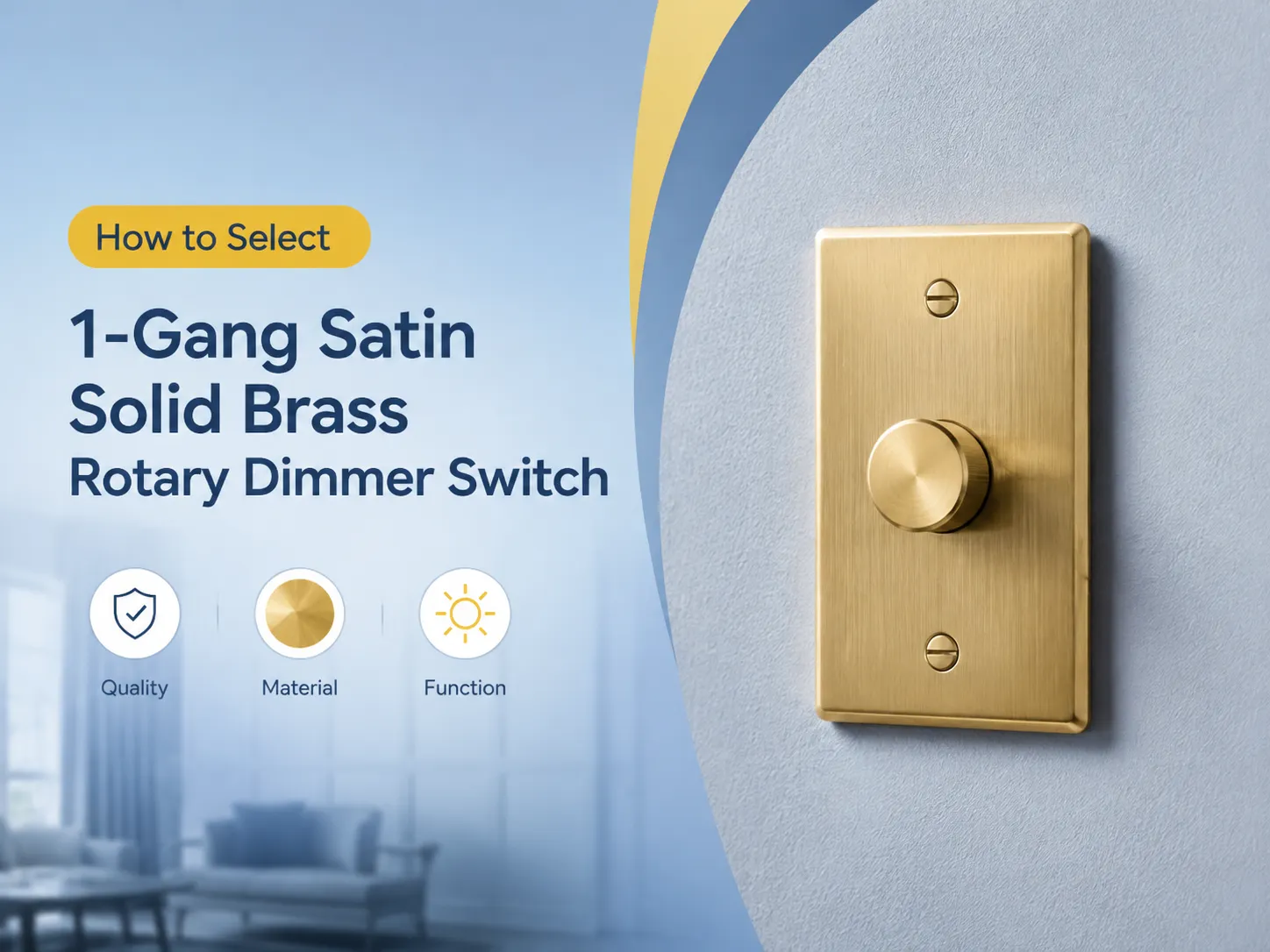
If you’re working on a renovation of a period property, outfitting an industrial-style loft, or just want a switch that gives the impression of costing much more than it actually does, a satin solid brass rotary dimmer is one of the more satisfying details you’ll be able to buy. But “select 1-gang satin solid brass rotary dimmer switch” actually involves six different choices associated with it — getting any of them wrong means that you’ll end up with a dimmer that’s buzzing, flickering, or not working with your circuit. This guide will run through each of the aspects of the specifications, discuss brands that are worth your money, how much it ought to cost, as well as how to install and use it properly.
Brief explanation: A 1 gang satin solid brass rotary dimmer switch refers to a wall dimmer with a single plate (1 Gang) made of brushed brass without lacquer with rotary control. Proper selection depends on matching five criteria: (1) Gang, (2) wiring, (3) type of load and its wattage, (4) finishing, (5) certification.
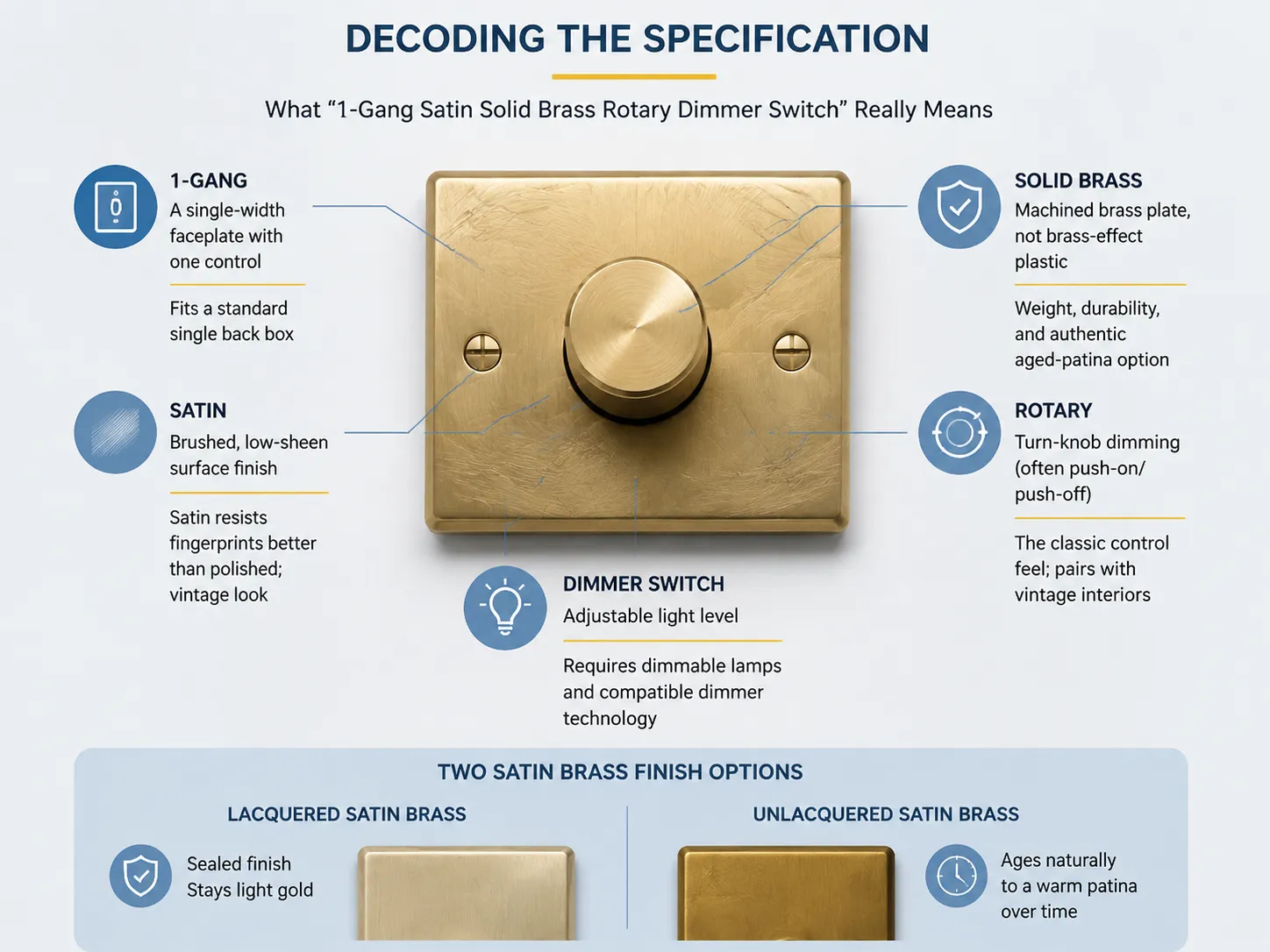
Decoding the Specification
Each term in the expression “1-gang satin solid brass rotary dimmer switch” has a particular meaning.
| Term | Meaning | Why It Matters |
|---|---|---|
| 1-gang | A single-width faceplate with one control | Fits a standard single back box; 2-gang is two dimmers side by side |
| Satin | Brushed, low-sheen surface finish | Satin resists fingerprints better than polished; the vintage look |
| Solid brass | Machined brass plate, not brass-effect plastic | Weight, durability, and the authentic aged-patina option |
| Rotary | Turn-knob dimming (often push-on/push-off) | The classic control feel; pairs with vintage interiors |
| Dimmer switch | Adjustable light level | Requires dimmable lamps and a compatible dimmer technology |
The “satin solid brass” finish deserves special attention: it denotes either satin brass lacquer plate that stays in its light golden color or satin brass that changes its color into the patina. And instead of the style of knob that we may think of, anyone who decides to buy high-ceiling quality dimmers should know that the rotary knob is usually a push-on switch: its turning is for dimming. The switch-family context — where rotary fits among rocker, touch, and smart controls — is covered in the types of light switch guide.
The Five Checks Before You Buy
In order to identify a dimmer that functions properly from one that emits buzzes, flickers, or does not work at all, consider five different checking points:
- The type of load: Is the load a type of LED or incandescent? To dim LEDs, an LED rated dimmer with a low minimum load should be used that says ‘LED ready’ and typically has to have a capacity of 0-120W. Incandesced and halogen loads require dimmers with the capacity of 60-400W. It is not advisable to mix the two types of loads in one circuit as this may lead to flickering of LED lamps and their damage.The compatibility logic is detailed in the LED dimmer compatibility guide.
- The type of wiring: Is it a one-way or a two-way circuit? A one-way circuit is used in most rooms since it has one switch operated by a light. A two-way circuit is used in rooms with two switches controlling the same light source, for example, the hallway or staircase. When a two-way switch is needed the dimmer should indicate that it’s the first or second type.
- Minimum load as well as trailing or leading edge. Dimmers made for LEDs have minimum load specifying: new cards of LEDs have a minimum load of 0-5W while older designs require minimum load of about 20W. The edge-type of the dimmers should be also indicated. The best type of dimmer for LEDs is trailing-edge type since they make minimum noise and suit LEDs better.
- Compliance with standards. Dimmers for sale in the United Kingdom have to comply with BS EN 60669 standard and be marked with UKCA/CC symbols. They also have to be labeled with voltage of 230V and to have terminals for the cable which size is 1.5mm².
- The finishing type of the dimmer and the depth of the back box. The dimmers made of solid brass will have a thicker plate compared to plastic dimmers, thus check the depth of the back box (it should be 25 or more) and make sure that the plate screws match the required dimensions.
After verification of the mentioned points, choosing an appropriate dimmer should not take you much time.
Brands and Price Ranges
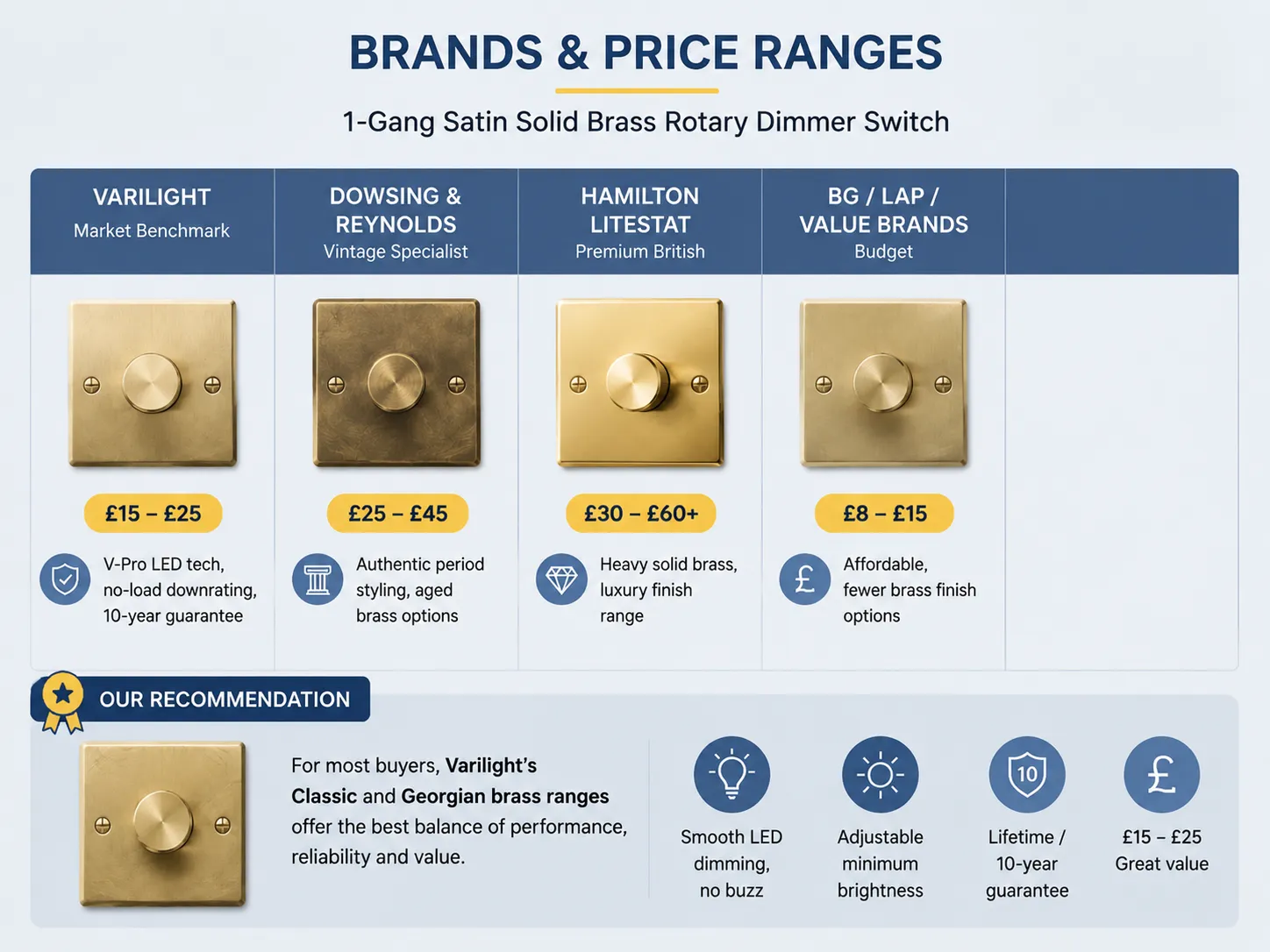
The brass rotary dimmer market can be separated into a distinct benchmark and a premium tier:
| Brand | Position | Typical Price (1-gang brass rotary) | Standout Feature |
|---|---|---|---|
| Varilight | Market benchmark | £15-25 | V-Pro LED tech, no-load downrating, 10-year guarantee |
| Dowsing & Reynolds | Vintage specialist | £25-45 | Authentic period styling, aged brass options |
| Hamilton Litestat | Premium British | £30-60+ | Heavy solid brass, luxury finish range |
| BG / LAP / value brands | Budget | £8-15 | Affordable, fewer brass finish options |
Most consumers are advised to purchase either of the Varilight Classic or Georgian brass collections; these consultant-grade brushed and polished brass rotary LED dimmers with V-Pro technology can be bought for £15-25 and provide a smooth dimming of LEDs without buzzing, a minimum brightness that can be tweaked, and a lifetime guarantee of 10 years. If the appearance is the most important aspect, than Dowsing & Reynolds is the best option. In the case of high-end models, Hamilton is the best place to go for high-quality products. The question of which brand actually makes the best dimmer — and how the leading-edge technologies compare — is examined in the best dimmer for LED lights guide.
Where This Dimmer Belongs
The satin solid brass rotary dimmer has particular spaces where it has a right to be — and choosing not to use it in other areas may help one save some money:
- Historical properties and buildings: brass fixtures and switches do very well in Georgian and Victorian settings, and the satin finish works very well with antique brass fittings.
- Industrial-style and retro-style homes: real brick walls, metals with dark coating, and Edison light bulbs are the places where one can see a rotary switch made of brass.
- Living spaces: dimmers work very successfully in case one needs to change light levels regularly; since the knob indicates the level of dimming, it is easier to control it than a hidden switch.
- Halls and bedrooms with lighting controlled with 2 switches: make sure to buy the version designed specifically for the 2-switch setup, so that the second switch still works.
Cons in your purchase: avoid kitchens and bathrooms which are exposed to high level of humidity (take certified IN-rated dimmers instead) and circuits with LEDs that are not designed for dimming. If you are planning dimmers room by room, the broader case for dimming — ambience, lamp life, and energy — is made in the advantages of dimming switches guide.
Installation and Use
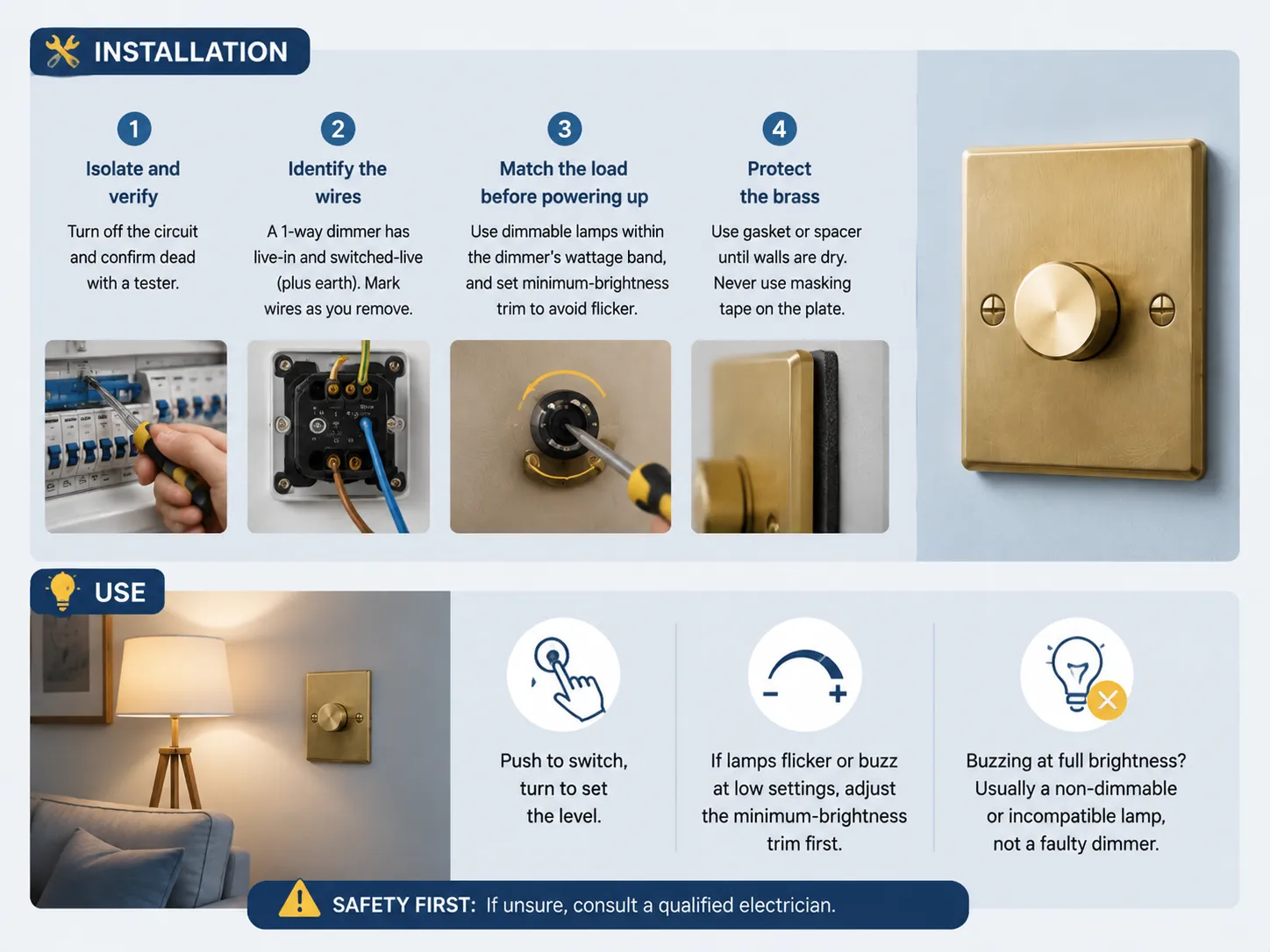
A 1-gang dimmer is typically a straightforward installation. It involves four significant stages:
- Isolate and check. Disconnect the circuit from the mains supply and ensure that there is no electricity with the help of a tester.
- Identify the wiring. The connections for a one-way dimmer should include the live-in and switched live wiring. The two-way dimmer has the two strappers/communication connections as well. While removing the existing switch, take note of the wiring.
- Ensure compatibility before energizing. Make sure the light-bulbs can be dimmed and that they are within the dimmer wattage rating and make the necessary adjustments of the minimum brightness.
- Protect the brass. Never place a metal plate against fresh plaster; rather, use a spacers or a gasket from the manufacturer until the wall drys out, as well as do not use any kind of adhesive on the plate.
In operation, a rotary dimmer is quite basic: you push the button to turn on and turn the dial to adjust the setting. If the lamps are flickering or making noise, it is important to adjust the minimum brightness before assuming that the dimmer is faulty; if the lamp makes noise at full brightness, it is usually because the lamp is not the right kind for that particular situation.
FAQ
What is a 1-gang 1-way dimmer switch?
A single gang single way dimmer is one plate that has one dimmer control installed on the electrical circuit in such a manner that dimmer control is the only electrical controlling point of light. The word gang refers to the number of controls on the plate whereas way represents the number of locations of the switches controlling the light in the electrical circuit. A one gang two-way dimmer will work when the light is also controlled by another switch installed somewhere else in the electrical circuit.
Who makes the best quality dimmer switches?
For the dimming of LED lights, Varilight is recognized as the standard in the business with its V-Pro technology that enables smooth and quiet dimming of LEDs at affordable price levels and with the guarantee for 10 years. At the premium level manufacturers Hamilton Litestat and Dowsing & Reynolds produce high-quality dimmers in terms of design and material. Lutron is the best in the area of smart and advanced control systems. The choice of the best quality brand depends on the type of load, the budget, and the finishing requirements.
What is a rotary dimmer switch?
A rotary dimmer is the dimmer controlled with the help of twisting the knob and unlike the dimmers having touch slider or being push button. Most of good quality rotary dimmers function by turning the knob. Rotary design is considered to be classical that matches properly to brass and vintage plates.
How much would an electrician charge to change a dimmer switch?
In the UK, the cost of changing a regular dimmer switch may account for 40 to 90 pounds including the fee of call-out and labor, but the cost of materials will be added separately. In the United States the cost of swapping a dimmer switch will be about 75-150 US dollars. The job can be done within thirty minutes by a person experienced in working with the mains.
References
- B&Q — Varilight 1-Gang Rotary LED Dimmer, Brushed Brass
- Switch Socket and Supplies — Varilight Dimmer Range
- The Lighting Company — Brass Switches and Dimmers
- UK Electrical Supplies — Varilight Victorian Brass Rotary Dimmer
- Varilight — Official Site (V-Pro Dimming Technology)
Conclusion
The choice of 1-gang satin solid brass rotary dimmer entails a number of decisions at once: determining the 1-gang nature of the dimmer for a single back box, choosing the satin-solid-brass finish (whether lacquered or not), selecting rotary to choose push-and-turn technology, and most importantly, figuring out the type of load used and the wiring. By doing so, shopping for one is very easy: Varilight’s brilliantly-crafted brass products sell for £15-25 and come with a 10-year warranty, Dowsing & Reynolds and Hamilton items focus on retro designs and quality construction, while cheap products fill in the rest of the market niche. It takes half an hour to install the dimmer if you are familiar with wires, though: isolate it, check load compatibility, protect the dimmer from wet plaster, etc. And the outcome is a dimming solution that fits in the interior and meets modern requirements at the same time.