The King of Prussia area occupies a special position in North America’s electricity industry. While Upper Merion is an area located within the township with a lot of retail and locations helping to create offices because of the malls filled with stores, its surrounding neighborhoods are made of homes that were constructed from the 1960s to 1990s with obsolete wiring. The expectations of residents for smart switches provided by their customers are coming from two kinds of customers. The first one is represented by residential customers willing to operate their properties without breaking the walls and the second one is represented by those managers within commercial offices needing the most reliable switch options. In this blog, you will find out more about different products that can be purchased in the King of Prussia area regarding their prices and effectiveness of working.
Smart switches offered in King of Prussia encompasses four range of devices: budget Wi-Fi switches (TP-Link Kasa/Tapo, Wyze, GE Cync; $15-$30), mid-range dimmers and multi-way kits (Leviton Decora Smart, Enbrighten, Belkin Wemo; $25-$90), premium consumer brands (Lutron Caséta, Philips Hue wall switches; $60 -$180) and professional installations through partners (Lutron RadioRA 3, Control4, Crestron; $150 -$400+ per control). You will have to consider three items before making the purchase: does the control box have a neutral wire (most of the KOP homes were built before this feature became standard); what sort of load do you need the Smart switch for (LED dimming compatible, fan loads, low wattage lamps); and how deep does your plate box need to be (single gang, double gang and triple gang as Smart switches usually require a deeper plate box).
Why smart switch demand is high around King of Prussia
The buyer’s choice is influenced by four main local realities:
- Aging suburban wiring. For approximately 40 years (1955-1995) a large percentage of the real estate has been constructed in a way that the switch loops do not have the neutral wire and thus Wifi smart switches cannot be used.
- Commercial and rental density. The existing offices, shopping malls, health clinics and apartments require that their switches can be easily scheduled, remotely controlled and replaced without the need of custom programming.
- Work from home energy efficiency upgrades. The shift to remote work as well as increase in electricity costs has made occupancy sensing, scheduling and dimming solutions more desirable than ever before besides being fashionable.
- Retail availability. In the region, the variety electrical products is amazing: there is an abundance of home improvement outlets (home centers), consumer electronics stores and electrical wholesale houses where contractors buy supplies.
In conclusion: in King of Prussia they rarely ask, “is there anything I can buy?” but “which product will fit with my wiring and lights?”
The brands you will find, and what each is good at
| Brand / family | Strengths | Main products | Best for |
|---|---|---|---|
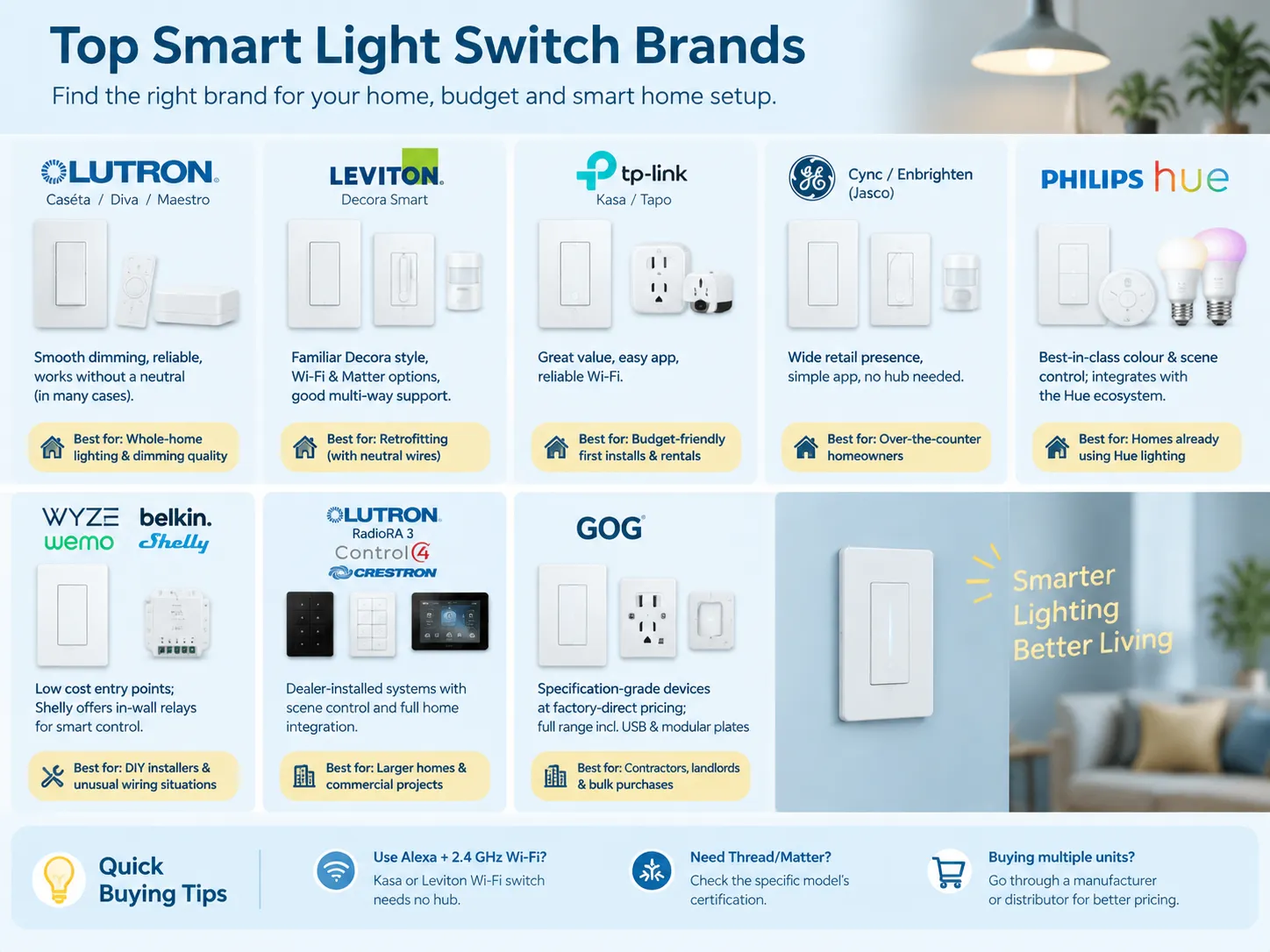
| Lutron (Caséta, Diva, Maestro) | The dimming benchmark — smoothest LED performance, rock-solid reliability, works without a neutral in many configurations | Smart dimmers, switches, plug-in lamp dimmers, remotes, hub | Whole-home lighting where dimming quality matters most |
| Leviton Decora Smart | Familiar Decora form factor, broad availability, Wi-Fi and Matter options, good multi-way support | Wi-Fi switches, dimmers, motion sensors, fan controls | Straightforward retrofits in homes with neutral wires |
| TP-Link Kasa / Tapo | Aggressive pricing, easy app, reliable Wi-Fi performance | Wi-Fi switches, dimmers, 3-way kits, plugs | Budget-conscious first installs and rental units |
| GE Cync / Enbrighten (Jasco) | Wide retail presence, simple app, no-hub design | Switches, dimmers, motion switches, fan controls | Homeowners buying over the counter |
| Philips Hue (with wall modules) | Best-in-class colour and scene control; integrates with its own ecosystem | Wall switch modules, dimmer remotes, bulbs | Homes already invested in Hue lighting |
| Wyze, Belkin Wemo, Shelly and similar | Low-cost entry points; Shelly offers in-wall relays that make dumb switches smart | Wi-Fi switches, in-wall relay modules | DIY installers and unusual wiring situations |
| Lutron RadioRA 3, Control4, Crestron | Dealer-installed systems with engraved keypads, scene control, and integration with blinds, HVAC, and security | Whole-home lighting control platforms | Larger homes and commercial projects where reliability and support matter |
| GOG and other certified wiring-device manufacturers | Specification-grade switches, sockets, and smart devices at factory-direct pricing; full range including USB-integrated sockets and modular plates | Switches, dimmers, sockets, smart controls | Contractors, landlords, and buyers furnishing multiple units or private-label programs |
The important buying advice here is “one brand matters less than the ecosystem.” For instance, if your home uses Alexa and a 2.4 GHz Wi-Fi network, there is no need to purchase a hub for a Kasa or Leviton Wi-Fi switch. Further, breakthroughs in Thread/Matter interoperability are not to be believed based upon a name. Instead, verify the actual certification of the particular item you are considering. If you are doing multiple installations, do some thorough research on costs from the source manufacturer or distributor and not merely from a single retail package. The same logic applies across the board with wiring devices.
What smart switches cost in the King of Prussia market
| Tier | Typical device price | Notes |
|---|---|---|
| Basic Wi-Fi on/off switch | $15-30 | No dimming; requires neutral; app + voice control |
| Wi-Fi dimmer | $25-50 | Check LED compatibility list before buying |
| 3-way / multi-way kit | $40-90 | Often sold as a kit with a companion switch or remote |
| Motion-sensing smart switch | $35-70 | Useful for hallways, laundry rooms, and commercial restrooms |
| Premium consumer dimmer (Lutron Caséta class) | $60-110 (hub $80-110) | Best LED dimming performance; some no-neutral options |
| In-wall smart relay (Shelly class) | $20-40 | Makes existing switches smart; needs box space |
| Professional platform point (RadioRA 3, Control4) | $150-400+ per point, installed | Dealer programming, engraved keypads, whole-home scenes |
| Professional installation labor | $40-120 per device locally | Varies with box condition, wiring, and whether a neutral must be run |
Local buyers find themselves ensnared in three cost traps. The first is that a “cheap” Wi-Fi switch that requires a neutral is likely to result in a higher cost once you include electrician installation. Second, you may need to buy the right dimmer twice because of LED compatibility issues. And third, you may need a companion device or a dedicated three-way switch to control a light from two locations — simply purchasing two standard smart switches may not work.Understanding the plate and gang configuration before you order prevents most of these surprises, and the terminology is explained in our guide to 1-gang, 2-gang, and 3-gang switches.
Wiring and technical checks before you buy
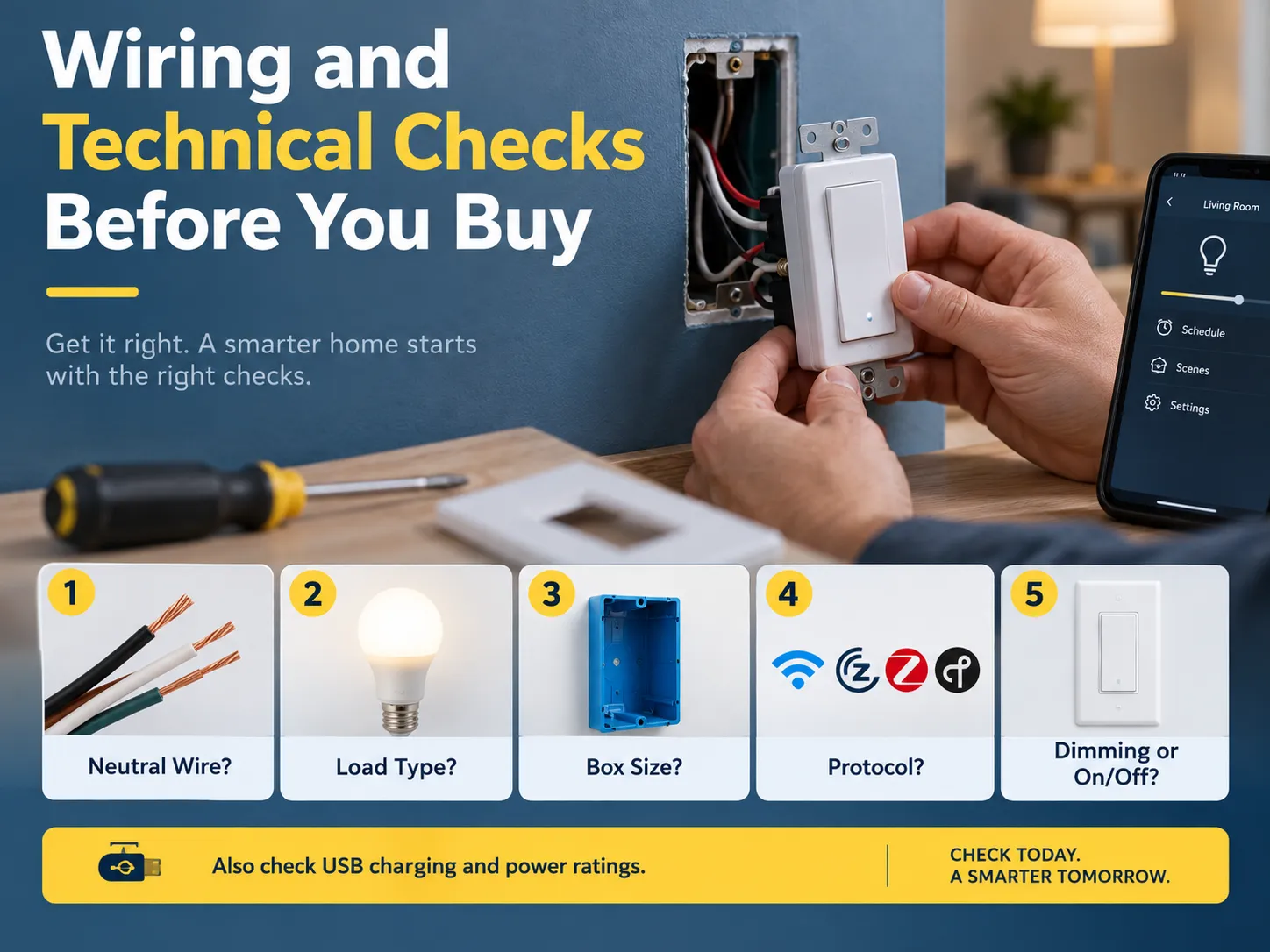
You can narrow down your choices of smart switch by taking five considerations into account:
- Does your switch box have a neutral wire? Most smart Wi-Fi switches require a neutral. In an older home, the switch loop may contain only a hot leg and a switched leg with no neutral. There are three options: 1) install a neutral (but you will need the services of an electrician), 2) select a model which does not require a neutral (there are several choices in the line of Lutron Caséta products and others), 3) or use an in-wall relay near the fixture where a neutral is available.
- What is the load? LED lights can vary considerably in their dimming capabilities. Check the information published by the manufacturer of the dimmer to find its LED load range and compatibility. For example, a dimmer rated at 300 W incandescent may only be suitable for 50-100 W of LED. Remember that ceiling fans require special fan-speed controls and that using a dimmer on a ceiling fan can result in both inefficiencies and dangerous situations.
- How many gangs do I have and how deep is the box? Smart switches are typically thicker than an ordinary switch. Therefore, a box with too much wiring may not be able to accommodate a smart switch (in which case, you will need an extension, or a deeper box).
- Which protocol does my system use? There are three protocols commonly used in homes today: Wi-Fi, Zigbee/Z-Wave, Thread/Matter, or a proprietary system. It is usually better to use the protocol used in your own system than to start a new protocol.
- Do I need dimming, scene control or just on/off? If you want to create scene programming, scheduling, and integration with other devices, you are looking for a more advanced system than a simple switch. Otherwise, you might just want to turn on your porch light at sunset, in which case a basic switch will do.
One more practical check specific to this area: if a project includes USB charging or power delivery at the wall, confirm the socket’s rating, because fast-charging USB sockets draw more than the basic receptacles many older circuits were designed around — the ratings and trends are covered in our USB charger socket guide.
How to choose the right smart switch
Follow this guideline to make a purchase that you can be satisfied with, and won’t have to make a new purchase due to not being satisfied.
Establish the correct wiring and switch first based on whether or not you are using neutral. Next is to select the appropriate dimmer based on the compatibility list given by the manufacturer. Protocol should be selected next based on the hub used. Prices should be compared based on the products’ performance based on dollars put into it; for example, a Wi-Fi dimmer costing $25 will give you about 90% of the overall functionality of a $300 platform point.
Here are two additional tips to keep in mind when making decisions. For one room, use only one brand of switch as the mix of the brands and devices will confuse the user. For home-wide projects, choose the protocol that will be used before choosing the switch as it will save time and be more effective.The trade-offs between connected switches and conventional controls, including when a smart switch is genuinely worth it, are discussed in our guide to what a smart switch actually delivers.And if your shortlist is down to the most popular models, our roundup of top-rated smart light switches compares the categories that matter most in practice.
Buying and installing locally
In the King of Prussia area, there are three different buying methods available to customers: retail stores for immediate and individual unit purchases, contractor pricing from electrical wholesale counters for bulk purchases, and purchasing through online channels for specialty models and kits. The wholesale and manufacturer-direct price breaks begin at about five units since volume pricing for wiring devices always means specification grade models from trusted manufacturers will be 20-40% lower priced than the premium retail brands with similar ratings.
Installation is fairly straightforward as a DIY project for any competent homeowner with hopefully no electricity present and with no complications regarding the box being used for the installation. However, there are three instances where it is required to use a licensed electrician for the installation, including when there is no neutral wire available in the existing box and running one is considered to be an official job; when aluminum branch wiring is to be worked on; and when the job is to be done in a commercial establishment or multi-unit facility where code and insurance requirements must be followed. According to Pennsylvania laws concerning electrician licensing, there is no state licensure process as is often the case in other states. Therefore, it is important to take the local city housing authority requirements and insurance needs into consideration when selecting an installer for your company or home.
For replacing your conventional dimmer switches at the same time, it is essential to remember that usually, the problem with LED dimmers not working correctly is due to a load compatibility issue and not a malfunctioning switch at all. This diagnosis should be done prior to returning the second unit to the store because it all relates to making sure that the necessary compatibility is actually present in order to prevent problems in the future.Genuine 3-way and 4-way circuits add their own constraints, and the traveler-wire logic behind multi-location switching is covered in our 3-way switch wiring diagram guide. For hallways and utility rooms, the third category to consider involves the use of motion switches and occupancy sensors as they tend to pay for themselves with just the convenience aspect.
FAQ
Do smart switches need a neutral wire?
The majority of Wi-Fi smart switches require a continuous neutral wire as its radio system needs a constant return path. In houses made in King of Prussia before the 1980s, the switch box is often equipped just with hot and switched lines. In such cases, hiring an electrician to establish a neutral line or selecting a model that does not require a neutral frame is possible. It is also possible to place an in-wall relay directly at the light fixture, which usually has a neutral line in it.
Are smart switches worth it in an older King of Prussia home?
In most cases, yes, because of wiring. For example, installing a no-neutral dimmer switch in a house built in the 1960s results in control through scheduling, dimming, and voice control however with no new wiring. However, if all rooms in the home should be connected to the same system through remote control of shades and thermostats, only after purchasing a complete home installation system would the smart dimmer become useful.
Can I install a smart switch myself?
Yes, if you do not have a problem with working in a non-energized box and have copper wiring with a neutral wire connected. First turn off the breaker and using a tester check that no power is in the box, and then take a photo of all previous connections. Make sure the depth of the box is sufficient for a smart device installation.
Do smart switches work with Alexa and Google Home?
Most commercial smart switch devices do work with both platforms although some require their personal hubs to operate. Manufacturers often create devices that support Matter for use with major ecosystems, and some do not support it. If you want to use your smart device through multiple ecosystems, consider purchasing a Matter certified product.
What about smart switches for commercial spaces in the King of Prussia area?
Commercial users should focus on specification-grade equipment and occupancy sensors for meeting safety specifications. An engineering design should allow for centralized programming and not depend on app programming for each device.
References
- Lutron — Smart Lighting Control Systems
- Leviton — Decora Smart Product Range
- Connectivity Standards Alliance — Matter and Thread Specifications
- UL Solutions — Wiring Device Safety Certification
Conclusion
It is easy to find smart switches within King of Prussia; however, the biggest challenge you will face is determining which switch will work best for you. The marketplace is filled with many options including $15 Wi-Fi switches and $25-90 dimmers, as well as specialized professional-grade platform switches that cost between $150 and $400. Brand loyalty will not help you identify which one you should select; rather, start by identifying whether you have a neutral in your switch box. Is the LED bulb you are using rated compatible with your dimmer? How many dimmers will be used, and how many wires will they require? It is time to conduct some research and start with the wiring. Determine how much load is required. Such factors as the current protocols utilized in your home as well as the cost are important as well. While most items sold in King of Prussia are returnable, always buy from a store with a return policy! Also, if your project requires the use of new wiring, it may be best to hire a professional electrician. Following these steps will allow you to have the seamless operation throughout your home while only need to purchase one brand per room.