A homeowner from Florida decided to change her regular outlet in her bathroom for a new GFCI receptacle. After pressing the TEST button and hearing a click, she thought that her bathroom now offered ground-fault protection. It does — but only for the outlets downstream of that GFCI. The ceiling light and the exhaust fan, which are on the same circuit and wired upstream from the GFCI, remain without protection. Six months later, the exhaust fan motor shorted and sent current to ground through the housing of the fan. The circuit breaker in the panel did not trip because the fault current was too low to trigger it. Given that the GFCI outlet would have detected the imbalance, it is clear that there was no issue to detect.
What Both Devices Do: The Shared Ground‑Fault Protection Function
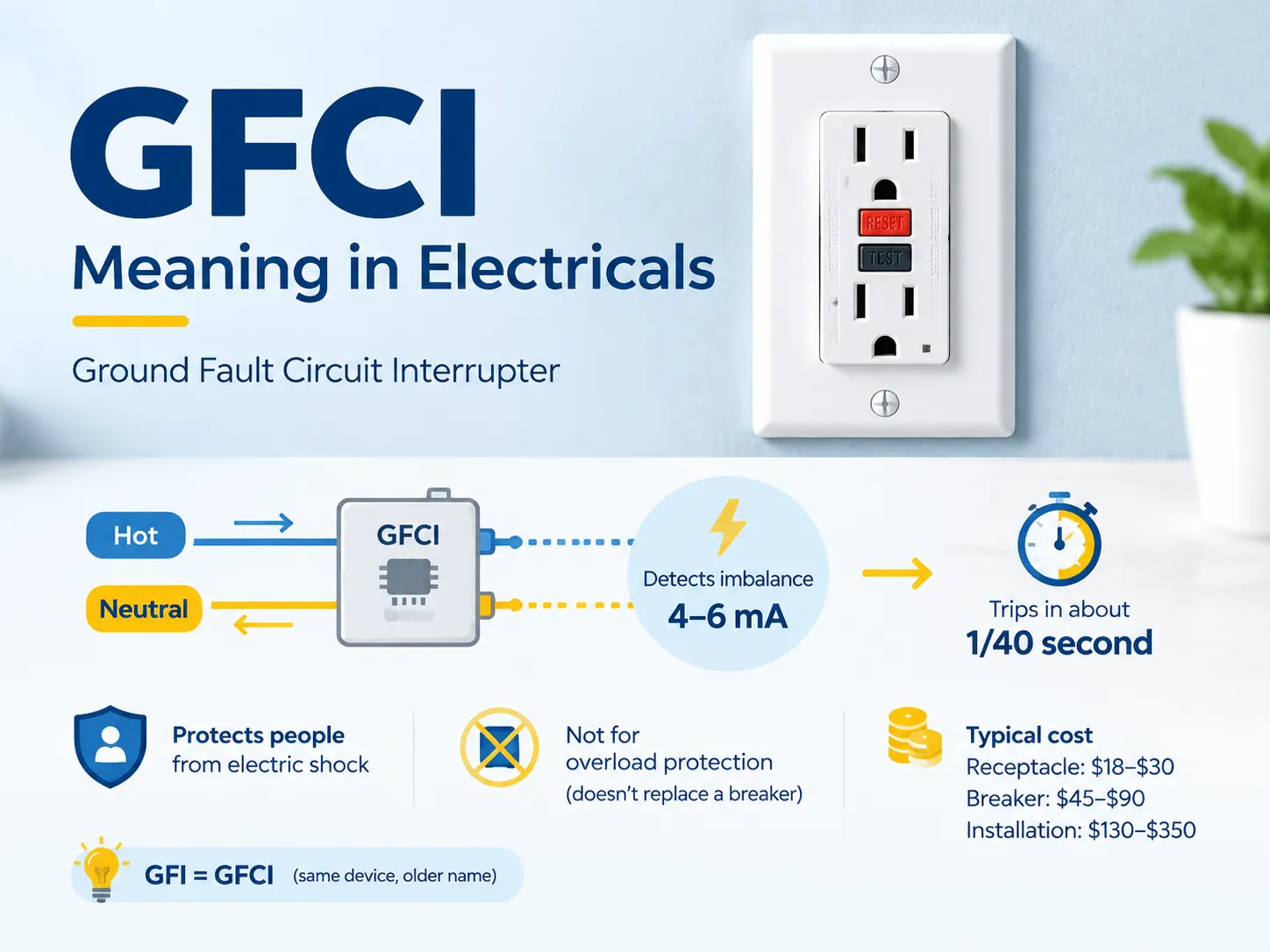
Before outlining the differences between them, it is useful to understand the function of a GFCI. A Ground Fault Circuit Interrupter, or GFCI for short, is an electrical device that continually compares the current on the hot wire with the current on the neutral wire. Under normal and functioning circumstances, the two readings should be equal. If a person accidentally touches an energized conductor or the current leaks through a faulty device cord, part of the current will not go back to the neutral wire, as it should, ending up elsewhere the GFCI will detect the error. What’s crucial about GFCI devices is that these are designed to detect differences as low as 5 mA. In Europe, for example, these devices can respond to discrepancies as small as 30 mA. Many believe it’s one of the biggest inventions in electric safety, as it has saved thousands from electrocution.
GFCI circuit breakers perform the same sensing and tripping function as GFCI outlets. The distinction lies in the way they act in relation to the circuit and what elements of the circuit are protected when tripped.
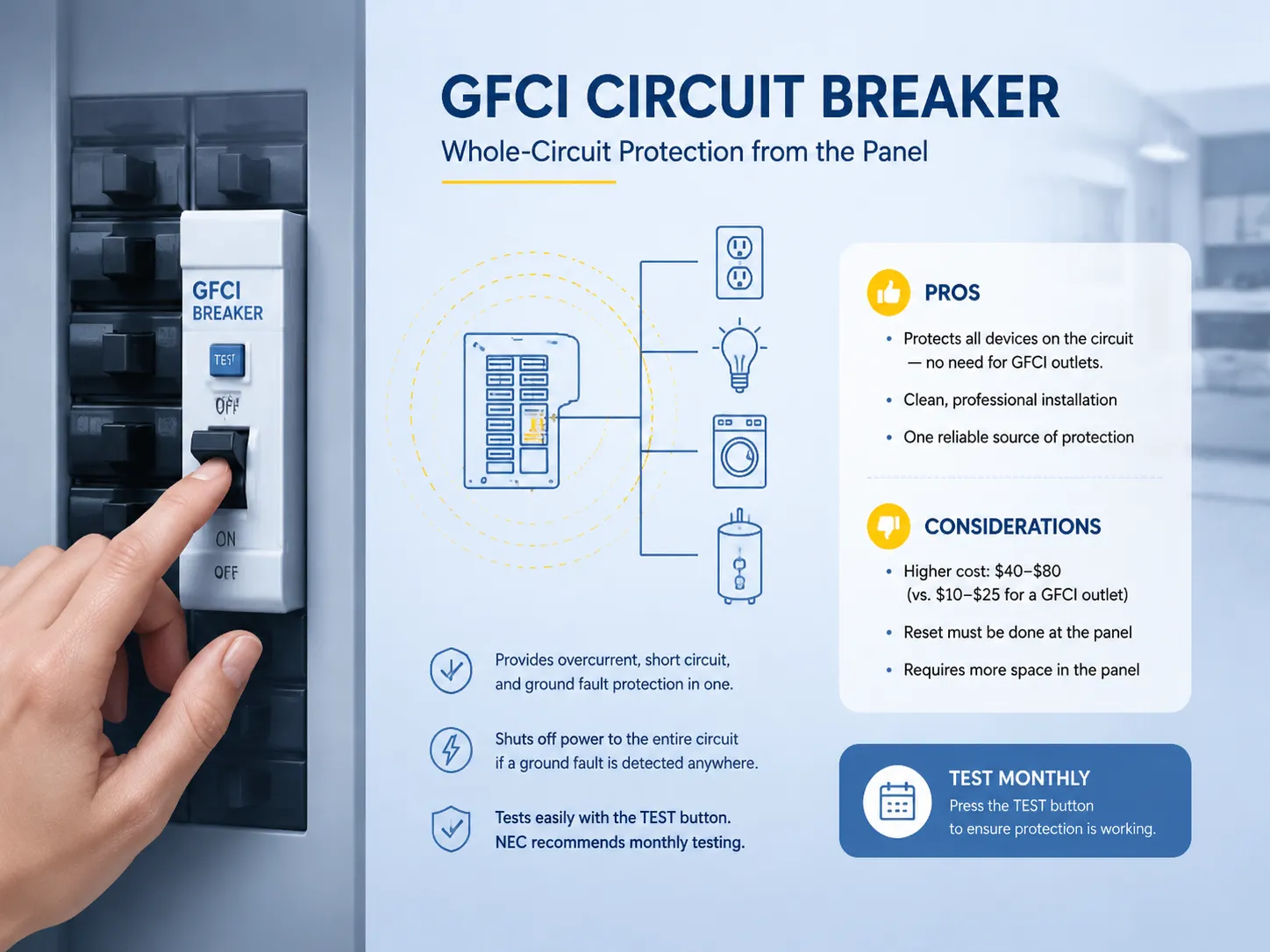
GFCI Circuit Breaker: Whole‑Circuit Protection from the Panel
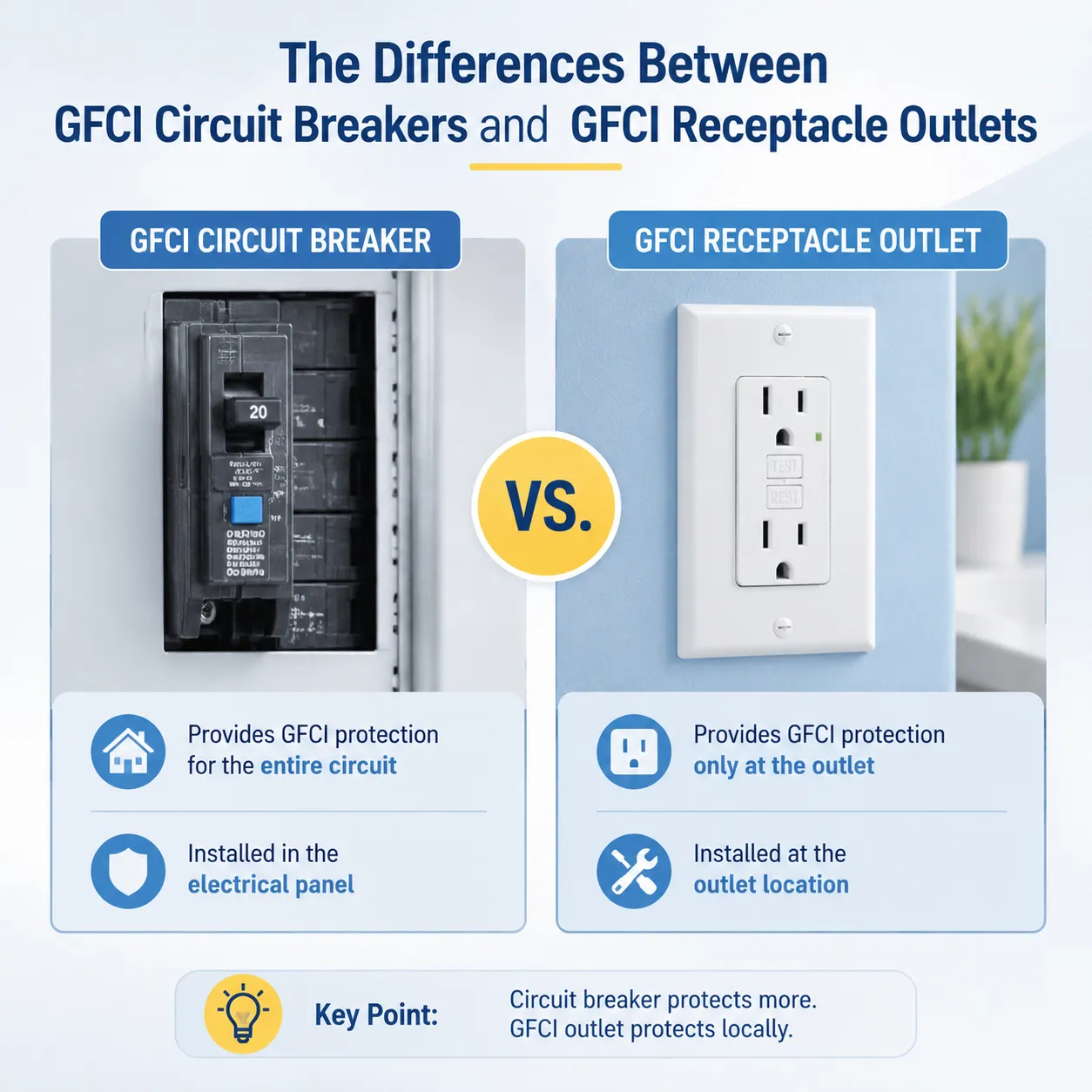
GFCI circuit breakers are utilized in the main electrical panels or load centers; operating in a similar manner and occupying the same space as regular circuit breakers. It acts in such a manner taking over two protective roles in one device – overcurrent and short circuit protection of regular breakers and ground fault detection of GFCI. If any ground fault occurs at any outlet, at any light fixture, or in a wiring, GFCI breaker cuts off the power completely. Each receptacle, each light, or any hardwired device is then secure. To reset the breaker, it is necessary to go to the panel, find the tripped breaker and reset it manually starting from the OFF position. Besides, GFCI breaker has TEST button that allows the user to check its operation without real ground fault. According to NEC, GFCI must be tested on a monthly basis and TEST button simplifies this task.
The GFCI breaker’s pros are its convenience and its clean installation. All appliances on the circuit would be protected without having to use GFCI outlets. You have just one source of protection and do not have to worry about finding the first outlet and the other outlets on the circuit. There are some cons as well; this breaker is more expensive than a regular GFCI; the price is somewhere between $40 and $80; while a regular GFCI outlet costs only about $10-$25. Another drawback is that in order to reset the GFCI breaker, you will have to go to the panel, which can be located either in the basement, garage or outside. The GFCI breaker is also larger than a regular breaker, so you have to set aside enough space for it in the electric panel. In old electric panels and those which are full, there may not be enough room to add this breaker without the upgrade of the panel or the installation of a sub-panel. For help selecting the correct breaker for your panel and your circuit, our guide on what size circuit breaker you need covers the ampacity and type selection process.
GFCI Receptacle Outlet: Point‑of‑Use Protection with Downstream Capability
A Type I GFCI outlet is mounted on the wall and replaces a standard duplex. It has the same two slots and ground hole, as well as two buttons labeled TEST and RESET. Internally, it has the same current sensing toroid, electronic circuitry, and trip relay as a GFCI breaker. When a ground fault is detected on any equipment plugged into that particular outlet, the receptacle will trip and disconnect power from the outlet. The device causing the fault will be isolated while the circuit, such as lights and other downstream receptacles, will remain powered on. This is the first significant difference between a GFCI outlet and other similar devices: the GFCI outlet protects only the device connected to the outlet as well as the load terminals. The LINE terminals bring the power to the GFCI from the panel but are therefore not protected. A typical GFCI device is installed at the first outlet in the circuit, thus allowing it to protect all downstream duplex outlets. If any devices are installed upstream of the GFCI device, they remain unprotected unless there is also a GFCI breaker installed at the panel. For a step‑by‑step guide through the installation process, our article on how to replace a damaged wall socket covers the wiring, the terminal identification, and the safety checks that apply to any receptacle replacement, including a GFCI.
GOG Electric manufactures GFCI receptacle outlets in both 15‑amp and 20‑amp ratings, with tamper‑resistant shutters as standard and with the TEST and RESET buttons clearly marked and easily operated. Our GFCI receptacles are designed for the residential and light commercial environments where ground‑fault protection is required by code: bathrooms, kitchens, garages, outdoor receptacles, laundry areas, and any outlet within six feet of a sink. For a broader look at how GFCI outlets compare with standard duplex receptacles and where each belongs, our article on the difference between GFCI and regular outlets explains the functional and code‑required distinctions.
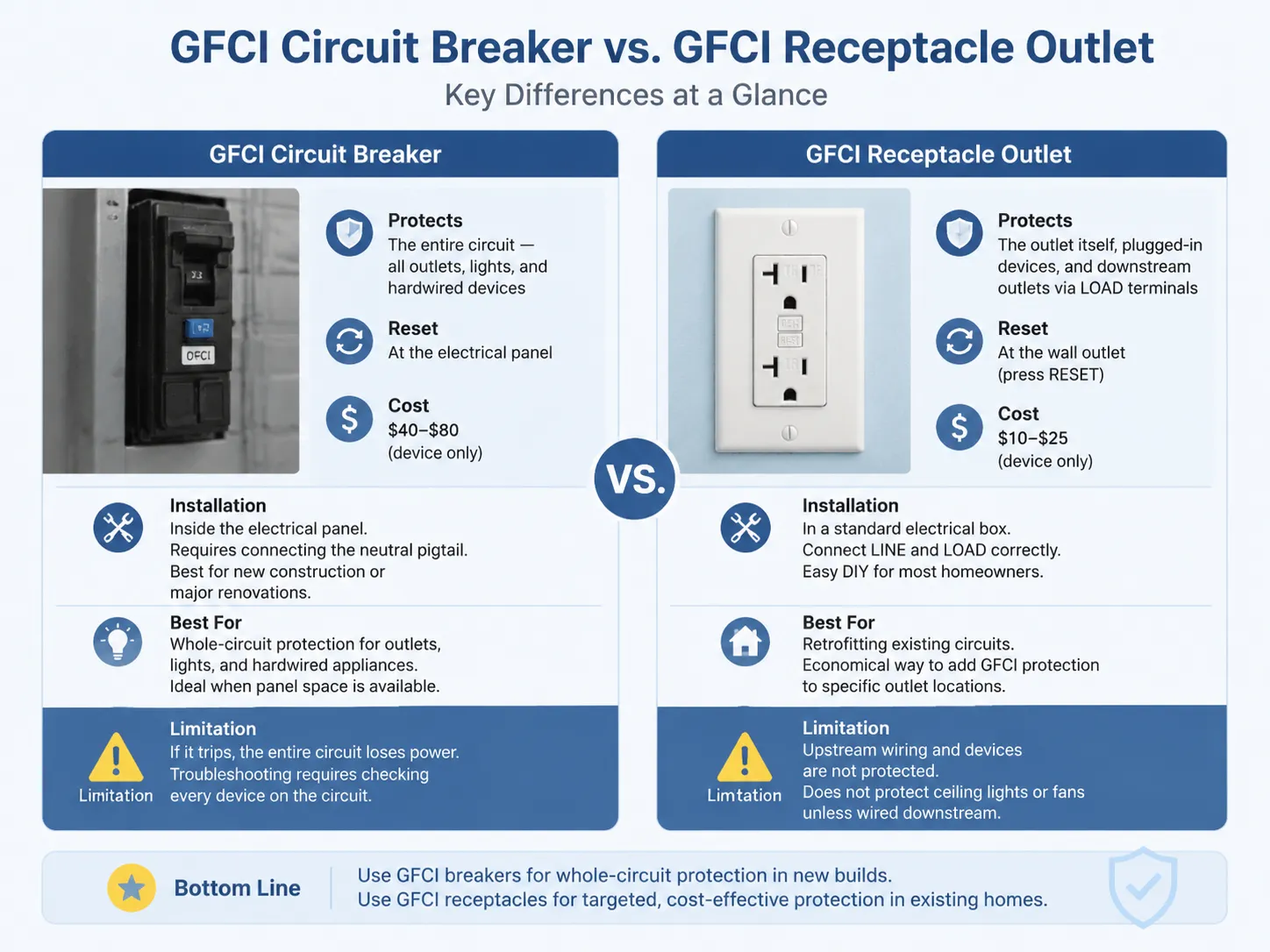
Comparing the Two: Installation, Protection, Cost, and Convenience
The table below provides a direct comparison of GFCI circuit breakers and GFCI receptacle outlets across the criteria that matter most when deciding which to install — or when troubleshooting a tripped GFCI and trying to determine which device is responsible.
| Characteristic | GFCI Circuit Breaker | GFCI Receptacle Outlet |
|---|---|---|
| Where it is installed | In the main electrical panel, occupying one or two breaker slots | In a standard electrical wall box, replacing a standard duplex outlet |
| What it protects | The entire circuit — every outlet, light, and hardwired device connected to that breaker | The outlet itself, any device plugged into it, and any standard outlets wired downstream from its LOAD terminals. The upstream wiring and devices are not protected. |
| Where it is reset | At the electrical panel — walk to the panel, identify the tripped breaker, move the handle to OFF, then to ON | At the wall outlet — press the RESET button on the face of the receptacle |
| Cost (device only, approximate) | $40–$80 for a standard single‑pole 15A or 20A GFCI breaker | $10–$25 for a standard tamper‑resistant GFCI duplex receptacle |
| Installation complexity | Installation inside the electrical panel, with the main breaker off. Requires connecting the breaker’s neutral pigtail to the panel’s neutral bar. A task for a confident DIYer or an electrician. | Installation in a standard electrical box, with the circuit breaker off. Requires identifying the LINE and LOAD terminals and connecting the wires correctly. A straightforward DIY task for a careful homeowner. |
| Best application | New construction or major renovation where whole‑circuit protection is desired and the panel has space. Circuits that serve both outlets and hardwired appliances (bathroom fan, ceiling light). | Retrofitting an existing circuit where GFCI protection is required at specific outlet locations. The most common and most economical approach for adding GFCI protection to a kitchen, bathroom, or outdoor outlet. |
| Limitations | If the GFCI breaker trips, the entire circuit loses power — including lights. Troubleshooting a tripped breaker requires checking every device on the circuit to find the cause of the ground fault. | The upstream wiring and any devices connected to it are not protected. A GFCI receptacle that is installed in a bathroom will not protect the ceiling light or the exhaust fan unless they are wired downstream of the GFCI. |
Which One Should You Install? A Decision Framework
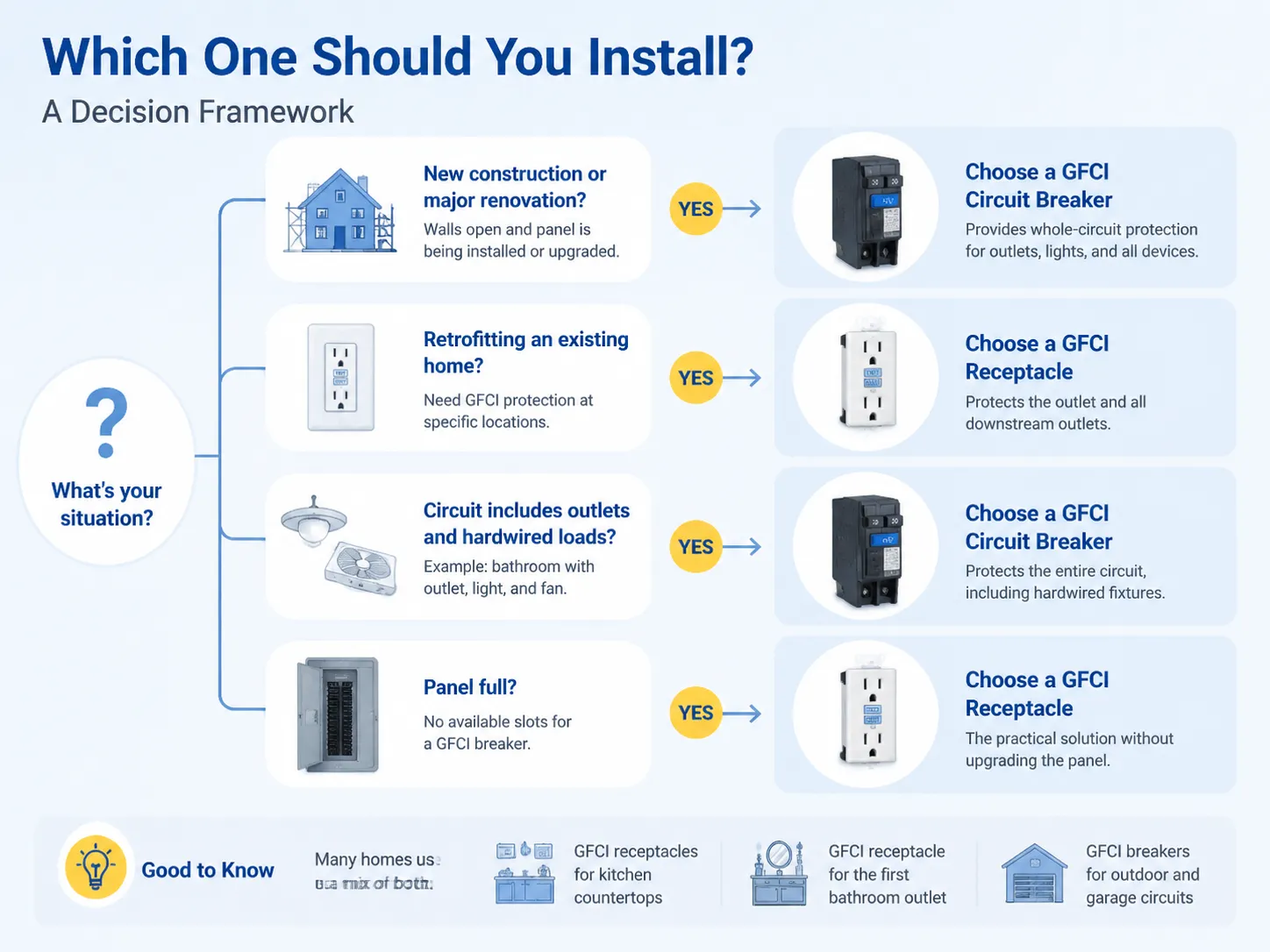
Choosing between a GFCI breaker and a GFCI receptacle depends on the nature of the job at hand, along with the wiring already in place, plus any building code specifications that apply to the situation. The following decision tree shows how to decide between the two options.
- New construction or a major renovation where the walls are open and the panel is being installed or upgraded. A GFCI circuit breaker is capable of providing extensive whole-circuit protection with just one single device. Due to its ability to protect everything on the circuit, it can ensure optimal protection of all types of devices including outlets, lamps, and any other devices connected to the circuit in order to keep the wall boxes stylish.
- Retrofitting an existing home where GFCI protection is required at specific locations. The installation of a GFCI outlet at the first point on the circuit is the most effective and least invasive way of adding protection to this outlet along with those downstream. A GFCI outlet will protect the first outlet along with all others downstream, and the installation can be done in less than an hour by a competent DIYer as long as they don’t need to touch the breaker panel.
- A circuit that serves both outlets and hardwired loads that also require GFCI protection. An example of a bathroom circuit serving a GFCI outlet, a ceiling fixture, and a ventilation fan. If the light fixture and fan are not connected to the circuit trunk after the GFCI outlet, they are not protected. Using a GFCI breaker at the main panel gives protection to all units connected to the circuit, which includes the light fixture, and the fan. The National Electrical Code specifies that all 120-volt, single-phase, 15- and 20-ampere outlets in the bathrooms must be GFCI protected; it does not require GFCI protection for the hardwired fan or light, although it is common for electricians to implement that protection in practice.
- A panel that is full, with no available slots for a GFCI breaker. The only sensible approach short of upgrading the electrical panel or installing an additional panel is to use a GFCI outlet. GFCI outlets can be installed wherever required without changing the electrical panel.
In several homes, a mixture of both methods is utilized. GFCI receptacles are used for protecting kitchen countertop outlets. There is no standardization that is enforced for home devices. However, GFCI receptacles are installed for the first bathroom outlet while outdoor and garage circuits are protected with GFCI breakers which function as protections also for the installed systems. Many people are now wondering if there is a strict code requirement for the installation of one type of device in the whole system.
Frequently Asked Questions
What is the difference between a GFCI breaker and a GFCI outlet?
A GFCI breaker is put into the main electrical box, hence protecting all electrical appliances connected that circuit. Whereas a GFCI outlet is connected to the wall outlet and protects that outlet suitably so long as nothing is connected to that outlet beyond the connection.
Can I use a GFCI outlet instead of a GFCI breaker?
Certainly, GFCI receptacles are usually an acceptable option in residential situations instead of a GFCI breaker, according to the code. The NEC states that places where protection is needed include bathrooms, kitchens, garages, at external locations, and laundry sites; hence a GFCI receptacle or breaker would meet the requirement. The GFCI receptacle must be the first device on the circuit for downstream protection. However, the upstream circuit and the hardwired items will remain unprotected unless a GFCI breaker is used.
Why does my GFCI outlet keep tripping, but the breaker does not?
A GFCI outlet will trip if there is a ground fault, which occurs when the current leaks to ground via someone, water, or damaged wiring. A standard circuit breaker cannot detect ground faults — it can only trip in the event of a short circuit or overload. If the GFCI trips without causing the breaker to trip as well, it means there is a ground fault with a leakage current that is in the range of milliamps (so that it is too low to trip the breaker, but still sufficient to trigger the GFCI). This could be caused by any of the following reasons: the appliance that is connected to the GFCI could be damaged, moisture could come into contact with the outdoor receptacle, or the GFCI itself may have failed.
How do I know if my outlet is GFCI‑protected?
Take a look at the outlet’s front. A GFCI receptacle has TEST and RESET buttons. However, an outlet can also be GFCI protected if it is connected to the GFCI receptacle’s wiring or if it is on a GFCI breaker. If you press the TEST button on a well-functioning GFCI outlet, and the outlet in question loses its power, the outlet in question is GFCI protected. Check the circuit breaker panel to see if there is a GFCI breaker — it will have a TEST button on it. Otherwise, the outlet is not GFCI protected.
References
- Electrical Safety Foundation International (ESFI) — GFCI Protection and Home Safety. Consumer and professional guidance on the role of GFCIs in preventing electrocution and the locations where GFCI protection is required.
- National Fire Protection Association (NFPA) — NEC Article 210.8. The specific code article that lists the locations in residential occupancies where GFCI protection is required for personnel.
- Leviton — GFCI Receptacles and Circuit Breakers. Manufacturer of residential GFCI receptacles and circuit breakers, with installation guidance and wiring diagrams for LINE and LOAD connections.
- Eaton — GFCI Breaker and Receptacle Selection Guide. Manufacturer information on the selection, installation, and testing of GFCI breakers and receptacles for residential and commercial applications.
A GFCI circuit breaker and a GFCI receptacle outlet perform the same life‑saving function: they detect ground faults and disconnect power before a person can be electrocuted. The difference is where they are positioned in the circuit and what they safeguard against. The circuit breaker is positioned in the panel and protects anything in the circuit including lights, outlets, and fixed appliances and must be reset at the panel when used. The circuit receptacle is positioned on the wall and protects the outlet and all devices connected to it and can be reset on the wall using the toggle switch. Both devices are specified in the regulations and need to be checked every month. Both are excellent and effective safety devices. GOG Electric makes GFCI receptacle outlets that comply with the NEC and UL standards.