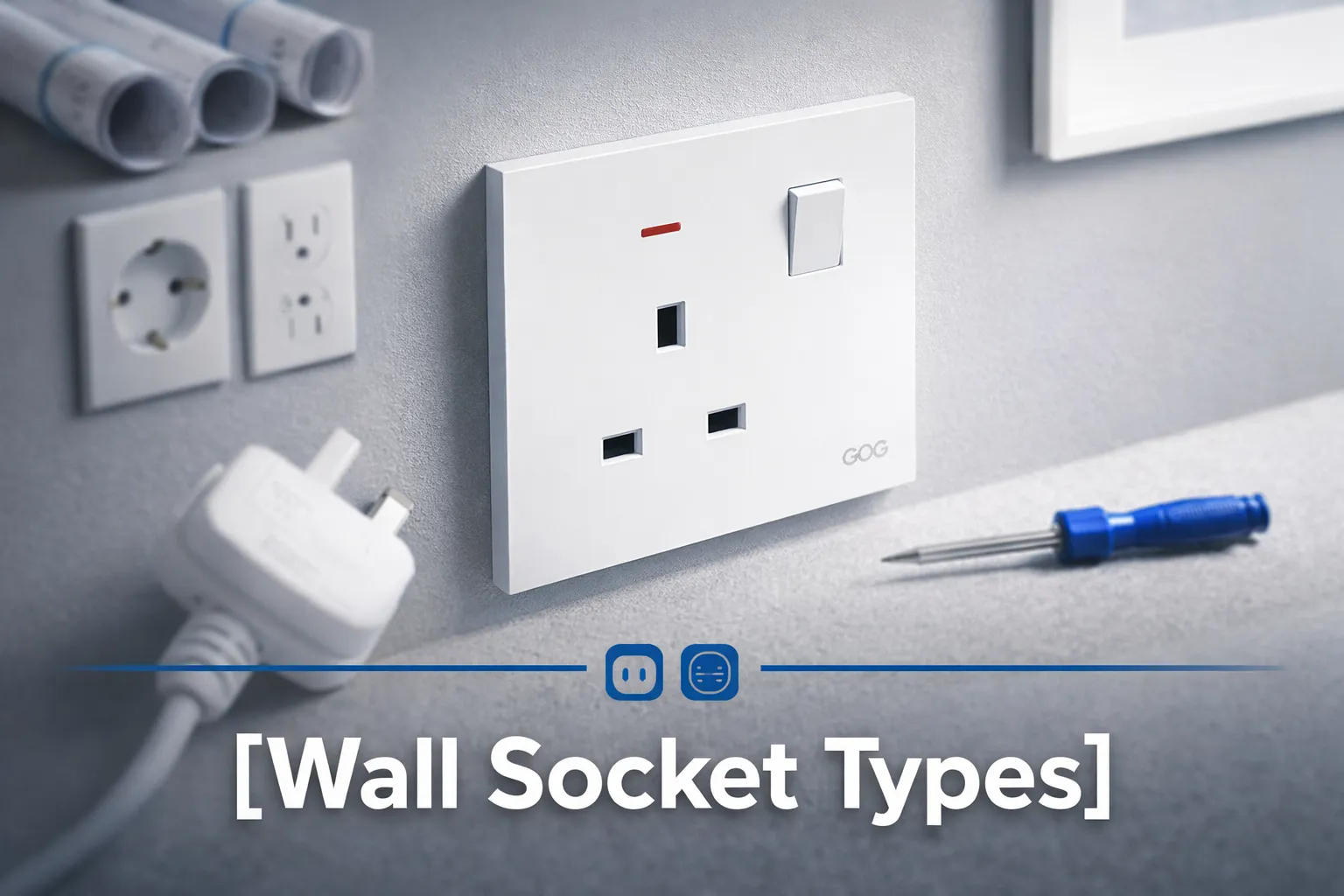
Ya sea que esté recableando su casa, cambiando un tomacorriente o simplemente tenga curiosidad sobre los diversos tomacorrientes eléctricos en la habitación, podría interesarle conocer los dos tipos diferentes de tomacorrientes eléctricos. Aunque pueda parecer una pregunta de examen, es importante conocer esta información al comprar tomacorrientes eléctricos, planificar la remodelación de la casa o determinar la seguridad de su casa antigua. En términos generales, todos los enchufes eléctricos pertenecen a dos familias básicas, y una vez que entienda esas familias, le será bastante fácil navegar por el complejo universo de los tomacorrientes eléctricos. En otras palabras, el documento responderá preguntas comunes sobre la clasificación de los dos tipos diferentes de enchufes eléctricos, su apariencia, precio relativo y otros factores importantes.
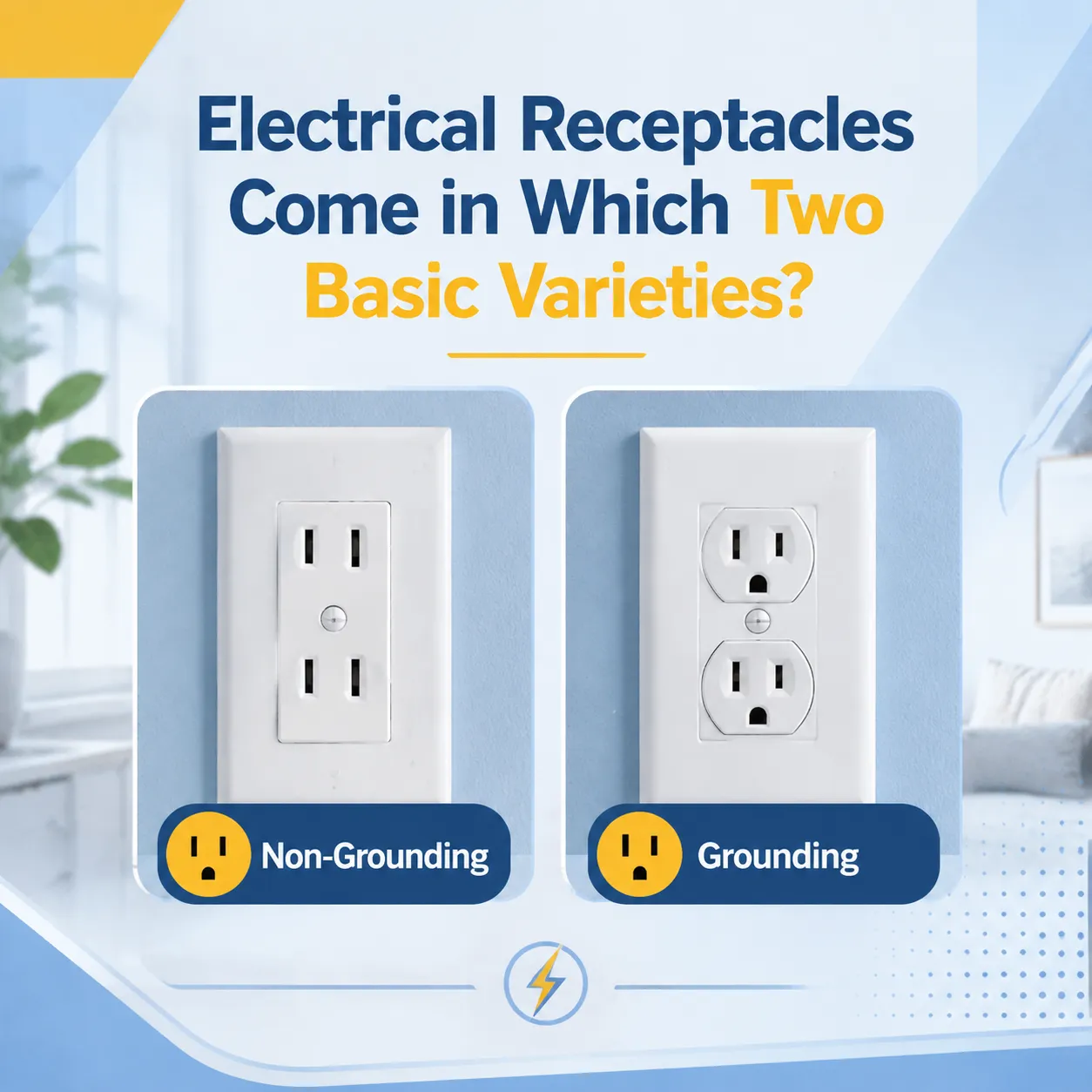
Respuesta rápida: Los tomacorrientes eléctricos (a menudo denominados puntos eléctricos, enchufes de pared o sockets) están disponibles en solo dos tipos principales: enchufe con tierra y enchufe sin tierra. Un enchufe sin tierra de dos clavijas se denomina tipo Nema 1-15, y el enchufe con tierra de tres clavijas se llama tipo Nema 5-15. Los enchufes con tierra son tomacorrientes estándar de tres clavijas que tienen un pin adicional redondo de conexión a tierra. Los enchufes con tierra se dividen en varias categorías según el voltaje y los amperios, como los enchufes de 120V (15A y 20A).
Las Dos Variedades Básicas de Receptáculos Eléctricos
La pregunta “los receptáculos eléctricos vienen en cuáles dos variedades básicas” se responde de dos maneras comunes, y ambas son correctas dependiendo del contexto:
Respuesta 1: Por conexión a tierra — sin conexión a tierra vs. con conexión a tierra
| Variedad | Clavijas | Tipo NEMA | Estado en Hogares Modernos |
|---|---|---|---|
| Receptáculo sin conexión a tierra | 2 clavijas | NEMA 1-15 | Obsoleto — se encuentra solo en casas antiguas |
| Receptáculo con conexión a tierra | 3 clavijas | NEMA 5-15 (y 5-20) | Estándar — requerido para construcción nueva |
Tiene dos ranuras planas, por lo que el tomacorriente sin conexión a tierra de dos clavijas se conoce como un enchufe Tipo A. El tomacorriente con conexión a tierra de tres clavijas, también llamado enchufe Tipo B, tiene un pin redondo de conexión a tierra además de las dos ranuras planas para una conexión segura al sistema de tierra del edificio. En el caso de los códigos de construcción recientes, existe la obligación de tener enchufes con conexión a tierra en todas partes en edificios nuevos, así como actualizar cualquier enchufe sin conexión a tierra al hacer renovaciones en una habitación en caso de inspección.
Respuesta 2: Por voltaje — 120V vs. 240V
| Variedad | Voltaje | Usos Comunes | Amperaje Típico |
|---|---|---|---|
| Estándar / uso general | 120V | Lámparas, televisores, teléfonos, computadoras, pequeños electrodomésticos de cocina | 15A o 20A |
| De alta potencia / electrodomésticos | 240V | Secadoras, estufas, unidades de aire acondicionado, cargadores de vehículos eléctricos, soldadoras | 15A–50A |
Los enchufes de 120 voltios alimentan la gran mayoría de los dispositivos domésticos. Los enchufes de 240 voltios (con sus distintivos diseños de clavijas) alimentan grandes electrodomésticos que necesitan el doble de potencia. Si desea entender la diferencia en detalle, nuestra guía sobre la diferencia entre enchufes de 120V y 240V lo explica con ejemplos.
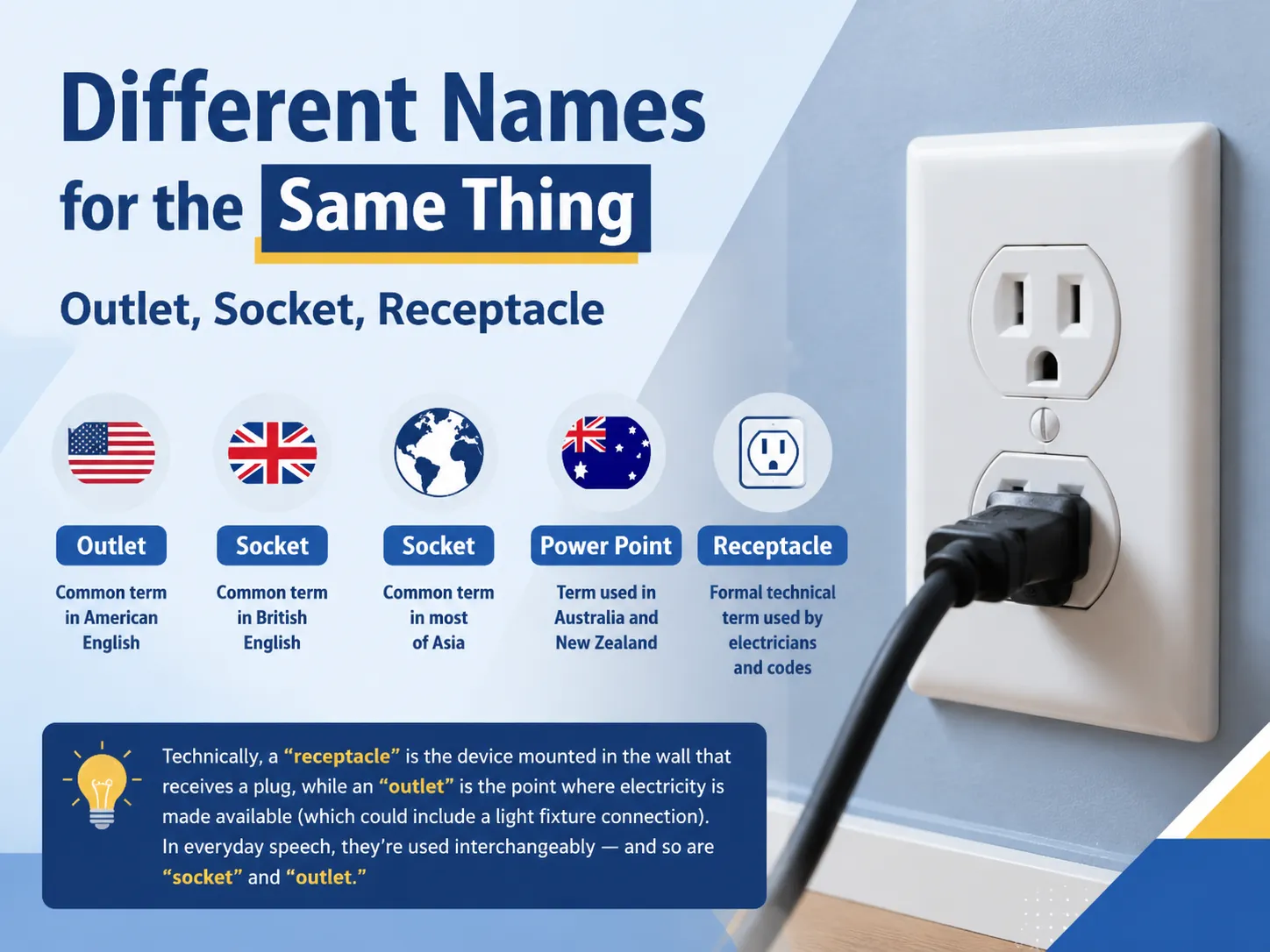
Diferentes Nombres para lo Mismo: Tomacorriente, Enchufe, Receptáculo
Antes de continuar con nuestra discusión, aclaremos algunos términos ya que el mismo dispositivo tiene múltiples nombres — todos correctos:
- Receptáculo eléctrico — el término técnico oficial que utilizan los electricistas y los códigos escritos
- Enchufe de corriente o enchufe eléctrico — el término común en inglés británico y en la mayor parte de Asia
- Toma de corriente o simplemente toma — el término usado en el inglés americano para referirse a este dispositivo
- Punto de energía — un término usado por los australianos y neozelandeses
- Enchufe de pared — otro término popular usado en inglés británico
Estrictamente hablando, “receptáculo” es el dispositivo que está fijo en una pared y recibe el enchufe, mientras que “toma” significa la ubicación del suministro eléctrico (lo que también puede implicar la luminaria). Sin embargo, en el lenguaje hablado se usan indistintamente, al igual que “enchufe” y “toma”. Para un análisis más detallado de la terminología y anatomía, consulte nuestro artículo sobre qué es un receptáculo eléctrico.
Cómo se clasifican los receptáculos: el sistema NEMA
El sistema de clasificación utilizado para todos los receptáculos norteamericanos fue desarrollado por la National Electrical Manufacturers Association (NEMA) y tiene un código para la clasificación. Por ejemplo, el código 5-15R se desglosa de la siguiente manera:
- El primer dígito (es decir, 5) indica el tipo de familia de configuración y muestra el voltaje y la conexión a tierra.
- El segundo dígito (es decir, 15) define la clasificación de amperaje.
- La letra denota el tipo de receptáculo (R) en oposición al enchufe (P).
| Código NEMA | Voltaje | Amperaje | Clavijas | Uso común |
|---|---|---|---|---|
| 1-15R | 120V | 15A | 2 | Tomas antiguas sin conexión a tierra (obsoletas) |
| 5-15R | 120V | 15A | 3 | Toma de corriente estándar para el hogar |
| 5-20R | 120V | 20A | 3 | Cocinas, baños, lavandería |
| 6-15R | 240V | 15A | 3 | Aire acondicionado de ventana, equipos pequeños |
| 6-20R | 240V | 20A | 3 | Compresores de aire, herramientas eléctricas |
| 14-30R | 120/240V | 30A | 4 | Secadoras eléctricas |
| 14-50R | 120/240V | 50A | 4 | Estufas, conexiones para RV, cargadores EV |
Si desea aprender más sobre los diferentes estilos usados en enchufes, eche un vistazo a nuestra publicación sobre tipos de enchufes eléctricos, ya que discute tanto los tipos NEMA usados en Norteamérica como otros tipos de enchufes internacionales.
Receptáculos de 120V: Los enchufes cotidianos
Estos son los enchufes que usa todos los días. Todos están conectados a tierra (excepto el tipo obsoleto de 2 clavijas) y están clasificados para 120 voltios.
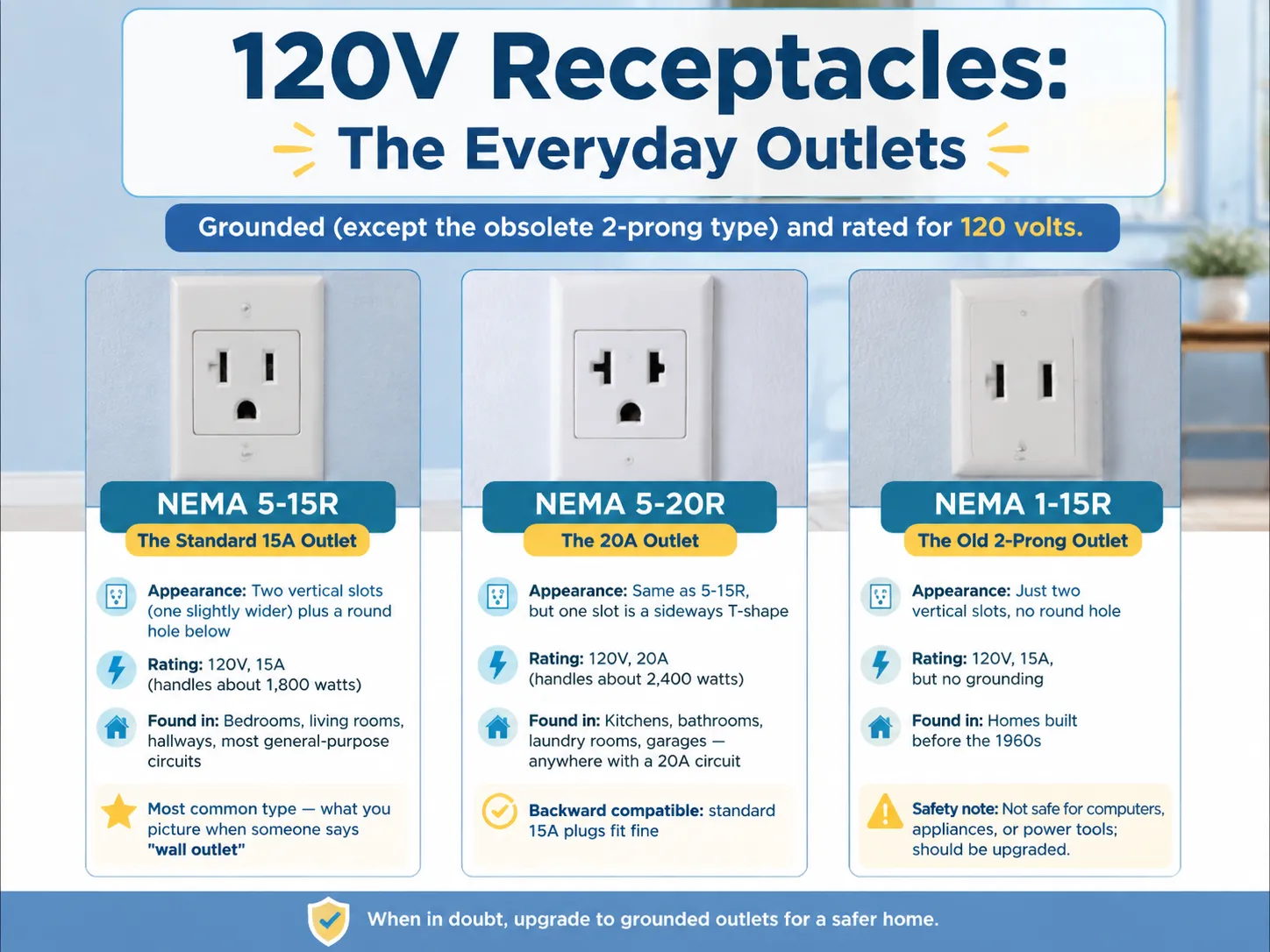
NEMA 5-15R — El enchufe estándar de 15A
- Apariencia: Dos ranuras verticales (una de ellas un poco más ancha) y un orificio redondo debajo
- Clasificación eléctrica: 120 voltios, 15 amperios (consumo aproximado de 1800 vatios)
- Aplicación: Normalmente montado en dormitorios, salas, pasillos y otros tipos de circuitos de uso general
- Tipo: Este tipo de enchufe es el más común, al que la gente suele pensar cuando imagina un enchufe de pared
NEMA 5-20R — El enchufe de 20A
- Apariencia: Similar al 5-15R, excepto que un receptáculo tiene forma de T horizontal.
- Clasificación: Clasificado para 120 Voltios, 20 Amperios (maneja alrededor de 2,400 vatios).
- Instalación: Usado en cocinas, baños, lavanderías, garajes o en cualquier lugar con 20 Amperios de corriente.
- Compatibilidad: Compatible con 15 Amperios.
NEMA 1-15R — El antiguo enchufe de 2 clavijas
- Característica: Simplemente dos aberturas verticales, sin ningún orificio circular.
- Capacidad: 120V; mínimo 15A, pero no tiene conexión a tierra.
- Presente en: Casas construidas antes de los años 60.
- Precaución: No es seguro para conectar computadoras, dispositivos o maquinaria, y debe ser actualizado.
Nuestra comparación de enchufes de 2 clavijas vs. 3 clavijas explica las diferencias de seguridad en detalle.
Receptáculos de 240V: Los enchufes de alta capacidad
Los enchufes de 240 voltios entregan el doble de voltaje para grandes electrodomésticos. Tienen disposiciones de clavijas distintivas que evitan conectar accidentalmente un dispositivo de 120V.
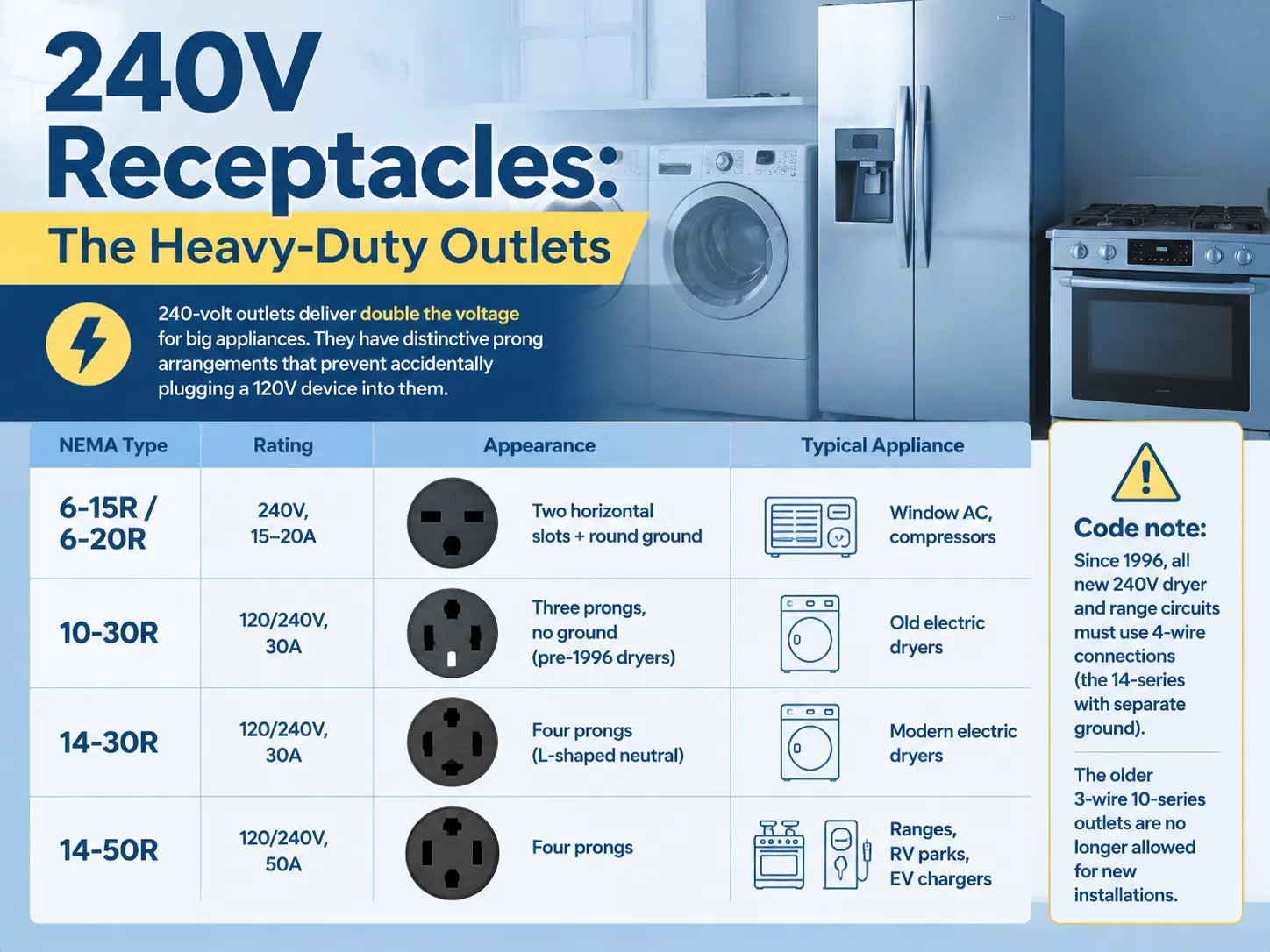
| Tipo NEMA | Clasificación | Apariencia | Electrodoméstico típico |
|---|---|---|---|
| 6-15R / 6-20R | 240V, 15–20A | Dos ranuras horizontales + tierra redonda | Aire acondicionado de ventana, compresores |
| 10-30R | 120/240V, 30A | Tres clavijas, sin tierra (secadoras anteriores a 1996) | Secadoras eléctricas antiguas |
| 14-30R | 120/240V, 30A | Cuatro clavijas (neutro en forma de L) | Secadoras eléctricas modernas |
| 14-50R | 120/240V, 50A | Cuatro clavijas | Estufas, parques de casas rodantes, cargadores EV |
Puntos clave en el contexto del código: El código ha mandatado que todos los nuevos circuitos para secadoras y estufas que operen a 240V deben contar con conexiones de 4 cables o del tipo serie 14 en las que la conexión está aterrizada. La alternativa de 3 cables serie 10 ya no puede emplearse en nuevas instalaciones.
Diferencias de apariencia a simple vista
Así es como se pueden distinguir las variedades básicas solo con mirarlas:
| Receptáculo | Ranuras | Característica distintiva |
|---|---|---|
| 2 clavijas sin tierra (1-15R) | 2 ranuras verticales | Sin orificio redondo |
| 3 clavijas 15A (5-15R) | 2 verticales + 1 redondo | Ambas ranuras verticales, tierra redonda abajo |
| 3 clavijas 20A (5-20R) | 1 vertical + 1 en forma de T + 1 redondo | Ranura en T horizontal a la izquierda |
| 240V hoja recta (6-15R/6-20R) | 2 horizontales + 1 redondo | Ambas ranuras horizontales |
| Secadora (14-30R) | 3 ranuras + 1 redondo | Ranura neutral en forma de L |
| Estufa/EV (14-50R) | 3 ranuras + 1 redondo | Neutral en forma de L más grande |
Examine la placa frontal: los botones TEST y RESET están presentes en un tomacorriente GFCI; el tomacorriente a prueba de manipulaciones tiene persianas deslizantes en las aberturas y un tomacorriente USB tiene puertos USB en la placa frontal.
Receptáculos de propósito especial: GFCI, TR, USB
Más allá de las dos variedades básicas, los receptáculos modernos añaden características de seguridad y conveniencia:
| Tipo | Qué hace | Donde se requiere | Precio |
|---|---|---|---|
| Receptáculo GFCI | Dispara el circuito si detecta corriente fugándose a tierra (previene descargas eléctricas) | Baños, cocinas, garajes, exteriores, sótanos | $10–$25 |
| A prueba de manipulaciones (TR) | Persiana interna bloquea objetos insertados por niños | Requerido en toda construcción residencial nueva | $2–$5 |
| Receptáculo USB | Puertos de carga USB-A / USB-C integrados | Opcional — escritorios, mesas de noche, cocinas | $15–$45 |
| Receptáculo AFCI | Detecta arcos peligrosos en el cableado | Dormitorios y áreas de estar (a nivel de circuito) | $15–$30 |
| Interruptor/tomacorriente combinado | Interruptor y receptáculo en un solo dispositivo | Donde se necesita un tomacorriente con interruptor | $4–$12 |
Para una visión completa de las cuatro categorías principales de tomacorrientes usados en hogares, nuestro artículo sobre los 4 tipos de tomacorrientes eléctricos es una referencia rápida y visual.
¿Qué receptáculo para qué habitación?
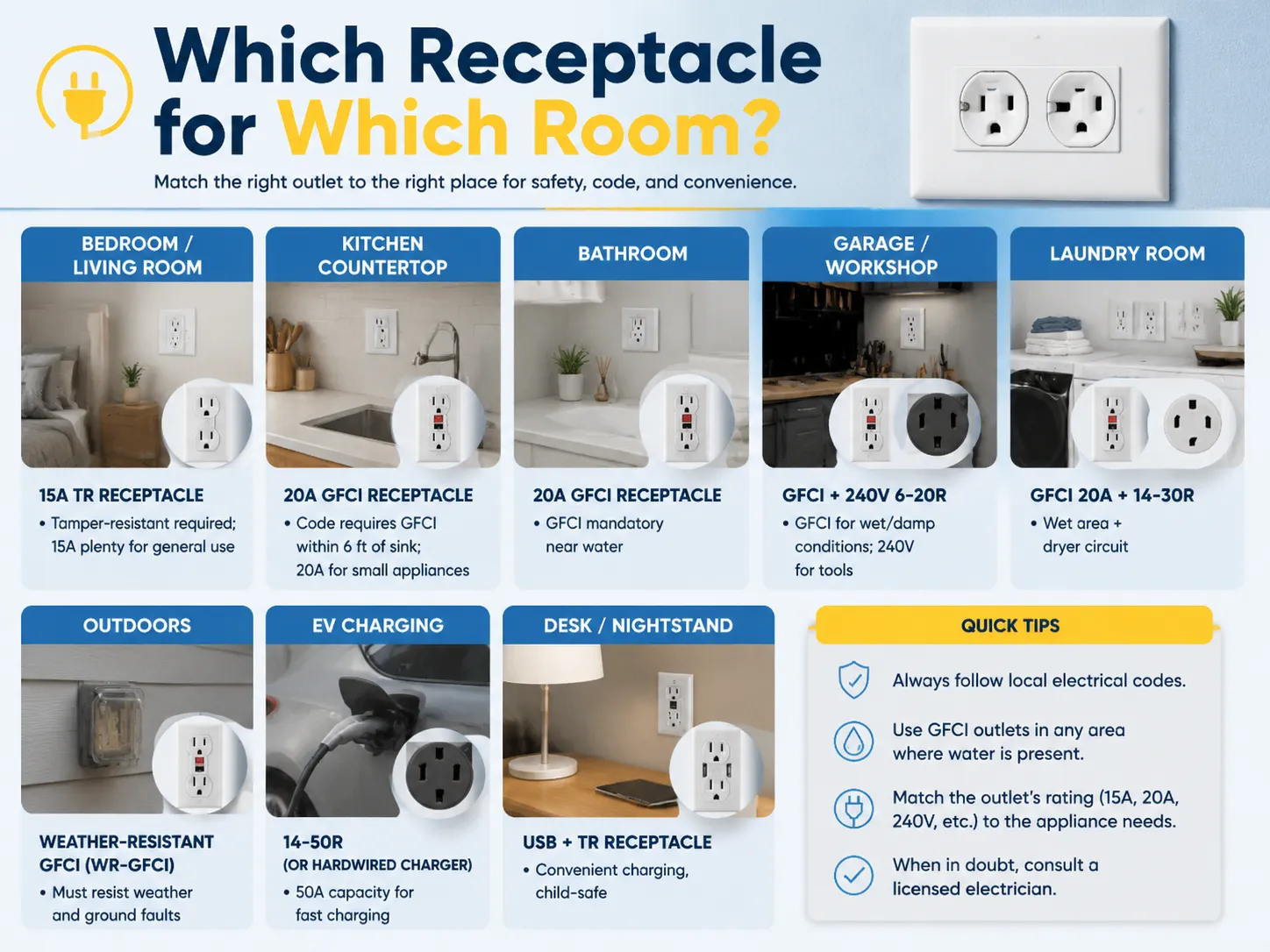
| Ubicación | Receptáculo recomendado | Por qué |
|---|---|---|
| Dormitorio / sala de estar | Receptáculo TR de 15A | Se requiere a prueba de manipulaciones; 15A es suficiente para uso general |
| Encimera de cocina | Receptáculo GFCI de 20A | El código requiere GFCI a menos de 6 pies del fregadero; 20A para pequeños electrodomésticos |
| Baño | GFCI de 20A | GFCI obligatorio cerca del agua |
| Garaje / taller | GFCI + un 240V 6-20R | GFCI para condiciones húmedas/mojadas; 240V para herramientas |
| Lavandería | GFCI 20A + toma de secadora 14-30R | Área húmeda + circuito para secadora |
| Exterior | GFCI resistente a la intemperie (WR-GFCI) | Debe resistir la intemperie y fallas a tierra |
| Carga de vehículo eléctrico | 14-50R (o cargador cableado) | Capacidad de 50A para carga rápida |
| Escritorio / mesa de noche | Receptáculo USB + TR | Carga conveniente, seguro para niños |
Guía de precios: cuánto cuestan los enchufes
| Tipo | Precio minorista | Precio de marca |
|---|---|---|
| Receptáculo básico de 15A con 3 clavijas | $1–$3 | $2–$5 |
| Receptáculo de 20A | $2–$5 | $4–$8 |
| 15A a prueba de manipulaciones | $2–$4 | $3–$6 |
| Receptáculo GFCI | $10–$18 | $15–$25 |
| Receptáculo USB (puerto dual) | $12–$25 | $20–$45 |
| Receptáculo AFCI | $15–$25 | $20–$30 |
| Receptáculo para secadora (14-30R) | $8–$15 | $12–$20 |
| Receptáculo para estufa/EV (14-50R) | $10–$20 | $15–$30 |
Hay diferencias entre marcas, acabados (como blanco, marfil, negro, latón) y certificación (certificado UL vs. genérico no listado) que afectan el precio. Además, la instalación por profesionales puede costar entre USD 50 y 150 por cada enchufe, dependiendo del lugar de instalación y el estado del cableado.
Principales marcas de receptáculos
| Marca | Country | Nivel de precio | Conocido por |
|---|---|---|---|
| Leviton | EE.UU. | Medio | Línea de diseño Decora, amplia selección, confiable |
| Eaton / Cooper Wiring | EE.UU. | Medio | Durabilidad de grado comercial, instalaciones comerciales |
| Legrand (Pass & Seymour) | Francia/EE.UU. | Medio-Alto | Acabados de diseño, tomas inteligentes |
| Hubbell | EE.UU. | Alto | Receptáculos de grado industrial, fiabilidad extrema |
| GE (Current) | EE.UU. | Presupuesto-Medio | Tomas de uso diario, ampliamente disponibles |
| Kopp / Belanko | Alemania | Medio | Tomas de calidad estilo europeo |
| IGOTO | China | Valor | Interruptores y tomas inteligentes, OEM para marcas globales |
| Schneider Electric | Francia | Medio-Alto | Líneas Unica y Clipsal, estándares globales |
Para uso residencial diario, Leviton y Eaton son las marcas más instaladas en Norteamérica. Si desea acabados premium o funciones inteligentes, Legrand y Schneider lideran el mercado. Nuestra guía sobre las 10 principales marcas de dispositivos de cableado en el mundo profundiza en las fortalezas de cada fabricante.
Preguntas frecuentes
¿Cuáles son los diferentes tipos de receptáculos eléctricos?
Las tomas eléctricas pertenecen a dos categorías principales, a saber, tomas sin conexión a tierra (con dos clavijas) y tomas con conexión a tierra (con tres clavijas). Se podrían hacer otras clasificaciones verticales. Los tipos de receptáculos eléctricos comunes hoy en día incluyen: NEMA 1-15 (ahora obsoleto de 2 clavijas), NEMA 5-15 (toma estándar de 15 amperios con 3 clavijas), NEMA 5-20 (20 amperios con orificio en forma de T), NEMA 6-15/6-20 (herramientas de 240 voltios), NEMA 14-30 (para secadoras eléctricas) y NEMA 14-50 (para estufas eléctricas y vehículos recreativos). El uso de tipos especiales de tomas proporciona ventajas adicionales.
¿Cuáles son los dos tipos de tomas que se encuentran en un sistema eléctrico?
En los sistemas eléctricos, existen dos variedades principales de tomas: las tomas de 120 voltios (las tomas eléctricas de uso general que se utilizan para alimentar dispositivos pequeños como lámparas, gadgets electrónicos y otros equipos domésticos) y las tomas de 240 voltios (que son tomas de alta potencia para electrodomésticos como secadoras, hornos, aires acondicionados y cargadores de vehículos eléctricos). Otra forma de identificar los dos tipos diferentes de tomas puede ser a través de la conexión a tierra, que se refiere a dos tipos de tomas, a saber, tomas sin conexión a tierra de dos clavijas (que se encuentran en casas antiguas y ahora se consideran obsoletas) y tomas con conexión a tierra de tres clavijas (el estándar actual). Básicamente, se refieren a las dos formas distintas en que los dispositivos consumen electricidad de diferentes tipos de tomas.
¿Cuáles son los dos tipos de sistemas eléctricos?
Casi todo el mundo habla de dos tipos de sistemas eléctricos, a saber, sistemas monofásicos y trifásicos. Los sistemas monofásicos (usualmente 120/240 voltios) se utilizan en la mayoría de las residencias. Tienen dos conductores activos y un cable neutro. Los sistemas trifásicos (208 voltios o 480 voltios) se utilizan en entornos industriales y comerciales para suministrar mayores cantidades de energía de manera más eficiente y hacer funcionar motores pesados. Las instalaciones residenciales casi siempre dependen de electricidad monofásica. Puede haber algunos casos en los que un hogar utilice algún tipo de equipo eléctrico trifásico, como una bomba de pozo, un taller o un inversor solar.
¿Cuáles son las dos categorías básicas de interruptores eléctricos?
Los interruptores eléctricos se clasifican en dos categorías principales: el interruptor unipolar que permite controlar una carga eléctrica desde una sola posición y el interruptor de tres vías que permite controlar una carga eléctrica desde dos ubicaciones. Existen otras clasificaciones, entre ellas el interruptor de cuatro vías (que se utiliza para controlar una luz desde tres o más ubicaciones) y tipos especiales de interruptores como los interruptores inteligentes, temporizadores y atenuadores. Sin embargo, los interruptores unipolares y de tres vías siguen siendo los dos tipos más importantes de interruptores eléctricos. El interruptor unipolar consta de dos terminales, mientras que el interruptor de tres vías está compuesto por tres terminales.
Referencias
- NEMA (Asociación Nacional de Fabricantes Eléctricos) — El organismo normativo que define el sistema de configuración de receptáculos NEMA (1-15, 5-15, 6-15, 14-30, 14-50, etc.) utilizado en toda Norteamérica.
- NFPA 70 (Código Eléctrico Nacional) — El código que regula los requisitos para receptáculos, incluyendo ubicaciones de protección GFCI, tomacorrientes a prueba de manipulaciones y circuitos de 4 cables a 240V.
- Normas UL para enchufes y receptáculos — UL 498 cubre los requisitos de seguridad para enchufes y receptáculos de conexión vendidos en los Estados Unidos.
- Seguridad eléctrica OSHA — Guía de seguridad laboral en EE.UU. sobre receptáculos, conexión a tierra y requisitos de GFCI.
- Departamento de Energía de EE.UU. — Tomacorrientes GFCI — Guía práctica sobre cómo funcionan los receptáculos GFCI y cómo probarlos.
- Catálogo de receptáculos Leviton — Referencia del fabricante que muestra la gama de tipos de receptáculos, desde tomacorrientes básicos de 15A hasta modelos GFCI, TR y USB.
Conclusión
Entonces, ¿cuáles son los dos tipos generales de tomacorrientes eléctricos? La respuesta simple es sin conexión a tierra (2 clavijas) y con conexión a tierra (3 clavijas), o dicho de forma más sencilla, 120V de uso general y 240V de alta resistencia. Esto hace que la conclusión sea muy clara:
- Para uso diario, opte por receptáculos con conexión a tierra de 15 o 20 amperios, ya que son económicos, seguros y cumplen con la normativa.
- Para ubicaciones húmedas (baño, cocina, garaje, exteriores) debe usar tomacorrientes GFCI, ya que pueden salvar su vida y son requeridos por el código.
- Para maquinaria pesada use el tomacorriente NEMA adecuado de 240V en lugar de modificar un tomacorriente de 120V para esos aparatos.
- En caso de renovación de un edificio antiguo, asegúrese de reemplazar los tomacorrientes antiguos sin conexión a tierra de 2 clavijas por tomacorrientes con conexión a tierra (o protegidos con GFCI).
Por lo tanto, sin importar dónde quiera comprar un receptáculo, ya tiene una idea de por dónde empezar.