Recientemente en Manchester, un electricista asumió un proyecto de remodelación de cocina en una casa de 1968. La primera caja que abrió reveló una mezcla de cableado eléctrico antiguo y nuevo. Lo primero que notó fue que había un cable moderno con conductores azul/marrón conectado a un circuito más antiguo con pares rojo/negro también. Aparentemente, había sido extendido a esta ubicación por un propietario anterior, pero en ningún momento marcaron la diferencia entre los cables nuevos y antiguos. Además, el electricista dedicó una hora extra rastreando todos los diferentes tipos de conductores hasta su fuente original antes de continuar; su precaución estaba bien fundamentada. Los colores de los cables eléctricos cambiaron en el Reino Unido en un año (no varios) — por lo tanto, es probable que cualquier trabajo eléctrico que ocurra en una casa construida antes/después de esa transición contenga al menos dos tipos diferentes de esquemas de color (y posiblemente más). Entender cómo manejar estos diferentes tipos de cableado cuando se encuentran en una caja de conexiones es fundamental para realizar un trabajo eléctrico seguro en cualquier hogar del Reino Unido.
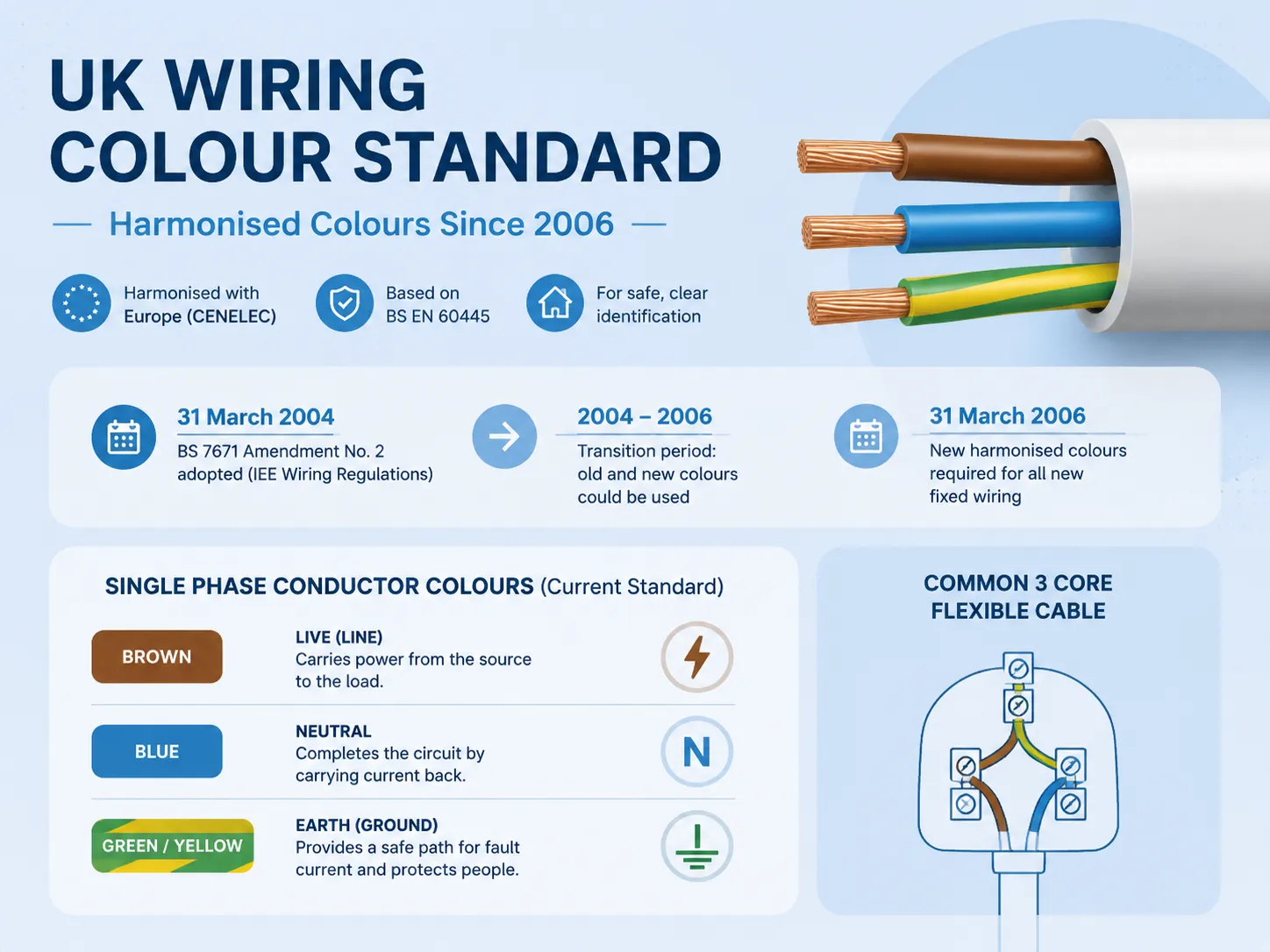
El estándar actual de colores de cableado en el Reino Unido: Colores armonizados desde 2006
El estándar armonizado de colores de cableado para Europa fue adoptado el 31 de marzo de 2004 por el Reino Unido, publicado como BS 7671 Enmienda No. 2 (Reglamentos de cableado IEE). Eran nuevos colores para el cableado fijo en edificios para alinearlos con los colores europeos. Se otorgó un período de transición de dos años desde el 31 de marzo de 2004 hasta el 31 de marzo de 2006 durante el cual se podían usar tanto los colores antiguos como los nuevos en la misma instalación. Los nuevos colores armonizados deben usarse para todo el cableado fijo nuevo instalado después del 31 de marzo de 2006.
No es un ajuste fácil para un electricista con muchos años de experiencia emparejar 2 colores de cable eléctrico con sus respectivos terminales donde el rojo se usaba para línea(s) y el negro para neutro. Ahora tienen que reprogramar su cerebro para asociar marrón y azul respectivamente. Esto se debe a un acuerdo de cambio por parte de CENELEC (Comité Europeo de Normalización Electrotécnica) respecto a la armonización. La armonización está mandatada dentro de BS EN 60445 en el estándar. Estos estándares proporcionan la forma correcta de identificar conductores usando designación por color o numérica.
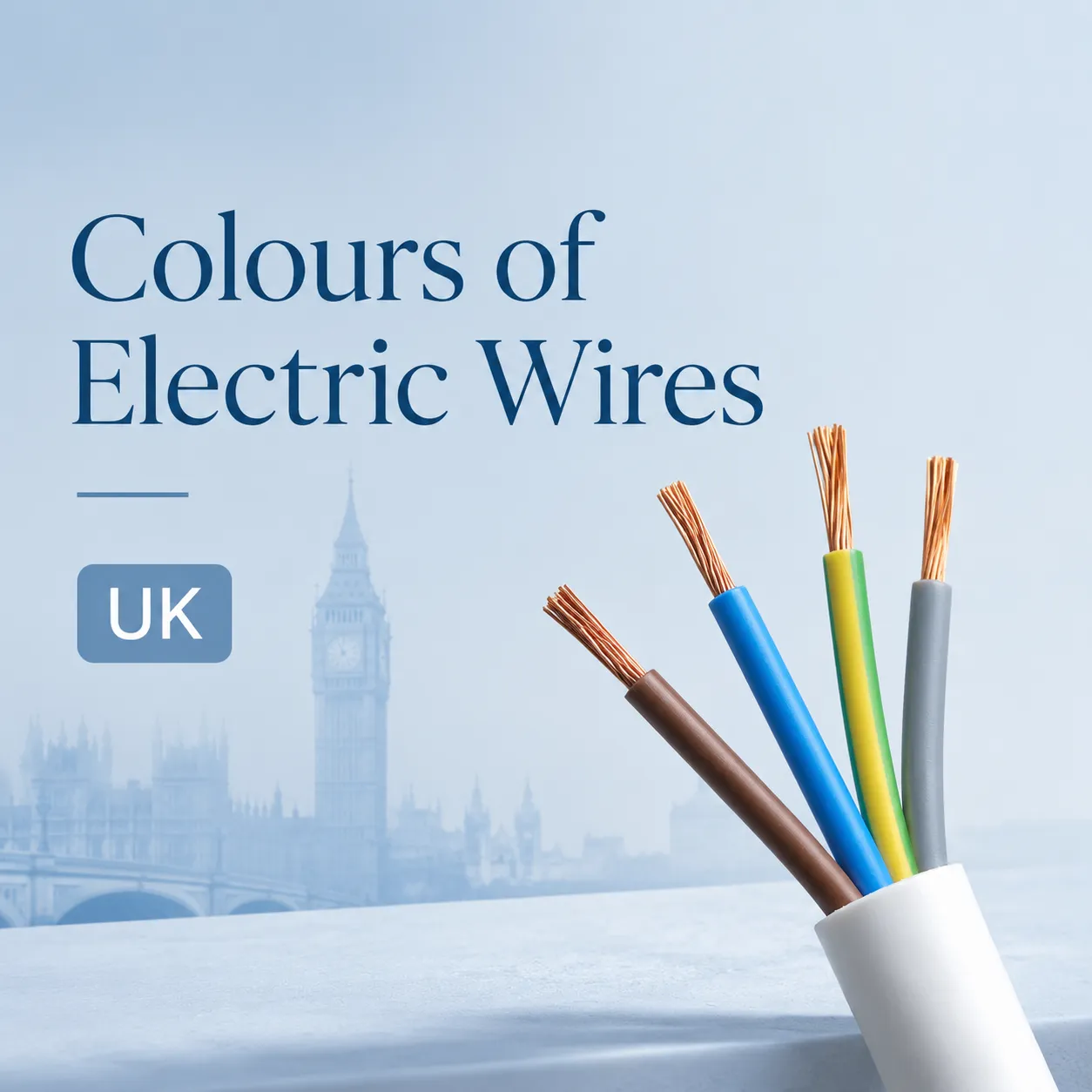
Según el código de colores de cable eléctrico monofásico británico actualmente armonizado son:
- Marrón: El cable marrón se refiere como conductor de línea (también conocido como conductor activo), ya que anteriormente se asociaba con el rojo. El conductor marrón, según la nueva convención de cableado, transporta la energía desde la fuente de alimentación hasta la carga prevista.
- Azul: El cable neutro. Anteriormente referido como el ‘cable negro’. El cable azul ahora completa el circuito llevando la corriente de retorno de vuelta a la fuente de alimentación.
- Verde y amarillo a rayas: En el Reino Unido, desde 1977 ha existido un estándar consistente para tierra (ground) que no fue alterado durante la armonización. El conductor de tierra proporciona un camino conductor para cualquier falla que ocurra, y está conectado a cualquier objeto metálico expuesto.
Los colores de los conductores en un cable flexible común de tres núcleos utilizado en electrodomésticos y alargadores, se asignarán de la siguiente manera: el conductor activo será de color marrón, el conductor neutro será de color azul y el conductor de tierra (ground) será de color verde/amarillo.
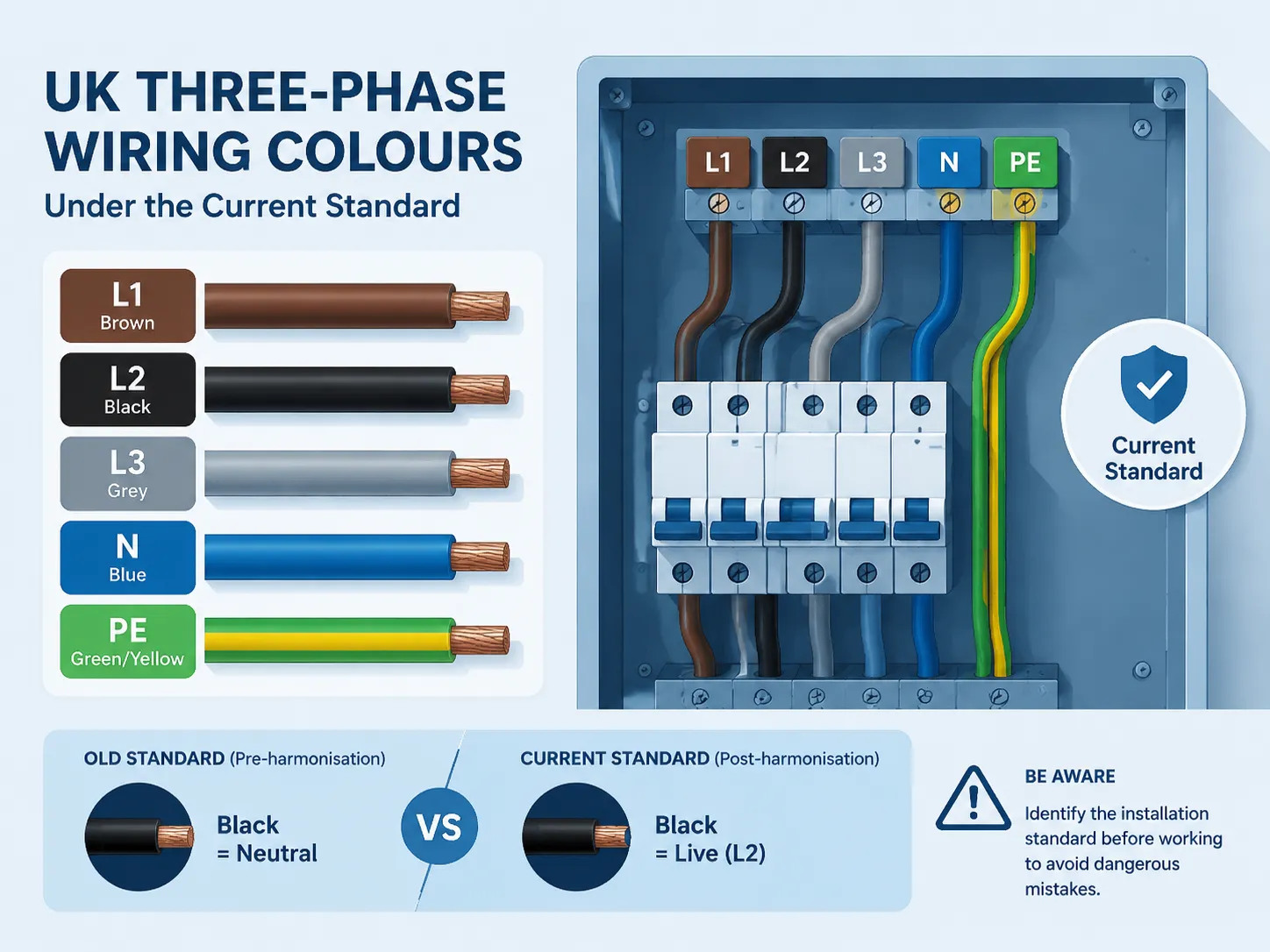
Colores de Circuito Trifásico Bajo el Estándar Actual
Para instalaciones trifásicas, el estándar actual del Reino Unido utiliza los siguientes colores de cable:
- Fase L1: Marrón
- Fase L2: Negro
- Fase L3: Gris
- Línea (fase entrante, siempre viva): Azul
- Tierra Protectora: Verde con franjas amarillas
La armonización de los códigos de colores de cableado ha creado una posible confusión debido a las diferencias entre estos códigos. Bajo el estándar antiguo, el color negro representaba el conductor “neutro”, mientras que el nuevo código de colores (armonizado) ha cambiado el negro para representar “activo” en un sistema eléctrico trifásico. Por lo tanto, un electricista debe determinar si está trabajando en una instalación pre o post armonización si encuentra un cable negro en el panel eléctrico trifásico o que provee servicio eléctrico a un sistema trifásico; de lo contrario, el electricista podría clasificar erróneamente el cable negro y crear un cortocircuito o energizar la estructura metálica expuesta.
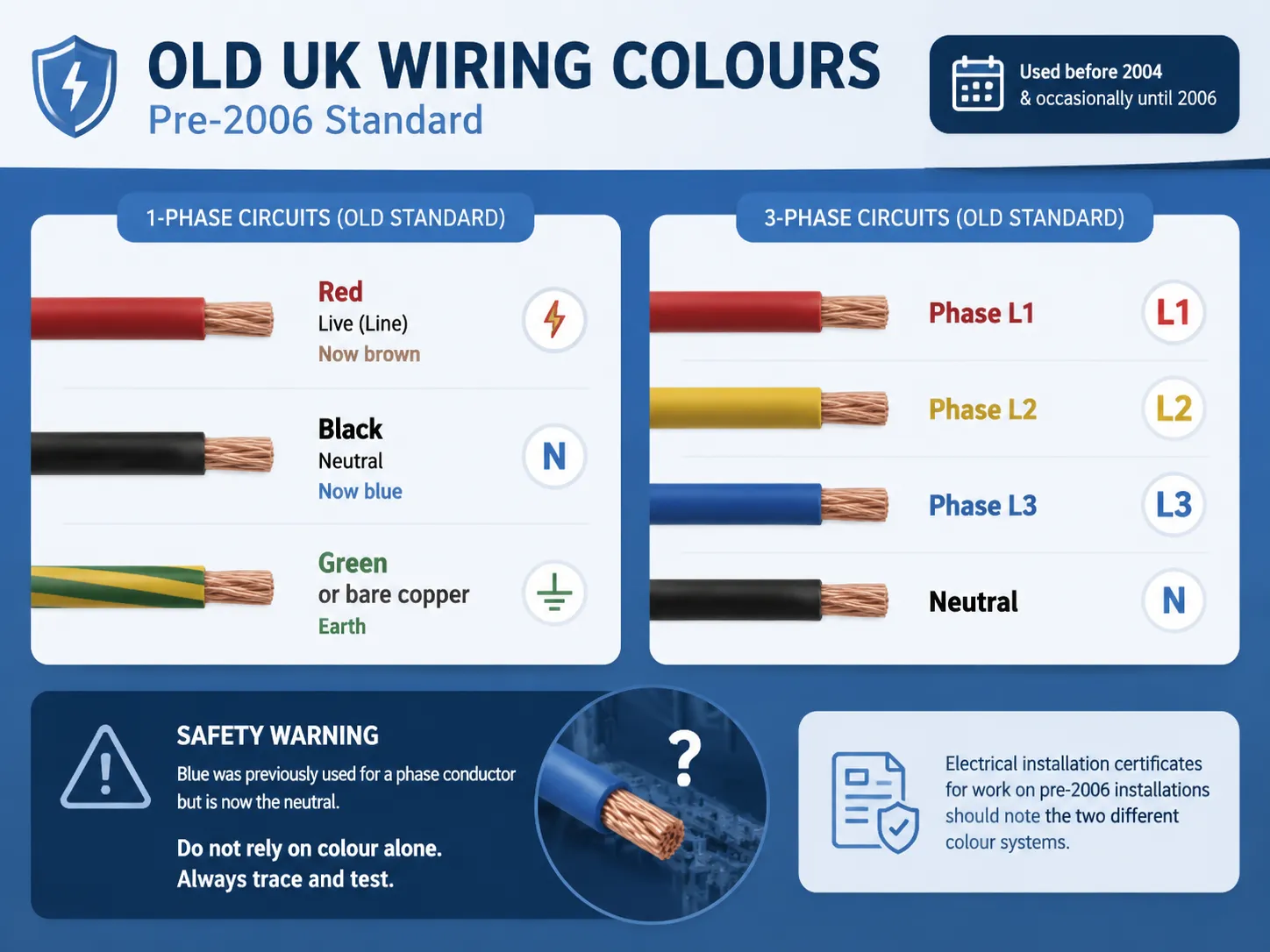
Los Colores de Cableado Antiguos del Reino Unido: Estándar Pre-2006
Los colores de los cables eléctricos anteriores a 2004 y ocasionalmente instalados en el período intermedio de 2004 a 2006 seguirán el estándar británico anterior y tendrán este conjunto de colores: estándar de color para circuitos monofásicos previos:
- Rojo: Activo (línea). Ahora marrón.
- Negro: Neutro. Ahora azul.
- Verde o cobre desnudo: Desde 1977, el esquema de colores universalmente aceptado para conductores de tierra en Australia es verde con franjas amarillas, pero instalaciones anteriores pueden haber usado solo verde o conductores de tierra sin aislamiento.
Para instalaciones trifásicas bajo el estándar antiguo, los colores de fase eran:
- Fase L1: Rojo
- Fase L2: Amarillo
- Fase L3: Marrón
- Neutro: Negro
El sistema trifásico antiguo presenta un peligro específico debido a los colores armonizados; el color azul se asignaba previamente al conductor de fase pero ahora se usa como color para el conductor neutro. Por lo tanto, no se puede identificar un cable azul en un tablero trifásico solo por el color. Debe ser rastreado y probado. La Health and Safety Executive ha emitido un documento de orientación que contiene información sobre la gestión de este riesgo particular; y cualquier certificado de instalación eléctrica para trabajos realizados en una instalación completada antes de 2006 debe contener una nota respecto a los dos sistemas de colores diferentes que existen.
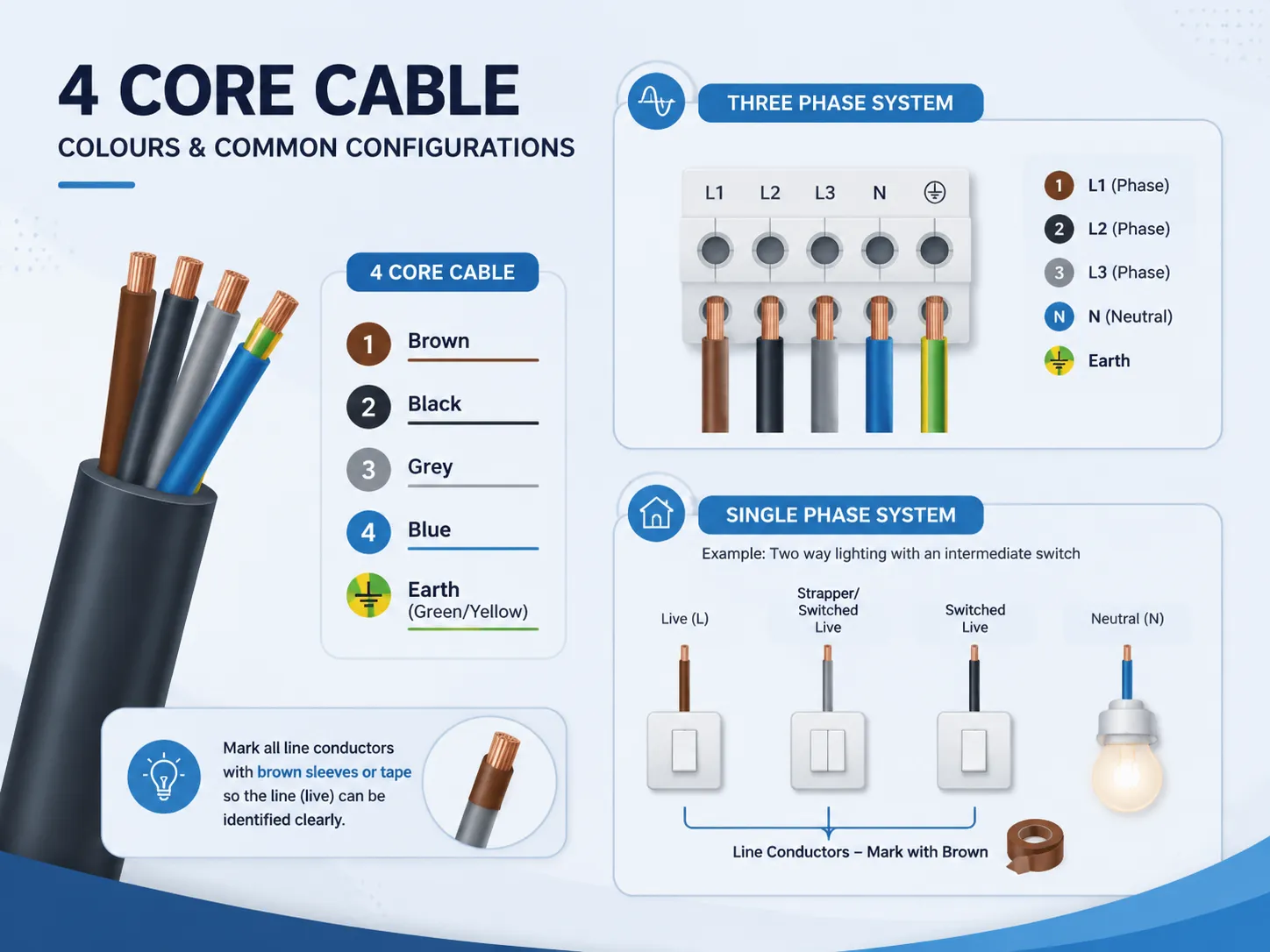
Colores de Cable de Cuatro Núcleos y Otras Configuraciones Comunes
En términos generales, un cable de cuatro núcleos consistirá en cuatro conductores aislados y un conductor de tierra sin aislamiento, o alternativamente, un núcleo de tierra verde/amarillo. Los cuatro conductores aislados tienen el siguiente código de colores según la norma armonizada:
- Núcleo 1: Reino Unido / IEC (BS 7671, Actual)
- Núcleo 2: Negro
- Núcleo 3: Gris
- Núcleo 4: Marrón
En un sistema trifásico, el Marrón (B), el Negro (B) y el Gris (B) se utilizan como los 3 conductores de fase mientras que el Azul (B) es el conductor neutro. Al usar un cable de cuatro núcleos en un sistema monofásico (por ejemplo, iluminación de dos vías con un interruptor intermedio), un electricista puede asignar estos núcleos de manera diferente. El electricista debe marcar todos los núcleos que se usan como conductor de línea con mangas o cinta marrón para que la constante de línea pueda determinarse correctamente. En particular, el núcleo gris a menudo se marca porque su función no es evidente para la persona que usa el núcleo debido a su color.
La transición de las normas antiguas a las nuevas es más fácil de entender al comparar las normas antiguas con las nuevas de conductores que realizan las tareas más comunes.
| Qué significan los otros colores en una caja de interruptores de luz | Color antiguo del Reino Unido (Pre‑2004/2006) | Color armonizado actual |
|---|---|---|
| Fase monofásica (Línea) | Rojo | Reino Unido / IEC (BS 7671, Actual) |
| Neutro monofásico | Negro | Marrón |
| Trifásico L1 | Rojo | Reino Unido / IEC (BS 7671, Actual) |
| Trifásico L2 | Amarillo | Negro |
| Trifásico L3 | Marrón | Gris |
| Tierra Protectora | Verde o desnudo (verde/amarillo desde 1977) | Verde con franjas amarillas |
¿Cuáles son los cables L y N en el Reino Unido?
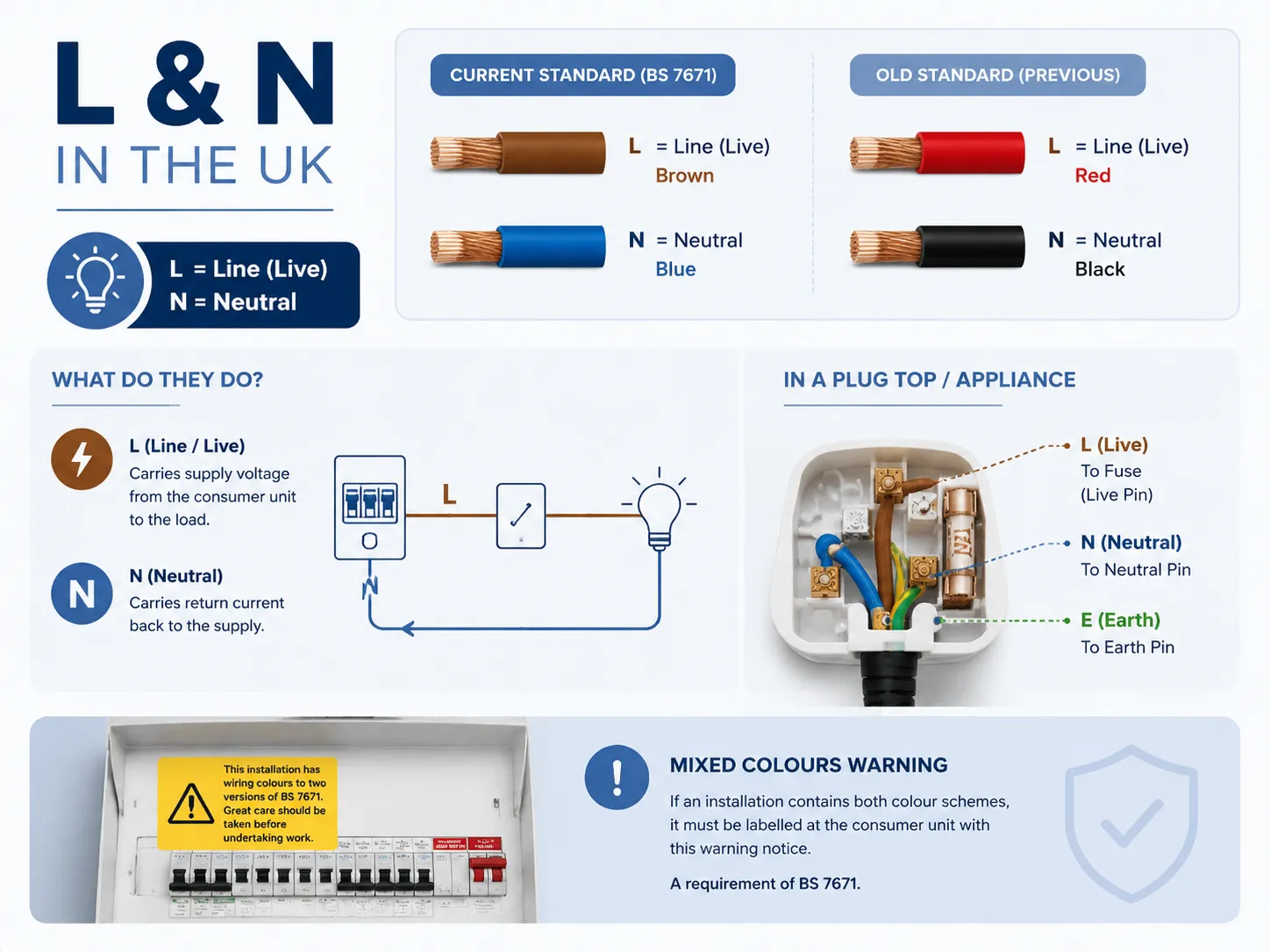
En el contexto del cableado fijo del Reino Unido, L y N son las abreviaturas estándar para Línea y Neutro. Bajo la norma armonizada actual, L es marrón y N es azul. El conductor de línea (marrón) transporta el voltaje de suministro desde la unidad de consumo al interruptor, luz o enchufe. El conductor neutro (azul) transporta la corriente de retorno de vuelta al suministro. En un enchufe o aparato correctamente cableado, el cable marrón se conecta al fusible (pin vivo), el cable azul se conecta al pin neutro y el cable verde/amarillo se conecta al pin de tierra.
Bajo la norma antigua, L era rojo y N era negro. Una instalación que contiene ambos esquemas de color debe estar claramente etiquetada en la unidad de consumo con un aviso de advertencia, que típicamente dice: “Esta instalación tiene colores de cableado de dos versiones de BS 7671. Se debe tener mucho cuidado antes de realizar trabajos.” Esta etiqueta de advertencia es un requisito bajo BS 7671 y es lo primero que un electricista responsable busca al abrir una unidad de consumo desconocida.
¿Siguen siendo seguros los colores antiguos de cables del Reino Unido?
Los antiguos colores de cables del Reino Unido no son inherentemente inseguros. El aislamiento de PVC rojo y negro usado en cables británicos desde los años 60 hasta principios de los 2000 es generalmente duradero y mantiene sus propiedades aislantes durante décadas, siempre que no haya sido sometido a sobrecalentamiento sostenido, daño físico o exposición química. La preocupación de seguridad no es la antigüedad del aislamiento sino el riesgo de identificación errónea cuando coexisten colores antiguos y nuevos.
Cuando un electricista encuentra un conductor rojo o negro en una instalación que también contiene marrón y azul, el único enfoque seguro es probar cada conductor con un comprobador de voltaje y un comprobador de continuidad antes de hacer cualquier conexión. No se puede confiar solo en el color a través de la división de armonización. La publicación IET Wiring Matters ha tratado este tema en detalle, y la guía de la industria de la Asociación de Contratistas Eléctricos (ECA) refuerza la necesidad de un etiquetado claro y pruebas en instalaciones de colores mixtos.
Si se está ampliando o modificando una instalación antigua, la mejor práctica es utilizar los colores armonizados actuales para el trabajo nuevo y aplicar una etiqueta de advertencia duradera en la unidad de consumo. Colocar funda aislante en cualquier conductor antiguo que se reutilice con la identificación de color adecuada — funda marrón en un vivo rojo, funda azul en un neutro negro — ayuda a salvar la brecha visual y reduce el riesgo de una futura identificación errónea.
Guía práctica para propietarios y electricistas
Para un propietario que reemplaza un interruptor de luz o un frente de enchufe dañado, el color de los cables eléctricos en la caja trasera es lo primero que debe observar antes de desconectar cualquier cosa. Una caja de interruptores que contiene marrón y azul es una instalación moderna; una que contiene rojo y negro es anterior a 2006. Si encuentra una mezcla de ambos, deténgase y llame a un electricista cualificado. La presencia de esquemas de colores mixtos indica que el circuito ha sido modificado durante el cambio de norma, y el riesgo de una conexión incorrecta de conductores es real.
Para un electricista, el protocolo es metódico: identificar la antigüedad de la instalación a partir de la unidad de consumo y cualquier certificado de prueba disponible. Probar cada conductor. Aplicar funda aislante adecuada cuando los colores no coincidan con las expectativas modernas. Etiquetar la unidad de consumo. Y registrar la presencia de colores de cableado mixtos en el Certificado de Instalación Eléctrica o en el Certificado de Trabajos Eléctricos Menores. Esta documentación protege no solo al electricista que realizó el trabajo, sino a todos los electricistas y propietarios que lo sigan.
Referencias
- BS EN 60445 — Principios básicos y de seguridad para la interfaz hombre-máquina, marcado e identificación — Identificación de conductores por colores o números. British Standards Institution.
- BS 7671 — Requisitos para Instalaciones Eléctricas (Reglamentos de Cableado IET) BS EN 60445.
- Health and Safety Executive — Seguridad Eléctrica en el Trabajo — Guía para la gestión de riesgos eléctricos incluyendo instalaciones con colores de cableado mixtos.
- Asociación de Contratistas Eléctricos (ECA) — Guía industrial sobre prácticas seguras de instalación eléctrica e identificación de colores de cableado.
Preguntas frecuentes
¿Siguen siendo seguros los colores de cables antiguos del Reino Unido?
El sistema tradicional de cableado del Reino Unido solía estar compuesto por cables de diferentes colores. Esos cables antiguos — rojo y negro — no son necesariamente peligrosos. La cubierta del cableado antiguo es generalmente muy duradera. Sin embargo, cuando se cablea con una mezcla de cables antiguos y nuevos, es posible identificar erróneamente los cables, creando un posible problema de seguridad. Se requiere que cualquier instalación que utilice circuitos con cables antiguos (rojo y negro) y nuevos (marrón y azul) esté claramente etiquetada en la unidad de consumo. Todos los conductores deben ser verificados antes de la conexión.
¿De qué color son los cables L y N en el Reino Unido?
El cable marrón es línea (L); el cable azul es neutro (N) bajo la Norma Armonizada, mientras que bajo la antigua Norma Pre-2006 el cable de línea (L) era rojo y el cable neutro (N) era negro. Ambos tienen verde y amarillo a rayas como tierra (conductor de puesta a tierra), pero las instalaciones antiguas de conductores de tierra pueden ser verdes lisos o desnudos.
¿En qué año cambió el Reino Unido los colores de cableado?
El 31 de marzo de 2004, el Reino Unido implementó oficialmente el código de colores estándar para el cableado eléctrico. Hubo un período de transición durante el cual se podían usar tanto los colores de cableado antiguos como los nuevos hasta el 31 de marzo de 2006. A partir de esa fecha, todas las nuevas instalaciones eléctricas debían cumplir con el nuevo esquema de colores de cableado de marrón, azul y verde/amarillo.
¿Cuáles son los colores de cable de 4 núcleos en el Reino Unido?
Según las normas armonizadas, los cables de 4 núcleos están fabricados con conductores de color marrón, negro, gris y azul. Además, un cable de 4 núcleos contendrá un conductor de tierra verde/amarillo o un conductor de tierra desnudo. En los casos en que el cable de 4 núcleos se utilice para un sistema trifásico; los tres conductores de fase son tradicionalmente marrón, negro y gris, siendo el azul el conductor neutro. En el caso de presentar una sola fase, todos los conductores de fase deben ser identificables con funda marrón.
Los colores de los cables eléctricos en el Reino Unido no son arbitrarios. Siguen un estándar nacional, alineado con un estándar europeo, que existe para proteger a electricistas y propietarios de las consecuencias de un conductor mal conectado. Ya sea que esté reemplazando un frente de enchufe en una casa adosada de los años 70 o cableando una nueva extensión según las regulaciones actuales, el color del cable cuenta una historia — pero es una historia que debe verificarse con un comprobador de voltaje, no tomarse por sentado. En GOG Electric, fabricamos accesorios de cableado — interruptores, enchufes y dispositivos para hogares inteligentes — diseñados para conectarse de manera segura y clara, con marcas en los terminales que corresponden a los colores actuales de cableado del Reino Unido, porque la conexión entre el cable y el dispositivo es donde la seguridad se confirma o se compromete.