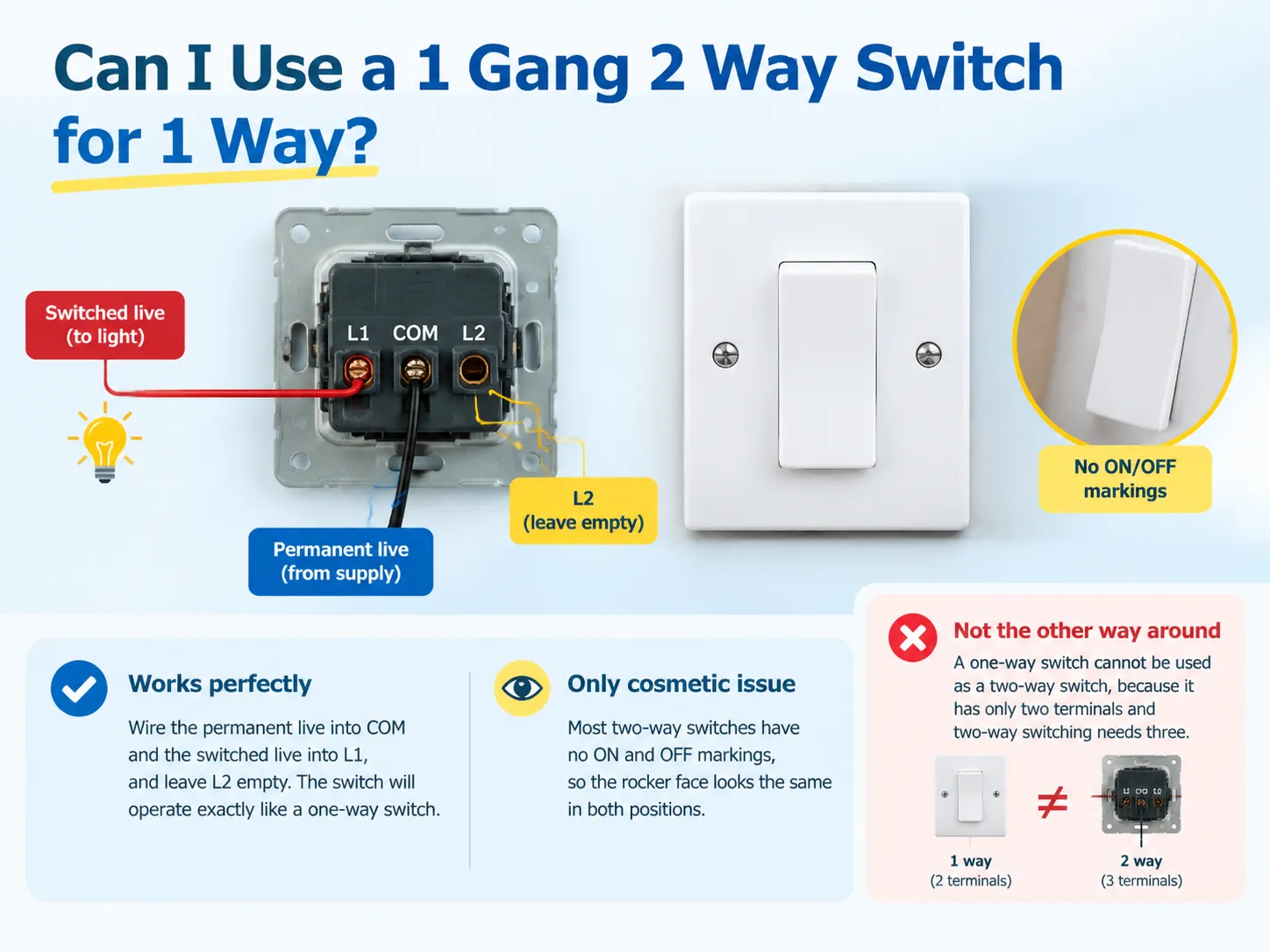
Você adquiriu um interruptor de duas vias, ou tem um do seu trabalho anterior em um corredor, e deseja usá-lo para controlar uma luz simples que pode ser ligada e desligada. O interruptor se encaixa no local e os contatos são reconhecíveis, e a única coisa que resta é verificar se o terminal extra tem alguma importância.
Não tem. Um interruptor de duas vias inclui tudo o que é encontrado em um interruptor de uma via, além de um terminal adicional que ficará sem uso.
Resumidamente, a resposta é positiva: de fato, um interruptor 1 gang 2 way pode ser usado como um interruptor 1 way sem nenhum problema. Você deve conectar o fase contínuo ao COM e o fase comutado ao L1, deixando o L2 sem conexão. Neste caso, o interruptor funcionará da mesma forma que um interruptor de uma via. O único inconveniente aqui está relacionado à aparência: a maioria dos interruptores 2 way é fabricada sem sinais de ON e OFF, então a face do interruptor parece idêntica nas duas posições.
Gang e Way São Duas Coisas Diferentes
Quase toda confusão nesta área vem do tratamento de “gang” e “way” como se descrevessem a mesma propriedade. Eles descrevem coisas perpendiculares.
| Termo | O que conta | Exemplo |
|---|---|---|
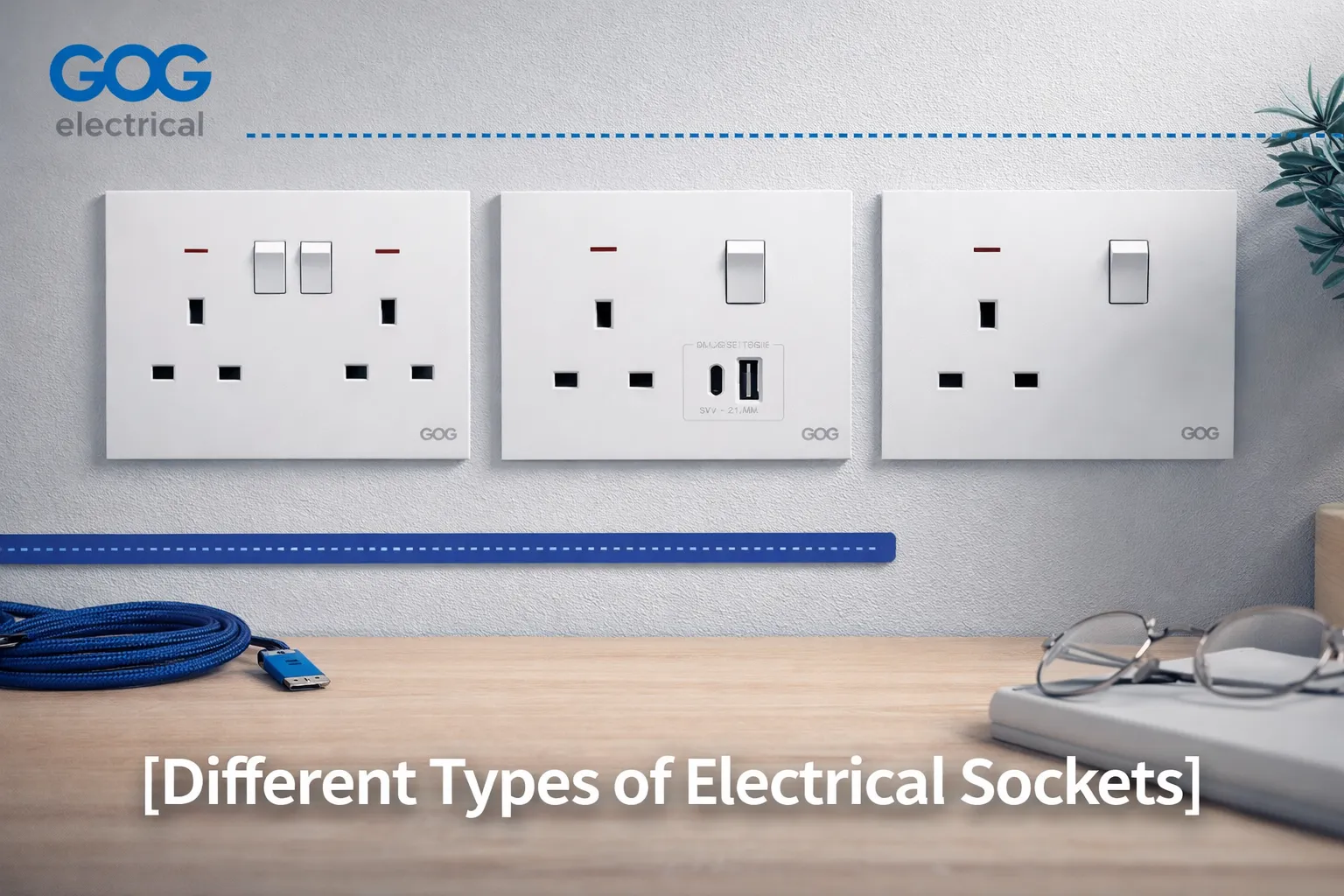
| Gangue | Quantos interruptores estão na placa | 1 gang = um tecla, 2 gang = duas teclas lado a lado |
| Caminho | Quantas posições de comutação um interruptor pode servir | 1 way = ligado ou desligado de um lugar, 2 way = ligado ou desligado de dois lugares |
| 1 gangue 1 caminho | Um interruptor, ponto de controle único | A luz padrão do quarto |
| 1 gangue 2 caminhos | Um interruptor, capaz de função de troca | Uma luz de escada controlada de cima e de baixo |
| 2 gangues 2 caminhos | Dois interruptores independentes de troca | Dois circuitos de iluminação, cada um com um segundo interruptor em outro local |
| Intermediário | Inserido entre dois interruptores de duas vias para três ou mais posições | Um corredor longo com um interruptor em cada extremidade e um no meio |
Um interruptor de duas vias de um gang consiste em uma única tecla em uma placa, com a tecla funcionando como um mecanismo de troca. Não há alteração na placa ou nos acessórios. O processo de montagem é semelhante, a caixa permanece inalterada, e a placa frontal tem a mesma medida.
Pior ainda, terminologia diferente também pode levar a confusão para qualquer pessoa que esteja comprando produtos internacionalmente. Por exemplo, o interruptor de duas vias no Reino Unido é chamado de interruptor de três vias na América do Norte. Da mesma forma, um interruptor intermediário no Reino Unido corresponde a um interruptor de quatro vias na América do Norte. Um interruptor de uma via na linguagem do Reino Unido refere-se ao que é chamado de interruptor de polo único na terminologia norte-americana. Portanto, se você quiser pedir interruptores do catálogo de um país estrangeiro, a contagem de terminais é a única coisa em que você pode confiar. As convenções de nomenclatura e as formas como elas se relacionam estão descritas nesta explicação de o que significam 1 gang, 2 gang e 3 gang.
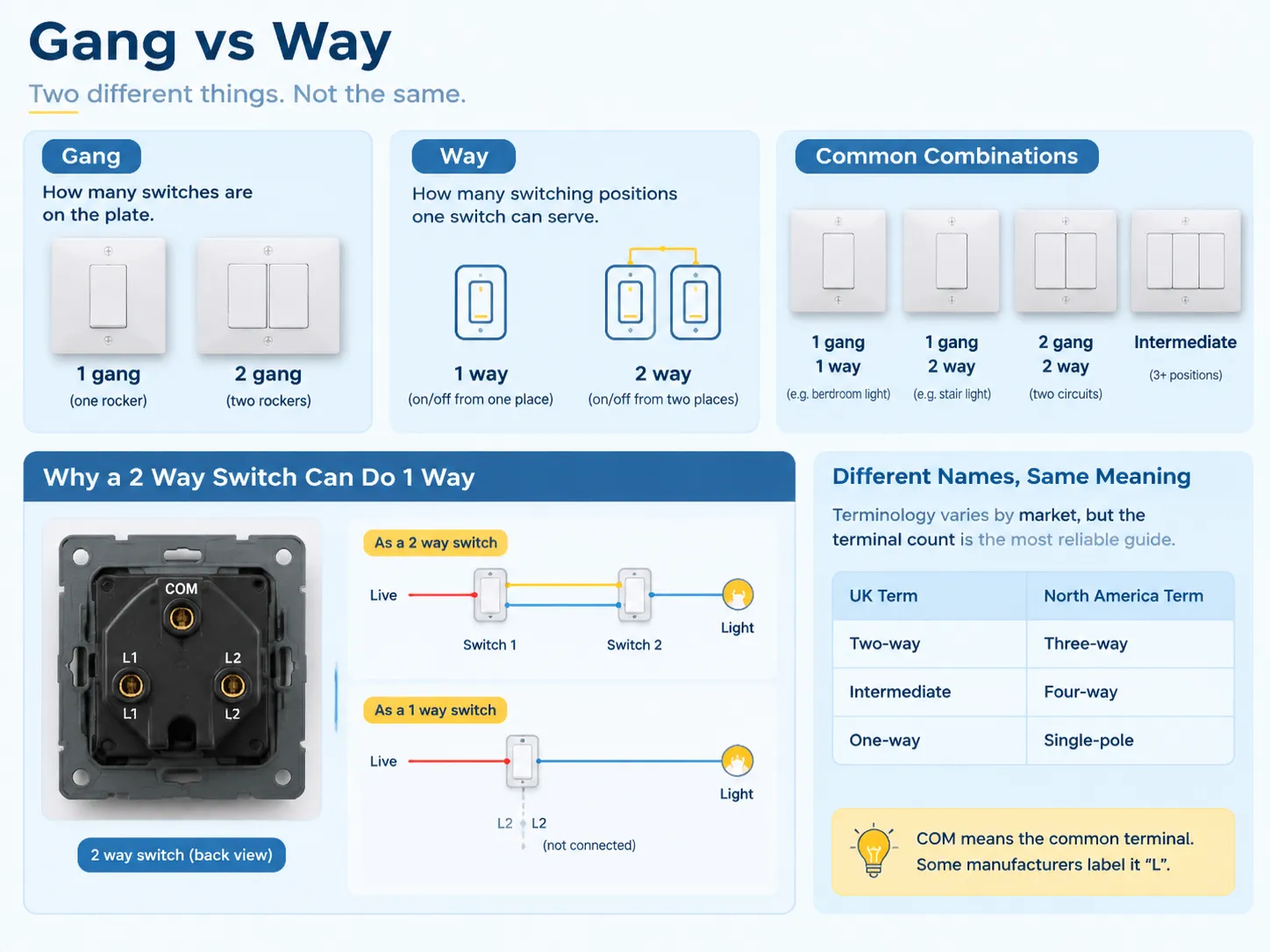
Por Que Um Interruptor 2 Way Pode Fazer 1 Way
Confira o interruptor na parte de trás. Como um dispositivo de duas vias, ele possui 3 terminais marcados como COM, L1 e L2. O mecanismo consiste em uma chave reversora, onde o COM conecta-se a um dos terminais L1 ou L2, mas nunca a ambos ao mesmo tempo. Assim, ao acionar a tecla, você faz a conexão de um terminal para o outro.
Esse comportamento é responsável por ambas as aplicações do interruptor de duas vias.
Como um interruptor de duas vias, o fio COM está conectado a uma fase permanente, enquanto L1 e L2 são condutores strapper que vão para outro interruptor. Os dois interruptores formam um circuito, pois um deles pode completar o circuito. Como um interruptor de uma via, o fio COM ainda está conectado a uma fase permanente. No entanto, L1 agora conecta-se a um pino de fase comutada para a luz e L2 fica efetivamente desconectado. A chave reversora ainda ocorre neste caso, mas devido a uma das opções estar anulada, ele se torna um interruptor simples de ligar e desligar.
Não há diferença elétrica entre o interruptor de duas vias e um interruptor de uma via que utiliza a mesma construção com um dos contatos omitido e apenas dois terminais conectados.
O que COM significa em um interruptor, e por que alguns fabricantes rotulam o mesmo terminal como L, é um dos pontos mais comuns de confusão, abordado nesta explicação de qual é o terminal comum em um interruptor de luz.
A Única Desvantagem Real: Ausência de Marcação de LIGADO e DESLIGADO
Um interruptor de uma via geralmente é identificável. Ele terá um símbolo “I” e “O”, ou a superfície do interruptor indicará qual extremidade sinaliza a posição “ligado”.
Com um interruptor de duas vias, não há necessidade de marcações indicativas. Isso ocorre porque o interruptor não possui estados definidos; em circuitos de duas vias, a posição para cima do interruptor não é necessariamente a posição “ligado”. Por isso, os interruptores de duas vias podem ser encontrados com teclas em branco ou rotuladas como 1 ou 2.
Se o interruptor de duas vias for utilizado como um interruptor simples, sua funcionalidade permanece inalterada; no entanto, pode parecer estranho. O proprietário do equipamento certamente saberá qual posição é a de “ligado”, embora não combine esteticamente com o restante do equipamento encontrado no ambiente.
As três medidas a seguir podem ser tomadas para resolver a situação:
- Use um interruptor de uma via. Se o circuito for de uma via, é melhor comprar um interruptor que corresponda ao design. Interruptores de uma via são bastante baratos.
- Gire o mecanismo. Muitos sistemas modulares permitem girar o módulo do interruptor dentro da placa, ajustando a posição correta do interruptor.
- Aceite. Se o equipamento estiver instalado em uma área não residencial, funcionará bem e o proprietário não lembrará do design em poucos dias.
Por que um Interruptor de 1 Via Não Pode Ser Usado em 2 Vias
Neste caso, devemos dizer não, e a situação descrita acima é basicamente a mesma novamente, e temos que dizer que é um contato simples de ligar ou desligar. Internamente, um interruptor de uma via possui apenas dois terminais conectados entre si. A operação de comutação ocorre quando os dois terminais estão conectados ou não conectados.
Por outro lado, no caso de comutação de duas vias, precisamos de um interruptor de mudança em cada extremidade do circuito. Existem dois condutores strapper entre os dois interruptores que completam o circuito quando ambos os interruptores selecionam o mesmo strapper. Essa operação só pode ocorrer com um dispositivo de três terminais em cada extremidade, pois o fio fase permanente de entrada deve ir para um dos dois condutores de saída.
Em um interruptor unipolar, a falta do segundo terminal é uma desvantagem séria. Portanto, sempre podemos incluir um interruptor unipolar em um circuito de duas vias, mas ele funcionaria apenas como um interruptor de sobreposição e não faria o sistema funcionar corretamente. A lógica de mudança de três terminais, e sua relação com o interruptor intermediário de quatro terminais, é explicada nesta comparação de comutação de duas vias e três vias.
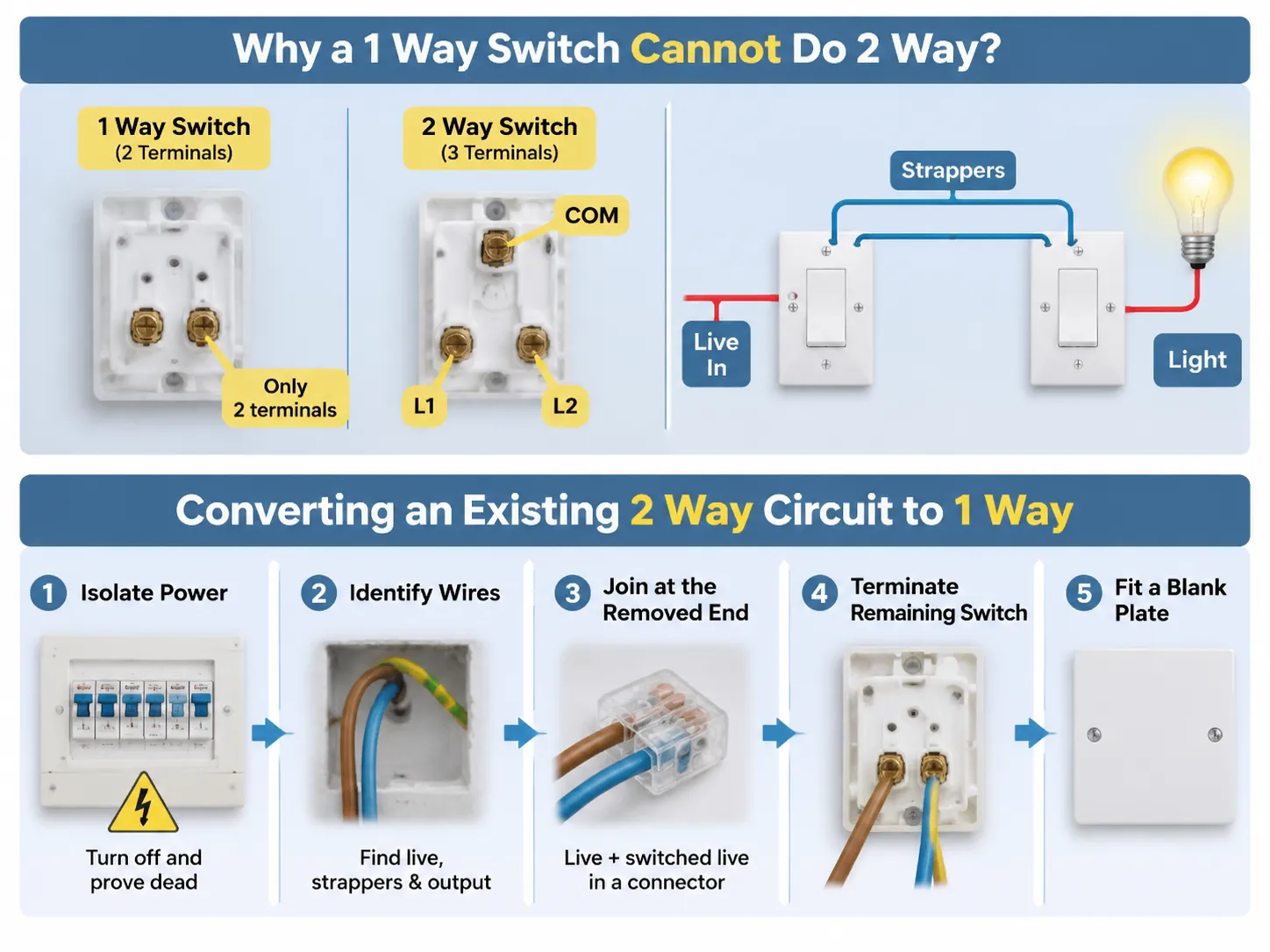
Convertendo um circuito de 2 vias existente para 1 via
Remover um interruptor pode ser um trabalho eficaz, mas deve ser realizado da maneira correta.
- Deal with the consumer unit by isolating the electricity and checking that everything is dead. Most lighting circuits use 10 A or 6 A MCBs; thus, the circuit for the fixture that has just been switched off may be a different circuit.
- Determine which cable is the permanent live, which is the strapper and which is the switched live at the switch you’re using.
- Remove the second switch and remove its cable. The cable you removed connects the two switches. At the end where the cable was removed, you’re going to connect the permanent live with the switched live to provide current to the lamp.
- Terminate the working switch in a manner that the COM terminal gets constant live current and L1 takes the switched current to the fixture.
- If you kept the box, you’ll have to replace the switch with a blank cover; otherwise, you’ll have to take the box off and get the wires back in the wall if you do not need the room anymore. A blank cover is what most people do and is the most practical solution.
If the two-way circuit is made with three-core cable and the strapper can be easily identified, it’s easy to do. If two separate two-core cables were used, it would be impossible to tell which wire is which, and you may need to consult an expert. The wiring sequence for a switched lighting point is covered in this guide to wiring a light switch to UK conventions.
Double-Pole Switches on 1 Way Duty
A double-pole switch disconnects both the supply and neutral wires. It is used in places where isolation is needed, not regulation, for example, lighting located outside, shower pumps, or other devices that are meant to be switched off for maintenance.
In a single circuit, a double-pole switch only works if it is connected as a double-pole switch, meaning that one supply terminal handles the supply and one handles the neutral. Although, as noted, it may be allowed to use only one pole on the double-pole switch, it does not make sense to buy such a switch in the first place, otherwise, one terminal will stay useless.
Two things to keep in mind: a double-pole switch must be connected to the neutral in the location. Many circuit types do not have neutral conductors present as these circuit types usually have the neutral looping at the ceiling capping. Also, double-pole switches are typically deeper than normal switches and must be checked before buying.
Mixing Switches in a Multi-Gang Plate
In a two-gang plate, the two switches do not influence one another mechanically. One switch can be used in the one-way mode, while the other can either function in the two-way mode or in the one-way mode. The only restriction is physical, as certain modular ranges use a different module for a particular function, and the plate should be suitable for both types of modules.
Such flexibility makes modular ranges quite popular for retrofitting projects, as it is possible to create a plate consisting of a one-way module, another two-way module, and a dimmer module as needed, instead of making a complete change.The trade-offs of that system, including cost and availability, are worth understanding before committing to a whole house, as this comparison of gang switch configurations sets out.
What to Buy, and What to Check
- Ensure you verify the terminal count. A three terminal indicates that the switch can serve both functions, while if it features two terminals it can only serve the one function.
- Check the specification. 10AX is the normal specification for modern LED and fluorescent loads in the UK. Using a switch rated at 6A in a circuit with high inrush is a hazard that could trip the switch accidentally. The AX suffix suggests that the switch is rated for both capacitive and inductive loads rather than resistive loads only.
- Check the depth of the box. Two way and double pole mechanisms are generally thicker than the one way switches, so a 16mm box designed for the old switch might not accommodate the new one.
- Check the plate format. Having a two way switch in a one way position means there is a cosmetic mismatch which means trying to match up with what is already in the room will be more expensive that buying the correct switch for it.
- Avoid doing a very wrong thing: buying a two way switch simply because that is what you found at the store and then keeping terminal L2 connected to an unused wire. An unused terminal should not be connected to anything.
Perguntas Frequentes
Can you use a 2 gang 2-way switch for 1 way?
That is correct. Every gang operates as an independent changeover switch, making it possible to connect it as a one-way switch through COM and L1, leaving L2 vacant. You can use both gangs as one-way switches, or one of them as a one-way while the other as a two-way one at the same time. The only restriction is that you have spent money on a second switch that may not really be necessary.
How do I convert a 2-way switch to 1-way switching?
Disengage the switch and then determine the position of the permanent live and switched live wires. For the second switch being removed connect the permanent live directly to the switched live wire and install a maintenance free enclosure to serve the lamp with power. Finally disconnect the other switch and connect it to the existing switches COM to connect to the permanent live and L1 on the switched live wire. Finally, cover the hole with a cover plate.
Can I use a 1-way switch as a 2-way switch?
A single-pole switch contains only two terminals and cannot transmit the continuous incoming current either to one of the two-way switch strappers that two-way control at every end requires. If it is used in a two-way circuit, a switch will function by cutting off the working principle of the device.
Can I use a 2-pole switch for 1-way switching?
In addition to this, it is essential to remember that this point must also be separated. Run the hot wire through one end and the neutral through the other so that both connections would be opened. It is also important to have the neutral at the switch location which may not be possible with all lighting circuits and also the junction box should be big enough.
Referências
- Socket Store — Can I Use a 2 Way Switch for 1 Way?
- Electrical Safety First — Electrical Safety Guidance for Householders
- Legrand — Wiring Device Terminal Configurations
- UL Solutions — General-Use Snap Switch Standards
- Hubbell — Switches and Wiring Accessories
Conclusão
By definition a one gang two way switch is a one way switch fitted with an extra contact and is no mark in “ON”. Connect COM and L1 and leave L2 unused; it will work just like one way switch.
The only rule that answers each incarnation of the problem is the terminal count. Three terminals make either one; two terminals can only perform one way task and one in a two way circuit gives you the light from one side and constant irritation from the other.