

Vietnam Outlet Plug – Type A/C, Adapter Needed?
Vietnam is the country of dynamic energy from Hanoi’s active streets to Ha Long Bay’s calm waters. But before you turn on your devices, remember that electrical standards here are different. The country’s most commonly used sockets are Type A and Type C, while you can face Type F sockets in some modern buildings. This guide will explain the Vietnamese electrical plugs and sockets, voltage, and frequency. In addition, this guide contains answers to the most common questions raised by travelers, including your own.
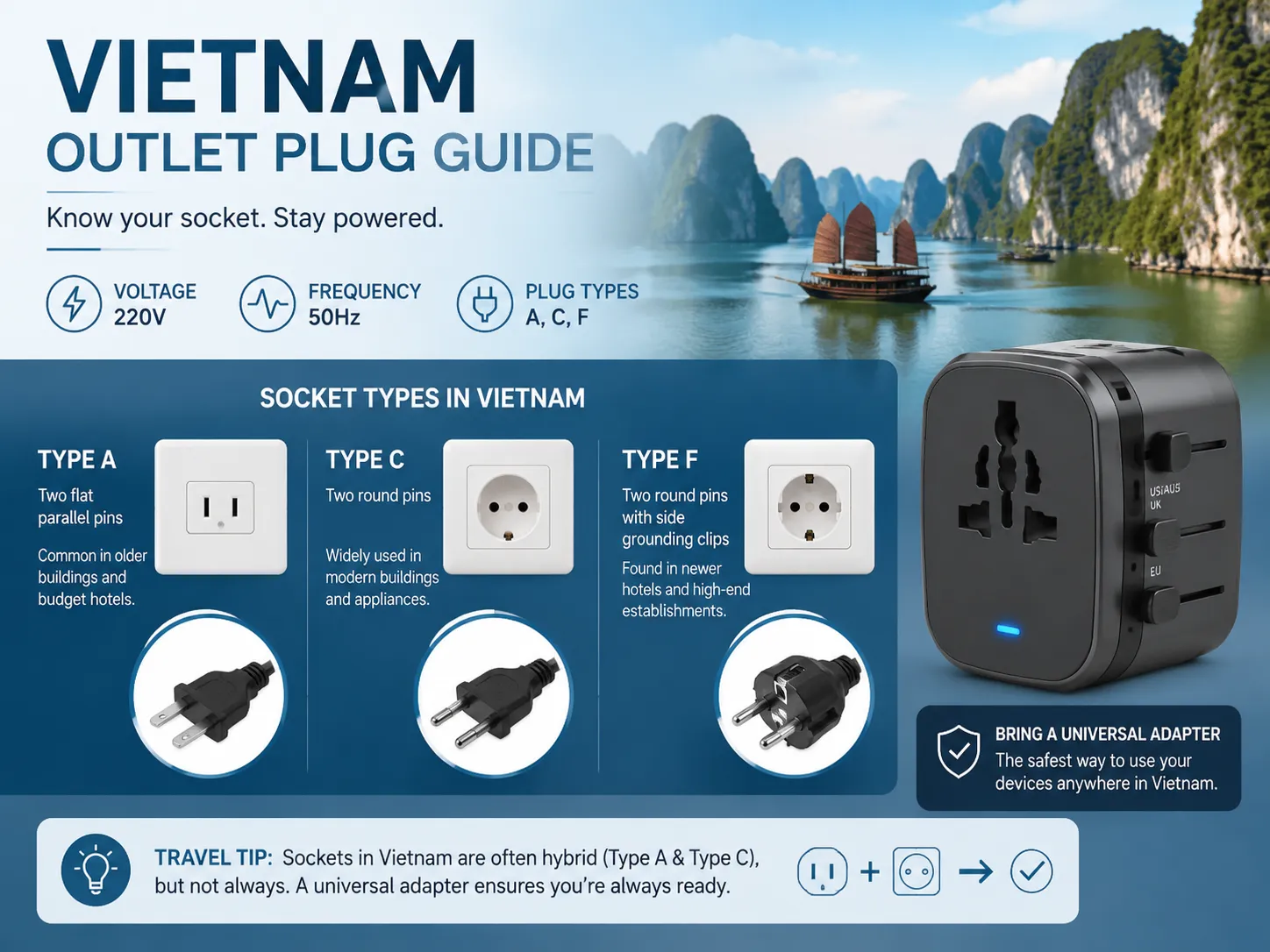
Vietnam Electric Socket Type
There isn’t a single socket standard in Vietnam – rather it is a mix of various old and new sockets. The wall sockets (also known as power outlets orPtrs) that are most extensively used are:
- Type A – It is about two flat and even pins (not grounded), similar to Japanese/US outlets. This type of outlet is typical for older buildings and low-cost lodging.
- Type C – A standard “Europlug” featuring two round (not grounded) pins. It is common in contemporary building works and is widely used in many electrical devices.
- Type F – There are two round pins incorporated with side grounding clips (Schuko), which are usually seen in modern hotels and prestigious venues.
Most of the sockets in Vietnam are hybrid in nature where they accept both Type A (with flat pins) and Type C (with round pins). The prevalence of hybrid sockets is especially high in tourist areas. However, this phenomenon cannot be relied on in all parts of the country. In some rural areas, primarily the ones that are older, the sockets may accept only Type A and in the cities, the majority of sockets may only be of Type C. To be on the safe side, one should have a universal adapter that can support both types of plugs.
In contrast to nations that only follow one standard, Vietnam employs a combined system whereby it is wise to expect pins either in one of two types, or better yet, carry an adapter that is compatible with both types.
Vietnam Plug Type
The plug types you’ll encounter in Vietnam are:
- Plug Type A – two flat parallel pins, no earth pin. Used mostly for smaller devices.
- Plug Type C – two round pins, no earth pin. The most common plug for European‑style devices.
- Plug Type F – two circular prongs plus lateral grounding clips (Schuko) – employed for continuously high-powered equipment, although less commonly.
If a device has a Type A plug, its Type A can be connected to any Type A socket but cannot be used with Type C sockets. For people with Type C or Type F plugs, these must use sockets compatible with Type C and F plugs as well. Since Vietnam has both types of sockets, they must have universal adapters.
Pro tip: Numerous contemporary sockets in Vietnam may be considered universal since they can accommodate both types of pins – flat and round – but this is not assured. Therefore, don’t slouch on packing a small travel adaptor that allows for both Type A and C connections.
Voltage and Frequency in Vietnam
With a nominal voltage of 220 V (+/- 220-240V) and a frequency of 50 Hz, the electricity supply in Vietnam conforms to the standard system in most of Europe, Asia, and Australia.
If you come from the United States (where 120V power is used) or Japan (where 100V is employed) and you have an appliance that does not operate with dual voltage, then in that case, you have to use a power converter. Nevertheless, almost all modern gadgets and electrical devices (i.e. phones, laptops, and camera chargers) are of dual voltage (100-240V) and will work normally as long as a proper adapter is provided.
It is important to point out that Vietnam utilizes 50Hz, which is the same as in Europe and Asia; however, devices from the United States and Canada are built on 60Hz, but the discrepancy matters only in case of motors and clocks and is of no significance with chargers.
Do I Need a Travel Adapter for Vietnam?
Yes – almost certainly. Even if your plug matches one type, you may encounter the other. The table below gives a quick overview for travellers from different regions.
| Your Country / Region | Your Plug Type | Need Adapter for Vietnam? | Voltage Compatibility |
|---|---|---|---|
| USA / Canada | Type A/B (120V) | ✅ Yes – need adapter for Type C (round pins) – or universal | ⚠️ 120V vs 220V – need converter for non‑dual‑voltage |
| UK / Ireland | Type G (230V) | ✅ Yes – need Type A/C adapter | ✅ Voltage compatible – adapter only |
| Europe (Type C/F) | Type C/F (230V) | ⚠️ Maybe – if you have Type C, it fits Type C sockets, but if you encounter Type A, you need adapter. Recommended: bring universal. | ✅ Voltage compatible – adapter only if needed |
| Australia / New Zealand | Type I (230V) | ✅ Yes – need Type A/C adapter | ✅ Voltage compatible – adapter only |
| Japan | Type A/B (100V) | ✅ Yes – need adapter for Type C (round pins) | ⚠️ 100V vs 220V – need converter for non‑dual‑voltage |
| China | Type A, C, I (220V) | ✅ Yes – need adapter if your plug is not A or C | ✅ Voltage compatible – adapter only |
| India | Type D/M (230V) | ✅ Yes – need Type A/C adapter | ✅ Voltage compatible – adapter only |
| South Africa | Type M (230V) | ✅ Yes – need Type A/C adapter | ✅ Voltage compatible – adapter only |
Key takeaway: Vietnam uses both types of plug; both Type A (flat) and Type C (round) can be found in the country. Therefore, it is advisable to use a universal adapter which supports both types of connections. However, voltage issues come into play. Travellers can use an adapter only when visiting from countries where 220–240 volts is the standard voltage; they need to make sure that their devices are dual-voltage in case they are from a country where the standard voltage is 120 volts.
Our recommendation would be to use an adaptable travel plug with a variation of plug types that include those of the USA and Europe, as that will allow you to travel hassle-free in Vietnam.
Frequently Asked Questions (FAQ)
What plug type is used in Vietnam?
In Vietnam, the common electric plugs used are the Type A, which consists of two flat pins, and the Type C, which consists of two round pins. Type F, which is also referred to as Schuko, plugs are occasionally found, but you are more likely to come across Type A plugs in older buildings while Type C plugs are used in new buildings. There are many hybrid sockets that accept both types of plugs, but it cannot be verified that they are indeed all hybrid sockets.
Is Vietnam plug type A, C, or F?
According to the country, adapters may be A, C or F. Types A and C are more common; Type F is less common but still used in modern hotels. Therefore, it is advisable to take with you an adapter that works with all types.
Do I need to bring an adapter to Vietnam?
Yes – unless all your electronic devices have plugs which are compatible with both Type A and Type C which is irregular. If such a plug does exist, then you may still traverse a Type A power socket and you will need to have your device plugged in. A small universal adapter will be handy and help you deal with this issue.
What does a Vietnam plug look like?
The standard plugs utilized in Vietnam feature either a pair of flat plug pins resembling Type A (US type of a plug) or a pair of round pins akin to Type C (European plug type). Vietnam retains the combination socket possessing openings that fit into both formats i. e. with U.S.-style openings above and European-style openings below or even with a single universal opening.
Can I use my US hair dryer in Vietnam?
Hair dryers from the US run at 120V only. If you plug them into a 220V socket, they will break immediately. You will need a powerful step-down converter that supports the wattage and a silly plug adaptor. Most travelers opt to buy an inexpensive Vietnamese hair dryer instead, as converters are not only heavy but also expensive.
Are USB chargers available in Vietnamese hotels?
It doesn’t matter if you are in a big city or a five-star hotel—or if you are staying in a low-cost hotel or a budget homestay, it can be quite challenging to find USB ports. Thus, you should always carry a multi-port USB adapter with you.
Travel Tips for Using Electronics in Vietnam
- Carry a universal adapter – one that covers Type A, C, and F (US/Euro) is ideal.
- Check voltage labels – look for “100‑240V” to know you only need an adapter.
- Power banks are essential – especially for long motorbike trips or boat tours in Ha Long Bay.
- Voltage fluctuations – Voltage in remote areas may not be reliable; thus, surge protection should be considered when dealing with delicate electronics.
- Hotel outlets – Usually placed at a low position such as on the floor or desk, do not forget to pack an extension cord in case you need to charge multiple devices from your bed.
- Adapter vs. converter – remember: adapter = shape, converter = voltage. Don’t confuse them!
Summary
Vietnam’s electrical system is a blend of Type A and Type C sockets with 220V/50Hz. Travellers from Europe, UK, Australia (230V) only need a universal plug adapter (covering both flat and round pins). Travellers from US/Canada/Japan (120V) need that same adapter plus a voltage converter for non‑dual‑voltage devices. Most modern electronics are dual‑voltage, so an adapter is often all you need. With a little preparation, you can stay powered up and fully enjoy the beauty and energy of Vietnam. Chúc bạn có một chuyến đi vui vẻ (Have a great trip)!
Safe travels and happy charging!