

Power Plugs and Sockets of the Canada – Type A/B, Adapter Needed?
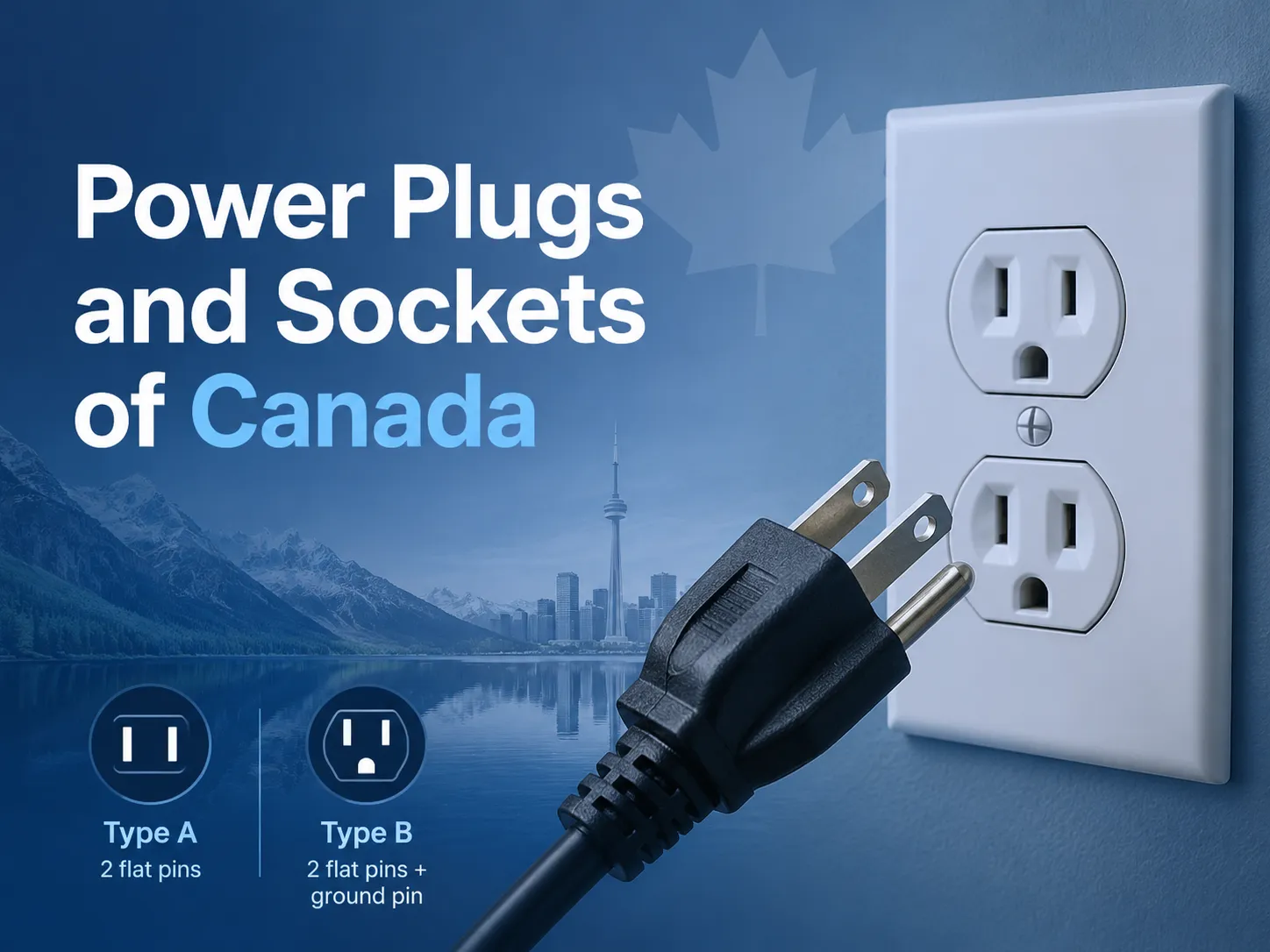
Making arrangements to travel in Canada? Regardless if you will be seeing The Rockies, going to large cities (Toronto or Vancouver), or visiting the East Coast area (Halifax), you should know if your electronic equipment will work when you arrive. In this article, we have outlined all the details regarding Canadian electrical outlets, plug types, power supply (voltage), and power source type (frequency); we have provided information on how to connect devices with foreign power supplies to Canadian outlets, as well as answers to many frequently asked questions about travelling in Canada (including your particular questions).
Canada Electric Socket Type
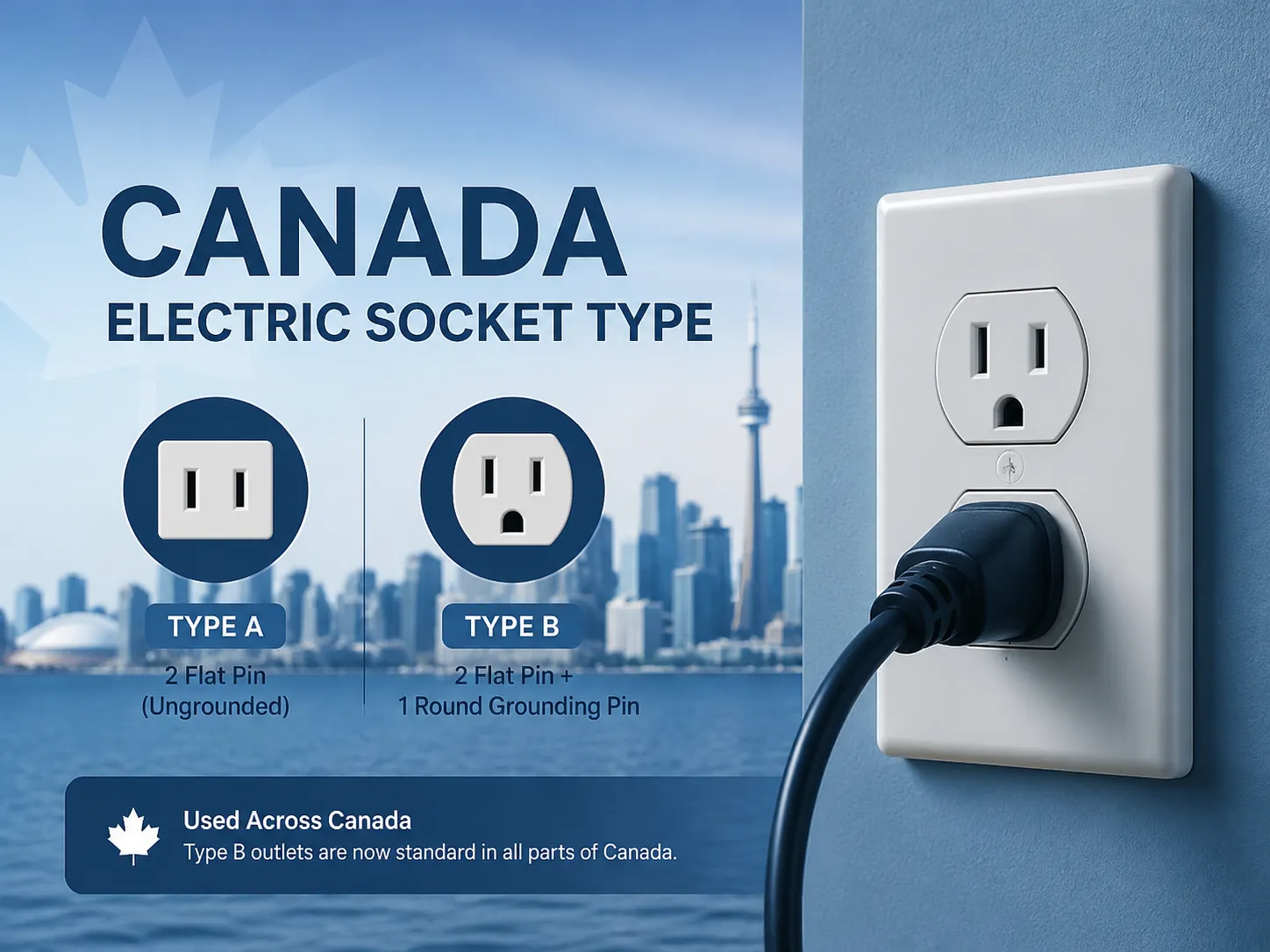
In Canada, standard power outlets or receptacles are types A and B, which are also identical to the power outlets used in the USA and Mexico.
- Type A – a two‑flat‑pin (ungrounded) socket. It accepts plugs with two flat parallel blades.
- Type B – In the modern world, the three-prong outlet type is the most widely used type of electrical outlet. The three-prong outlet contains two flat blade connectors and one round grounding pin.
Across Canada, you will find Type B outlets in most hotels, airports and public places. Some older houses may still have the older Type A sockets on them. For your device to be able to use your grounding plug (three prong), you need a socket that will work with that plug. However, all Type B sockets are now standard in all parts of Canada.
Canada Plug Type
The plug types used in Canada are exactly the same as in the United States:
- Plug Type A – two flat parallel pins, no earth pin.
- Plug Type B – two flat parallel pins plus a round earth pin.
Unless your device has either the Europlug (Type C) or the UK Type G plug, you will need an adapter to use it in Canada. Many new devices (laptops and phone chargers) are designed for dual voltage, so you won’t need a converter, just a simple travel plug adapter to fit the shape into the Canadian socket.
Pro tip: Most electrical chargers whether it be USB or power bricks utilized for laptops support 100-240 volts of electricity which means they can operate in any country around the world. All one needs to do is look at the label on the device itself, if that label indicates it receives input voltage between 100-240 volts and the input frequency is measured either 50 or 60 times per second, you are good to go.
Voltage and Frequency in Canada
Canada uses a standard voltage of 120 volts with a frequency of 60 hertz, which is the same as what’s used in both Mexico and the United States and is almost the same as Japan’s (100 volts).
When using appliances made to run on 220-240 volts (common in Europe, UK, Australia, etc.), you will need to use a voltage converter in order to avoid damaging them. Most modern electronics (like smartphones, tablets, cameras and electric shavers) can run at both voltages so just double check the label before plugging them in. If you plan on using high wattage devices (like hair dryers or curling irons) and they aren’t dual voltage, then you will need a step down converter to go from 220-240 volts to 120 volts.
Do I Need a Travel Adapter for Canada?
It depends on where you’re coming from. The table below gives you a quick answer for most common origin countries/regions, including plug type, whether you need an adapter, and voltage considerations.
| Your Country / Region | Your Plug Type | Need Adapter for Canada? | Voltage Compatibility |
|---|---|---|---|
| USA | Type A/B (120V) | ❌ No – identical | ✅ Yes – same 120V/60Hz |
| Mexico | Type A/B (127V) | ❌ No – identical | ✅ Yes – voltage close enough |
| Japan | Type A/B (100V) | ❌ No – plugs fit | ⚠️ 100V vs 120V – most devices tolerate, but check |
| United Kingdom | Type G (230V) | ✅ Yes – need Type A/B adapter | ⚠️ 230V vs 120V – need step-down converter for non-dual-voltage devices |
| Ireland | Type G (230V) | ✅ Yes – need Type A/B adapter | ⚠️ Same voltage issue as UK |
| Europe (most countries) | Type C/E/F (230V) | ✅ Yes – need Type A/B adapter | ⚠️ 230V vs 120V – need converter for non-dual-voltage |
| Australia / New Zealand | Type I (230V) | ✅ Yes – need Type A/B adapter | ⚠️ 230V vs 120V – need converter for non-dual-voltage |
| China | Type A, C, I (220V) | ✅ Yes – need Type A/B adapter (if using C/I) | ⚠️ 220V vs 120V – need converter for non-dual-voltage |
| India | Type D/M (230V) | ✅ Yes – need Type A/B adapter | ⚠️ 230V vs 120V – need converter for non-dual-voltage |
| South Africa | Type M (230V) | ✅ Yes – need Type A/B adapter | ⚠️ 230V vs 120V – need converter for non-dual-voltage |
| Brazil | Type N (127V / 220V) | ✅ Yes – need Type A/B adapter (unless you have Type N) | ⚠️ Check your device’s voltage; some regions use 127V (compatible), others 220V (needs converter) |
Key takeaway: Usually, if you’re from a country that uses a Type A or B plug (i.e., the USA, Canada, Mexico, or Japan) you will not need to purchase an adapter. If your country has a different plug type than A or B then you will need an adapter to convert to an A or B plug. Furthermore, if you are from a country that runs off of 220V-240V and your device is not made for dual voltage then you will need a converter to change your electric power voltage to 110V.
We recommend using a universal adapter because it will work with Type A/B plugs in the USA, Mexico and many other areas of Latin America, making this a great choice for frequent travelers.
Frequently Asked Questions (FAQ)
Are US and Canada outlets the same?
Yes, completely. Traveling from the United States to Canada allows you to plug your devices directly into Canadian AC outlets without needing an adapter or converter as the same (Type A & B) plugs and sockets are used in both countries, as well as identical voltage (120V) and frequency (60Hz).
What type of plug adapter do I need for Canada?
You must have a type A or type B plug adapter – the type B being the three-pronged grounded variety, which is the most common found in accommodations. If your device has a type A two-pronged flat plug, it can be plugged into either the type A or the type B outlets. If your device has a type B three-prong plug, it can only be plugged into a type B outlet; however, all Canadian outlets are currently type B. A universal adapter with North American pins will work.
Can I use my US phone charger in Canada?
Absolutely. Canadian standards use the same type of plug as Americans, which means if you bring an American charger with you to Canada, you will be able to use that charger in Canada because of the compatibility of plugs. You will not require any converters or adapters.
Is voltage the same in the US and Canada?
Yes – both use 120V at 60Hz. To put it simply: If your appliance says it can handle 110V then it will work just fine with the Canadian 110V. You should also be aware that since both countries use the same voltage, they will have identical plugs — therefore all appliances made for the USA can also be plugged into sockets in Canada.
Can I use my European hair dryer in Canada?
A European hair dryer is normally rated at 220‑240V. Plugged directly into a Canadian outlet rated at 120V, European hair dryers will run very weakly or not at all. Also, the European hair dryer plug type C/F is physically incompatible with a Canadian plug type A/B. You will need both a step-down voltage converter (from 120V to 240) and an adapter plug type A/B for use with a Canadian outlet. Most travelling people bring their own cheap Canadian hair dryer instead of carrying a heavy converter and then an additional plug adapter.
Are USB charging ports available in Canadian hotels?
More of today’s modern hotels and airport facilities have made use of installing USB-A and USB-C charging stations directly into their guests’ bedside lamps, desks, or wall outlets; however, you should always bring your own multi-port USB charger with a type-a/b plug so that you will have enough outlets available to charge all of your devices.
Travel Tips for Using Electronics in Canada
- Pack a universal adapter – even if you’re from the US, it’s useful for future trips to other countries.
- Bring a power bank – essential for long hikes in national parks or days out without immediate access to a socket.
- Check your hotel – While most medium-priced or luxury hotels feature type B electrical outlets, some of the older motels might only have type A connections. For this reason, it remains advisable to carry a simple power adapter with you.
- Voltage fluctuations – Voltage fluctuations are common in some remote environments, so an appliance such as a CPAP machine may experience damage if it is not plugged into a proper surge protector.
- Winter travel – If you plan to visit during the winter, keep in mind that cold temperatures can significantly deplete battery life. That means it’s wise to bring along a backup battery for your phone.
- Adapter vs. converter – remember: adapter changes the plug shape; converter changes the voltage. Don’t confuse them.
Summary
In conclusion, Canadians utilize Type A/B electrical outlets at 120 volts (V) and 60 Hertz (Hz), which are exactly like those in the United States. Thus, if you are traveling from the USA to Canada, you can plug directly into Canadian electrical outlets without the need for an adapter. If you are traveling from Europe, the UK, Australia, and many other areas of the world to Canada, you will need a Type A or B plug adapter; non-dual-voltage devices, however, will also require a voltage converter. Most of today’s electronic devices (smartphones, mobile computers, and tablet computers) are dual-voltage, so they only require an adapter to be able to operate in Canada. By being prepared with the correct equipment, you will be able to stay charged and connected while experiencing your Canadian vacation! Have a great trip!
Safe travels and happy charging!