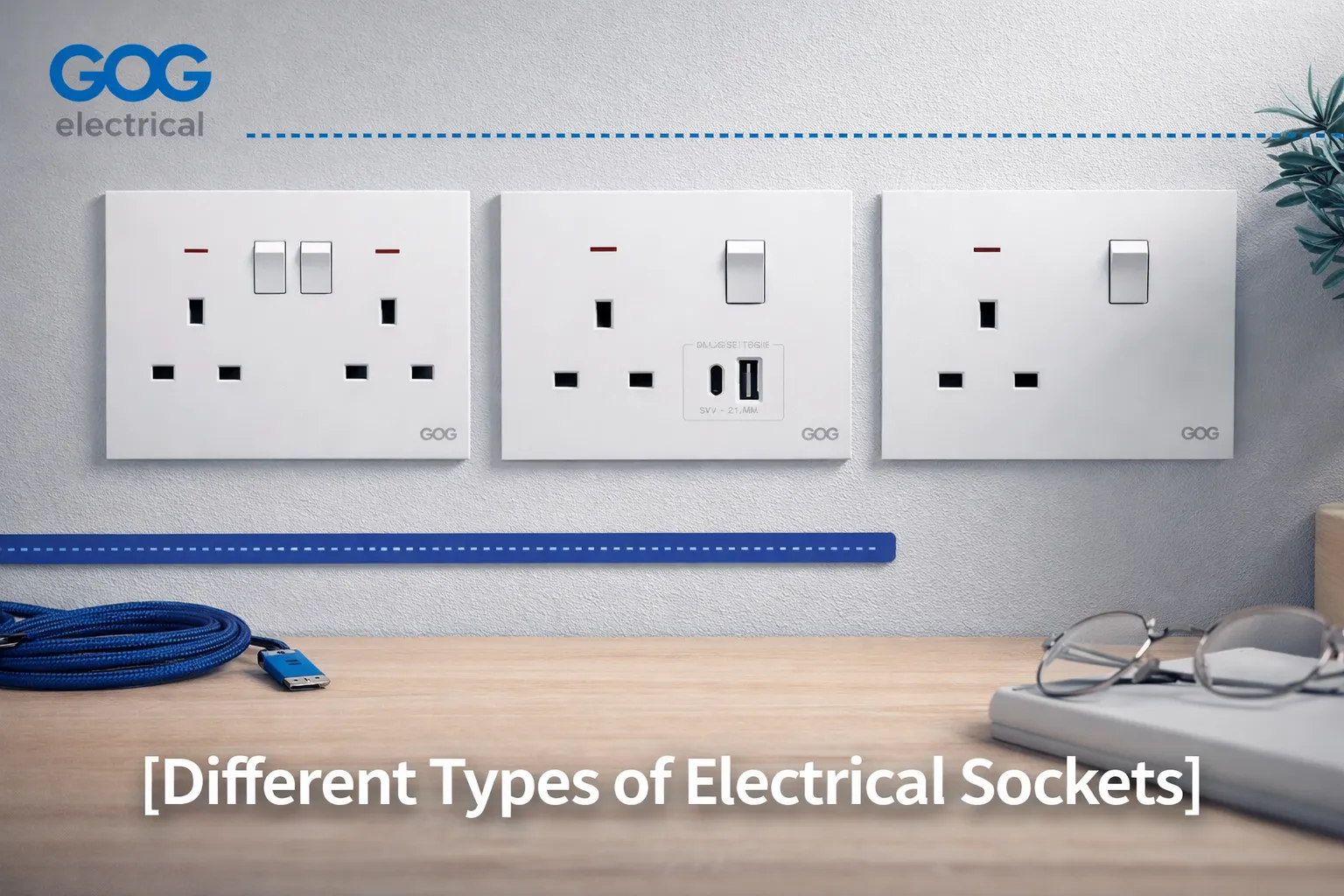
Changing the power point in New Zealand is possible (whether you have an old, broken, or out-of-date power point); however, whether you should do it yourself or hire someone with a license will depend on the wiring in the walls and what Electrical New Zealand regulations say about electrical work here. If you have a modern house that conforms to current standards, replacing a socket (as long as it complies with the correct brand) can be done by the home owner as long as the owner is following the written down safety procedures (i.e., that you have nice clean wiring) as described under the ‘own-home’ exemption. If you live in an older house, or if your circuit isn’t earthed, or if there is something wrong with your switchboard, then you can only get this done by a registered electrician. It’s very important to know what is compliant and what is not. Not only will it help ensure that you don’t electrocute yourself; it will also prevent you from putting a hidden risk of fire or shock that could happen years later.
What New Zealand Regulations Say About DIY Electrical Work
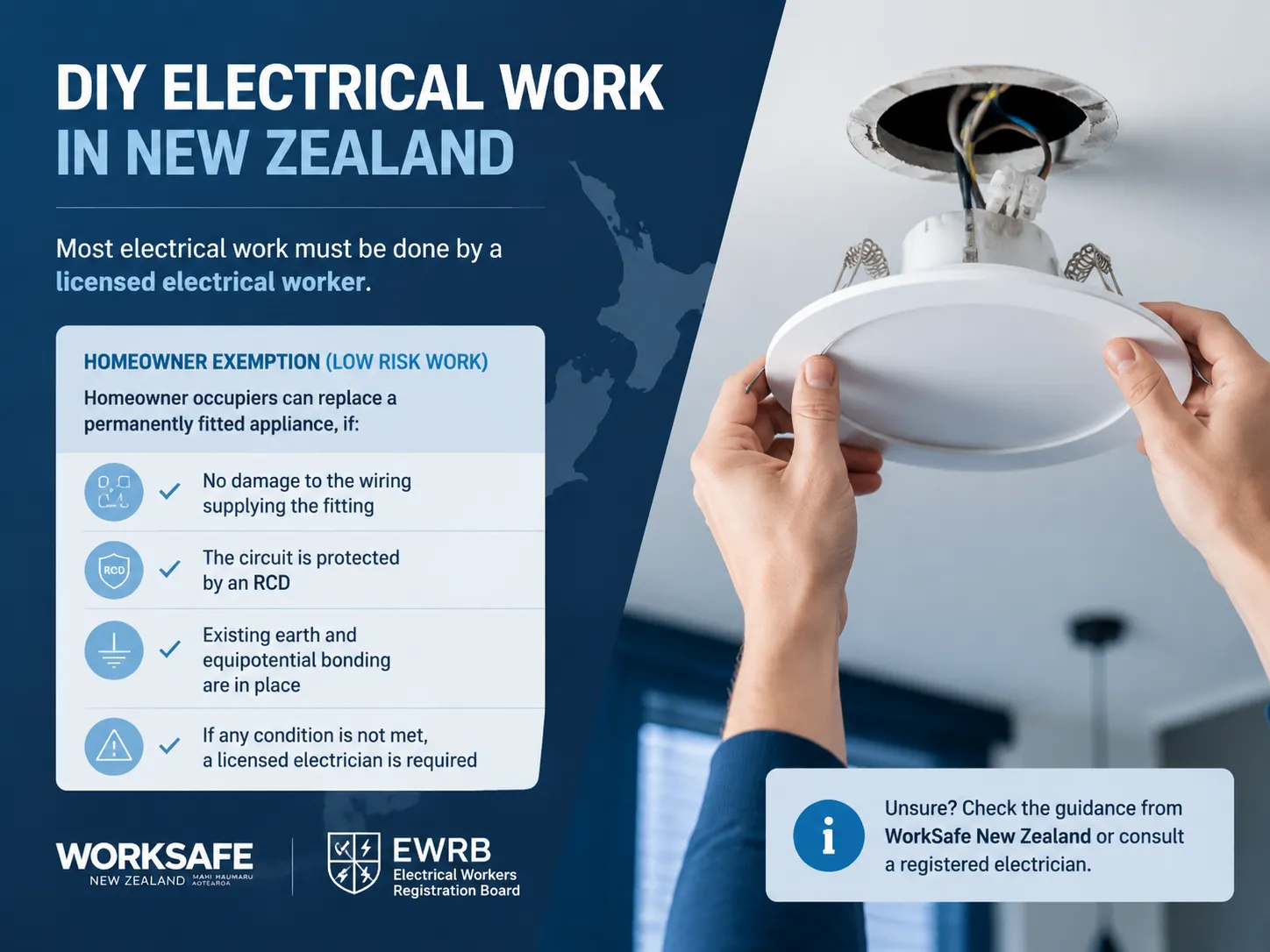
The electricity safety system in New Zealand is one of the most stringent internationally, governed by the Electricity (Safety) Regulations 2010 and the Electricity Act 1992. In the vast majority of cases, all prescribed electrical work (PEW) must be completed by a licenced electrical worker unless there is a specific exemption available. However, Homeowners (Homeowner Occupiers) can also undertake certain low risk work at their own home if certain criteria are met. For example, a Homeowner can replace an electrical appliance which has been permanently fitted to an electrical socket (e.g. a light fitting, a switch or an electrical plug) are permitted by the regulations to do so under the above provisions.
Nonetheless, the exemption has very specific parameters. There must be no damage to the wiring supplying the fitting. The circuit must be protected with a RCD before installing the new fitting. The existing earth and equipotential bonding must still be in place. If any one part of these conditions is not met, the work will no longer be covered by the exemption and will need to be completed by a licensed electrical worker. Energy Safety, a division of WorkSafe New Zealand, publishes detailed guidance on the boundary between homeowner maintenance and prescribed electrical work, and the Electrical Workers Registration Board (EWRB) maintains the public register of licensed workers. A homeowner who is uncertain should consult these resources or ask a registered electrician to inspect the installation before beginning work.
How to Safely Replace a Power Point: Step by Step
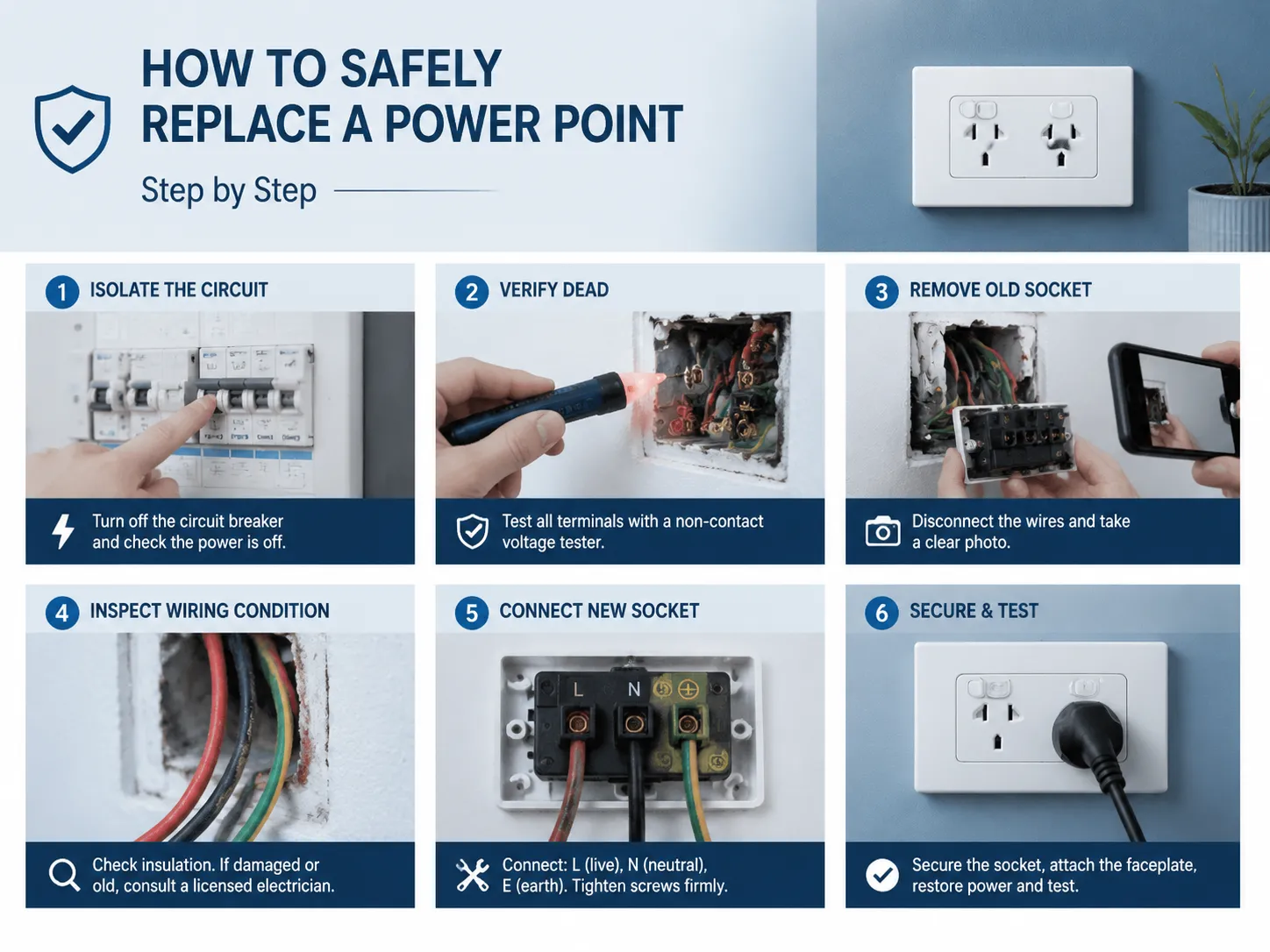
The replacement of a socket will go according to the sequence of the electrical worker’s recommended method describing the work safety procedures of good practice; therefore, if it has been confirmed that the existing installation is an RCD protected circuit, the wiring is in good order, and you will be installing back the same type of outlet in the same position следовательно, вы можете выполнять замену на систематизированном творчестве.
- Locate and isolate the correct circuit. Use a lamp or a voltage tester by plugging into the power point that you are about to replace. Then turn off the circuit breaker or remove the fuse that supplies power to that circuit at the switchboard and check to ensure that the lamp has gone out. Do not work on any assumption that may be made, since one of the main reasons for receiving an electric shock is because of incorrectly identifying which circuit has been de-activated.
- Verify dead with a non‑contact voltage tester. After removing the faceplate, test each of the terminals using an appropriate non-contact tester. If the tester lights or beeps at any of the terminals, there is a dangerous voltage present. Test the tester on a known live circuit before and after testing the terminals to ensure the tester is functioning properly.
- Remove the old socket and photograph the wiring. To remove the old socket from the flush box, simply remove it by hand; then disconnect the wiring as per the instructions provided above… After taking a clear picture of all wires on each terminal about which was taken to the snap shot, you will now know exactly where each conductor goes to add to the new socket. The phase (also may be coloured as brown/red) should connect to a terminal labelled “P” or “L”; the neutral (also may be coloured as black/blue) should connect to a terminal labelled “N”; and the earth (also may be coloured as green/yellow or bare) should connect to a terminal labelled “E” or to the earth symbol.
- Inspect the wiring condition. Inspect the insulation on the wires, and if you find any signs of brittleness, crack/heat damage, and any form of rubber insulation or lead sheathe, discontinue immediately and have a licensed electrician complete the work.
- Connect the new socket. Align the wires correctly based upon the terminal markings on this new power outlet. Phase goes to P or L, Neutral to N, and Earth to E. Each conductor should form an anti-clockwise loop under the terminal screw so that as you tighten the screw it pulls the wire in. Tighten the screws firmly to secure the connection. If the new outlet has a rocker switch, the mechanism will only break the phase wire, so it will be very important that the phase wire is wired to the correct terminal.
- Secure the socket and attach the faceplate. Carefully fold your wires into the flush box so that each conductor is not pinched or pressed against a sharp edge. Securely fasten the socket to the box; put on the faceplate; restore power; and test with a plug-in appliance.
If you need a more visual guide that covers both the wiring logic and the specific terminal layout for a single‑pole switch and socket combination, our article on how to wire a single pole switch applies the same principles in a companion device context.
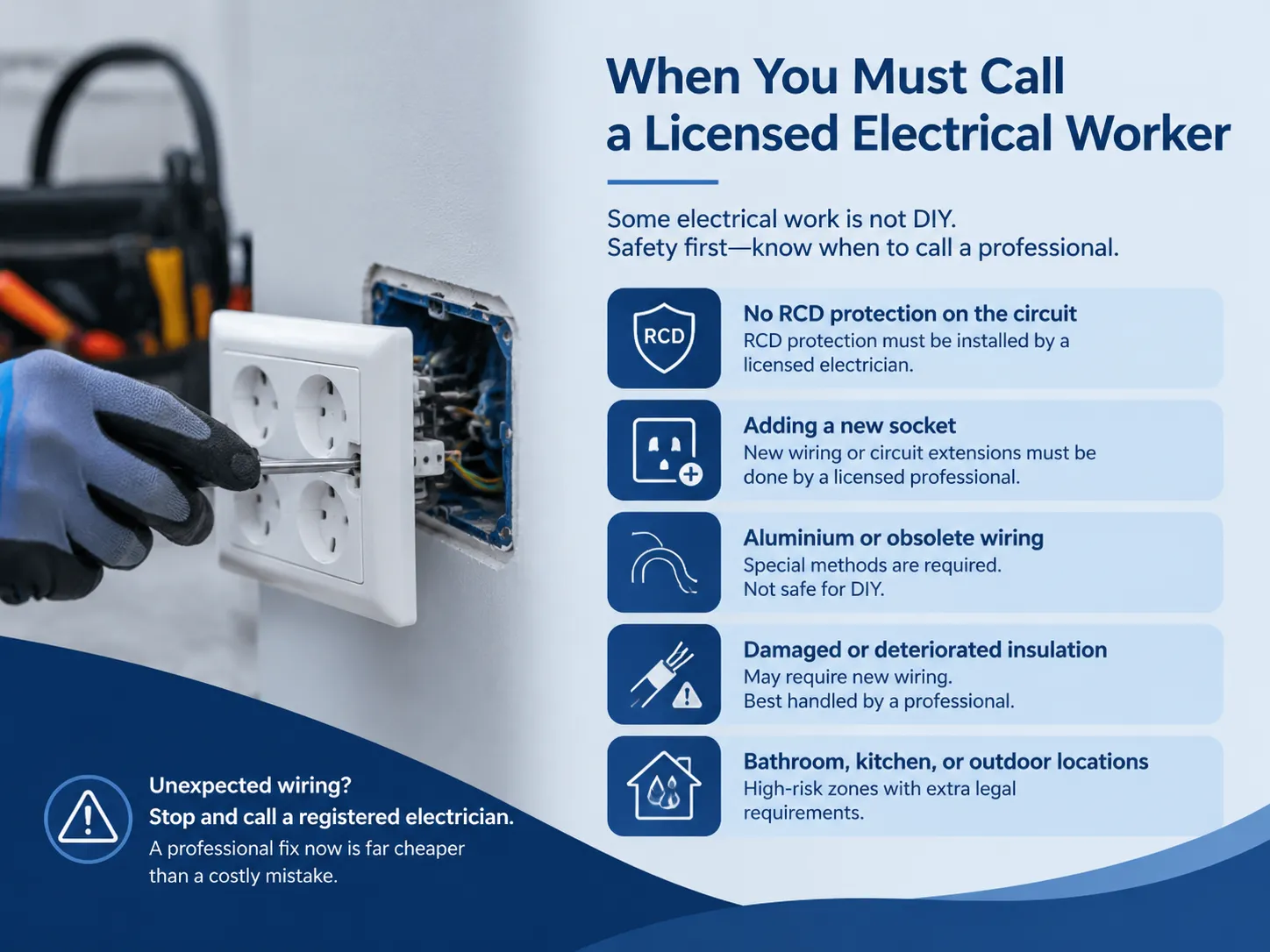
When You Must Call a Licensed Electrical Worker
The exemption allowing homeowners to work on electrical wiring with no permit does not include working on power outlets. The scope of work that may be done on power outlets will be limited. There are some cases when work must be done by an authorized electrical worker:
- No RCD protection on the circuit. If the switchboard is equipped with rewirable fuses or plug-in type circuit breaker devices that do not include any form of residual current device (RCD) protection, then the professional that replaces the socket must be a licensed contractor, and install any required RCD devices as part of their electrical service.
- Adding a new socket where none existed before. New cabling will be required for installation of a completely new power point, circuit extension or conversion from single to double socket and is subject to the specified electrical work as per regulations.
- Aluminium or obsolete wiring. If your home was either built or wired using Aluminium conductors then special connection methods must be used when doing electrical repairs in those types of installations, as they are considered unsafe installations for non-professional home owners to attempt any electrical repair on them.
- Damaged or deteriorated insulation. Special handling is needed because of the deteriorating rubber combined with very likely requiring new wiring to repair damage from the previous installation or the current condition.
- Bathroom, kitchen, or outdoor locations. There are designated areas within the Wiring Rules as zones of higher danger; additionally, when working in these zones, extra requirements will apply. A licensed worker has been properly trained to perform within these areas.
If you open a flush box and find something you did not expect — mixed wiring colours, multiple circuits, an earth that is cut short or missing — stop and call a registered electrician. The cost of a professional repair at that moment is a fraction of the cost of getting it wrong. For a broader look at how these devices fit into a complete modern installation, our overview of the best electrical outlets and switches for modern homes covers options from basic to USB‑integrated and smart‑compatible.
What Should You Expect to Pay an Electrician in New Zealand?
The cost of hiring an electrician to change a power point will depend on how complex or what region they are located in. For a standard like-for-like switch replacement with easy access and up to date wiring, the cost will likely be NZD $80 – $150 or more and will include both the service call and new switch.
If additional work is needed, such as installing an RCD, running an earth conductor, or replacing a damaged flush box, expect your total bill to be higher. The cost to fully upgrade your switchboard to comply with today’s Wiring Rules will increase substantially, but doing so will ensure RCD protection, circuit capacity, as well as peace of mind that comes from having a safe and modern electrical system.
Request a written quote before work begins. This should state what will be done (including replacing the switch as well as the labour cost), any compliance documentation needed, and a certificate of electrical safety (CES) if the work is considered to be either high risk or prescribed. A copy of the invoice issued by a registered electrician will also serve to document that the work was performed lawfully.

New Zealand‑Specific Socket Standards and Compatibility
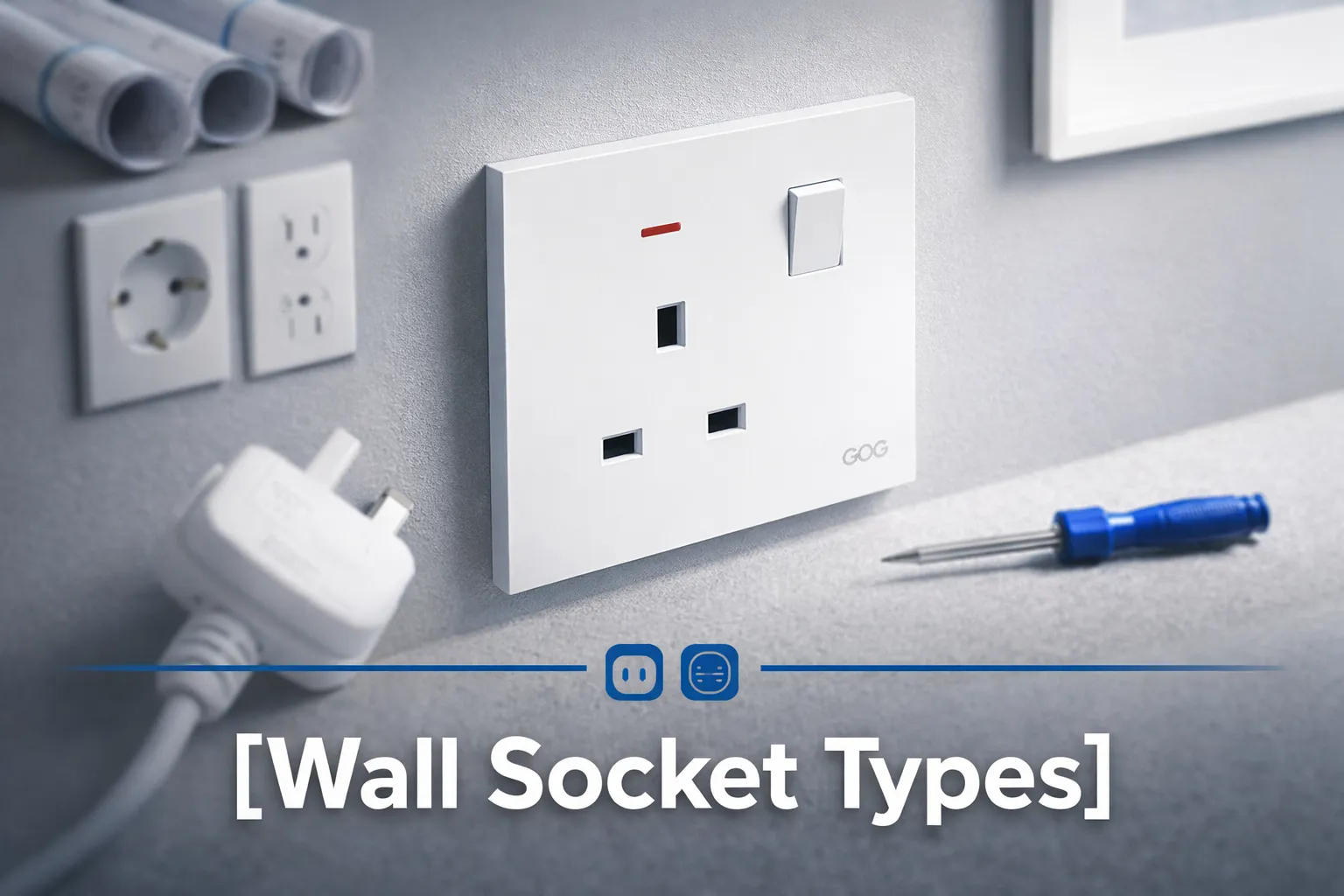
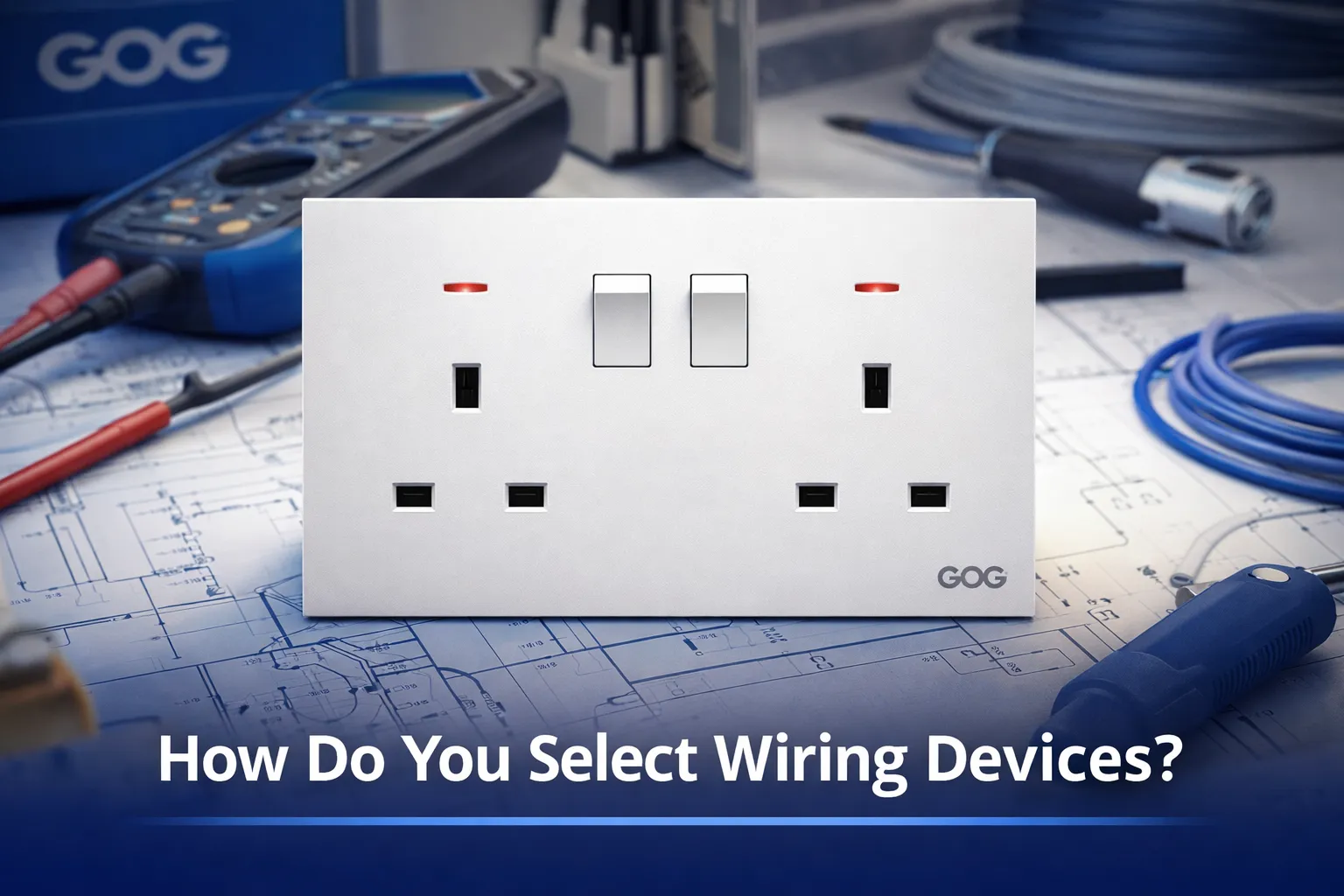
New Zealand uses the AS/NZS 3112 standard three-pin flat-pin socket, which has a supply voltage of 230-240 volts AC. A switch is incorporated into every single socket in New Zealand and Australia to allow safety isolation of an appliance at the point of installation, ie at the wall, without removing the plug from the socket, is a local safety practice. Therefore, when you change any socket it must conform to the AS/NZS 3112 standard and have the RCM. GOG Electric has a full range of power points that have been tested and certified to conform to this standard, including the appropriate pin configuration, rockerswitch mechanism and terminal layout in accordance with New Zealand flush box requirements. To use a socket rated to a different standard outside New Zealand, such as a 120-volt North American socket, on a 230-volt circuit is illegal and poses a serious risk to life.
Frequently Asked Questions
Do I need an electrician to change a powerpoint?
If you live in New Zealand, you can replace a power point with another of the same type in your own house (assuming it is your main residence). If you meet two conditions, you do not have to hire a licensed electrician to perform the job: 1) Your circuit is protected by an RCD, and 2) The existing wiring is in acceptable condition. If the circuit does not have RCD protection or the existing wiring is in poor condition, or if you are adding a new power point, you must hire a licensed electrical worker to perform the work.
How much does an electrician charge to change a power point?
In New Zealand, a registered electrician charges between NZD 80-150 for a simple, like-for-like replacement of a power point, including service call and new socket, and more complex electrical jobs (i.e., adding RCD protection or repairing damaged wiring) will require a higher fee to complete the project.
Can you change power points yourself?
In accordance with the Electricity (Safety) Regulations homeowner exemption, you are permitted to change the existing power point within your home as long as: the existing circuit has RCD (residual current device) protection; the existing wiring is safe; and you do not add a power point or make any alterations to the existing circuit wiring. You will be required to hire an electrical worker to perform any type of electrical work other than this.
Do I need an electrician to replace an outlet?
A homeowner may change their existing electrical outlet fitted with residual current device (RCD) protection as long as the wiring is modern and installed in accordance to New Zealand electrical safety rules. Any other hazard like using damaged wires, installing new outlets, and installing new electrical outlets in bathrooms or outdoors must be completed by a qualified electrician.
References
- WorkSafe New Zealand — Energy Safety — Guidance on homeowner electrical work and the boundary between exempt and prescribed work under the Electricity (Safety) Regulations 2010.
- Electrical Workers Registration Board (EWRB) — Public register of licensed electrical workers in New Zealand and information on licensing and competency.
- AS/NZS 3112 — Approval and test specification — Plugs and socket‑outlets — The joint Australian/New Zealand standard for the 230‑volt three‑pin flat‑pin plug and socket system.
- Electrical Safety New Zealand — Practical resources and guidance on electrical safety and compliance for New Zealand homes.
Replacing a power point in your New Zealand home is a job that sits right at the boundary of what a careful homeowner can legally and safely do. In a modern, RCD‑protected installation with wiring in good condition, a like‑for‑like socket swap is methodical and safe when the correct isolation and testing sequence is followed. In any other situation — no RCD, deteriorated wiring, a new outlet location — the law and common sense point to the same conclusion: call a registered electrician. GOG Electric manufactures power points that meet the AS/NZS 3112 standard and fit New Zealand flush boxes, so whether you or your electrician performs the work, the device on the wall is built for the voltage, the switch‑operated safety culture, and the long‑term reliability that a Kiwi home expects.