Power strips and extension cords are often found in homes, especially next to televisions, where they may be treated as the same device by consumers. Using one or the other in the wrong situation is a recipe for an electrical fire. Although they have the same general appearance, the products have different purposes, different safety features, and using them incorrectly can result in overload to a circuit. Therefore, this article will outline the characteristics of both products and help readers decide which device to use.
In simple terms, the extension code is a long wire which helps transfer power to different locations and it consists of 1 long wire with sockets in it that allows a certain amount of electric current to reach its destination. Whereas a power strip is basically a small piece of equipment which can turn a single electric current source into several one with 6–12 outlet depending on the type of power source. In using extension cords and power strips, multiple appliances with power strips, while extension cords are meant for connecting an appliance which is away from the wall outlet.
What Each One Actually Is
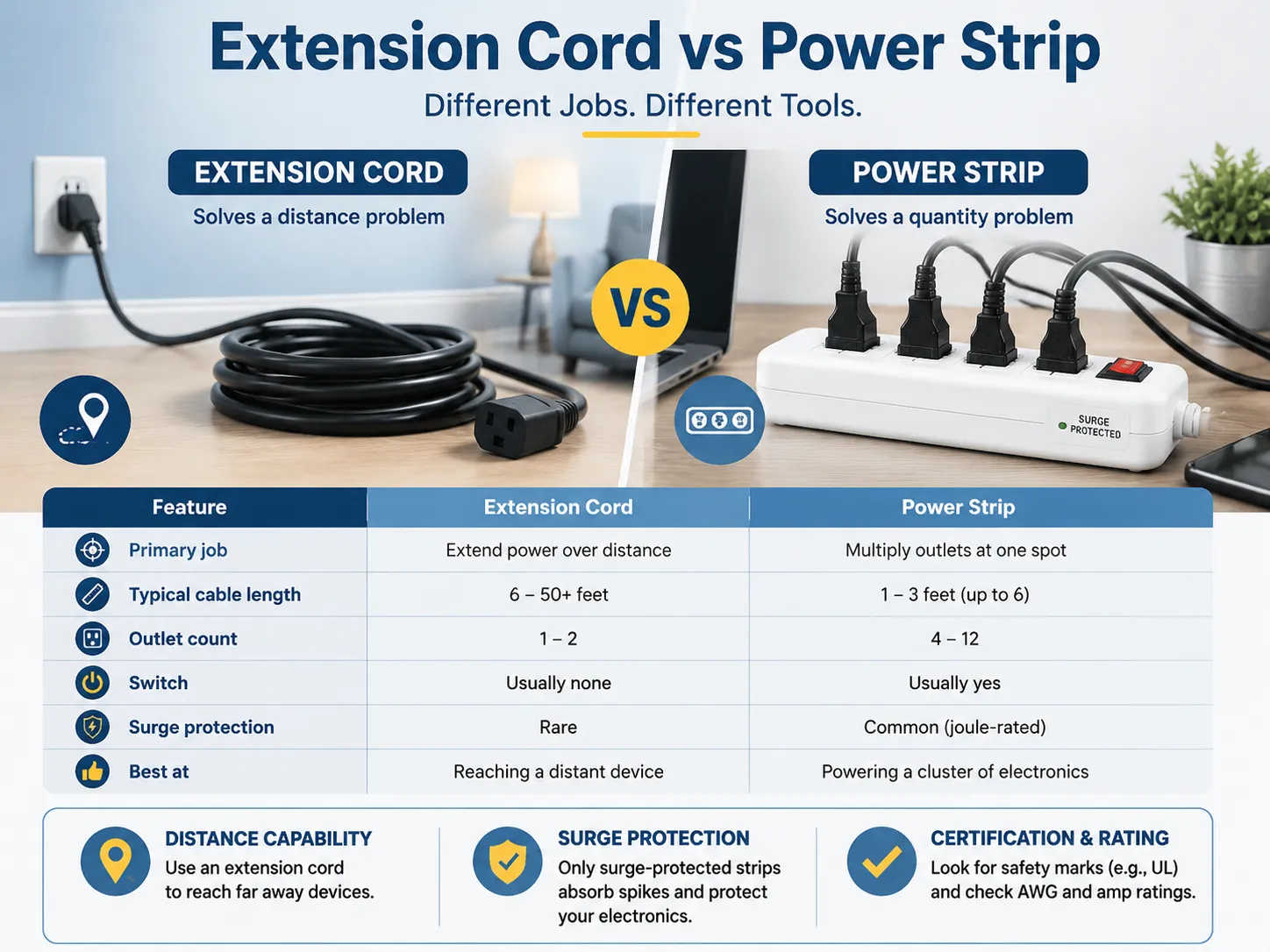
When it comes to power sources, extension cords and power strips can be categorized into two groups: extension cords offer a solution to distance, while power strips provide a solution to the quantity problem. An extension cord is common; it is a flexible wire (usually between six and fifty feet), one end of which has a plug for connecting the wire to the electrical power source and one or two sockets on the other end. The wire length, which would have a proper diameter (thickness) for electricity flow, sets the extension cord apart from the power strip.
The power strip operates by providing many electrical points out of one. It consists of an electric wire (about twelve inches long) with one plug connected to the electrical grid. The extension strip connects several devices to one power outlet. It usually has several sockets (from six to twelve) that allow to use multiple devices with a single outlet. Numerous strips offer also a switch. The major distinctive feature here is the possibility to use many devices at once.
The similarity that is leading to confusion lies in the fact that both types of products have a plug and sockets. However, the purpose of their use and the ways of malfunctioning are different.The types of electrical outlets guide explains the wall side of the equation that both devices plug into.
| Feature | Extension Cord | Power Strip |
|---|---|---|
| Primary job | Extend power over distance | Multiply outlets at one spot |
| Typical cable length | 6-50+ feet | 1-3 feet (up to 6) |
| Outlet count | 1-2 | 4-12 |
| Switch | Usually none | Usually yes |
| Surge protection | Rare | Common (joule-rated) |
| Best at | Reaching a distant device | Powering a cluster of electronics |
Three distinctions are more important than others. Distance capabilities: the cord of a power strip is usually robust and short but does not have the ability to provide electricity over long distances. Surge protection: the only strips that can absorb any surges are surge-protected strips (or specialized cords) so you should connect your TV and computer to a surge protector, not just to a plain extension cord. Certification and rating: both of the devices should be certified, however, a $5 unmarked strip is a danger waiting to explode therefore a good quality cord will have a certain AWG and the amp rating that can be checked.
Ratings, Wire Gauges, and Power Limits
The information provided by the numbers printed on the label gives all the necessary background information needed for deciding on the safety of using a wire.
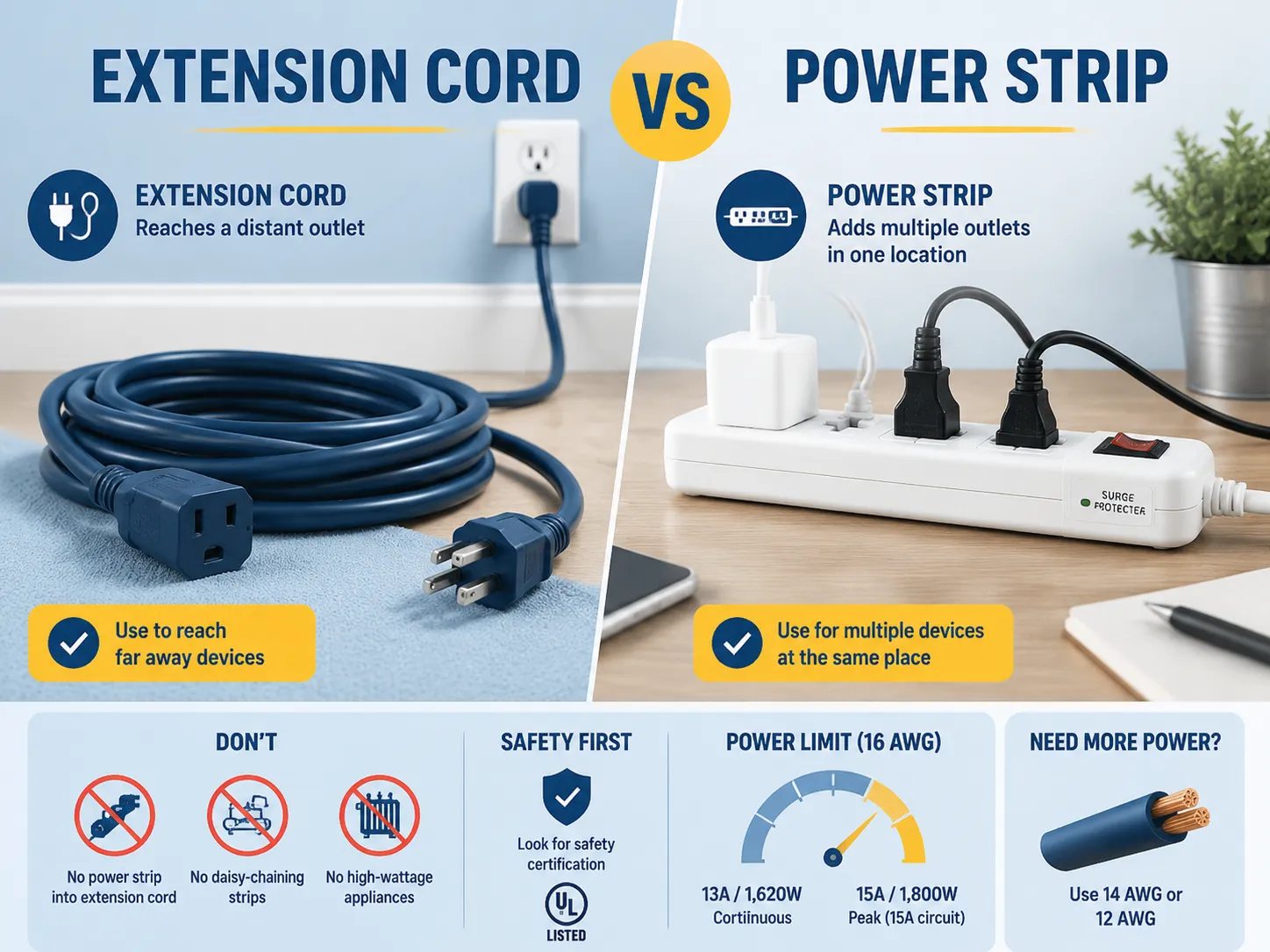
- 16 AWG (for light duty): maximum allowed current is about 13 A / 1,620 W. This wire may be used for lamps, phone chargers, televisions, and electronic devices, and is the most widely used wire in households.
- 14 AWG (for medium duty): this wire may carry current of 15 A / 1,800 W and is the minimum wire used for power tools and other appliances requiring high current.
- 12 AWG (for heavy duty): has the maximum allowed current of 20 A / 2,400 W (20 A socket). This wire is used for tools in factories and workshops requiring electricity, as well as for electric heaters, when circuit wiring allows it , and for long wires, when the voltage drop is important.
The rule is simple: thinner wire (the higher gauge number) heats up more quickly in use. For instance, the 16-gauged extension wire, which is 100 feet long and used for power tools, will drop in voltage and may overheat, while 16-gauge wire used in 6-feet wire in the same mode will not face such a problem. That is why the longer lengths should always use a larger gauge. Therefore, generally speaking most wall circuits provide up to maximum 15 Amps of current (for UK 13 A, via fused connector). Therefore, no cord should be used to use any higher amps than allowed.The wall socket types guide explains the outlet-side ratings these cords plug into.
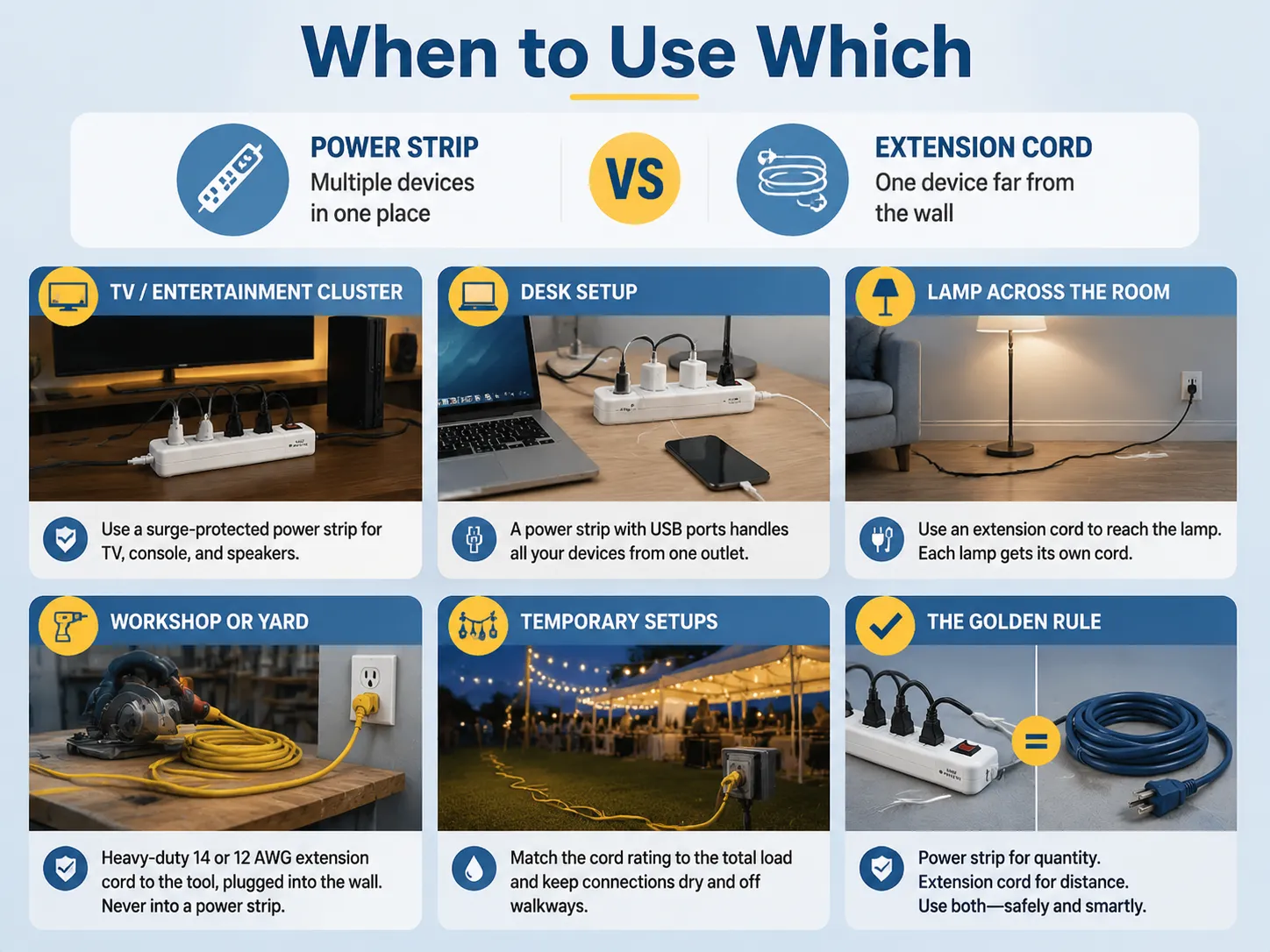
When to Use Which
The guideline could not be simpler: one location multiple devices equals a power strip, one device far away from the outlet equals an extension cord. But the settings must be secured as follows:
- Television/entertainment setup consists of surge protected power strip for TV, console and sound appliances so one outlet supplies power and surge protection
- Computer area where a power strip with USB sockets is used to connect the computer, screen, phone and other devices from one wall connector
- A lamp that is located away from the wall should be connected with an extension cord, by one power cord for each lamp
- Handyman business or gardening involves using a heavy-duty 12 or 14 in AWG extension cord and plugging it directly into the wall.
- Temporary solution or cable in use should have voltage rating suitable for appliances.
Modern sockets have also made some cords unnecessary — a wall outlet with built-in USB ports removes the charger clutter that drives people to buy strips in the first place, and the USB charger socket guide covers that upgrade path.
Safety Rules (and What Never to Plug In)
The guidelines that prevent the risks associated with extension cords and power strips include the following:
- Do not daisy-chains. Using an extension cord to connect to a power strip, or one strip to another, compromises the performance ratings of all of the products involved. Each wall socket accommodates one appliance or the device; there are some exceptions due to possibilities of engineering design, such as a power strip with a long cord.
- Never use space heaters on the strips or cords. A heater consuming 1,500 W uses 12.5 A close to the capacity limit of a circuit rated for 15 A. Thus, a heater must be plugged in directly into the wall, no questions asked.
- No major appliances meant to surpass other basic requirements are meant to be connected to strips. Such appliances include air conditioning systems, microwaves, toasters, and refrigerators. It is also important to know the difference between 2-prong and 3-prong configuration as it concerns using the appliance by means of an adapter — the guide describing the difference is helpful.
- Be sure to check certification and condition. All cords must have safety signs, and those which are broken or worn out must be thrown away.
- Keep away from water. Use only outdoor wires for outdoor work and never get indoor wires in contact with water.
When a cord or a strip of an appliance feels warm, has a bad smell or switches off, it is most likely due to the overuse of it rather than malfunction. Therefore, prior to using it the next time take it out of the socket and redistribute the load.
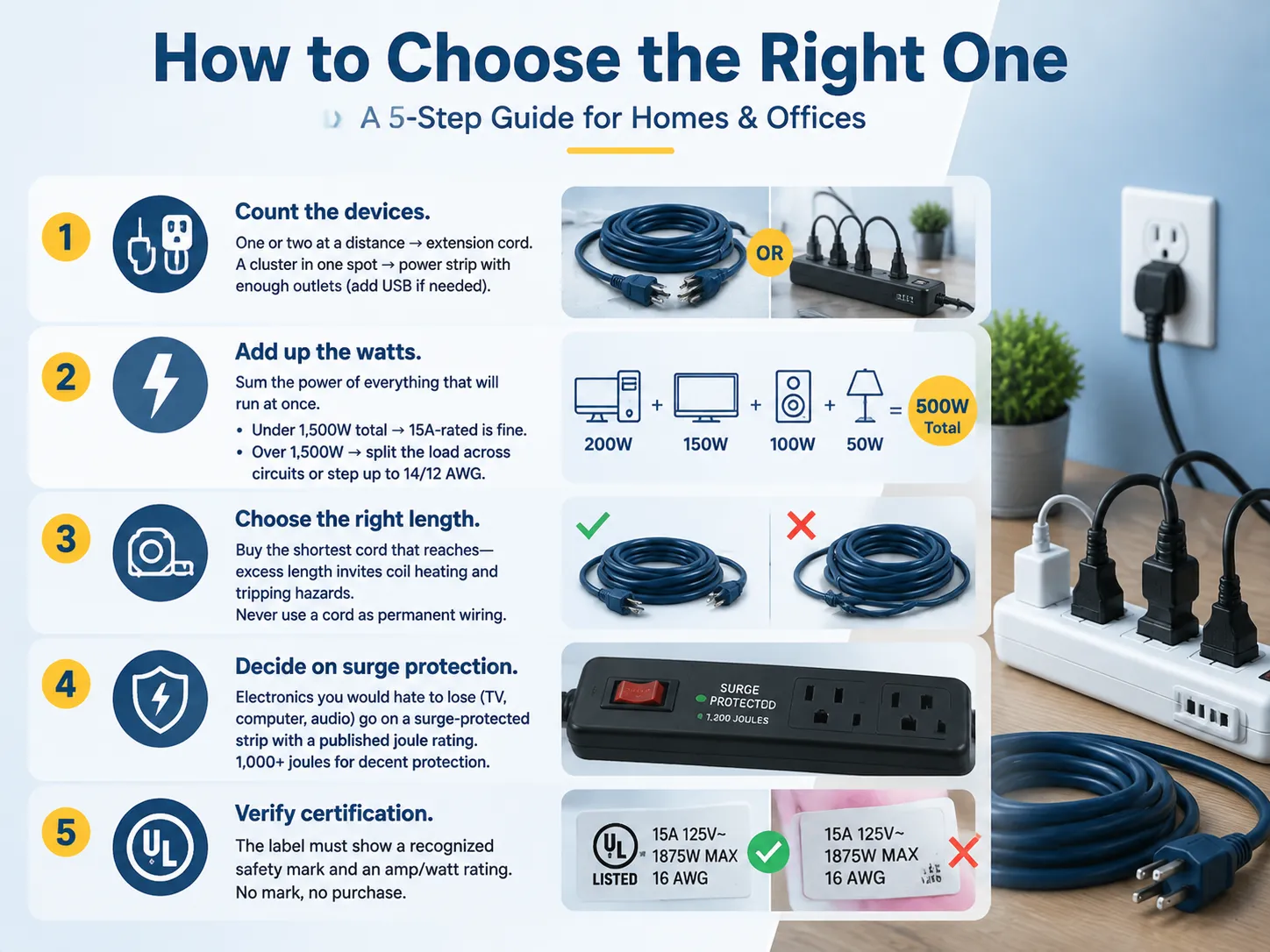
How to Choose the Right One
A five-step selection process for homes and workplaces:
- Take stock of your devices: if you have one or two devices spaced apart, you will need an extension cord; if there are multiple devices in a single place, one needs to consider a power strip with enough outlets (USB sockets may be included).
- Number of watts has to be calculated: Nameplate wattage has to be summed for all the devices being powered at once; if the total wattage is below 1500W, 15A wiring is acceptable; if the total wattage is higher than the standard, use a heavyweight (14 or 12 AWG).
- Assess the necessary cord length: The shortest cord that can reach the thinnest distance would be optimal. The length of the cord should not be longer than needed.
- Determine if surge protection is needed: All the electronics that are expensive and/or which the consumer would assume are worth losing like TVs, computers, radios, etc should be plugged into the strip with surge protection that has been certified for a certain number of joules.
- Check if certification is present: There should be a certification mark on the label and a power rating according to an amp/watt ratio. No certification – no purchase.
FAQ
Can you use a power strip as an extension cord?
Not really. The purpose of a power strip is to increase the number of outlets in one place, and its lead has a certain length. If you use it as an extension cord you will be applying a short and mediocre lead where a good one should be used. It means that if you need a line of power in the room you have to go for a proper extension cord.
Is a power strip better than an extension cord?
Neither. They perform different functions. A power strip is good when you need to connect several devices to one socket (preferably, with surge protection whereas an extension cord is the right solution when you need to connect only one device that is far from the outlet. While using each device for its intended purpose is safe, the problem arises when a power strip is used instead of an extension cord.
What should you never plug into a power strip?
Appliances that draw a lot of power such as space heaters, air conditioning units, refrigerators, microwaves, toaster ovens and hair dryers should not be plugged in into the power strip. They generate 10-15 A of current by themselves, thus melting mishaps are inevitable.
Do power strips raise the electric bill?
A power strip does not consume electricity itself and it does not cause any increase in devices’ power consumption. The overall effect would only be saving power since many strips have a power switch which allows for turning the strip off and cutting down standby consumption due to chargers and other electronics left plugged in.
References
- NFPA — Electrical Safety in the Home
- US CPSC — Electrical Safety Information Center
- UL — Power Strip Safety Guidance
- Electrical Safety Foundation International — Extension Cord Safety Tips
Conclusion
While both electrical cords and power strips deal with the issue of providing electricity, understanding what they are and what they do to provide electricity is essential. Electrical cords are for distance while power strips are for outlet multiplication. Just remember the numbers: make sure to correspond wire size with load and amperage, be aware of which voltage (120 or 240 volts) applies to which plugs, ensure that heaters and other power-hogging devices are plugged into wall outlets that allow for that level of electricity use, use only certified devices, and discard anything overheating or otherwise appearing faulty.