One day several years ago, a young mom in Brisbane was cleaning up her living room when she noticed her toddler reaching for an electrical socket using a hairpin. Luckily she caught him just in time; however, she’ll always remember that moment. When she mentioned to an electrician friend that he had never heard of such a system before, he explained that every outlet installed in her new home was equipped with an internal shutter mechanism—also known as a tamper-resistant receptacle—designed to prevent a hairpin from coming into contact with anything energized; therefore, she had never noticed the difference. The purpose of a tamper resistant outlet is to provide protection from accidental shock without being obvious or having to be activated by someone else. As such, it is important for every homeowner, landlord and electrician to understand tamper-resistant receptacles and the major differences between these types of outlets and traditional receptacles. In addition, they should educate themselves on local codes and regulations governing receptacle installations as they pertain to new residential buildings throughout North America (NEC 406.12).
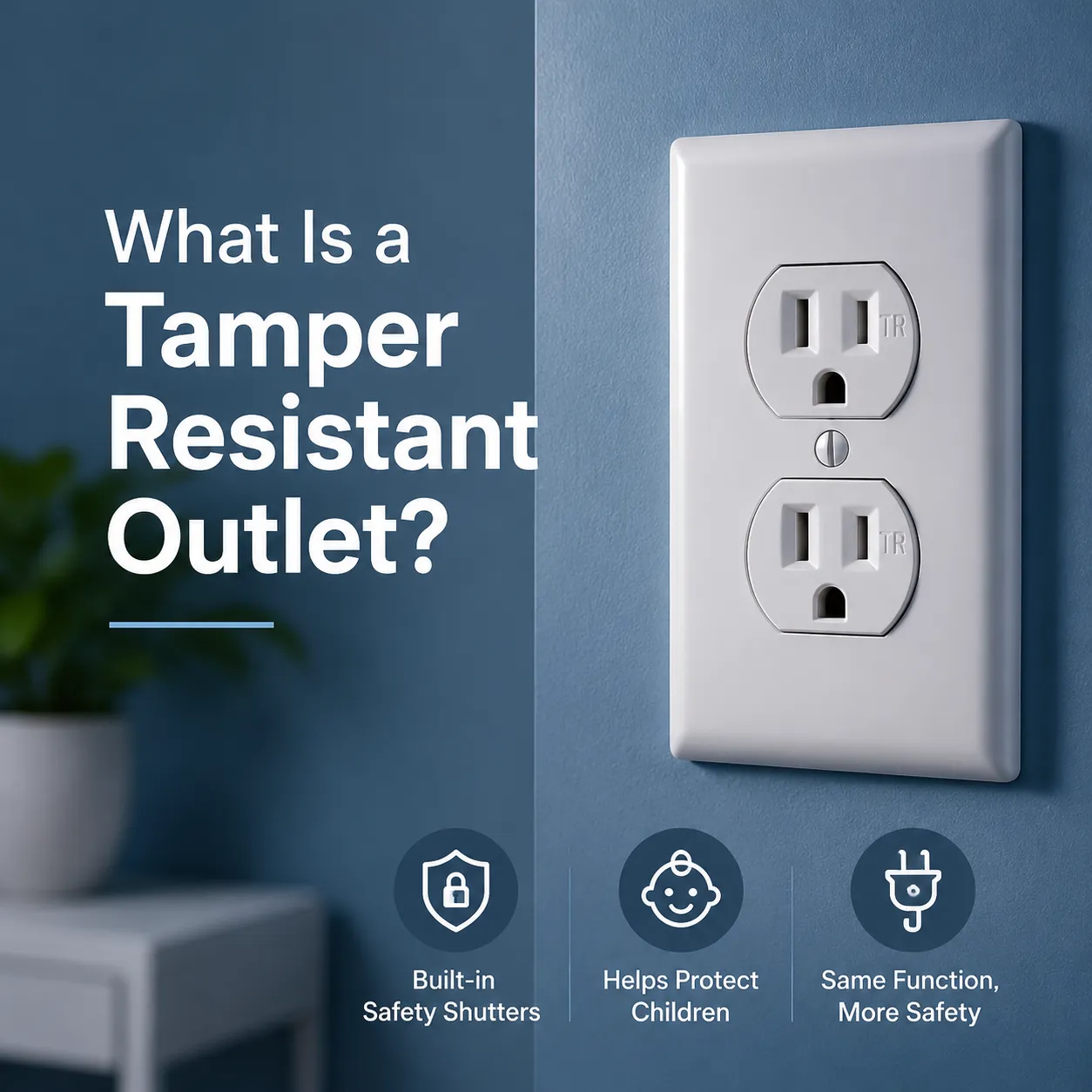
What Is a Tamper Resistant Outlet?
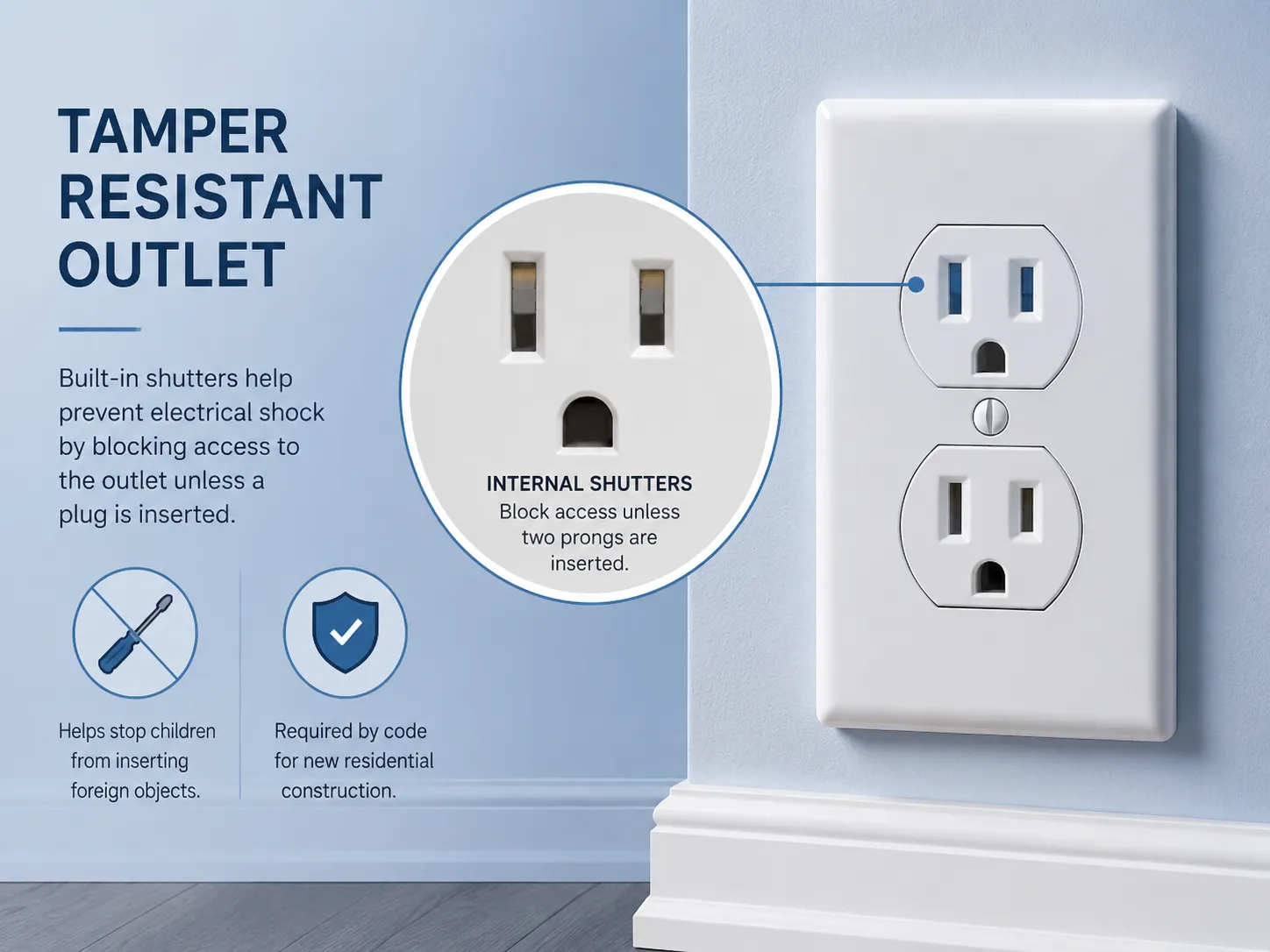
Tamper resistant Outlets, or TR Outlets for short, are an ordinary type of duplex receptacle and contain an internal shutter system (or spring loaded shutters) concealed behind the faceplate’s slots. The shutters block the live and neutral contacts from being accessed unless two equally applied prongs (plug) are inserted into the receptacle at once. This stops children from inserting any singular object into the receptacle such as a key, paper clip or screwdriver into either slot and coming into contact with a live conductor. The shutters cannot be viewed from the exterior of the receptacle and do not impede proper plug insertion.
Tamper Resistant Outlets retail generally for a marginally higher price than Non-Tamper Resistant outlets, but Tamper Resistant Outlets are required by the National Electrical Code (NEC) for all new residential construction, as adopted throughout the United States and similarly in the Canadian and Australian wiring standards. The National Fire Protection Association (NFPA), issuing body of the NEC, maintains documentation related to the adoption of this ongoing standard and safety organisations such as the Electrical Safety Foundation International (ESFI) track injury statistics leading to adoption of the requirement.
How It Differs from a Standard Outlet
A standard electrical outlet has open slots that lead directly to the brass contact wipers. There is no barrier between the outside world and the live metal inside. For decades, parents used plastic plug inserts to block unused sockets, but those inserts can be removed by a determined child, and they do nothing to protect the outlet that is in use. A tamper‑resistant receptacle protects every socket, whether it is empty or occupied, without any additional device. The table below captures the functional differences.
| Feature | Standard Outlet | Tamper Resistant Outlet |
|---|---|---|
| Internal shutters | None | Spring‑loaded shutters behind hot and neutral slots |
| Protection method | Passive; relies on plastic plug inserts (removable) | Built‑in; shutters open only with simultaneous two‑blade pressure |
| Child safety | Low; single object can contact live conductor | High; single object is blocked by shutters |
| Cost | $1–$3 | $2–$6 (TR standard); $10–$25 (TR GFCI) |
| Code requirement (new residential) | No longer permitted in most jurisdictions | Required by NEC 406.12 since 2008 |
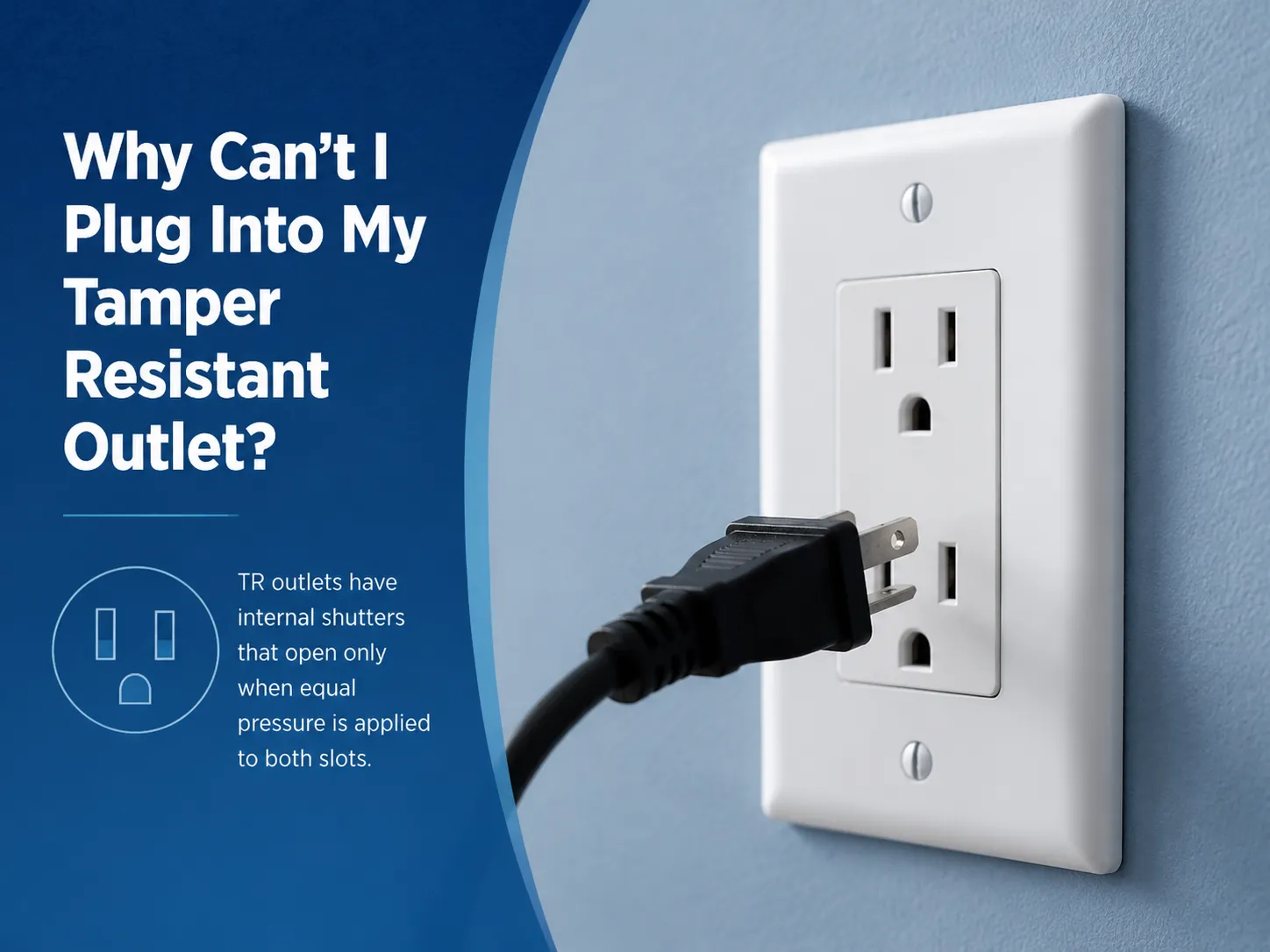
Why Can’t I Plug Into My Tamper Resistant Outlet?
Sometimes homeowners discover that when trying to insert a plug into a Tamper Resistant outlet, it will not properly go into place. The usual cause of this situation is that the person is trying to insert the plug at an angle or using uneven pressure to make the insertion. In order for the shutters to open, there must be pressure applied to both slots at the same time, which is exactly what happens when a standard plug is pushed straight into the outlet. Therefore, trying to rock the plug into place or inserting it at an angle may cause it not to work correctly. If the blade of the plug is damaged or bent, the plug will also not push down on both shutters equally, which means that when the plug is pushed into the outlet, the shutters will not open properly. The simplest way to correct this problem is by ensuring that the plug is aligned and pushed evenly and firmly. If the outlet continues to be unable to accept a standard plug, then the internal mechanism that operates the shutters in the outlet could be defective or broken and the entire outlet should be replaced. The NEMA has established standards to test the design of TR shutter mechanisms, to ensure that they do not create an impediment to normal use.

Do You Need Tamper Resistant Outlets in Your House?
Legally, TR outlets must be installed in every residential structure built (or substantially modified) since 2008; the NEC has mandated TR outlet installation law for more than 15 years. Homes built prior to 2008 do not have to have TR outlets but TR outlets are strongly recommended for any home with children present (either as residents or visitors). The installation of TR outlets is one of few ways to upgrade electrical safety and cost next to nothing for materials at the time of installation (the cost differential between a TR outlet and a standard outlet is approximately $1 to $3 per outlet). Because TR outlets provide ongoing protection without further action by the occupant, a landlord’s liability is reduced by installing TR outlets. A parent receives a feeling of comfort using TR outlets. Selling a home with TR outlets provides prospective buyers a visible indicator the home’s electrical system is current with today’s electrical safety standards.
How to Identify a Tamper Resistant Outlet
Identifying a tamper-resistant receptacle is easy. You’ll need to look at the face of the receptacle to see if it is a TR-type receptacle. If the receptacle is a TR-type outlet, and if there are two slots, there will be either “TR” embossed or printed in plastic on the front of the outlet. If it is a TR GFCI type outlet, there will be “TR” along with the familiar “Test” and “Reset” buttons. When looking in the slots of a TR outlet, you may be able to see the rear edges of the internal shutters as they are just behind the face of the outlet. If you do not see “TR” anywhere on the outlet, it cannot be a tamper-resistant outlet and can be confirmed as a TR outlet by shining a flashlight into one of the slots. With the flashlight shining into the slot, on a TR receptacle (the shutter is blocking), you will see that the passage into the outlet has been blocked. On a non-TR outlet, you will see brass contacts only.
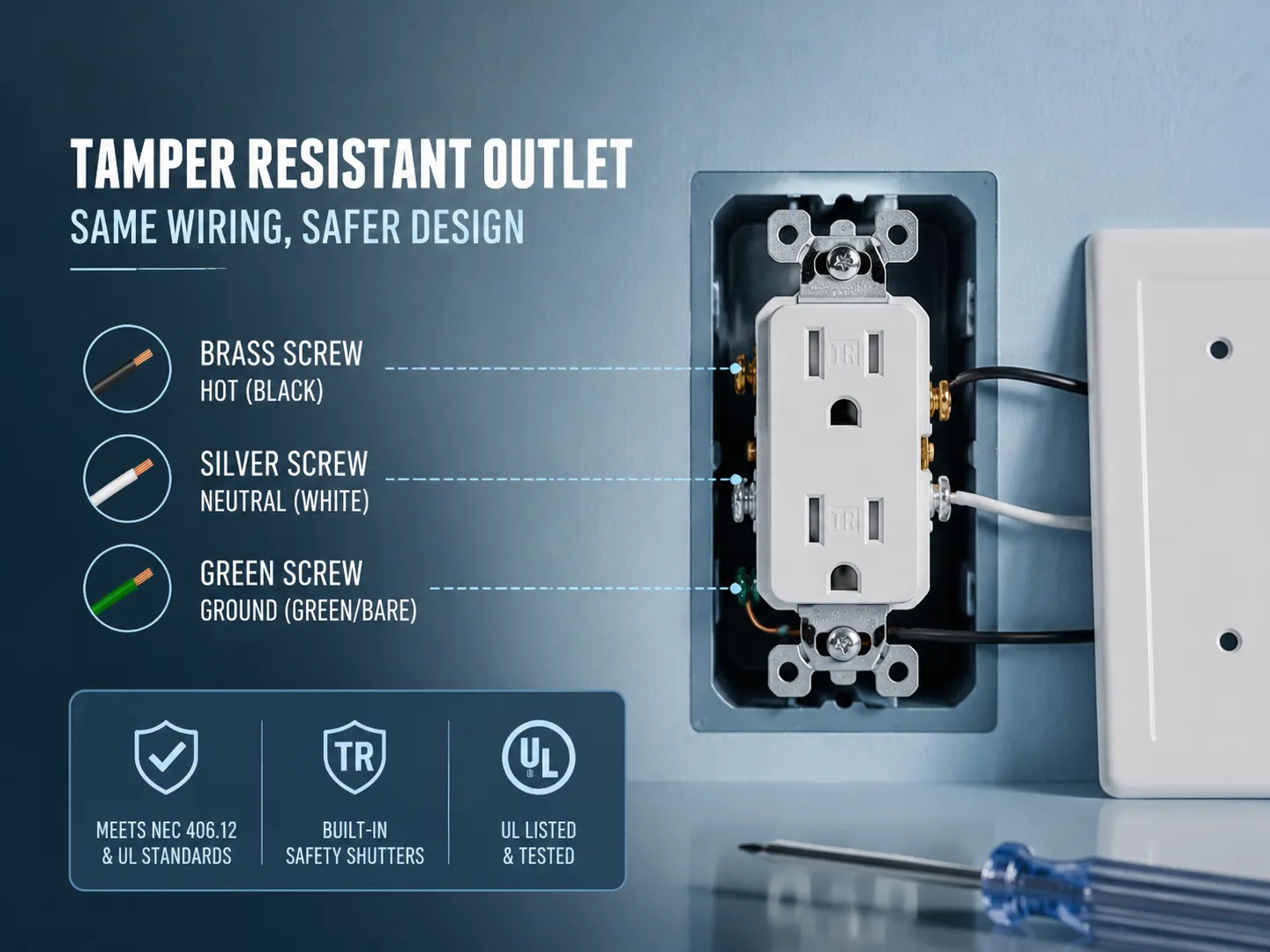
Wiring a Tamper Resistant Outlet: Exactly the Same as a Standard Receptacle
Installing a tamper resistant outlet follows exactly the same wiring procedure as a standard duplex receptacle. The internal shutters do not add any wiring complexity. The brass terminal screws receive the black hot wire, the silver screws receive the white neutral wire, and the green screw receives the bare or green ground wire. The terminal layout is identical to a non‑TR outlet, and the outlet fits in the same electrical box. The only difference is the shutter mechanism inside, which requires no attention from the installer. For a step‑by‑step guide through the replacement process, our article on how to replace a wall socket covers the procedure from power isolation to final test, and the same steps apply to a TR outlet.
GOG Electric manufactures tamper‑resistant duplex receptacles in standard, GFCI, and USB‑integrated configurations. Our TR outlets use thick‑gauge brass contacts that maintain grip force over thousands of plug cycles, and the shutter mechanism is tested to meet the NEMA and UL standards for both safety and normal‑use reliability. The “TR” marking is clearly moulded into the face, and every outlet carries the UL listing that confirms it has been independently tested to meet NEC 406.12. For a look at how these outlets fit into a complete modern installation, our overview of the best electrical outlets and switches for modern homes covers the full range of options.
Frequently Asked Questions
What is the difference between tamper resistant and regular outlets?
A tamper-resistant receptacle has shutters that are spring-loaded to block access to the hot and neutral terminals inside. In the case of a typical receptacle, the access is completely open. A tamper-resistant receptacle will prevent a child from inserting a single object into one of the slots, while a typical receptacle will allow this to occur.
How do you tell if you have tamper-resistant outlets?
If you examine the electrical outlet, the words “TR” will either be embossed or printed in between the two slots where you would insert a standard plug. If you shine a flashlight into one of the receptacles, you will see the cover blocking your view of the brass contacts inside.
Why can’t I plug into my tamper resistant outlet?
If a plug will not go into a TR or tamper resistant outlet, it is typically because the plug is not being inserted at the correct angle. The plug has to be pushed into the receptacle with equal pressure, on both slots, at the same time for the shutters to open. Align your plug so that it is square with the outlet and apply a firm amount of pressure into the outlet. A bent blade on the plug may also prevent the shutters from being opened.
Do I need tamper-resistant outlets in my house?
Since 2008, NEC mandates all new residential construction to have tamper-proof electrical outlets installed. However, any home built prior to that time is under no legal obligation to upgrade and install new outlets; it is considered a low-cost permanent child safety improvement and highly recommended.
References
- National Fire Protection Association (NFPA) — NEC 406.12 — Tamper‑Resistant Receptacles requirement and adoption history.
- Electrical Safety Foundation International (ESFI) — Tamper Resistant Receptacles — Child electrical injury statistics and the safety case for TR outlets.
- National Electrical Manufacturers Association (NEMA) — TR Receptacle Standards — Design, testing, and marking standards for tamper‑resistant receptacles.
- Leviton Manufacturing — Tamper‑Resistant Receptacles — Product information and installation guidance for TR outlets.
A tamper resistant outlet is a safety device that costs almost nothing extra at the time of installation, requires no activation, and works silently for the life of the home. It blocks the path between a curious child and a live conductor without impeding normal use. For the homeowner, the landlord, or the contractor, installing a TR outlet is one of the simplest, least expensive, and most permanent safety upgrades available in residential electrical work. GOG Electric manufactures TR receptacles that meet the NEC requirement and the NEMA standard, because the outlet on the wall should protect the people in the room as reliably as it powers their devices.