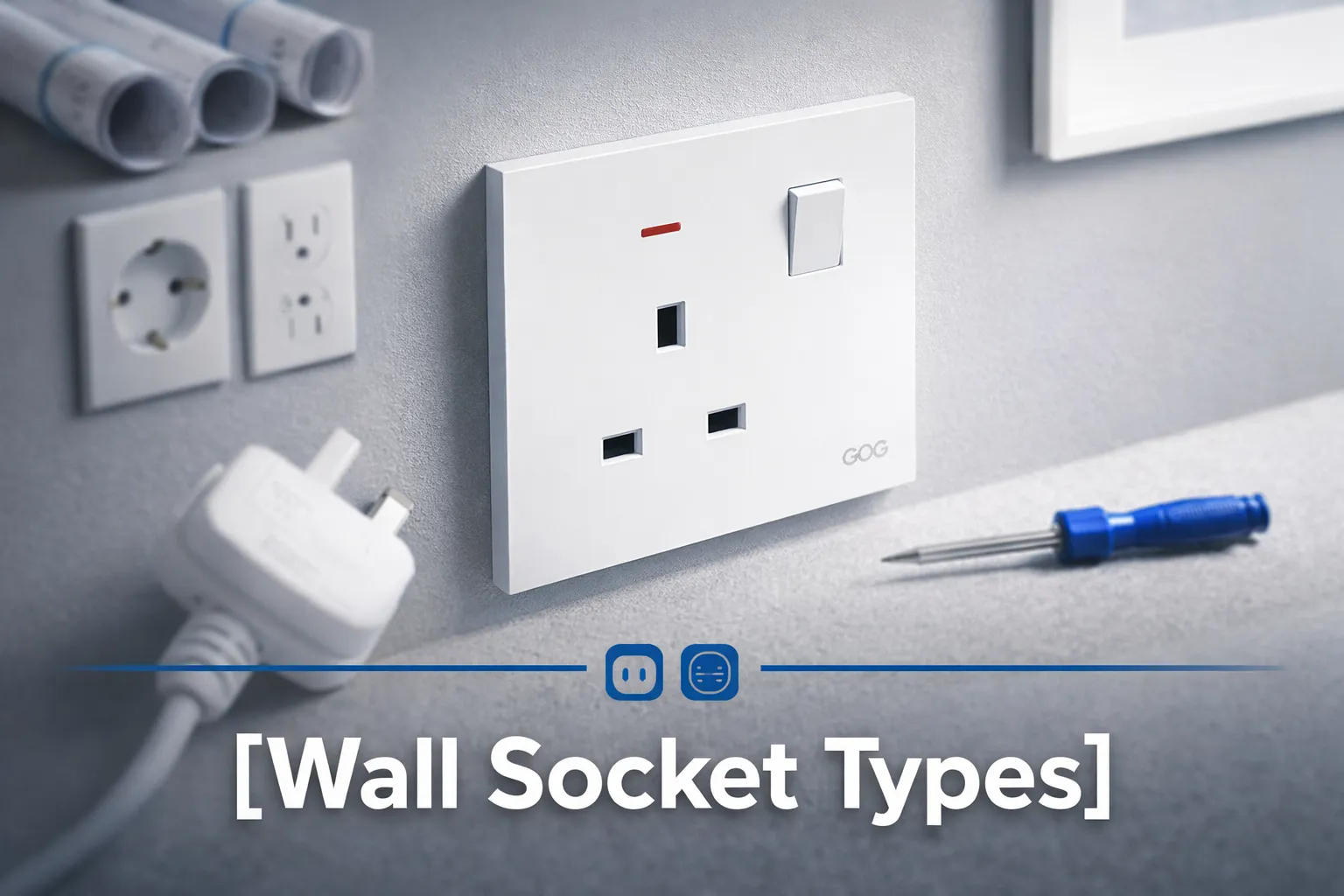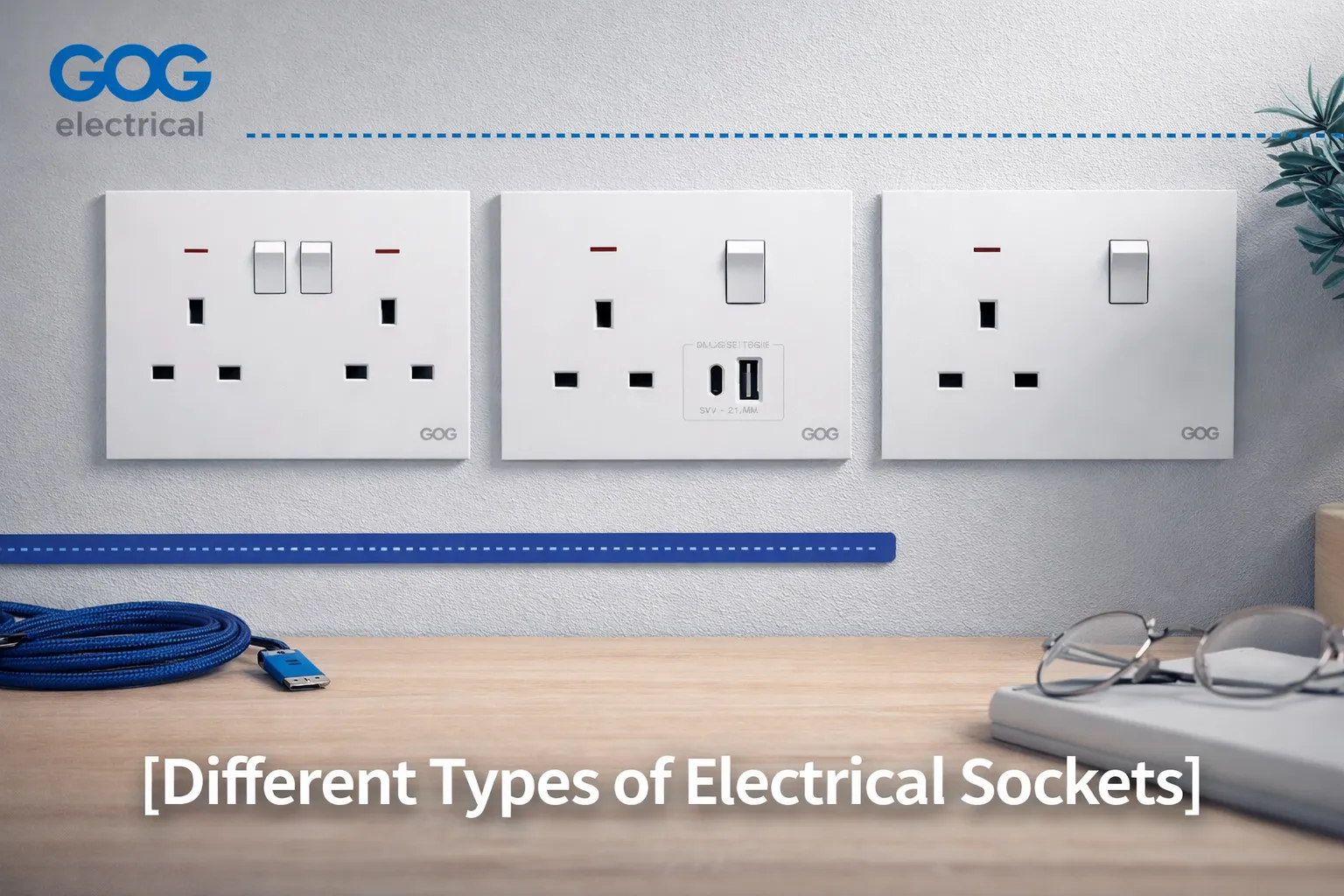
Once you enter the American premises, you will see that the device there is most likely a NEMA 5-15R or 5-20R one.The manufacturer, the model might be different, and whether the blueprint mentioned the right specification is questionable. Therefore, in such instances, rejection, costs, or warranty claims may follow. Below is the list of the best ten outlet brands and suppliers in the North American market by the year 2026 along with their specifications, prices, and important information for homeowners, construction companies, resellers, and private label customers.
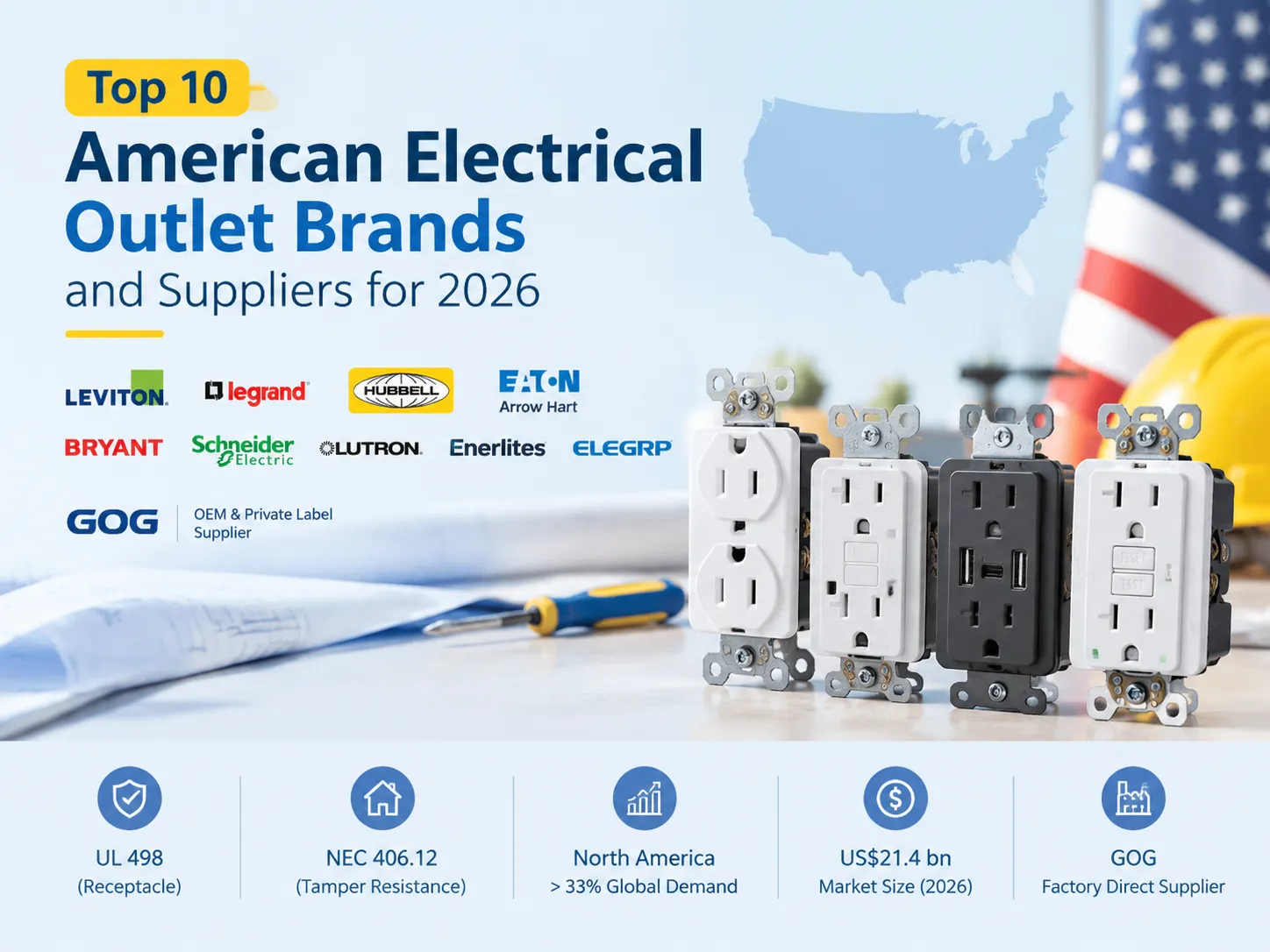
In 2026, electrical outlet manufacturers in the United States, among other things, were surveyed by industry specialists, and it was revealed that Leviton, Legrand (also known as Pass & Seymour), Hubbell, Eaton (that can be found under the name of Arrow Hart in some regions), Bryant, Schneider Electric (frequently named as Square D), Lutron, Enerlites, and ELEGRP are leading manufacturers of electrical outlets in America. Given that these companies produce electrical outlets in accordance with UL 498 and NEC 406.12 regulations, they have certain features in common but differ in prices and components used, production methods, and warranty periods. It is expected demand for electrical outlets and equipment in North America will be more than $21.4 billion in 2026, out of which more than $16.4 billion will be provided by the U.S. market. Although GOG is present in various projects related to the production of duplex outlets (following American standards, tamper and weather resistant duplex outlets), and unique designs of electrical outlets, it is not as popular among the North American audience as Leviton.
What Counts as an American Outlet
The term “American outlet” is informal. In terms of definition, NEC Article 100 provides a distinction most people overlook. An outlet is the part of the wiring system, which is used for taking power to supply appliances, whereas a receptacle is a device that is installed at the outlet for connecting an attachment plug into an outlet. In case of having hardwired smoke detectors, there is an outlet, but there is no receptacle there. When buyers look at products of different brands, they look at receptacles.
NEMA configuration determines the physical interface of the outlet, and this configuration determines the devices that will be used for plugging. Making such a mistake is not a mistake of style. For example, a 5-20R receptacle will take both 15 A and 20 A plugs, while a 5-15R one will take only 15 A plugs. In such a way, one can say that a 20 A circuit uses a T-slotted device.
| NEMA configuration | Voltage | Current | Where it is used |
|---|---|---|---|
| 5-15R | 125 V | 15 A | Standard US residential and light commercial duplex |
| 5-20R | 125 V | 20 A | Kitchens, workshops, commercial 20 A circuits (T-slot neutral) |
| 6-15R / 6-20R | 250 V | 15 A / 20 A | 240 V equipment, air conditioners, welders |
| 14-30R | 125/250 V | 30 A | Dryers and similar 4-wire 240 V loads |
| 14-50R | 125/250 V | 50 A | Electric ranges, RV pedestals, Level 2 EV charging |
| L5-20R / L6-20R | 125 V / 250 V | 20 A | Locking devices for vibration or security-critical loads |
The standards for constructing devices are equally important. The relevant standards include UL 498 with respect to electrical outlets, UL 943 wherever ground-fault circuit interrupters are used in the circuit, and UL 489 for breakers that would protect those circuits corresponding to the panel end. If you are new to the terminology, our explainer on what an electrical receptacle actually is covers the definitions in more detail.
The Ten Brands and Suppliers That Matter
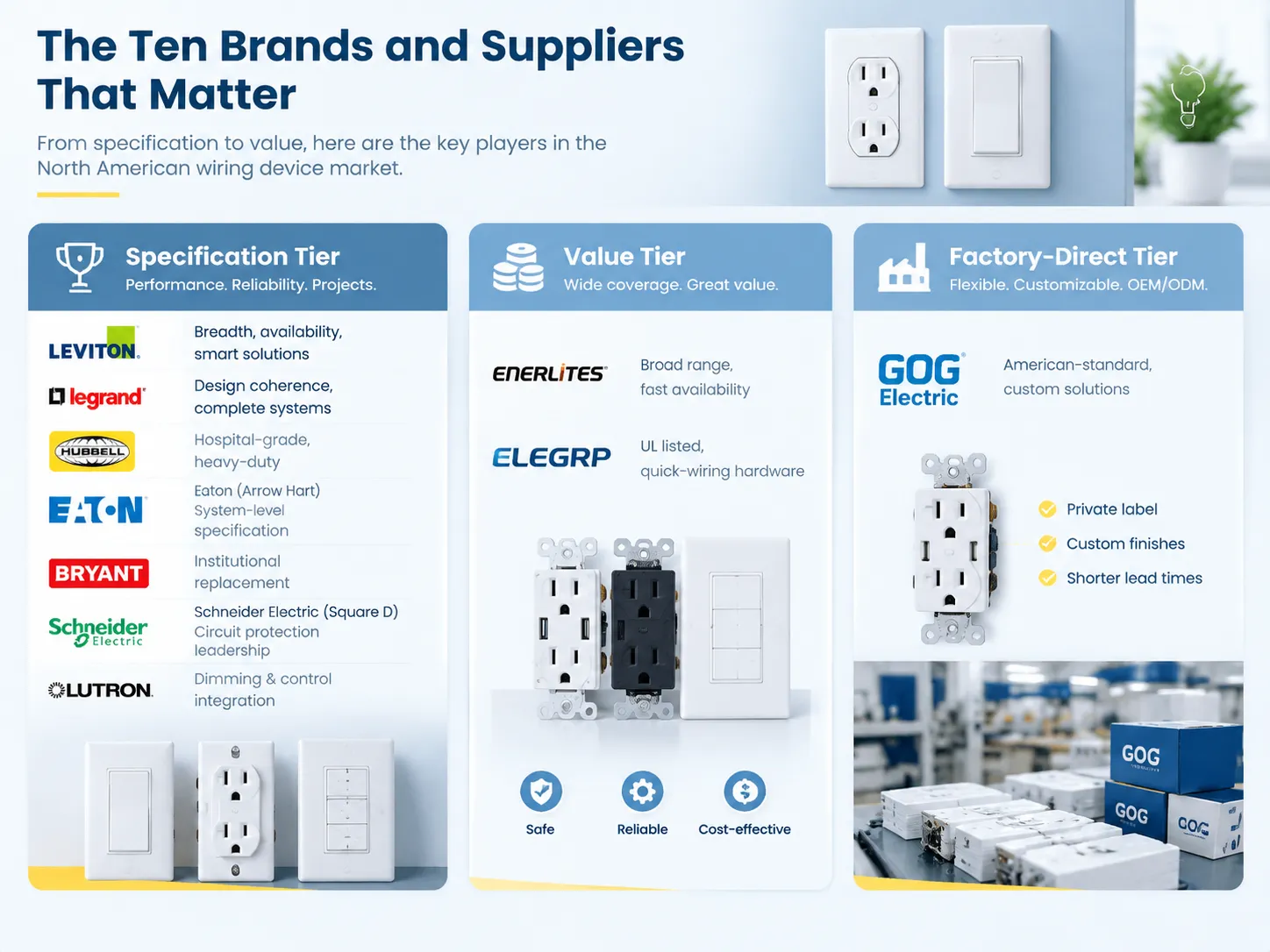
The wiring device market in North America is partially consolidated, where several brands develop specifications, some compete on variety and price and a huge number of manufacturers sells their products under private label and OEM brands. The below list embraces all three categories.
| Brand | Origin and base | Core strength | Where it sits |
|---|---|---|---|
| Leviton | Founded 1906, Melville, NY | Breadth and availability; Decora and SmartlockPro families | Volume standard across residential and commercial |
| Legrand / Pass & Seymour | Legrand HQ France; US operations Syracuse, NY | Design coherence across receptacles, switches, plates and dimmers | Specification and design-led projects |
| Hubbell | Founded 1888, Shelton, CT | Hospital-grade and heavy-duty construction; invented the separable plug | Healthcare, industrial, specification tier |
| Eaton (Arrow Hart) | US operations Cleveland, OH | Spec-grade and heavy-duty devices inside a full electrical system | System-level specification |
| Bryant | Historic US brand, part of Hubbell | Hospital-grade and industrial-grade devices | Institutional replacement market |
| Schneider Electric (Square D) | US operations Andover, MA | Circuit protection leadership; X Series decorator devices | Projects planned around panel and protection choice |
| Lutron | Founded 1961, Coopersburg, PA | Dimming and lighting control; matched keypads and receptacles | Where the wall device is part of a control system |
| Enerlites | Irvine, CA | Value tier with broad coverage and fast retail availability | Apartments, remodels, light commercial |
| ELEGRP | Manufacturing base in Suzhou, China | Value tier with UL listings and quick-wiring hardware | Price-sensitive volume projects |
| GOG Electric | Manufacturing base in China | Factory-direct American-standard receptacles, TR/WR versions and USB outlets | Contractor, distributor and OEM/ODM programmes |
The first name that comes to mind for electrical contractors is Leviton, which is understandable because it’s the biggest independent manufacturer of electrical products in the US. Its offerings include products ranging from inexpensive duplexes to state-of-the-art smart load centers and Electric-vehicle charging facilities, making it possible for the company to remain active in the market and continue acquiring other firms , such as Berk-Tek in 2020 and in September 2025 acquiring Molex’s ArcArrest brand of industrial pin and plug connectors. One disadvantage of such wide range of products is that the information conveyed by Leviton product number does not say much about the grade of the product.
Legrand is in the opposite camp. Its Pass & Seymour line originated in North America and the company has about 19% of the entire world market of socket outlets, allowing it to produce a wall device that matches the switch, the dimmer, and the plate pretty well. When it comes to hotels, multifamily projects, and any project where the wall plate is part of the interior design work, such harmonization is the case. It is not the cheapest solution and it does not position itself as one.
Hubbell occupies the top position on the technical ladder. Founded in 1888 in Bridgeport, Connecticut, this company was the one to invent detachable plug; it still produces the devices in the US. Its hospital-grade line has the green dot which is specified in the OSHA standards for medical facilities. The commercial line is situated between the hospital-grade devices and the builder-grade devices, as it uses stronger materials in contact and a sturdier yoke. Hubbell has also developed an alternative to classic tamper resistance, called Safety Grade, which prevents the insertion of foreign objects without shutters, an invention useful for hospitals where the conventional tamper-resistant devices can be difficult to operate with medical equipment.
Eaton depends on its range in terms of socket outlets rather than on the wall device itself.The company took its first steps into the wiring device industry via its acquisition of Cooper Industries in 2012, with Arrow Hart having become synonymous with its specification and heavy-duty devices. In December 2025, Eaton made the announcement that UL Solutions had mandated wiring device manufacturers, including Eaton, to certify both 15 A and 20 A devices as compliant with UL 498 for their suitability for use with copper-clad aluminum wiring from 1 December 2025. This development has rendered much older product literature obsolete and should be considered in any specification involving CCA.
Bryant, Schneider Electric, and Lutron complete this part of the market for different reasons. Bryant belongs to Hubbell now and its hospital-grade products are still widely used in the field of institutional replacements. Schneider Electric is more of a protection-type player; many projects in the US compare GFCI receptacles at the point of service to GFCI circuit breakers at the panel. Schneider’s strength lies in load centers and circuit breakers, making them relevant. Meanwhile, Lutron, which is known for being the only device manufacturer that is accepted by most designers for display next to keypads, is known for its dominance in dimming products and lighting control.
Under specification devices, Enerlites and ELEGRP compete on volume and price basis. Enerlites is based in Irvine, California and provides middle-market products, such as self-testing GFCIs, tamper-proof devices, weather-resistant devices, USB receptacles, and some sensors and floor boxes, without the buyer premium. ELEGRP manufactures at Suzhou’s plant and competes on the UL-listed product volume basis, which includes their quick-wiring TrapConnect line, launched early in 2025. The differentiating factor in this part of the market in comparison to the upper tier lies in the tooling quality, contact metallurgy, documentation practices, and specification stability.
GOG is in a different league of factory-direct manufacturing, meaning it is not of inferior status. GOG manufactures NEMA 5-15R and 5-20R receptacles, both tamper-resistant and weather-resistant, various designer-grade finishes, as well as USB and Type-C charging devices and in combination with its own tooling, molding and assembly, meaning the company has not sourced any installations. The adverse factors include the branding with no specification standing, meaning that parts from other manufacturers, like Leviton or Hubbell, can be included in the bid documentation without any doubts. It is the right answer for distributors and OEM buyers who control their own specification, and the wrong one for a project where the engineer of record has already named a brand. Larger OEM programmes and private-label work are handled through the OEM and ODM programme.
Grades and What They Cost
The grade level is the most useful filter in this category but it is also the most neglected aspect by the buyers. Most big-box retailers stock equipment that is builder grade such as devices that have flimsy brass terminals, plated steel yoke and nylon face. Such device passes inspection on its first day but also experiences the first failures when subjected to continuous high-draw load.
| Grade | Typical construction | 2026 price | Best application |
|---|---|---|---|
| Residential / builder | Nylon face, backstab terminals, thin brass wipers | $0.80–$1.25 | Closets, guest rooms, low-use areas |
| Commercial / spec | Polycarbonate face, screw-clamp back-wiring, thick brass wipers, heavier yoke | $2.50–$4.80 | Kitchens, offices, retail, any continuous-use location |
| Hospital grade | Reinforced yoke, captive screws, extreme retention force, green dot | $11.00–$18.00 | Healthcare, sensitive AV and lab equipment |
| Self-test GFCI | Built-in ground-fault interruption with automatic self-testing | $15–$25+ | Kitchens, bathrooms, garages, outdoors, basements |
| USB Type-C PD | Integrated 30 W-class Power Delivery charging | $25–$50 | Bedrooms, hotels, waiting areas, co-working desks |
| Weather-resistant (WR) | UV-stabilised, gasketed, listed for damp and wet locations | $4–$12 | Patios, poolsides, outdoor kitchens, covered porches |
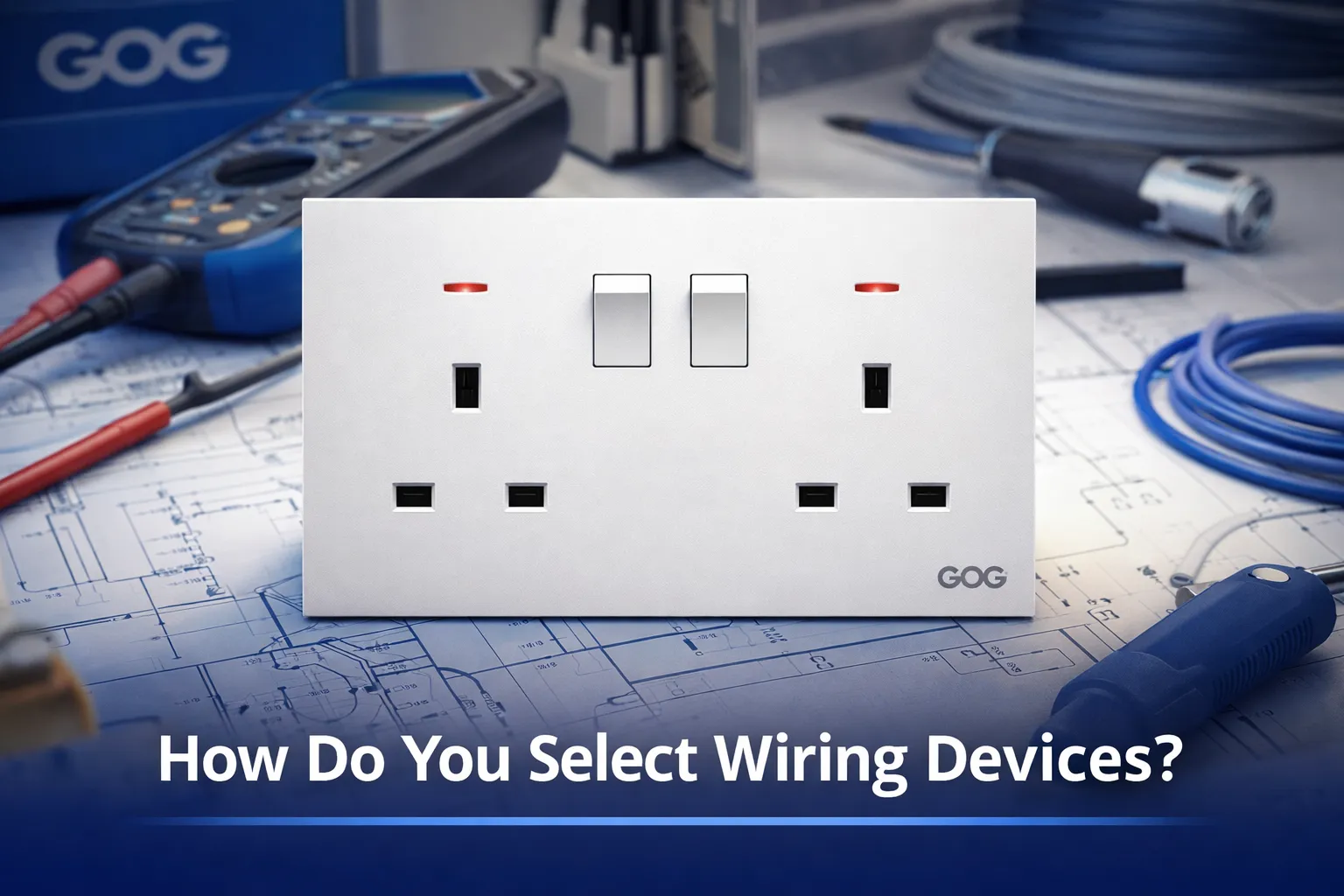
The difference in price in terms of builder grade and spec grade is approximately $2.50 per device, which amounts to $500 in the case of a 200-device house, which is less than the single service call to replace the five outlets that failed, This is the reason seasoned contractors specify using spec grade in kitchen and home office applications regardless of minimum code requirements. If you are replacing outlets rather than building new, the grading decision is covered in our guide to selecting wiring devices.
How the Market Is Structured
The planet’s wiring device market can be categorized into three major geographical regions. North America is dominating the market and accounts for more than 33% of the market value (around US$21.4 bn in 2026) with the United States surpassing US$16.4 bn at the annual growth of nearly 5.2%. The Asia-Pacific region has become the biggest in terms of volume because it accounts for over 36% of the market share (accounting for about US$23.3 bn and approaching nearly 9.5% of the annual increase) with an expected US$8 bn achieved by China only. The European market represents approximately one-fourth of the total world market value with Germany being responsible for attracting 23%. Legrand enjoys the biggest share in the socket outlet market globally (19%) with Schneider Electric being behind with just 17%.
The figures stated above bear practical implications for buyers. The residential segment is developing faster than others because of the growing implementation of smart home systems, while the industrial segment is the biggest in terms of its share of value (more than 26%) due to the increased durability, safety, and eco-friendliness of industrial devices. Thus, if you export to North America, the rate of growth comes from fast-paced developments in smart and connected devices, while in the Asia-Pacific region, it is the volume sector that is thriving.The competitive landscape at the brand level is covered in more depth in our ranking of wiring device brands worldwide.
Choosing by Buyer Type
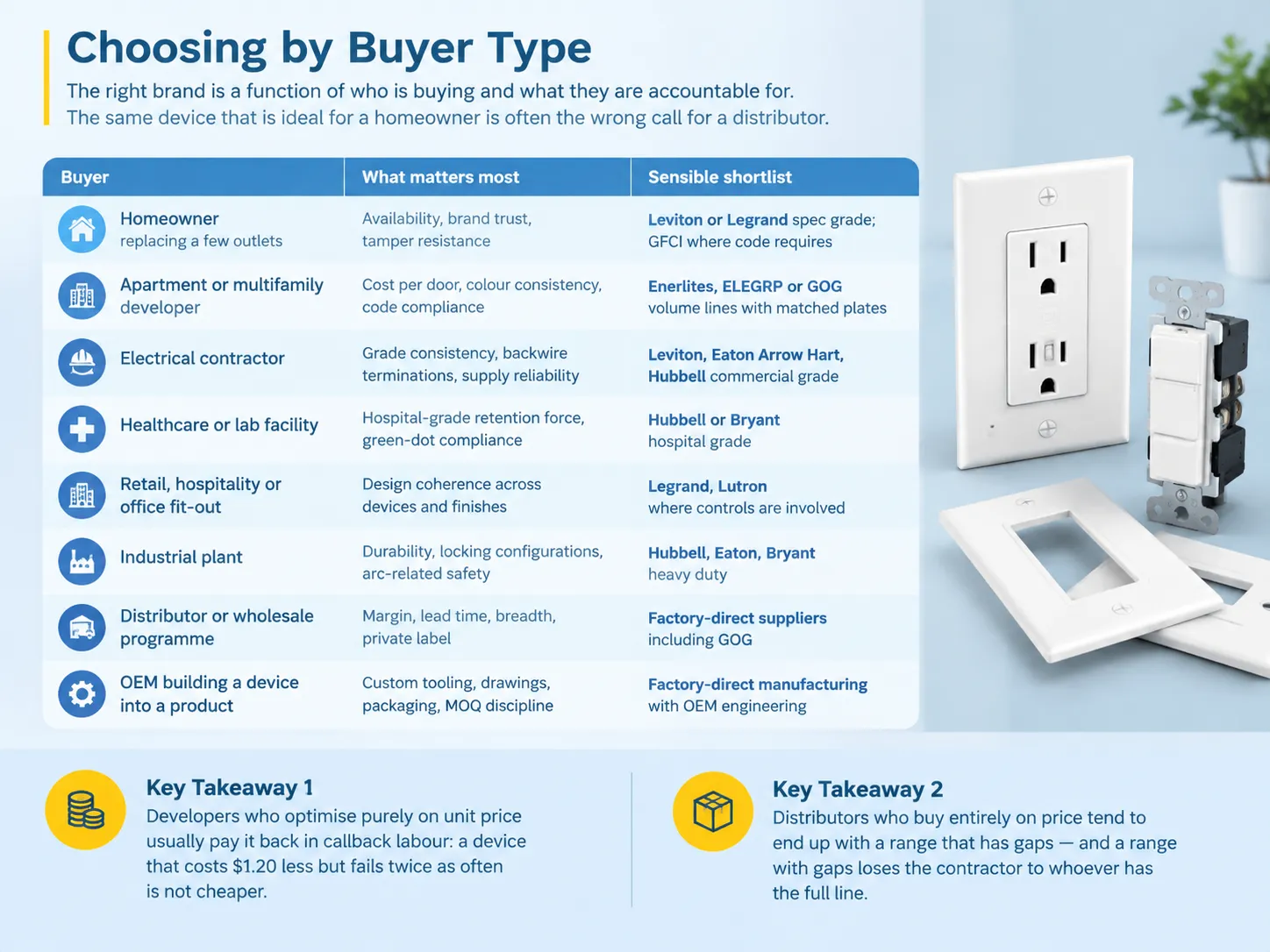
The right brand depends on what the buyer is and what he/she is accountable for, meaning that the right device for a homeowner may not work for a distributor.
| Buyer | What matters most | Sensible shortlist |
|---|---|---|
| Homeowner replacing a few outlets | Availability, brand trust, tamper resistance | Leviton or Legrand spec grade; GFCI where code requires |
| Apartment or multifamily developer | Cost per door, colour consistency, code compliance | Enerlites, ELEGRP or GOG volume lines with matched plates |
| Electrical contractor | Grade consistency, backwire terminations, supply reliability | Leviton, Eaton Arrow Hart, Hubbell commercial grade |
| Healthcare or lab facility | Hospital-grade retention force, green-dot compliance | Hubbell or Bryant hospital grade |
| Retail, hospitality or office fit-out | Design coherence across devices and finishes | Legrand, Lutron where controls are involved |
| Industrial plant | Durability, locking configurations, arc-related safety | Hubbell, Eaton, Bryant heavy duty |
| Distributor or wholesale programme | Margin, lead time, breadth, private label | Factory-direct suppliers including GOG |
| OEM building a device into a product | Custom tooling, drawings, packaging, MOQ discipline | Factory-direct manufacturing with OEM engineering |
There are two patterns to note. Firstly, the programmers that optimize for unit price only end up paying for that strategy in callbacks: a product that costs $1.20 less but fails twice as often is in fact not cheaper. Secondly, distributors that buy purely on price tend to find themselves with a product line with gaps — no weather-resistant version, no USB option, no screw-less plate in the proper finish — and a product line with gaps leads to a loss of customers to whoever offers a full line.
Compliance Traps in the American Outlet Market
There are four major requirements that affect customers in every purchasing cycle and these do not relate to brands.
- Tamper-proof electrical receptacles are not only required in homes. The National Electrical Code (NEC) 406.12 has been extending the list of all industries which are required to use tamper-resistant receptacles, and in 2026, the list of those will include park and recreation areas (playgrounds). If you do not specify a standard electrify device in a covered premise, you have failed in your plan review.
- The amperage must comply with the circuit. According to NEC 210.21 (B) (1), a 20 A receptacle is to be installed on a 20 A circuit. And this is one of the most frequent failures of the residential inspections, as both devices look the same when they are placed on the shelve.A detailed look at how tamper resistance is defined and verified is in our article on what a tamper-resistant outlet is.
- The UL listing is not equal to “designed according to UL standards”. When a supplier claims their product is UL compliant and does not provide a file number as well as a controlling number, they ask buyers for liability in this situation. Always check the supplier’s UL file number.
- The requirement for wiring compatibility has been changed since December 2025. From that point, UL Solutions started requiring the certification that both 15A and 20A electrical devices are compatible with the copper-clad aluminum wiring.
FAQ
What is the best American electrical outlet brand?
The one best brand does not exist; only the best fit. When it comes to specification-quality work in commercial and residential applications, Leviton and Eaton’s Arrow Hart products provide the best combination of availability and reliability. When it comes to health care and industrial settings, Hubbell and Bryant lead the way in hospital-grade products and retention. In projects involving design-based considerations where the wall plate must be compatible with the light switch and dimmer, the Pass & Seymour product lines from Legrand represent the best solutions. If you are not constrained by specification limitations, you can find the same quality manufacturer from a factory direct company like GOG at much lower costs. Decide on quality first and then brand.
Are all American outlets the same size?
The opening in the wall is of standard size; the duplex receptacle fits inside the single-gang box and the cover plates are interchangeable with different brands. What changes is the depth of the body, and the wiring devices. There is more space required for backwire/screw-clamp terminations because push-ins/backstabs need a smaller area. Additionally, a receptacle with USB cannot be installed deep enough compared to the regular duplex type. In very shallow box, it may not be possible to install the device properly if it is too big in size, so the professionals keep a box extender in their means of transportation. The devices in decorator style use a special plate that can either be screwed on or fixed without screws, and therefore, while installing devices from different brands the issue of mixing the brands will become obvious.
Is a 20 amp outlet better than a 15 amp outlet?
It isn’t better, it is simply different, and putting on a wrong circuit is a violation of the code in both ways. A 20 A outlet should be installed on a 20 A circuit designed with 12 AWG copper and it’s good because it accepts both 15 and 20 A plugs in kitchens or workshops. However, a 15 A outlet should always be installed on a 15 A circuit designed with 14 AWG and it does not work with a 20 A plug. NEC 210.21(B)(1) makes it clear that the outlet must have a rating that can be matched by the breaker therefore the outlet is determined by the circuit, and not by the outlet it is installed in a shop. Upgrading an outlet without upgrading the breaker and wires would not do anything but cause a problem during inspection.
How can I tell whether an American outlet is genuinely UL listed?
You need to check whether the product has a UL mark and a file number, and use UL’s Product iQ service to verify the file. Remember that there is a difference between a product that is UL-listed and what a supplier claims is “UL-compliant,” as the latter does not require any subsequent inspection in the factory. For products that are private-labelled, establish who has the legal certificate; often the certificate is registered in favor of the manufacturer of the product instead of the brand name on the device, and this distinction determines the party liable for the product failure.
Where can I buy American standard outlets in bulk?
There are three different options, each having its own cost structure. Distributors have the branded products in their inventory at distributor prices so that they can enjoy certain earnings. Importers and wholesalers buy bulk products directly from factories, and they manage their own inventories and stockpiles. The last method gives rise to the lowest cost and implements total control over the entire production process, but the buyer should take care of their own UL documentation and specifications since they will not be backed by the brand.
References
- NFPA — NFPA 70 National Electrical Code, Article 406 and 210
- UL Solutions — UL 498 Receptacles and UL 943 GFCI standards
- NEMA — Wiring device configurations and standards
- Leviton — company history and product documentation
- Legrand North America — Pass & Seymour wiring device range
- Hubbell Incorporated — Wiring Device-Kellems
- Eaton — Arrow Hart wiring devices
- Schneider Electric — Square D wiring devices and protection
- Lutron Electronics — lighting control and receptacles
- OSHA — hospital-grade receptacle marking requirements
- Persistence Market Research — Wiring Devices Market Size and Share
Conclusion
Though electrical outlets appear to be a simple product category on the surface, they are difficult to dissect. Every manufacturer in this category adheres to UL 498 and uses the same NEMA dimensions, so the main differentiating factors of a product priced at $1.20 when compared to one priced at $4.50 are aspects like the metallurgy of contacts, the specifics of how they were made or installed, the design of the yoke, and the factory’s ability to keep the parameters steady for a number of years.
Only three things enable customers to make them the best choice. Choose the grade rather than the name; hence, a low quality item from a big name manufacturer is still a low quality item. Take care of matching the product with the circuit, since the current is defined by the wiring and not the dimensions of the product itself. Obtain the UL file before ordering anything; hence the makers need to turn to the concrete data rather than to the manufacturer’s name.