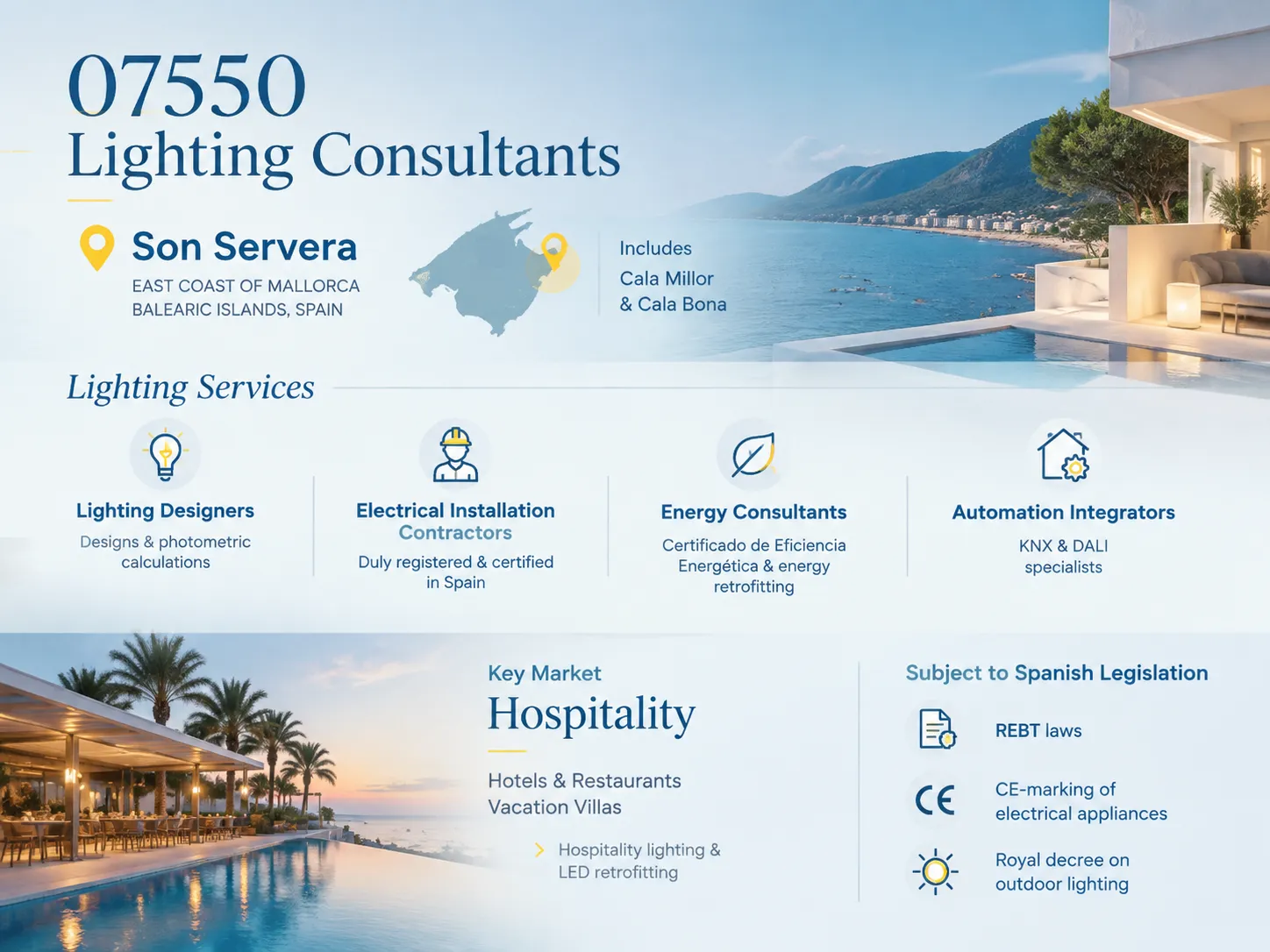
The specific postcode 07550 serves Son Servera, which is a municipality located on the east coastline of Mallorca in the Balearic Islands of Spain. Son Servera is a location which consists of beach resorts like Cala Millor and Cal Bona along with a peaceful residential area named Costa de los Pinos. The local market is characterized by tourism and vacation rentals. To meet the requirements of the local market, the lighting works needed in Son Servera include a variety of things such as hospitality interiors, outdoor lighting solutions that can withstand the hot summers, and residential lighting in buildings. The process of finding the desired lighting designer in the area is quite difficult because it entails hiring a consultant who knows the regulations of Spanish electrical systems and other laws related to such installations. The guide explains how to find the right lighting designer for the needs of the market.
The area of Son Servera, which has the postcode 07550, is located in Mallorca in Spain and includes Cala Millor and Cala Bona and the residential neighborhoods surrounding them. There are four categories of lighting services in Son Servera, namely lighting design, electrical installation, energy consultancy and automation integration. The lighting design is provided by independent specialists who design lighting schemes and carry out photometric studies. Electrical work is completed by licensed electricians who can provide the relevant certification. The specialized energy consultants take care of the monitoring of lighting efficiency and retrofitting projects, while the automation specialists are experts in KNX, DALI and other systems of control. The dominating branches of business in the region make hotels, restaurants, and rental houses and thus, practically all lighting work concerns hotels, restaurants and villas. All legal acts of Spain are applied in this area, namely CE marking and Real Decreto 1890/2008 regulating outdoor lighting efficiency. As for costs, they range considerably.
Where 07550 Is
Son Servera is located in an area designated 07550 on the northeast coast of Mallorca, about 60 km east of Palma and nestled inland from the bay which divides Porto Cristo and Artà respectively. The postal area is about 36 km square and the coded area is home to around 5200 residents, while the number rises significantly because of tourists who flock to the region.
However, even if the postal code is useful information, it is of no practical importance as its geographical significance supersedes the administrative one. The area is home to Cala Millor and Cala Bona which are two of the oldest resorts of the island and is known as Costa de los Pinos. Therefore, one postcode is home to three different parties: people running hotels needing a different billing and other lighting provisions, owners of rental villas which should be equipped accordingly and residents of the pre-existing homes that used to be equipped ages ago.
Thus, when hiring consultants one should always check the area in which they work because the requirements continue to vary significantly. For instance, if the project in at the heart of Cala Millor, the hotel owners would need a license and work in the off-seasons while choosing contractors wisely. However, if Costa de los Pinos is involved in the villa construction the requirements would be limited to planning limits, landscape lighting restrictions and garden supplies only.
The Local Lighting Market
There are four features of the market, and each of them affects the meaning of a reasonable specification.
- Tourism leads the demand. In the area of Cala Millor, hospitality establishments renew the interior every season, and lighting is part of larger renovation work. This is the reason why concentrated activities take place during the winter period, while summer months do not favour installation processes. As a result, in such conditions, projects must be scheduled in a narrow timeframe, and the delays will have significant expenses.
- Seasonal occupancy alters the requirements. A villa that is unoccupied for six months has completely different lighting needs vs. a villa that is used all year long: in the first case, automated control, simulation of occupancy, and fixtures that endure long periods of non-usage are important. On the contrary, highly demanded rental property requires devices that are not sophisticated but rather reliable and easy to maintain.
- Energy costs are under discussion. Spain’s electricity prices vary constantly, and the hospitality business keeps consumption under control. LED retrofitting with control systems makes its economic sense evident, while the Certificado de Eficiencia Energética necessary for homes being sold or rented makes energy efficiency a documented problem rather than an abstract one.
- Marine conditions affect poor specifications. Salt-filled air, humidity, strong sun rays, and sand impact the properties of materials used for appliances. The equipment that works normally at the administrative centre does not show good performance on the sea coast, and associated costs related to failures exceed savings achieved due cheap fixtures.
Who Provides Lighting Services
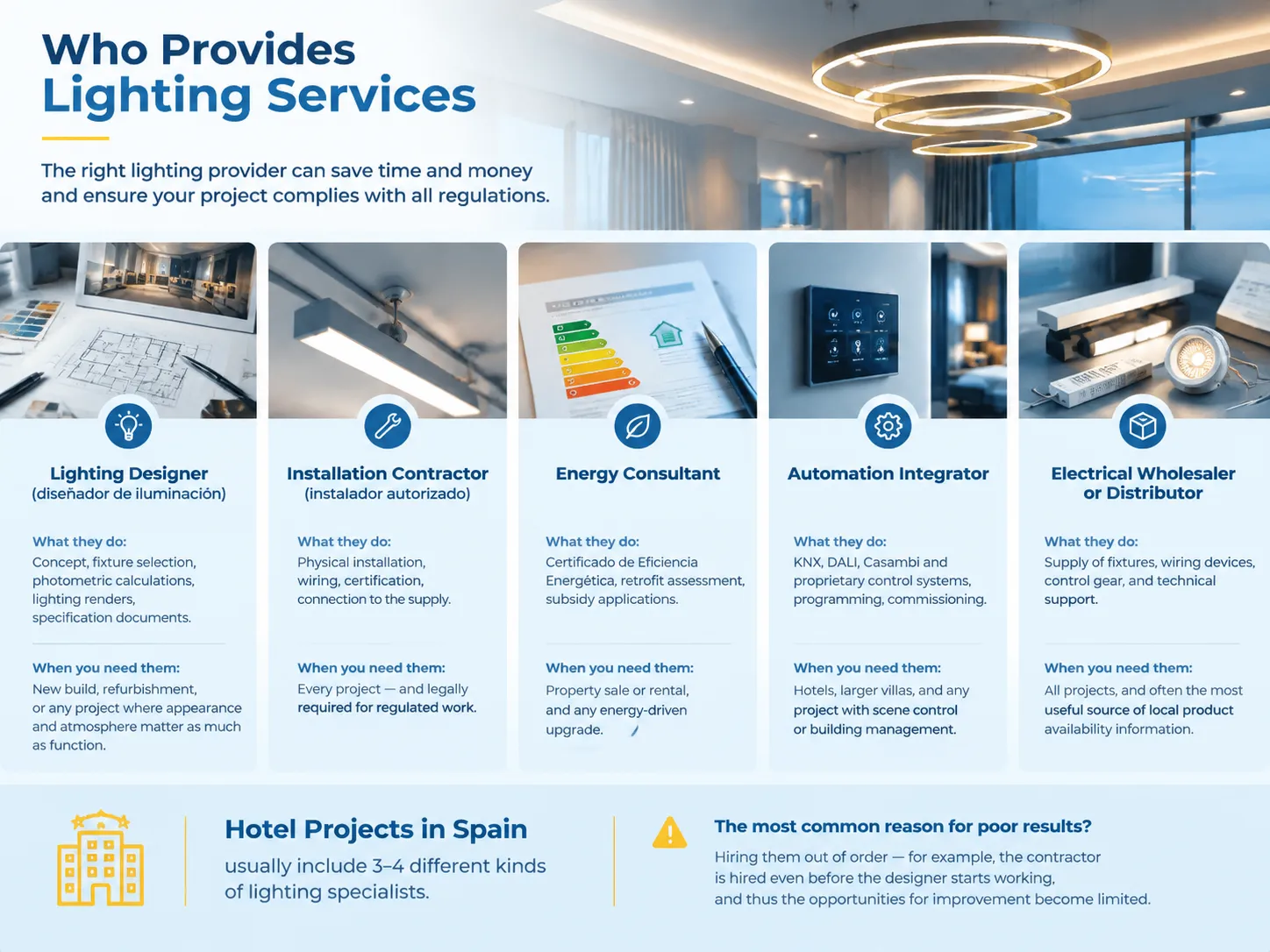
The term ‘lighting’ in Spanish refers to a variety of professions and identifying the right type of lighting provider for a project can save time and money as well as ensure that the project complies with all regulations.
| Provider type | What they do | When you need them |
|---|---|---|
| Lighting designer (diseñador de iluminación) | Concept, fixture selection, photometric calculations, lighting renders, specification documents | New build, refurbishment, or any project where appearance and atmosphere matter as much as function |
| Installation contractor (instalador autorizado) | Physical installation, wiring, certification, connection to the supply | Every project — and legally required for regulated work |
| Energy consultant | Certificado de Eficiencia Energética, retrofit assessment, subsidy applications | Property sale or rental, and any energy-driven upgrade |
| Automation integrator | KNX, DALI, Casambi and proprietary control systems, programming, commissioning | Hotels, larger villas, and any project with scene control or building management |
| Electrical wholesaler or distributor | Supply of fixtures, wiring devices, control gear, and technical support | All projects, and often the most useful source of local product availability information |
From a practical point of view, hotel projects in Spain usually include three or four different kinds of lighting specialists; the most typical reason why projects do not yield good results is hiring them out of order, in this case, the contractor is hired even before the designer starts working and thus the opportunities for improvement become limited.
What the Services Cover
In this market, the service scope is divided into six categories.
- Hospitality interior lighting. Restaurants, lobbies, bars, and terraces of hotels where the primary focus is to create an attractive atmosphere while ensuring system durability along with an easy control system that allows the creation of daytime, evening, and cleaning scenarios without the need for extensive experience from the employee.
- Exterior, garden, and façade lighting. Villa gardens, swimming pools, driveways, hotel façade and terrace lighting. This category of services as far the environmental aspect is concerned poses the greatest problems to comply with due to light pollution regulations.
- LED retrofitting. Replacement of halogen and discharge lamps with LEDs, downsizing circuits, upgrading the control device if existing dimmers cannot cope with LED load, and showing the energy effect.
- Control and automation. Scene control, detection of presence, daylight detection, astral clock for outdoor lighting, and integration with room management systems in hotels.
- Compliance and certification. Checking if the installation complies with REBT, installation certificate issue, energy performance certificate issue.
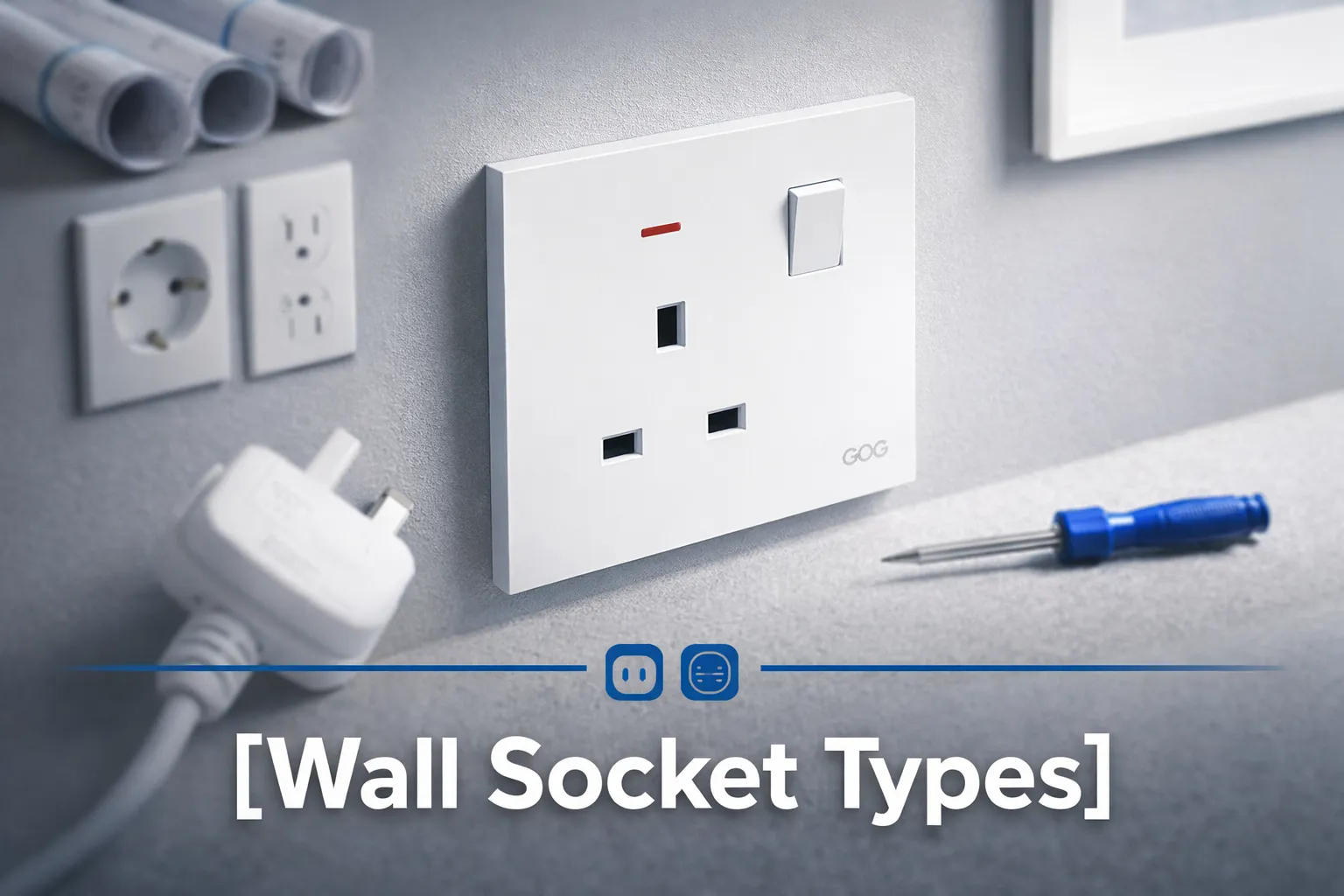
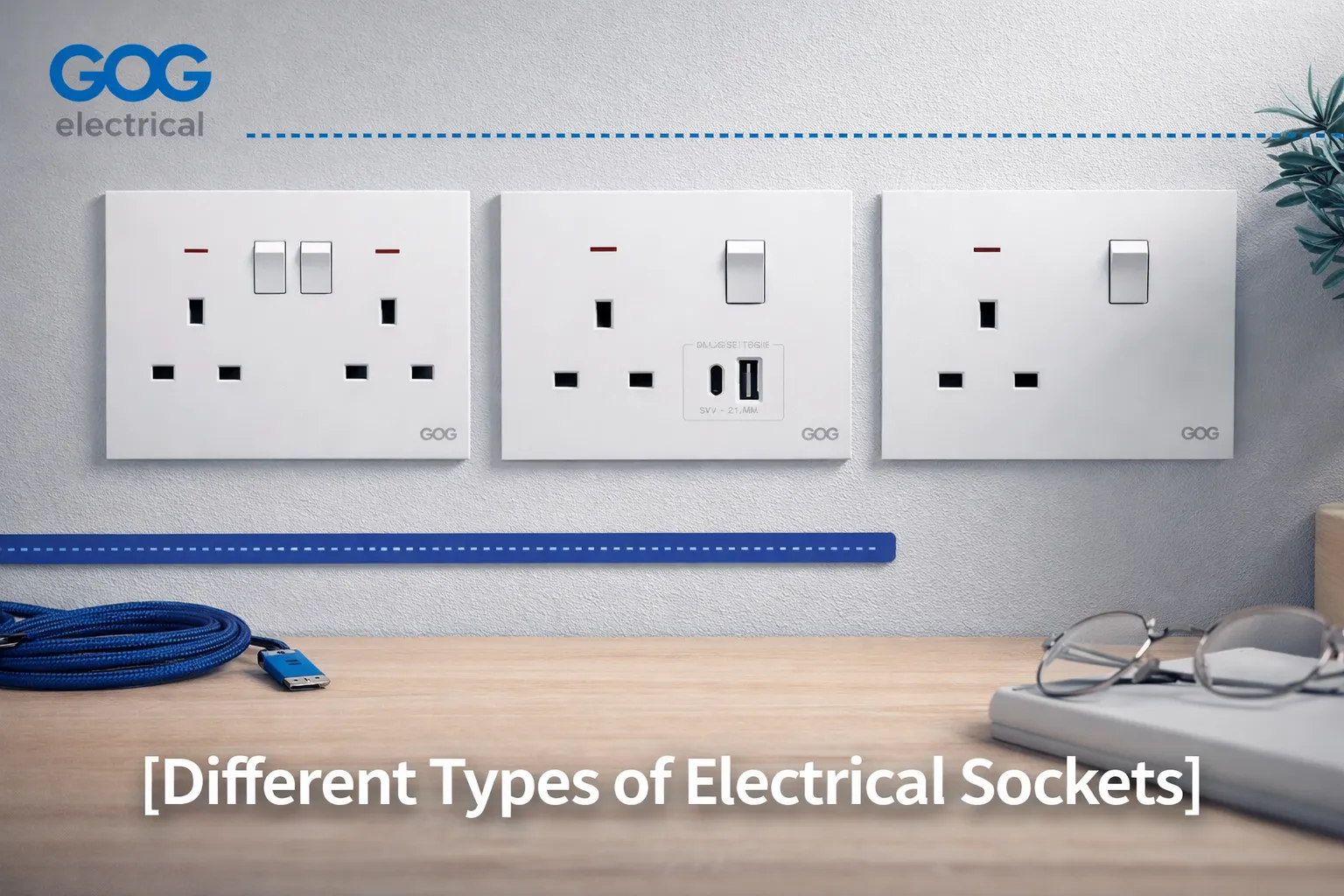
- Electrical accessories and wiring devices. Switches, sockets, dimmers and their plates — visible layers of the installation that greatly contribute to the impression about the project as a whole.
The last category is worth less than the others but much more visible which is harmful. A bright lighting design idea presented through outdated, mismatched or ugly switch plates ruins the idea developed in all other components of the project, which is also what clients see every day.Understanding which switch family suits a scheme — and how many circuits a plate has to accommodate — is a small technical discipline in its own right, and the terminology is set out in our explanation of what one-gang, two-gang and three-gang mean.
Why Coastal Conditions Change the Specification
The coast of the Balearics is a difficult environment for electrical installations and the way they fail is predictable.
| Condition | Effect on equipment | Specification response |
|---|---|---|
| Salt-laden air | Corrosion of terminals, screws, metal plates and fittings; accelerated failure of exposed contacts | Corrosion-resistant materials; avoid untreated steel; specify IP-rated enclosures |
| High humidity | Condensation inside enclosures; insulation resistance falls; tracking across contaminated surfaces | Adequate IP rating, drainage, and sealed cable entries |
| Intense summer UV | Degradation of plastics, cable sheathing and luminaire diffusers | UV-stabilised materials; avoid cheap polymer housings exposed to direct sun |
| Airborne sand and dust | Contaminated optical surfaces; reduced light output; ingress into fittings | Minimum IP65 for exterior luminaires; accessible cleaning routes |
| Seasonal disuse | Moisture ingress during unoccupied months; insects in fittings; battery failure in controls | Sealed construction, robust control gear, commissioning checks at season start |
The most crucial consideration in this context is the IP rating. The lights used indoors in a coastal property are usually rated at IP44 at a minimum in bathrooms and kitchens and the lights used outside ought to be rated at least IP65 but ideally they have to come with IP66 or IP68 ratings in case they are or will be submerged in water. There is a frequent misunderstanding about the ingress protection ratings: the first digit corresponds to solids and the second one is about water, whereas, for instance, IP65 stands for protection against dust but only against water jets, not against immersions. If something is described as “suitable for outdoor use” without any IP rating, it cannot be considered a specification.
When it comes to the actual advice for coastal installations, it can be said that it is better to over-specify materials rather than features. The marine-grade steel, die-cast aluminum with the proper coating and good-quality gaskets have a relatively low price and eliminate the majority of defective goods. The opposite approach, which involves saving on the materials and budgeting tests, would usually turn out to be more expensive over five years, as getting access to a failed outdoor fixture usually costs more than the fixture itself.
Spanish Regulation You Cannot Ignore
In Spain, the lighting works are performed according to a system of legislation that specifies the parties entitled to carry out the works, the equipment that might be used for the project, and the documents that must be produced afterwards.
- The low voltage regulatory framework is represented by the REBT, which govern the construction design in terms of installations, protection measures, and ensures qualified professionals carrying out installation and reporting on it. Certain types of works require qualified performers and, in most cases, a commissioning document.
- CE marking and standards established at UNE-EN level apply for equipment. In other words, lighting devices, control equipment, and installations used in a project in Spain must comply with the European requirements, which require compliance with the regulatory standards established through IEC/EN documents.
- Real Decreto 1890/2008 regulates outdoor lighting installations in terms of energy efficiency and light pollution control. It sets the limits on upward light flow, illuminance rates based on the classification of territory, as well as the types of monitors allowed in specific places. This is the reason behind the fact that the project aimed at lightening a villa garden or a hotel building in a close vicinity to a protected coastal zone is restricted not only by aesthetic preferences but also by the established legal requirements.
- The Certificado de Eficiencia Energética, which indicates the level of energy efficiency of a building in accordance with its lighting system, should be obtained before the sale or renting of a property.
- Additional local environmental protection requirements set further limitations in some zones concerning conservation nature sites and coastal protection zones. The implementation of any exterior lighting system in the 07550 area is subject to local planning.
A property owner ought to know its practical implication: it is not enough to say that exterior lighting is a decorative feature. It is, in fact, a regulated installation, with a number of technical limits. Hence, if a consultant is not capable of providing specific information concerning upward light flux and area classification, they are not able to fulfill the task. Interior lighting and wiring device selection are less constrained but still require compliant equipment — which is where the certification of switches, sockets and dimmers becomes a specification matter rather than a brand preference, as set out in our guide to what separates the leading wiring device brands.
What It Costs
The data supplied below represent planning range estimates for local markets with specifications, access and seasons impacting them. The information is meant to help prepare a budget for expenses based on the data collectively provided here and is not intended to function in lieu of a quote.
| Item | Indicative cost | Notes |
|---|---|---|
| Lighting design, villa | €500-3,000 | Scales with the number of spaces, whether photometric calculations and renders are included |
| Lighting design, hotel or restaurant | €2,000-15,000+ | Usually priced per area, with site supervision charged separately |
| Qualified electrical labour | €35-60 per hour | Higher rates for emergency and out-of-season working |
| Residential interior luminaires | €30-300 each | Decorative fittings at the upper end; utility fittings far lower |
| Exterior and garden luminaires | €50-500 each | Coastal-rated construction adds meaningfully to the price |
| LED dimmer or smart switch | €25-120 each | Compatibility with the load drives the price more than aesthetics |
| Complete rewiring, average villa | €6,000-20,000 | Highly dependent on access, surface type and whether the property is occupied |
| KNX or DALI automation installation | €5,000-30,000+ | Programming and commissioning typically 20-30% of the total |
| Energy performance certificate | €150-400 | Required for sale or rental |
There are two specific patterns related to costs in this market. The first is that work that is timed to coincide with the tourist season incurs a higher price: a hotel that is worked on only in the period from November to March must compete for contractor services in an extremely narrow window of opportunity and this is reflected in the costs involved. The second cost pattern involves the fact that the costs of outdoor work are compounded due to the fact that the project is in a coastal area where maintenance of seals, gaskets, and joints is required regularly.
Products and Brands
The players in the Balearic market come from Spain and anywhere around the globe, but it seems that the ability to source from a local wholesaler counts more than the variety of the product line.
On the side of wiring devices, meaning switches, sockets, dimmers and plates, there are many brands present on the local market — Simón, Niessen, Jung, Bticino, Legrand, Schneider Electric and Hager. Local solutions for plate systems will fit various styles of the interior and number of mechanisms. The specification on luminaires may have been advised by the lighting designer and include brands of the architecture elsewhere in the world or Spanish- and Italian-made products. As for the control systems, KNX is the main standard in hospitality and bigger homes, while DALI is used for commercial lighting systems to control luminaires.
The most interesting category for the finished look is wiring devices category where cooperation with distributors will be beneficial. The reason for that is that switch and socket plates are supplied in the form of systems so the existence of the devices as the entire product line matters more than prestige of the name. GOG among manufacturers provides such devices both for export and project channels and in case the distribution of several hundred products in one finish is needed, the comfortable supply is important. Deciding how the control interface should work, meanwhile, depends on the lighting it controls: LED loads behave differently from the incandescent loads older dimmers were designed for, and the matching rules are covered in our guide to LED dimmer compatibility.
The practical installation sequence that follows from that matching exercise is the same discipline as any wiring device swap, set out in our article on installing a dimmer switch.
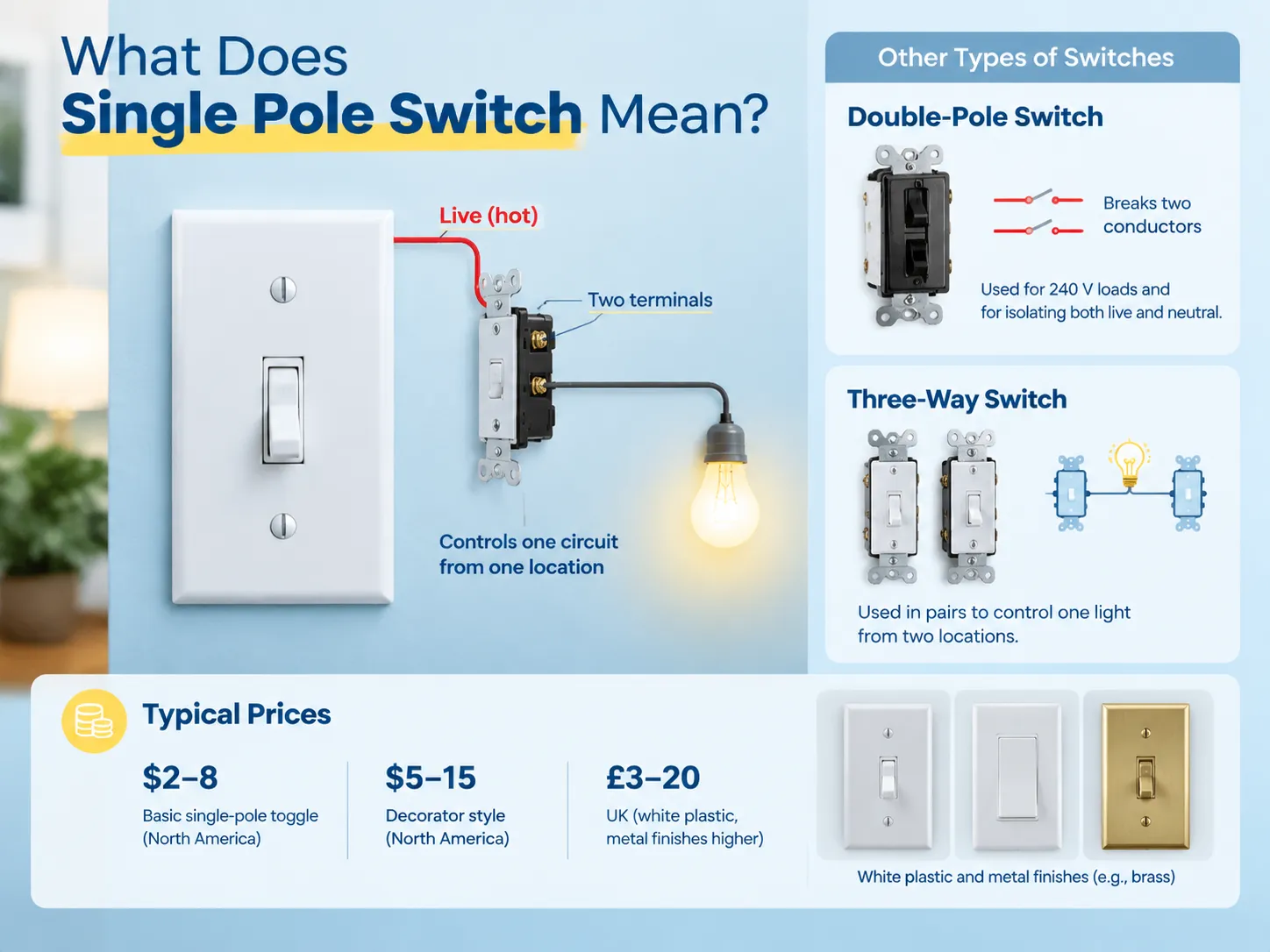
Where a project needs a simpler or more traditional control scheme, the alternatives are surveyed in our overview of the types of light switch.

How to Choose a Consultant
A competent contractor has to be recognized from a hopeful contractor.
- Confirm whether it is qualified to conduct regulated activity. Carry out of electrical works in Spain means using a certified provider. Inquire about who the certified person is and who the paper is to be signed by, making sure that the response is not something like ‘the subcontractor I believe’.
- Request for photometric calculations, not just renders. The lighting project must include the illuminance calculation and be ready for the analytical check with regards to the Royal Decree of 1890/2008 for outdoor works. Renders tell about the future project but calculations show how successful that project can be and whether it is acceptable according to the legislation.
- Check the specification for the coastal areas. Ask about the suggested IP values for each outdoor space and what the materials for the fasteners and terminals are. If that person gives you an unclear response, be ready for future maintenance issues.
- Check references for similar types of buildings. The designer may have a large list of successful projects in residential interiors but not be able to handle the hotel project which includes a guest room management system.
- Check the timeline. Ask directly how the process is to take place with taking into consideration when people may stay in the hotel and what the consequences of longer processing are.
- Decide on specifications. Usually, specifications for switches and sockets are left for the contractors which leads to discrepancies between the original design idea and the chosen products. Therefore, agree on who will be involved in that decision-making step.
Moreover, it should also be emphasized that property owners should keep in mind that the lowest estimate in the industry is usually the one which does not include any kind of regulatory background. If an offer does not say anything about the installation certificate, energy performance certificate or outdoor lighting compliance, it does not mean that it is simply a cheaper version of a compliant offer.
FAQ
What does a lighting consultant do that an electrician does not?
They work on various issues. The job of an electrician is to design and make sure all electrical systems work properly, that is: safe wiring, functioning protective devices, correct connections, and the required documentation. Lighting consultant’s work is to develop the lighting itself — to define how much light should go into the given location, what equipment should be used, how it is regulated, etc. Therefore, both specialists are needed because usually the first mistake made by the designers is inviting the electricians to the project instead of lighting designers.
Do I need a lighting designer for a villa in Mallorca?
While this is not true in all cases, new builds, major renovations, and properties with lighting that is complex enough to trigger light pollution concerns are the most favorable options for the rationale. For a simple renovation where the layout is without any alterations, an electrical contractor with good access to a supplier might be enough. Where budget allows designers to be hired, their action can be justified where lighting of the property is important.
Why is coastal specification so important in the Balearics?
Due to the aggressive behavior of salt, moisture, sunlight, and sand on the performance of electrical systems. As a result, connections are damaged and metal parts are corroded, while polycarbonate parts become weak and seals stiff. So equipment that works well inland can stop functioning in coastal areas in two-three seasons. Therefore, more expensive materials should be used, as well as special means of protection against corrosion: IP68 for outdoor devices, corrosion-resistant material, and UV-resistant polymers. Naturally, this will lead to bigger expenses, but in spite of higher costs, almost all possible repairs will get eliminated, as the cost of breakdowns is higher than costs of the devices themselves.
What is the Certificado de Eficiencia Energética and do I need one?
The Spanish energy performance certificate (EPC) is a legal requirement for anyone seeking to sell or rent property. This document provides details about the energy performance of the building including its lighting and its issuance is done by a trained technician. For rental villas in area code 07550 getting this certificate is mandatory and for anyone who is planning an energy-efficient lighting retrofit project would benefit from getting this document at the earliest which serves as an important base when establishing the improvement.
Can a lighting consultant work only in part of the year?
Although it is possible for contractors to obtain work in the Cala Millor and Cala Bona area, it can be challenging. Work in hospitality in this area is mostly found during the offseason since businesses do not want to disturb their operations in the busy tourist months, making the demand much higher in this limited time frame and limiting the number of available contractors. Aside from doing renovations in commercial buildings, clients in residential villas may also want repairs done, but the process takes longer since they tend to be away from their properties for long periods. Projects requiring work done in time for the beginning of the season need to be planned ahead, regardless of how fast the work will be done.
References
- Boletín Oficial del Estado — Reglamento Electrotécnico para Baja Tensión (REBT) y Real Decreto 1890/2008 de Eficiencia Energética en Alumbrado Exterior
- IDAE — Instituto para la Diversificación y Ahorro de la Energía, Certificación Energética de Edificios
- International Electrotechnical Commission — IEC 60529 Ingress Protection Ratings
- UNE — Normas UNE-EN Aplicables a Luminarias y Aparamenta Eléctrica
Conclusion
Lighting services in postcode 07550 function in a region with three key elements that establish demand for interior and exterior hospitality lighting, landscaping and terrace lighting (often known as LED retrofits) and automation: tourism; the coastal area which is influenced by Spanish law (‘real decreto’) and coastal tourism. Collectively, Son Servera, Cala Millor, Cala Bona and Costa de los Pinos create the demand for hospitality indoor and outdoor (exterior and garden) lighting, LED retrofits and Automated Lighting services. All of these lighting categories are limited by numerous aspects of the geographical landscape and Spanish law, not solely by personal preference as determined by taste. All of the works performed on the exterior of a property must comply with ‘Real Decreto 1890/2008’ concerning light pollution and energy efficiency; all works performed on the interior and exterior of properties must be certified as to the quality of materials used and the equipment for all works on the property must be corrosion-resistant. When it comes to the cost estimates between private residences, the budget range is €500-3000 for villa lighting design, €2000-15000+ for hospitality projects and €35-60/hour for qualified labour. Full automation installations will cost between €5000-30000+ depending on the system used, and the average lowest bids in this sector typically include many omitted compliance works necessary to install the lighting. When selecting a lighting design, once you have completed the production of the design and the installation of the control systems, do not forget to consider the items that clients will interact with daily. The switches, dimmers and electrical outlets are a minor portion of the overall cost of the project; however, they are significant in how clients will judge the work as a whole based on the use and feel of the devices.