I was recently asked by my friend to come over and check out a wiring project in his workshop (garage). He’d purchased a new 240-volt table saw and needed to wire in a disconnect switch securely mounted on the wall within reach. The switch he purchased, a standard single-pole toggle switch (the same one he used for overhead lights) would be unsafe for use here. By only disconnecting one phase (hot leg), this type of switch would leave an active (hot) leg inside the saw, even when the switch is in the OFF position. For this reason, a double pole switch (i.e., one that simultaneously disconnects both phases/hot legs) is needed to fully de-energyze (de-energize) the electrical load. Every day in workshops, kitchens and equipment rooms there are similar situations requiring an explanation of the difference of these two types of switches, and which switch is to be used for your project. Understanding how a double pole switch operates and when to use one is critical to performing safe electrical work.
What a Double Pole Switch Actually Is
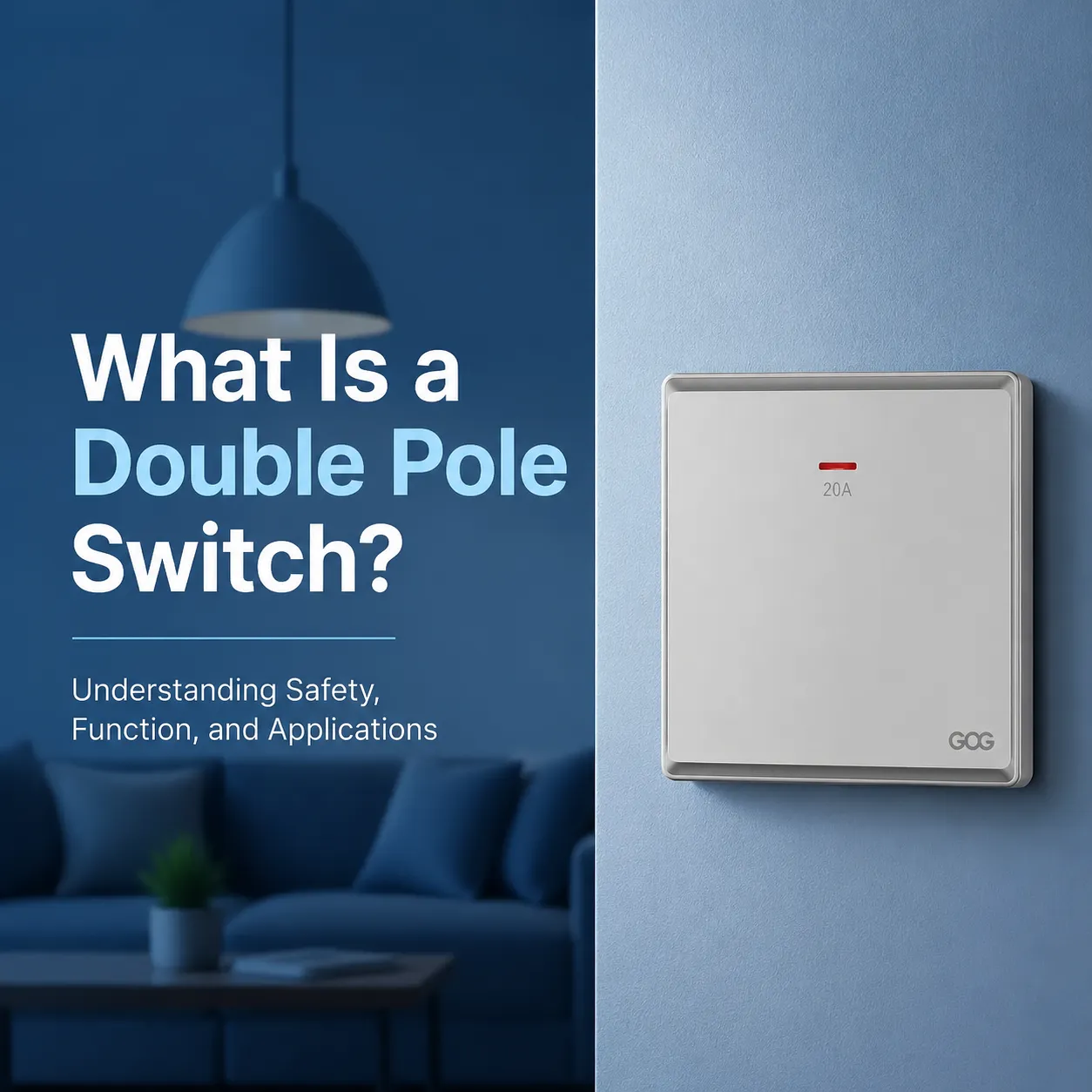
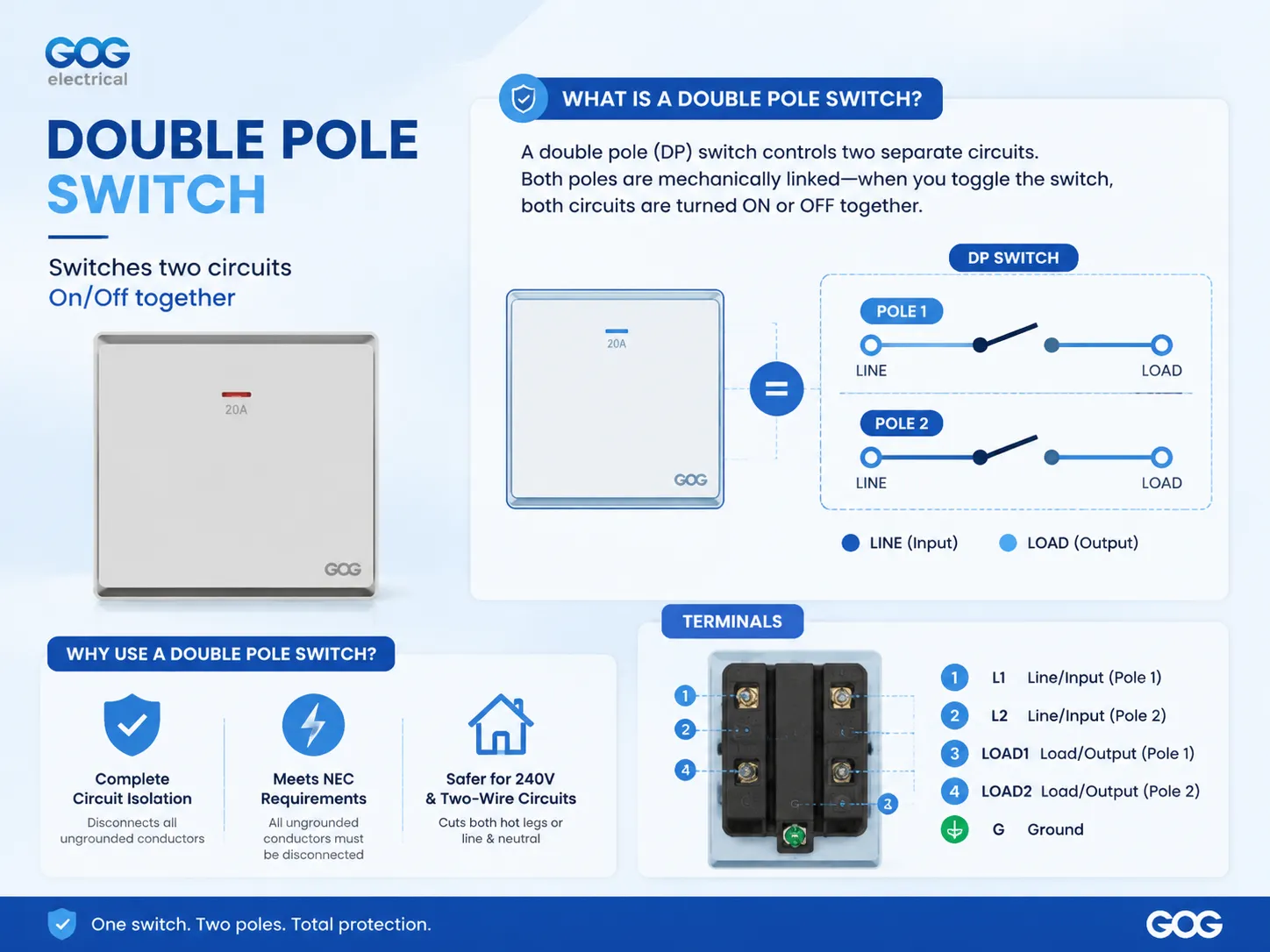
A double pole (DP) switch is an electrical switch that switches on and off two different circuits (independent from each other). A DP switch has two sets of contacts that are mechanically attached via a toggle, a rocker, or a rotary handle, so when you move the handle, both contacts move together. Each pole of the DP has its own two line terminals (for incoming/line voltage) and two load terminals (for outgoing/load voltage), for a total of four terminal screws, as well as one ground terminal on the DPSwitch itself.
A standard single-pole switch only has two brass terminals and breaks only one conductor, which is the hot conductor. A double-pole switch will break both the live and neutral conductors on a single-phase circuit for complete isolation or will break both hot legs on a 240-volt circuit. The National Electrical Code (NEC) requires that all ungrounded conductors of a circuit be disconnected at the service disconnect, and a double-pole switch will achieve this for two-wire circuits.
How It Differs from a Single Pole Switch
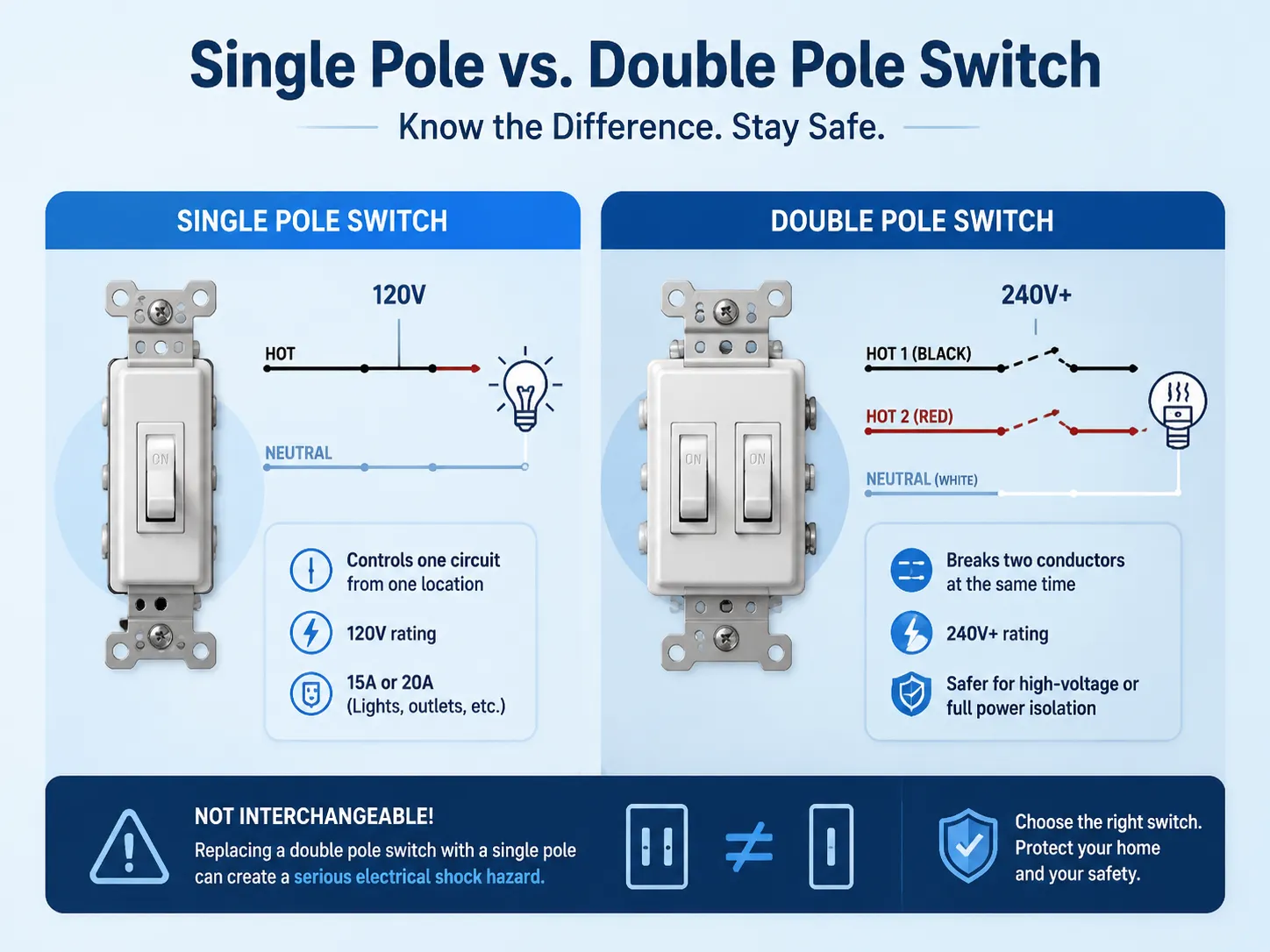
The most common area of confusion regarding switch selection, is in regards to whether to buy a single pole or a double pole switch. A single pole switch only controls one circuit, but it does so from one location. In essence, when you use a single pole switch, you only interrupt the hot wire when you toggle the switch, while the neutral wire remains connected. A single pole switch typically has a 120 volt rating and is rated for either 15 or 20 amps, which means it can be used to control the lights in your bedroom or the power supply for an outlet in the family room.
In contrast to a single pole switch; a double pole switch breaks two conductors at the same time. Therefore, when using a double pole switch in a 240 volt application, you are switching out both the black and red hot wires while still leaving the white neutral wire (if present) alone. For a 120 volt application that requires completely isolating the power from a 120 volt circuit, both the hot/black and white/neutrals would be switched off with the double pole switch. A double pole switch is physically larger, has a higher voltage rating (240 volts or greater), and costs more than a single pole switch since it contains the same number of contacts as the number of locations that are controlled by the switch. So, if you tried to replace a double pole switch with a single pole switch, you would be creating a serious electrical shock hazard! For a step‑by‑step wiring guide covering both types, our article on how to wire a single pole switch explains the terminal connections for the simpler device, and the principles extend directly to the double pole version.
Double Pole vs. Three Pole: When More Circuits Need Control
If two poles aren’t enough, a three pole switch (often called a three‑phase switch) controls three independent circuits simultaneously. This is standard for three‑phase equipment — commercial kitchen ovens, industrial motors, large HVAC compressors — where all three phase conductors must be switched together. A three‑pole switch has six terminals (plus ground) and is built to handle higher voltages and currents than a typical double pole unit. The choice between two and three poles is determined by the electrical service: a single‑phase panel needs a double pole for 240‑volt loads; a three‑phase panel needs a three‑pole for three‑phase loads.
The table below summarizes the key distinctions among the three common switch pole configurations.
| Feature | Single Pole Switch | Double Pole Switch | Three Pole Switch |
|---|---|---|---|
| Number of terminals (excluding ground) | 2 (brass) | 4 (two pairs) | 6 (three pairs) |
| Circuits controlled | 1 hot wire | 2 hot wires, or 1 hot + 1 neutral | 3 phase conductors |
| Typical voltage rating | 120V | 240V or 120/240V | 208V, 240V, or 480V three‑phase |
| Typical amperage | 15A or 20A | 20A, 30A, or higher | 30A and up |
| Common applications | Lighting, standard receptacles | Water heaters, AC disconnects, workshop tools | Three‑phase motors, commercial equipment |
Where Double Pole Switches Are Required
The most common residential and light commercial applications for a double pole switch include:
- Electric water heaters. According to NEC 422.31, a 240V 30A double pole switch must break both hot legs at the same time. The disconnecting switch will be located within view of your water heater and will function as a local disconnect for the device.
- Air conditioner and heat pump disconnects. A typical outdoor disconnect switch located adjacent to a condensing unit is usually a double-pole, weather-tight switch designed to handle the compressor’s full load.
- Large power tools and workshop equipment. Power tools such as a table saw, planer, welder and an air compressor that operate on 240 volts should have a double-pole disconnect switch, readily accessible.
- Swimming pool and spa pumps. A standard way to disconnect all ungrounded wires from the electrical supply for the pool components is to use a double pole switch inside a weatherproof housing, which also provides for safe operation of this equipment.
- Industrial and laboratory equipment. A double pole switch can be used to disconnect both the hot supply and the neutral supply of any 120‑volt device that requires total isolation for its safe operation. Examples of such devices include medical devices, laboratory equipment and other equipment used in the marine environment.
The one common denominator of all of these examples is that the switch must fully disconnect energy from an item of equipment. If a single pole switch leaves one side of a circuit energized (or “live”) while the switch itself is off it is not code compliant and exposes a person working on the equipment to hazardous electrical voltages.
How to Know If You Need a Double Pole Switch
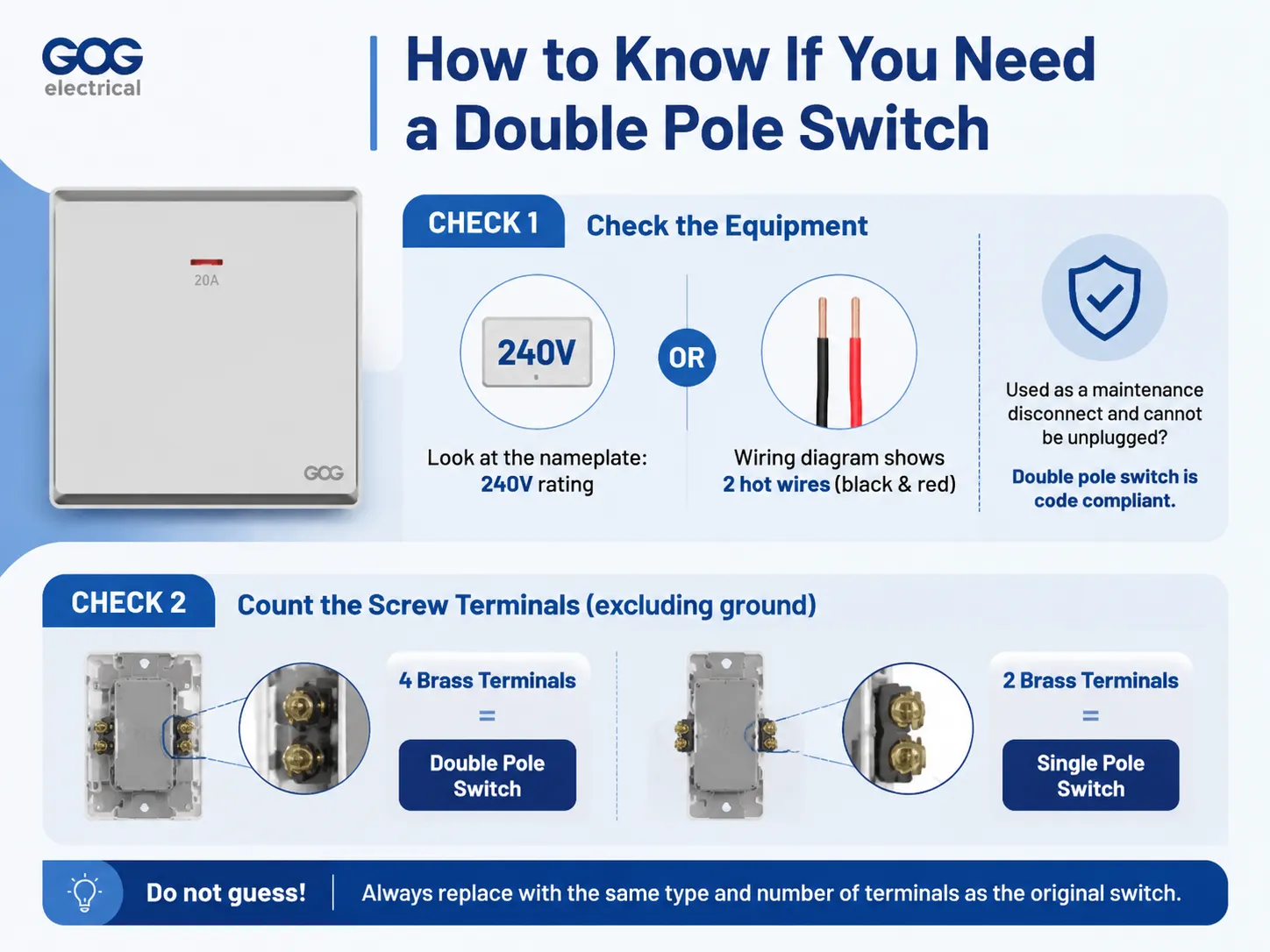
You can determine what type of switch to use by performing two checks. The first check is to look at the equipment nameplate, checking it for a voltage rating of 240V, or a wiring diagram showing 2 hot wires (usually black and red). If either one of these conditions exist you will require a double pole switch. Secondly, consider the purpose of the switch, whether it is being used as a maintenance disconnect and the equipment cannot be unplugged, a double pole switch which opens all ungrounded conductors is a code compliant option.
When replacing an existing switch, count the number of screws that are on the switch (do not count the one for the ground). If there are a total of 4 brass terminals, it is a double pole switch. If there are two brass terminals, you have a single pole switch. Do not guess – to be safe, just make sure that the replacement switch has the same number of terminals as the original switch. If the original was a double pole, so must be the replacement switch. For a broader look at how different switch types compare across the full product range, our article on different types of light switches covers everything from single pole to 3‑way to smart switches.
What a Double Pole Switch Costs
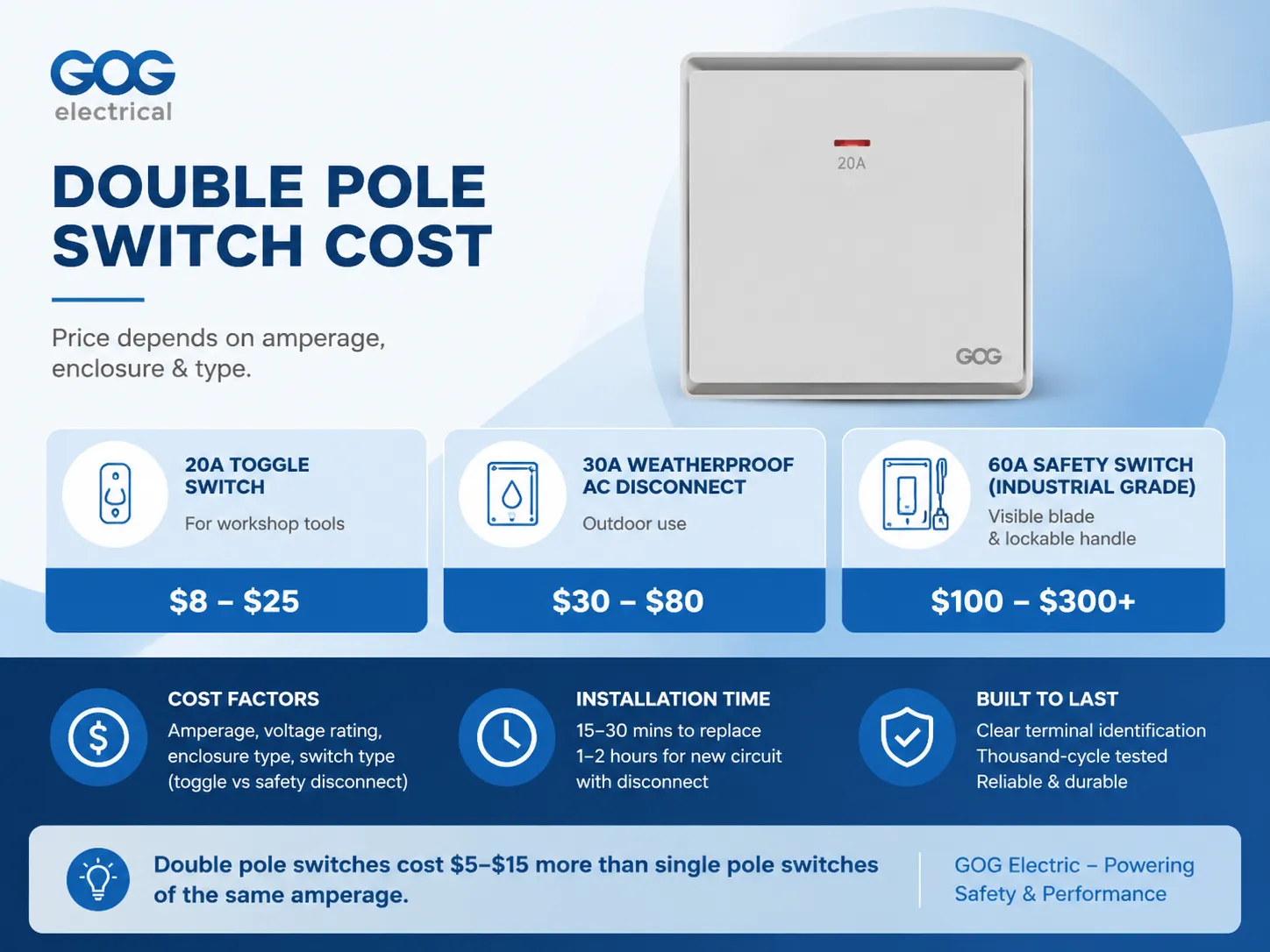
The cost of a double pole switch fluctuates according to amperage, voltage rating, enclosure type and type of switch; i.e. toggle vs heavy duty safety disconnect. A typical 20A double pole toggle switch (for workshop tools) would cost between $8 & $25, while a 30A double pole switch (in a weatherproof outdoor enclosure) would sell between $30 & $80 as an AC disconnect. An Industrial grade 60A double pole safety switch with a visible blade and lockable handle would be priced between $100 and $300+. Double pole switches generally carry a price increase of $5-$15 over single pole switches for residential/standard devices of the same amperage due to the added contact set and larger housing.
There are many factors that affect how much money will be required for installing a circuit. It typically takes between 15 and 30 minutes for a qualified electrician to replace a double pole switch, while a new circuit with a disconnect for a water heater or air conditioning unit can take one to two hours. GOG Electric supplies double pole switches rated from 20A to 60A, some weatherproof and others standard. All models have been manufactured with good terminal identification and provide long-lasting, performing contacts capable of handling thousands of cycles.
Installation and Safety: Getting It Right
Installing a double pole switch requires following the same safety procedures as other electrical work: turn off breaker, check voltage with voltage tester, and torque terminal screws to specifications. The only important difference is that two hot wires or hot and neutral in a full-isolation application need to be hooked up correctly. Incoming power (line conductors) should be connected on the terminals marked “line”; equipment (load conductors) should connect on the terminals marked “load.” The green ground screw connects to the ground wire.
Don’t ever attach a neutral wire to a double pole switch unless it has been made and labeled specifically for this purpose. In almost all 240 volt installations, the neutral wire will bypass the switch and be connected directly to the device being powered. If you do not understand the difference between a neutral and hot circuit, or if the existing wire is in disarray or has been damaged, hiring a licensed electrician to do the installation is your best option. The cost of hiring a professional to install your electrical system is very small compared to the costs associated with incorrectly wiring your electrical system.
Frequently Asked Questions
How do I know if I need a double pole switch?
Verify the voltage and quantity of conductors; if the circuit is providing 240 volts or if you need to have two hot conductors disconnected for safe maintenance purposes, then you will require a double pole switch. The equipment nameplate indicates the circuit voltage, and the wiring schematic provides the definition of the circuit’s conductor configuration.
Is a double pole switch safer?
A double pole switch removes all power from all three wires thus no live wires are left inside of the equipment (code compliant). On the other hand, a single pole switch will still have one energized wire inside of the equipment; therefore, a person thinks it is completely de-energized when in fact it is not and thus presents a fatal danger.
Can I use a double pole switch as a light switch?
In most cases, a standard wall switch for controlling 120-volt lighting can be accomplished with a single pole switch. While you may use a double pole switch and connect just one pole of the switch to turn on/off and/or dim down the lights in the circuit, adding the second pole would only waste your time and money, occupy more space in the electrical box, and confuse anyone else who might eventually open the electrical box you installed the light switch in. Using a double pole switch in this manner is not recommended except for unusual applications where total isolation from power to a light fixture is required.
Why is it called a double pole switch?
A double pole switch has two independent switches in its construction and therefore can operate two circuit independently. “Pole” refers to the fact that it properly controls two independent circuits so while it has two separate internal switches, it does not necessarily mean that these switches are creating any more than the appropriate number of circuits — the same would apply to screw terminals and toggle configuration.
Is a double pole switch the same as a breaker?
No. A dual pole switch is a manual switching device that will make and break the circuit while under load. However, it does not provide overcurrent (automatic) or short-circuit protection. A dual pole circuit breaker provides both manual switching and automatic overcurrent protection and is tested and listed for that dual function. The switch isolates; the breaker provides protection.
References
- NFPA 70 (National Electrical Code) Article 422.31 — Disconnection of Permanently Connected Appliances. National Fire Protection Association.
- UL 20 — General‑Use Snap Switches — Safety standard for AC/DC general‑use switches, including double pole configurations. UL Solutions.
- Electrical Safety Foundation International (ESFI) — Residential electrical safety guidance, including proper switch selection and installation.
A double pole switch is not a luxury or an unnecessary upgrade — it is the correct device for any circuit where two conductors must be disconnected together. Whether it’s a water heater in a utility closet, a table saw in a workshop, or an air conditioner outside the house, the switch that completely removes power is the switch that keeps the next person who services that equipment safe. GOG Electric manufactures double pole switches in the sizes and enclosure ratings that these applications demand, with the terminal clarity and contact reliability that make a critical safety device feel as straightforward as flipping a light switch.