The dimmable LED market is not new so when choosing a driver for your dimmable LED product the options available would include either wired or wired dimmer drivers not including RF control. The most common feedback from users of LED dimmers is they have the dimmer connected to their dimmable LED driver but the LED driver is flickering, buzzing and shutting off after the lamp’s full brightness has been reached. Even though users want to place the blame on the dimmer, it is important to understand that the dimmer was the initial source providing electricity to the LED driver, therefore a more expensive dimmer won’t help with this scenario, instead the goal is to find a dimmer that was designed and manufactured specifically to work with a specific type of dimmable LED driver. This manual explains the differences between how LEDs operate compared to incandescent bulbs; existing dimming technologies available; and what to consider when selecting and installing equipment and manufacturers of dimmers; how to calculate load requirements; and how to properly install dimmable LED drivers and all associated equipment.
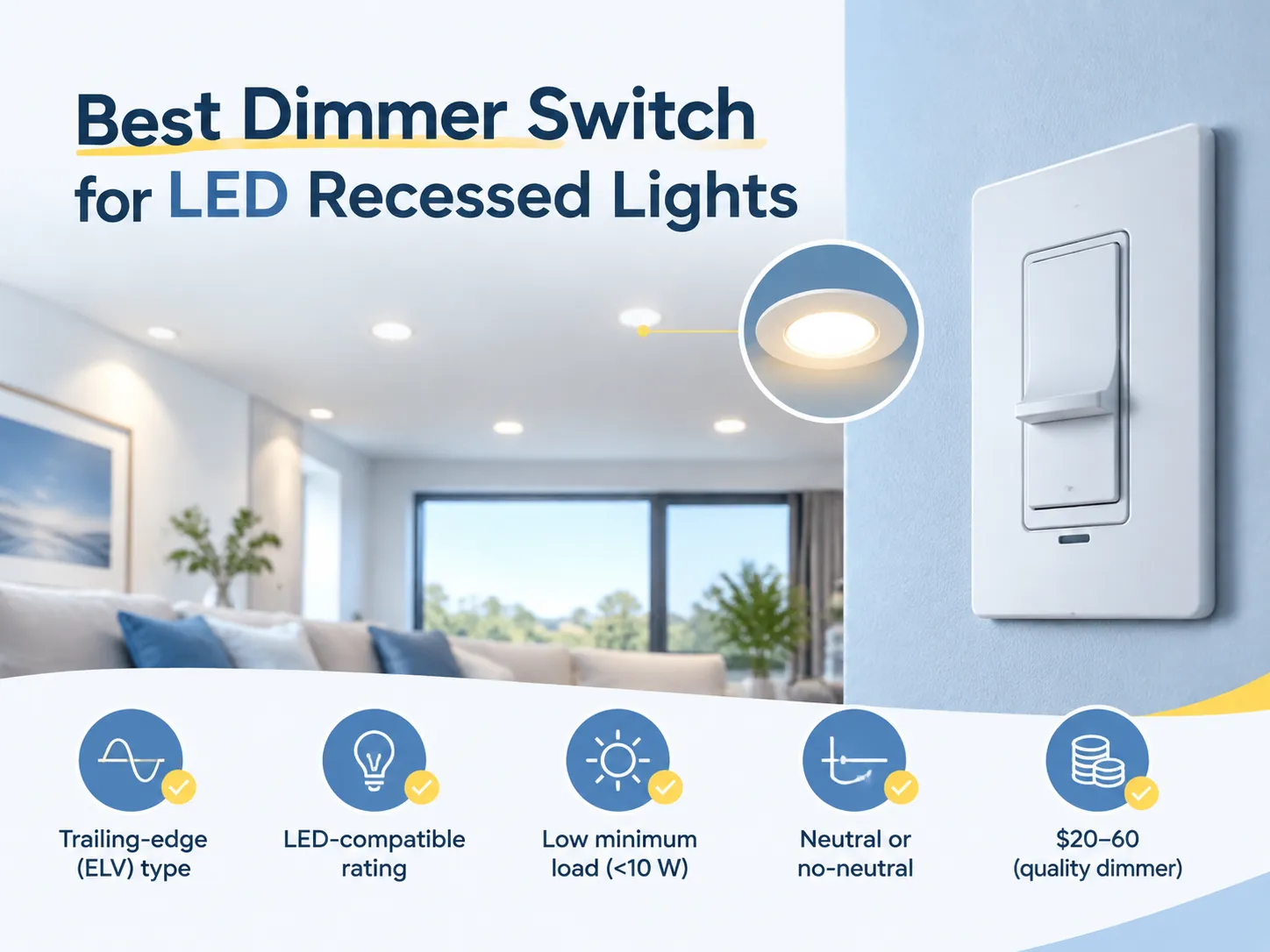
When it comes to selecting the best dimmer for LED lighting, the best option available on the market is the trailing-edge dimmer, also known as ‘ELV dimmer’ or ‘reverse phase dimmer.’ Trailing edge dimmers are superior to traditional triac (forward phase) style dimmers in the way that they produce a clean wave form signal that provides the LED drivers with a steady anti-flicker and anti-buzzing light. Therefore, the advantage to using a trailing edge dimmer is that they allow for much more dimming capability compared to the forward phase dimmers that are predominant in today’s market. Many companies manufacture LED compatible dimmers, including: Lutron, Leviton, Legrand and Eaton.
Why LED Recessed Lights Are Hard to Dim
An incandescent bulb operates on a fairly straightforward electrical concept. The resistive element in the bulb causes it to glimmer less with a drop in voltage. The dimmer circuit alters the supply wave in a simple manner so that the bulb is technically behind it in illumination levels. Hence lighting reductions with incandescent bulbs have been found to be working efficiently for a hundred years without any compatibility issues being raised.
LED downlights behave differently. A separate driver or the downlight mounting produces operation through a power supply, which transforms the current through the LED downlight into direct current. This power supply uses capacitors, a control unit and feedback to dispatch the function of keeping the LED glowing unchanged. When the dimmer switches the current on its way to the bulb, the driver only needs to process the wave applied and react.
Three types of failure may occur in this case. If the driver is unable to read the form of the wave, it will not know the front angle and will apply the wrong signal – usually represented by a small range of brightness. If the driver did learn the form but lacks the energy to keep the condensers full, it will lose its power and start blinking or flashing. Lastly, it may happen that the time of the signal causes noises from filtering done inside the driver, which may be loud enough to be audible at quite a distance.
None of this is a defect. It is two pieces of electronics designed in different eras, meeting for the first time. The resolution lies in matching the dimmer’s output characteristic to what the driver can read, and understanding which combinations work is the subject of the compatibility rules for LED dimmers.
Forward Phase vs Reverse Phase
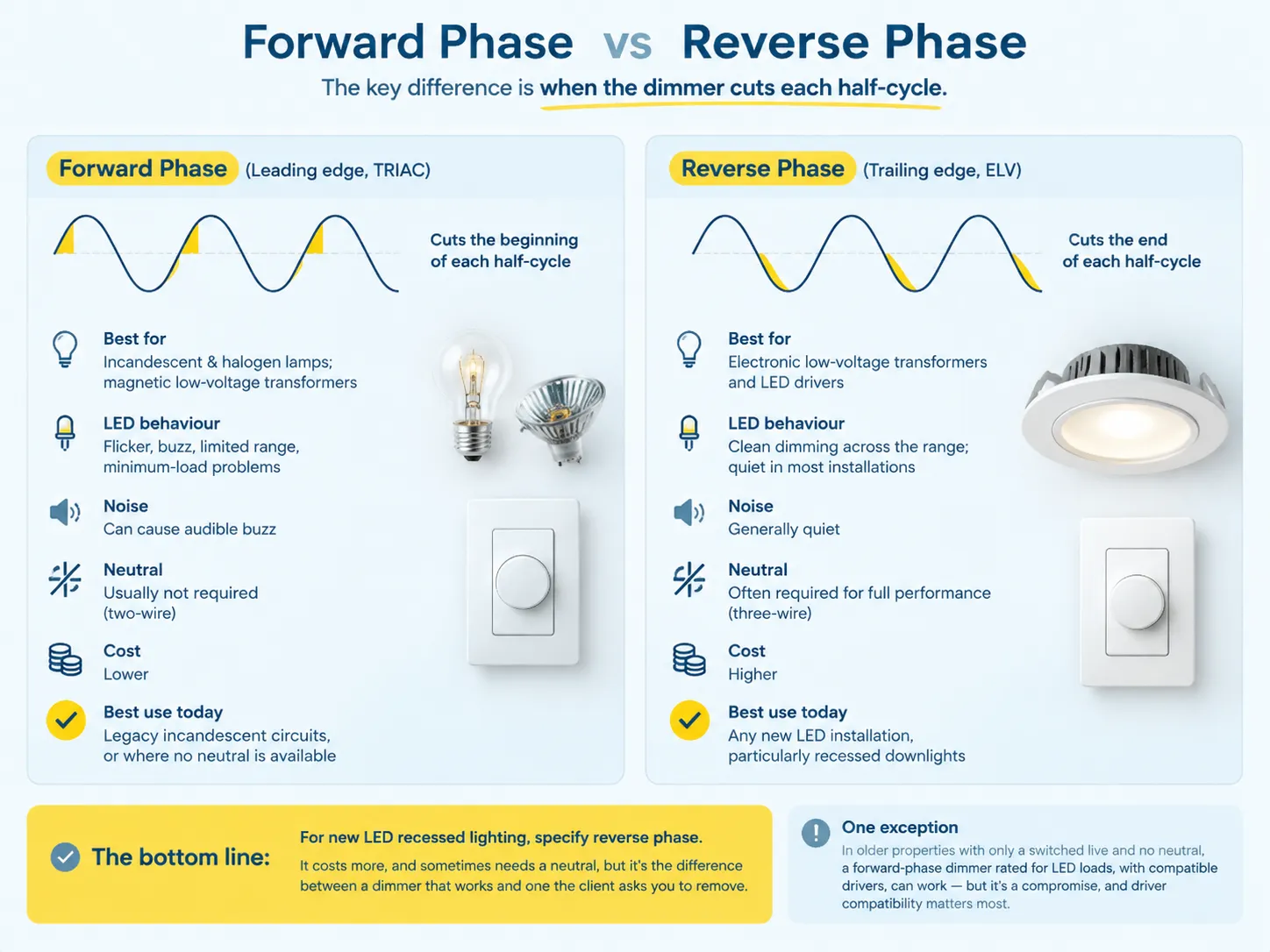
The most significant specification is the dimming style, which is contingent on the process of dimming during half-cycles.
| Forward phase (leading edge, TRIAC) | Reverse phase (trailing edge, ELV) | |
|---|---|---|
| Waveform | Cuts the beginning of each half-cycle | Cuts the end of each half-cycle |
| Designed for | Incandescent and halogen lamps; magnetic low-voltage transformers | Electronic low-voltage transformers and LED drivers |
| Behaviour with LED loads | Frequent flicker, buzz, limited dimming range, minimum-load problems | Clean dimming across the range; quiet in most installations |
| Noise | Can cause audible buzz in LED drivers and in the dimmer itself | Generally quiet |
| Neutral connection | Usually not required (two-wire) | Often required for full performance (three-wire) |
| Cost | Lower | Higher |
| Best use today | Legacy incandescent circuits, or where no neutral is available | Any new LED installation, particularly recessed downlights |
The rule is simple: when installing LED recessed lights, you should choose reverse phase. It is more expensive, and it may require a neutral in the box, but this type of dimmer is going to do its job just fine as opposed to the one you will have to take out upon client’s request.
However, there is an exception to this rule. Older residences may have the switch box only equipped with the switched live. If that is the case, installing a reverse phase dimmer may require rewiring. Then, a forward phase dimmer rated for LED loads and used with the drivers compatible with it can work. The practice here is a compromise and not the preferable choice since driver compatibility will be crucial in this case.
What a Dimmer Needs to Do
Five factors differentiate an LED dimmer that does perform from one that simply functions as a switch.
- The load type specification. The dimmer to be purchased must be rated specifically for LED loads. It is not safe to use a dimmer rated for incandescent or halogen loads, regardless of the wattage.
- The minimum load specification. This specification has probably been overlooked the most by customers. Many dimmers require a minimum load in order to work — usually 10, sometimes 25 or more. The dimmer that has a low minimum load or, better yet, states “no minimum load”, does not have this problem.
- The maximum LED load specification. Manufacturers provide different maximum values of incandescent and LED loads with the LED value usually being considerably lower. Therefore, it may happen that among the dimmers rated 400 W incandescent, there is one rated only 100 W LED.
- The neutral requirement specification. Two-wire dimmers operate on the load. That means that the customers may see that their LEDs glow faintly even when switched off. Three-wire dimmers with the neutral do not experience this, so it is important to choose the dimmer according to the presence of the neutral wire in the box.
- The dimming range specification. The good dimmer should provide smooth dimming with no dead zone at the bottom.
Recommended Types and Brands
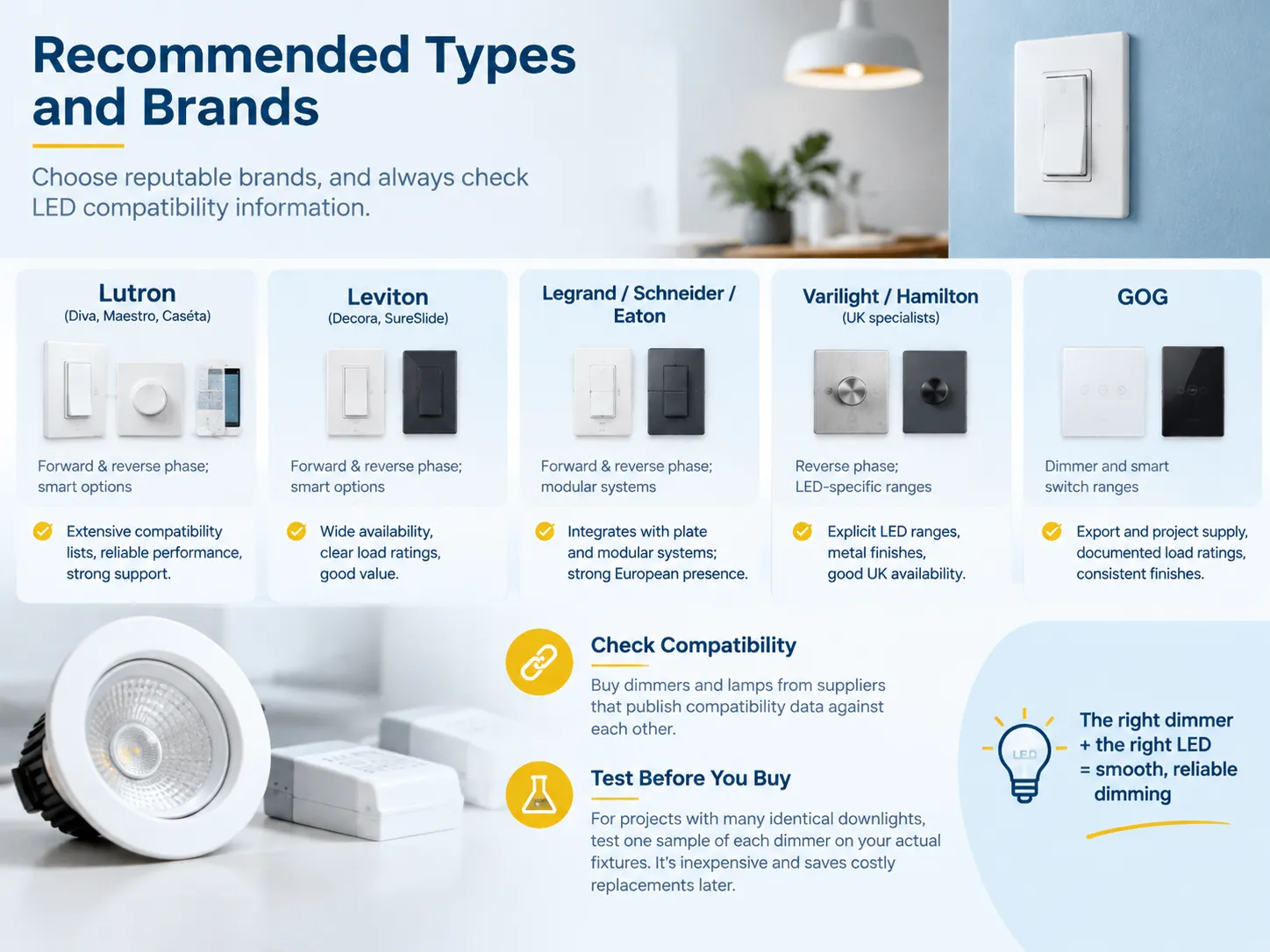
The market is segmented into established manufacturers of wiring devices with specific LED dimmer lines, smart switch manufacturers, and decorative niche brands. The respected brands disclose LED compatibility data, which is more valuable than the reputation of the brand itself.
| Brand range | Type | Strengths | Notes |
|---|---|---|---|
| Lutron (Diva, Maestro, Caséta) | Forward and reverse phase; smart options | Extensive published LED compatibility lists; reliable low-end performance; strong support documentation | The reference point for compatibility data; widely specified in North America |
| Leviton (Decora, SureSlide) | Forward and reverse phase; smart options | Broad availability, clear load ratings, good value in the mid-range | Common in retrofit and new-build residential work |
| Legrand, Schneider, Eaton | Forward and reverse phase; modular systems | Integration with plate and modular systems; strong European and commercial presence | Useful where the dimmer must match an existing plate range |
| Varilight, Hamilton, and similar UK specialists | Reverse phase, LED-specific ranges | Explicit LED dimming ranges, metal finishes, good UK availability | Strong choice for UK installations with decorative requirements |
| GOG | Dimmer and smart switch ranges | Export and project supply with documented load ratings and consistent finishes across large orders | Suits projects where several hundred matching points must be delivered |
Two useful observations about the brand choice. The first thing to consider is that by getting the dimmer and the lamps from manufacturers that supply information about their compatibility with one another, one minimizes the uncertainty; it is possible that a dimmer working well with one brand of driver may perform poorly with another. Another thing is that if there are many identical recessed lights in the project, it would be wise to buy one sample of each type of dimmers available for testing with the existent fixtures as this would imply a cost of just a few dozens of dollars instead of having to change many dimmers on that entire floor.Guidance on matching dimmer to load in practice is set out in the assessment of dimmers for LED lighting.
Gang, Load and Wattage
There are two computations that will determine if the dimmer you have picked actually works: the load and the plate configuration.
- Calculating the load: Add up the power of all of the lamps that the dimmer controls. For example, if you have ten recessed lights, each with 9 W of power, the load will be 90 W. Compare this against the dimmer’s maximum rating for LEDs, not for incandescent lamps. Then make sure it is in accordance with the dimmer’s minimum. For instance, if you have a dimmer that requires 25 W at a minimum power and only a single lamp with 9 W is used in the circuit, it will malfunction.
- Derating because of grouping: The use of multiple dimmers placed in one casing or a close warming box makes them hotter than if just one dimmer was used. All manufacturers publish grouping derating that decreases the maximum load, which is underestimated in many cases.
- Plate configuration: In essential, one plate can only apply to a certain type of a dimmer. The plate must be separated from the mechanism of this type. Thus, if the right terms are not known to the end-users, they might buy a wrong plate that is not compatible with the dimmer.
- Working circuits: In those situations when the same lights are controlled from two different points, a standard dimmer cannot replace a double pole switch since it does not have two control points.
Installation and Commissioning
While installing a dimmer is a quick task, the most important step in the process is the commissioning part.
- Electricians should make sure to shut off the electricity supply and check the circuit dead at the switch. Turning off the lights does not isolate the circuit.
- Technicians should investigate the type of conductors on the circuit. Presence of a neutral wire in the box is important, as it determines if the installation of a 2-wire or 3-wire dimmer is possible.
- Load of the circuit should be verified according to the dimmer rating on its specifications. The right connection should be made to the dimmer according to its diagram.
- Plate can be fitted and it should be ensured that the plate is level and no wires are being pinched by the plate.
- Commissioning of the dimmer takes place. If there is a trim on the dimmer, it needs to be set to the dimmest possible light setting, as this is the most important step in eliminating flickering problems.
- Dimming operation should be tested from the maximum to the minimum brightness, observing for flicker and buzzing sounds.
The wider sequence, including the safe isolation procedure and the checks to run when the existing wiring is not what the drawing suggests, is covered in the process of installing a dimmer switch. There are two further warnings about recessed LED installations: one is that the driver might be found in the ceiling space with testing implications in terms of ease of access; the other is that the sprinkling of insulation around the fittings could lead to excessive heat and subsequently prompt changes to the driver operations.
Flicker, Buzz and Minimum Load
| Symptom | Likely cause | Fix |
|---|---|---|
| Flicker at low brightness only | Driver below its minimum operating level; dimmer minimum set too low | Raise the minimum trim; if unavailable, add one more lamp to the circuit or change the dimmer |
| Flicker across the whole range | Phase mismatch — a forward-phase dimmer on a driver needing reverse phase | Change to a reverse-phase dimmer |
| Lights strobe or pulse | Driver’s capacitors not charging enough between chopped segments | Reduce lamp count per dimmer, or use a dimmer with a higher minimum-load rating compatible with the driver |
| Audible buzz from the dimmer | Lamp or driver filament/inductor responding to the chopped waveform | Switch to reverse phase; verify the load is within the LED rating |
| Lights glow faintly when off | Two-wire dimmer drawing its supply through the load | Fit a three-wire dimmer with a neutral connection |
| Dead zone at the bottom of the dial | Driver’s minimum dimming threshold | Set the dimmer’s minimum trim to match, or accept a higher floor |
| Dimmer hot to the touch | Load exceeds the LED rating, or grouping derating ignored | Reduce the load per dimmer or split the circuit |
It can be seen that nearly all the issues mentioned above arise from the same three reasons, whether it is because the phase type is wrong, the load falls outside the dimmer’s LED rating or the minimum level was never commissioned. So it is clear that all three are related to specification problems and not to equipment failures.
What Dimming Actually Buys You
It is important to understand the reason behind the importance of dimming because it is perceived as a decorative function whereas in reality it fulfills many more roles. Less light means less energy consumed and the reduction of energy consumption is more than proportional compared with less light in practice — the reduction of energy by 50% in a dimming LED means much more than half the drop in energy consumption. The lifespan of the light is also increased because lower current results in lower operating temperature while the main cause of wear of the LED is heat. And we can achieve possibility of using the same area for different purposes — the same room can serve as a bright working space during the day and a dimly lit place during the night thus not requiring additional circuits and fixtures.The broader case, including the control strategies that extend beyond simple dimming, is set out in the practical advantages of dimming switches.
Prices
Dimming is a cost-effective improvement when we compare it to the installation itself because switching from a bad to a quality dimmer is purely insignificant compared to replacing its whole system.
| Product | Indicative price | Notes |
|---|---|---|
| Basic forward-phase dimmer | $8-20 / £5-15 | Not recommended for LED loads unless explicitly LED-rated |
| Reverse-phase LED dimmer, quality brand | $20-60 / £15-45 | The sensible default for recessed LED downlights |
| Multi-location dimmer with companions | $40-90 / £30-70 per point | Cost multiplies by the number of control positions |
| Smart dimmer (Wi-Fi, Zigbee, no-neutral options) | $40-120 / £35-90 | Adds platform dependency and often a hub |
| Commercial 0-10 V or DALI control | $60-250 per channel | Justified where scenes, scheduling or central control are required |
| Installation labour | $60-150 / £45-110 per point | Higher where no neutral must be run to the switch box |
In comparison to the figures stated above, the costs associated with making wrong decisions tend to be underestimated. Replacing faulty dimmers which blink across a dozen pendant lamps and repairing walls after this process is a lot more expensive than buying a decent reverse-phase dimmer for each circuit.
FAQ
What is the best dimmer switch for LED recessed lights?
A reverse phase or ELV dimmer specifically designed for LED loads should boast the low minimum load and adjustable minimum brightness trim. The reverse phase technology produces output waveform with high enough quality for LED drivers to interpret it perfectly and eliminate, thus, most flicker and buzzin. Ensure that the load is within the parameter of the dimmer’s LED rating rather than its incandescent rating, as well as check if there is the neutral wire in the switch box, as three-wire dimmers work better and do not lead to the faint light that may appear with two-wire ones. Companies that have public data on LED compatibility are the least risky choice.
Do I need a special dimmer switch for LED lights?
It is true in most instances. Dimmers specifically made for incandescent and halogen lighting utilize a forward-phase control type that can’t be properly understood by most LED drivers which leads to flicker, buzzing, strobing, or a very small range of operability. An LED dimmer comes with an appropriate output mechanism at its core and also has the load specifications for LED light sources that is usually much lower than those for incandescent lamps. Although dimmers are excellent with traditional lamps, they shouldn’t be used for LEDs unless they are explicitly marked as being designed for that purpose.
What type of dimmer switch is best for LED lights?
Reverse phase, also known as trailing edge or ELV, is the optimal type of dimmer for LED applications, especially in recessed ceiling lights where many drivers are used on the same circuit. Instead of cutting off the power at the starting point of each half-cycle, reverse phase dimmers cut the electricity at the end of each half-cycle, making it ideal for the electronic drivers used in LED luminaires. Forward-phase dimmers can also be used for existing incandescent lighting circuits and in applications where there is no neutral line available; however, in this case it is essential to check compatibility between the dimmer and the driver from manufacturer’s list.
What wattage dimmer switch do I need for LED lights?
To begin the process of using a dimmer for LED lighting, total wattage must be determined and then compared to the LED maximum rating of the dimmer, rather than the incandescent. The total wattage is very specific—is 90 W in the case of 10 LEDs of 9 W each and is acceptable to a dimmer rated for 100 W LED load, but not to one rated for 75 W LED load. Consider the other end of the spectrum; many dimmers specify the minimum load, which can be as low as 10 W or 25 W, making the circuit with 1 or 2 lamps be less than that or malfunctioning. Select a dimmer with a very low minimum or no minimum at all or one with the minimum adjustable during installation/commissioning and apply derating multiplication factor for multiple dimmers in the same enclosure/group.
Why do my LED lights still flicker after fitting a dimmer?
Three problems mainly contribute to issues people experience. The first one is a phase mismatch when a dimmer of a forward phase is used with a driver that works in a reverse one. In this case, the first thing to do is to change a dimmer type. The second issue is having a load below the dimmer’s minimum. This typically leads to flickering only at low brightness and can be resolved by either increasing the minimum trim of the dimmer, adding a lamp to the line, or choosing a dimmer with a lower minimum. The third issue is the case when the driver does not draw enough current to charge its capacitors between segments that are chopped and normally requires fewer types of lamps connected to the dimmer or a different dimming model. It usually takes only a few minutes to test a dimmer candidate to check how it works with lamps.
References
- International Electrotechnical Commission — IEC 60669-2-1 Switches for Household Installations, Electronic Dimming
- NEMA — Wiring Devices and Dimmer Load Rating Standards
- UL Solutions — UL 1472 Solid-State Dimming Controls
- U.S. Department of Energy — LED Lighting and Dimming Performance Guidance
- BSI — BS EN 60669-2-1 Requirements for Electronic Dimming Switches
Conclusion
Certain things need to be taken into consideration when purchasing an LED recessed lighting dimmer. First, the voltage of the dimming signal needs to be compatible with the voltage of the driver it is going to connect to. The dimming signal for recessed LED recessed lighting is typically a trailing edge or reverse phase signal. Second, you need to determine if the dimmer you are purchasing is an LED dimmer or an incandescent only dimmer. The efficiency of the dimmer is greatly affected by the total wattage of all powered LEDs, in comparison to the minimum wattage passed through the dimmer. When installing the dimmer into your home I recommend to place the three-way switch at the junction box where the neutral wire is located, as it will make the installation process less complicated. If there is no neutral wire present, make sure to use a forward-phase dimmer. Just make sure that the forward-phase dimmer works with recessed LED fixtures as well.