
Power Plugs & Sockets of the Ireland – Type G, Adapter Needed?
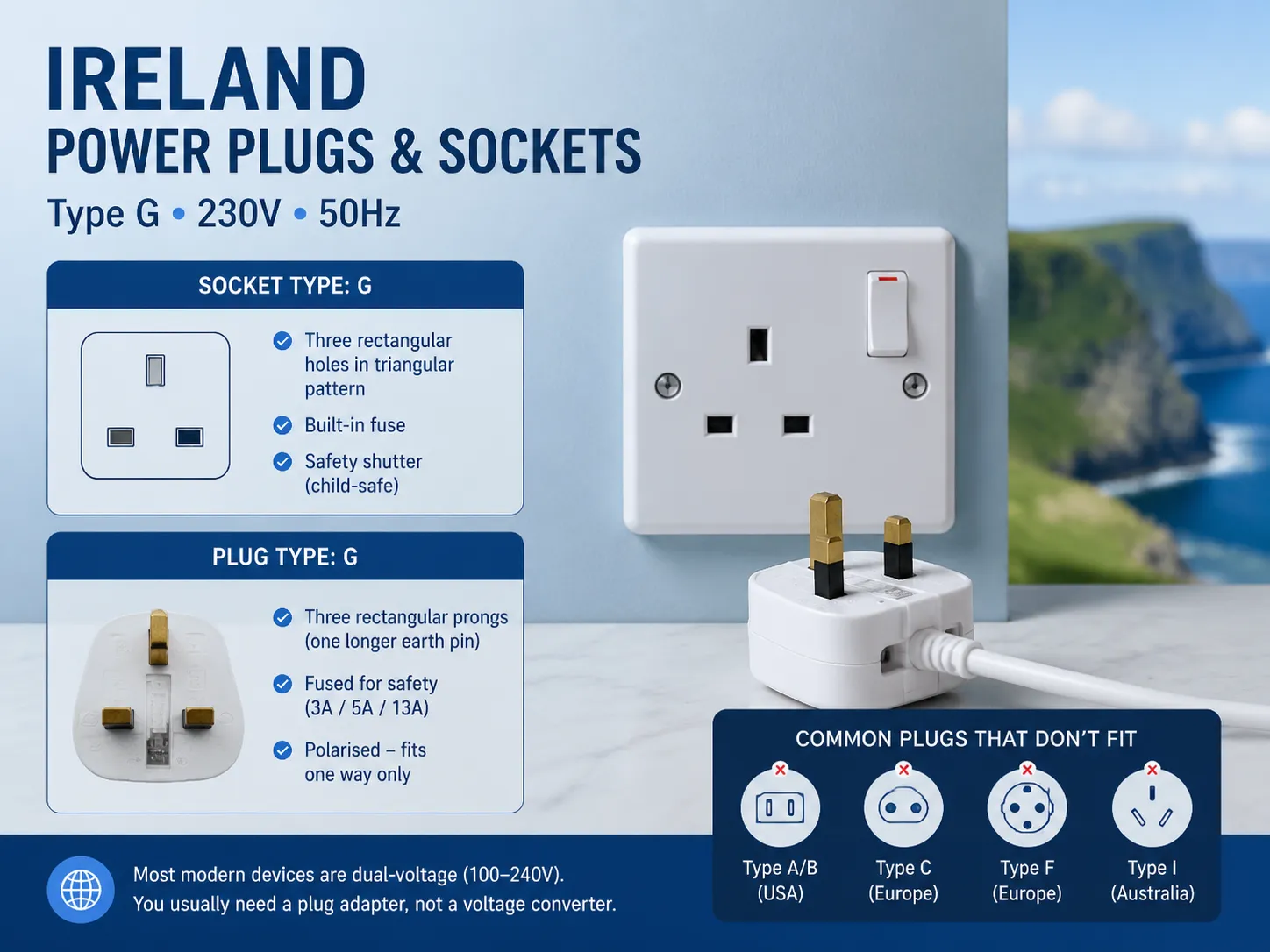
If you are traveling to the Emerald Isle, one of the first considerations is whether your electronics will function properly. Ireland has a unique plug and socket design that varies from the majority of Europe and North America. This guide will go over all the information regarding Ireland’s power plugs, socket types, voltage and frequency as well as sound advice on what types of travel adapters and voltage converters you may need. We have even answered some of the most frequently asked questions by travellers concerning Ireland’s electrical systems, including those you may have been curious about as well.
Ireland Electric Socket Type
In the Republic of Ireland (as well as in Northern Ireland; the UK system) the standard official wall socket (aka power outlet or receptacle) is a Type G socket, which will again be similar to that of the United Kingdom (similar but not identical).
- Type G built‑in fuses for devices that use a three rectangular pins as a socket variety. The device accepts a plug that has three rectangular prongs in a triangular configuration. To protect children, the device includes an aperture mechanism that will not open unless the longest pin is inserted – this safety feature is also referred to as a shutter system.
Type G is the only standard for electrical sockets found in Irish homes and hotels due to the differences between the electrical systems used by the United States (Types A and B) and the countries in Continental Europe (Types C and F). The only place you will find these types of plugs is either in a hotel or modern building using Type G. Be sure to bring the correct adapter for your appliance; otherwise, it may not work properly.
Ireland Plug Type
Ireland has a single common plug; it is known as Type G, or sometimes as the British plug; its features are as follows:
- Three rectangular prongs – one vertical earth pin (longer), two horizontal live and neutral pins.
- Internal fuse for safety, often rated at 3A, 5A, or 13A depending on the appliance.
- Polarised design – the plug only fits one way.
To use a device with a plug from the United States (flat prongs), Europe (round prongs), or Australia (slanted prongs) in Ireland, the device will not physically fit into the socket unless you use a plug converter. In addition, the majority of today’s electronics (cell phone chargers, laptops, cameras) are dual voltage, so generally you will only need a simple travel plug adapter and not a voltage transformer.
Pro tip: Verify your device’s power specifications. If they state “100-240V, 50/60Hz”, you may safely utilize your device in Ireland, with just a plug converter, otherwise, you will want to use a voltage step down converter.
Voltage and Frequency in Ireland
Ireland uses 230 volts and 50 Hz frequency – identical to the UK, Europe, Australia and most other countries around the world.
People who travel to another country needing to use their appliances should use a voltage converter. Most modern electronic devices can use either 110 volts or 220 volts; however, if you are bringing an appliance from the U.S., Canada, or Japan (where voltage is 100-120 volts), the voltage will be 220 volts, and therefore you will need a step-down transformer to change the voltage. But, as we’ve discussed earlier, most modern electronic devices can function with only an adapter plug.
Note that there may be different frequency ranges of operations (i.e., 50Hz or 60Hz) can cause a problem with some motors or clock applications, but for most charging systems or power supplies, it does not matter.
Do I Need a Travel Adapter for Ireland?
Yes, unless your device already has a Type G (UK-style) plug. Here’s a quick breakdown by region:
- From the UK or Ireland? → No adapter needed – your plugs are identical.
- From the US, Canada, Mexico, or Japan? → You need a Type G plug adapter (and possibly a voltage converter for non‑dual‑voltage devices).
- From continental Europe (Type C/F)? → You need a Type G adapter – round pins won’t fit.
- From Australia/New Zealand (Type I)? → You need a Type G adapter.
- From any other country? → Most likely you’ll need a universal adapter with Type G output.
A universal travel adapter with a Type G socket is highly recommended, because it can be used not only in England but also Singapore, Hong Kong and some other parts of the world. This makes it an excellent item to bring along if you travel frequently.
Frequently Asked Questions (FAQ)
What adapter do I need for Ireland from the USA?
To convert your US flat pin plug Type A or B into an Irish rect. type G plug, you need an adapter which you can pick up for a few dollars. If your device isn’t dual voltage (look at the label) then you’ll also need a step-down converter to go from 230V – 110 – 120.
Are UK and Irish plugs the same?
Yes, completely. The Republic of Ireland and the United Kingdom have the same type of plug and socket (Type G). The voltage, frequency, and pin configuration are all identical between the two systems; therefore, any UK plug will fit into an Irish outlet without needing an adaptor, and vice versa.
Do I need a voltage adapter for Ireland?
Your equipment will determine how you charge it. If your device can accept both 100-240 volts (for example, most laptop and phone chargers), all you need is an international plug converter. If your device can only accept one voltage (for example, the voltage on your older electronics or hair dryer will always be 110-120) than you will need to acquire an international plug or appliance that has appropriate heads/plug adapters plus a step-down transformer to reduce the power from 230 to 120 volt. Check the power rating – if it states “230 volts”, you must have a step-down transformer.
Can I charge my iPhone in Ireland without a converter?
Absolutely. Your iPhone from Apple will include a dual-voltage (100 to 240 volts, 50 to 60 hertz) USB power adapter. To charge your device in Ireland, you’ll require a plug adapter with the G socket type. If an adapter of this type is utilized, no other voltage converter is necessary; this would apply to all modern tablets, smartphones and laptops too!
Can I use my European hair dryer in Ireland?
In Ireland, hairdryers from Europe generally operate at 240 – 220 volts; therefore, it is appropriate to use them with regard to the voltage issue, but because of the different plug shapes, you must obtain a type G adapter to fit the plug into the outlet. Do keep in mind, however, that the power rating can be different between appliances; therefore, European appliances will work with a type G adapter so long as they have been made for use at 230 volts. So, when using a US hair dryer (110V), there should be no risk of burning up as long as a voltage converter is used.
Are USB charging ports available in Irish hotels?
Today in Ireland, most new hotels and bed-and-breakfast establishments provide their guests with USB-A and USB-C outlets for charging devices, either via bedside lamps, desks or wall sockets. Still, if you have multiple devices to charge at night or during your stay in a hotel, it is wise to bring an external USB charging hub with you (Type G).
Travel Tips for Using Electronics in Ireland
- Pack a universal adapter with Type G – this single adapter will work in Ireland, the UK, and many other countries.
- Check voltage labels When packing your appliance, it is important to examine the back of the product for voltage specifications before packing them in your suitcase/box. If they do not specify “100-240V,” they can stay home or you’ll have to buy an adapter.
- Bring a power bank – critical for extended day trips, particularly while out and about on the Cliffs of Moher or Ring of Kerry where it may not be possible to find an outlet.
- Hotel sockets – The majority of hotels have at least one Type G socket, although some B&Bs without modern electrical systems may only offer limited sockets. A compact power strip with a Type G connector may save your life!
- Adapter vs. converter – remember: adapter changes the plug shape; converter changes the voltage. Don’t confuse them.
- Emergency preparation – keep a paper copy of your itinerary and a map in case your phone battery dies.
Summary
So basically, Ireland uses Type G plugs and operates on 230V/50Hz, like the UK. People travelling from the UK or Ireland will be able to plug in and use their appliances directly without an adapter. Visitors from the US, different parts of Europe, Australia, and most other countries will have to buy or bring a Type G plug adaptor to convert their appliances over to work within Ireland’s electrical system. With regards to the dual-voltage (most current products) you do not need anything but a plug adapter to make your appliances work; however, if your device runs only at 110-120V then you will require a voltage converter. The important thing is after preparing/researching everything, you should be able to charge your devices while on your Irish holiday/adventure, and not worry about any problems with your electronics.
Safe travels and slán abhaile (safe home)!