

France Electrical Outlet – Type E, Adapter Needed?
France – the land of romance, fine cuisine, and iconic landmarks. But when it comes to electricity, France has its own distinct standard. The country uses a Type E socket, which is similar to but not identical to the German Type F. This guide covers everything about French power plugs, socket types, voltage, and frequency, plus clear advice on adapters and converters. We’ve answered the most common traveller questions, including the specific ones you’ve asked.
France Electric Socket Type
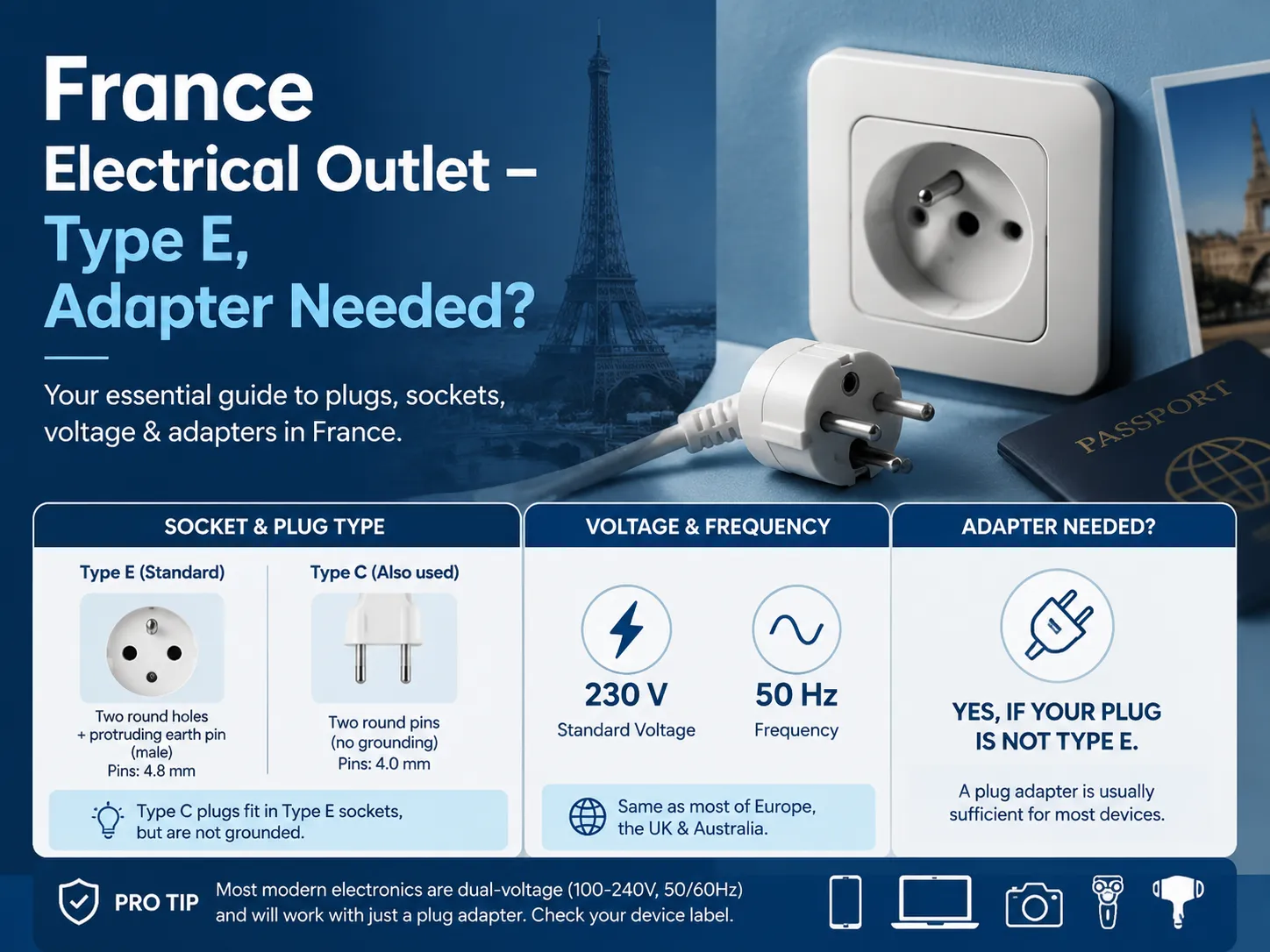
In France, the common wall socket (also known as a power outlet or receptacle) is Type E. This socket has two round pins (like the Europlugs) but additionally, features a male earth pin that is part of the socket. This differs from Type F (Schuko), which has grounding clips on the sides of the plug.
- Type E: There are two circular pins (4.8 mm) for the live and neutral connection with the addition of a male earth pin which protrudes from the plug. The socket is designed to accommodate the plug.
- Type C: Two round pins that are 4.0 mm in diameter and without a grounding system still remain in older electrical installations but are seen less often now.
French sockets are polarized, therefore they have defined connectivity between neutral and live, but most appliances manufactured lately are not affected. The socket has a recess and the safety obturator. This shutter opens only when the grounding pin is inserted.
Comparing the situation of the UK (type G) and North America (Type A/B), the French electrical system has a commonality with those found in Belgium, Poland, the Czech Republic, and Slovakia. Nevertheless, it doesn’t completely fit with the German Type F sockets (even though a lot of plugs can be used with them).
France Plug Type
The plug types used in France are:
- Plug Type E – two pins shaped the same way as with C, but with a female earth contact (for the socket’s earth pin). The pins measure 4.8 mm across, which is thicker than Europlug.
- Plug Type C – two round pins (4.0 mm) – ungrounded, fits into Type E sockets but does not connect to earth.
The majority of appliances sold in France feature Type E plugs. While devices equipped with Europlugs (Type C) might fit into Type E sockets physically, they do not offer the grounding feature. It is advisable to utilize a Type E plug for devices with higher power.
Pro tip: French outlets can accept Type C and Type F plugs (with a few exceptions). It is worth noting that the Type E sockets have a protruding earth pin, which may cause inconvenience for equipment featuring flat plugs. A simple universal adapter with European pins can be employed.
Voltage and Frequency in France
France uses a standard voltage of 230 V and a frequency of 50 Hz which is also found in the UK, mainland Europe, and Australia.
Residents of North America (120V) and Japan (100V) cannot use their appliances that are not designed to operate on dual voltage unless they have a step down converter. Many modern technological gadgets, such as cell phones, laptops, and tablets are dual voltage rated from 100V to 240V, which assures that a simple plug adapter will work. Look for a label that mentions “INPUT: 100 to 240 volts, 50 or 60 Hz.”
The frequency difference (50Hz vs 60Hz) may affect motors, but for chargers, it’s irrelevant.
Do I Need a Travel Adapter for France?
Yes – unless your device already has a Type E or C plug. The table below gives a quick overview for travellers from different regions.
| Your Country / Region | Your Plug Type | Need Adapter for France? | Voltage Compatibility |
|---|---|---|---|
| USA / Canada | Type A/B (120V) | ✅ Yes – need Type E adapter | ⚠️ 120V vs 230V – need converter for non‑dual‑voltage |
| UK / Ireland | Type G (230V) | ✅ Yes – need Type E adapter | ✅ Voltage compatible – adapter only |
| Germany / Type F countries | Type F (230V) | ⚠️ Maybe – Type F plugs often fit Type E sockets, but not always due to the earth pin. Often works but not guaranteed. | ✅ Voltage compatible – adapter only if needed |
| Europe (Type C) | Type C (230V) | ❌ No – Type C fits directly into Type E sockets (ungrounded). | ✅ Voltage compatible – no adapter needed |
| Australia / New Zealand | Type I (230V) | ✅ Yes – need Type E adapter | ✅ Voltage compatible – adapter only |
| Japan | Type A/B (100V) | ✅ Yes – need Type E adapter | ⚠️ 100V vs 230V – need converter for non‑dual‑voltage |
| China | Type A, C, I (220V) | ✅ Yes – need Type E adapter (if using A or I) | ✅ Voltage close – adapter only |
| India | Type D/M (230V) | ✅ Yes – need Type E adapter | ✅ Voltage compatible – adapter only |
Key takeaway: The Type of socket used in France is Type E. If you own a Type C (or Europlug) item or gadget made for the European market, you do not have to use an adapter. However, if you do not use one is required for your device, voltage will determine the type of adapter you will need to use.
We advise using a travel adapter with universal use which has pins that can cover type E,F and C plugs.
Frequently Asked Questions (FAQ)
What plug adapter do I need for France?
You’ll require a Type E plug adapter which is characterized by its dual round prongs (4.8 mm) and its female grounding component on the side for receiving the earth pin of socket. A majority of universal plug sockets contain Type E’s specifications in their system.
Does France use Type C or E?
France adopts Type E as its official plug. While Type C plugs can fit into Type E sockets, they have no ground connection. Older buildings may still be equipped with Type C sockets, but Type E is the prevailing standard.
What countries use the same plug as France?
The Type E standard of France is shared by Belgium, Poland, Czech Republic, Slovakia, and a part of Morocco and Tunisia. Further, Type E power plugs can also fit into Type F (Germany) sockets in some situations, but with limitations.
Are Type C and F plugs interchangeable?
Partially. The Type C (Europlug) consists of a pair of round pins (4.0 mm) and is compatible with both Type E and Type F sockets but does not include a ground connection. The Type F connector (Schuko) has a pair of round pins (4.8 mm), and is designed to fit Type F sockets, but may not be suitable to fit E sockets due to earth pin length. Nevertheless, a number of devices can be used in both configurations. Therefore, a Type E adapter would be the best option for France.
Can I use my UK hairdryer in France?
The voltage of hairdryers in the United Kingdom is 230V which is compatible however the plug (Type G) will not fit in and one requires a Type G-to-E adapter. If you have a hairdryer from the USA (120V), you will require both a converter and an adapter.
Are USB ports common in French hotels?
Today’s hotels usually have USB ports available, particularly in urban settings. However, they can often be missing in smaller B&Bs or vintage hotel facilities. Consider carrying a charger with a Type E plug.
Travel Tips for Using Electronics in France
- Pack a Type E adapter – even if you have a Europlug, having an adapter ensures grounding for high‑power devices.
- Check voltage labels – most devices are dual‑voltage, but always verify.
- Bring a power bank – useful for long days exploring Paris or the countryside.
- Voltage spikes – in rural areas, voltage can be unstable; a surge protector is advisable.
- Hotel outlets – often near the floor; an extension cord can be handy.
- Adapter vs. converter – know the difference.
Summary
France relies on Type E power sockets operating at 230V/50Hz. People traveling to France from European countries using Type C or F plugs may not require the use of add-ons (although there may be potential grounding issue). Visitors from all parts of the world, including the UK, US, and Australia, will need to get additional power sockets with Type E connectors. Regarding power issues, travelers with devices operating at varying voltages will be fine. It is crucial to be prepared ahead of time to truly enjoy everything France has to offer.
Safe travels and happy charging!