

India Electrical Outlet – Type D/M, Adapter Needed?
India, known for its colorful and chaotic setting and remarkable diversity, also has a unique electricity system. Type D plug socket (in certain cases Type M plug is used) is the peculiar Indian socket type. Therefore, if you are going to visit India, it’s better to know what kind of power plugs, sockets and their specifications you will face.
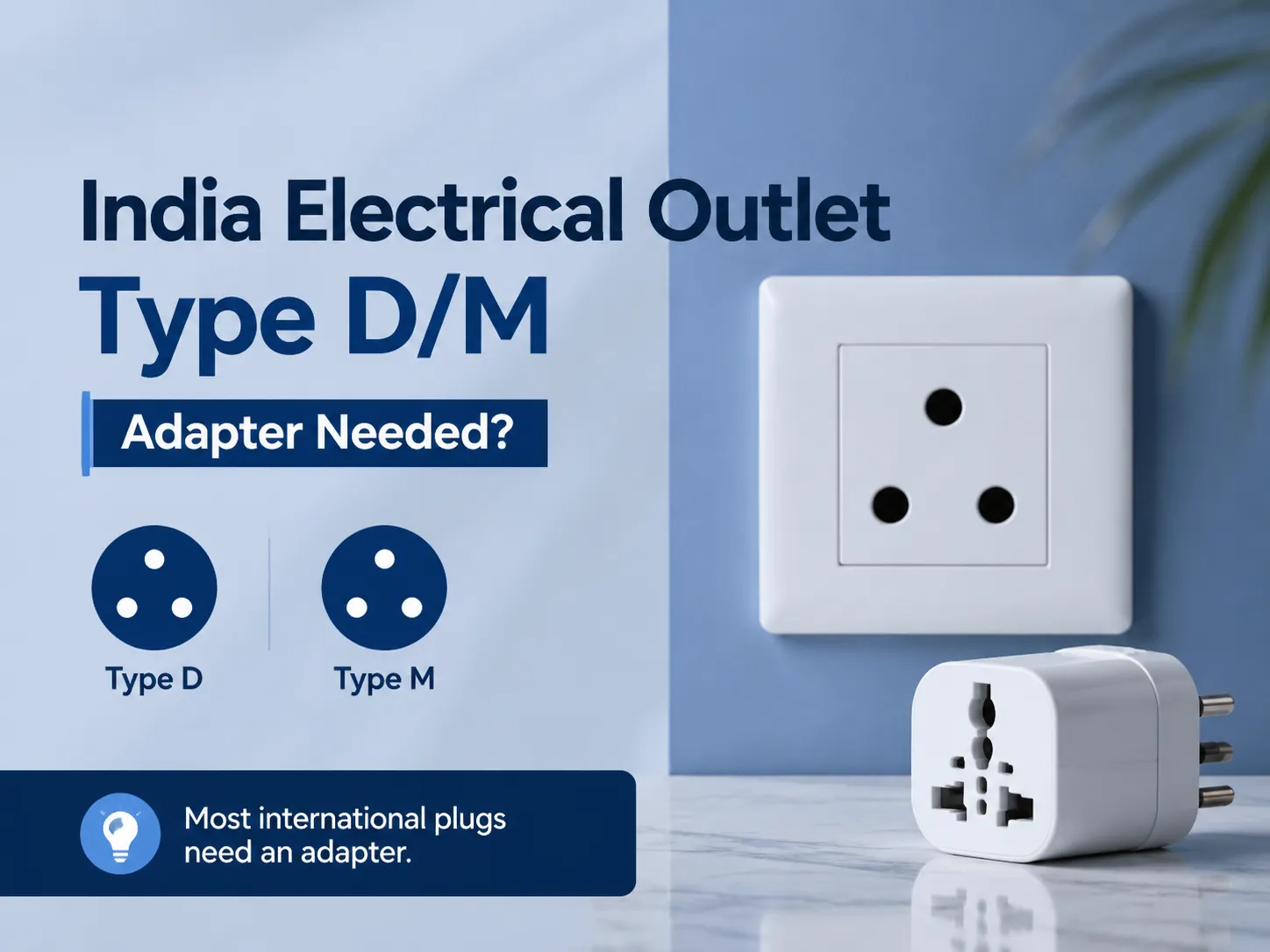
India Electric Socket Type
Officially classified as Type D (a power outlet or wall socket) in India, the standard wall socket features three circular pins arranged in a triangular formation, the earth pin being the biggest. You might also find Type M sockets (with thicker pins) in some newly built constructions and occasionally Type C sockets (having two pins) in economically priced hotels.
- Type D – There are three round pins (the earth pin is thicker), with a current capacity of 5 A. Historically, they have been the standard type and there are still in common use.
- Type M – similar but with larger pins, rated at 15 amps. Increasingly used for high‑power appliances.
- Type C – two round pins (Europlug), found in some older sockets, but not reliable.
A lot of sockets in India are universal – they can accept Type D, M and, in some cases, Type C plugs – but this differs. In the countryside, you are likely to see only Type D sockets. The socket is usually recessed and comes with a safety shutter that only opens after the earth pin has been inserted.
Different from the United Kingdom (Type G) or Europe (Type C/F), the main plug used in India, which is also used in countries such as Nepal, Sri Lanka, and Namibia. Therefore, it is almost obligate for those who travel internationally to have an adapter.
India Plug Type
The plug types you’ll encounter in India are:
- Plug Type D There are three round pins in total: one big pin for earth connection and two live/neutral pins which are smaller in size. The size of live/neutral pins is 4.5 mm in diameter which for earth pin its size is 7.1 mm in diameter.
- Plug Type M – The same layout with larger pins (7.1 mm live/neutral and 8.6 mm earth) is employed in heavier appliances.
- Plug Type C – two round pins (4.0 mm) – may fit some sockets but lacks grounding.
Your device’s Europlug (Type C) could go into an Indian socket if that socket happens to accept universal plug – but it will be without grounding and protected by a safety shutter. In order to be completely compatible, a Type D/M adapter is highly recommended.
Pro tip: In India, electrical outlets frequently feature holes designed for the insertion of plugs using Type D and Type M configurations. Nonetheless, it is advisable to carry a Type D adapter with you as that is a low-cost item and ensures that you can fit the plug anywhere.
Voltage and Frequency in India
Under normal conditions, the electricity comes in the form of standard voltage. The voltage in India is 230 Volts, plus or minus 10% (range of 220-240 Volts). The frequency of electricity in India is 50 Hertz which is similar to that found in the UK, Europe, Australia and some parts of Asia.
If you live in North America (120V) or Japan (100V), you will need a step-down converter for your electrical appliances. But nowadays, most gadgets (such as mobile phones, laptops, and tablets) normally work on dual voltage (100 to 240 volts), and you only need a plug adaptor. Check your device and look for the label “INPUT: 100-240V, 50/60Hz.”
The standard frequency is 50Hz in Europe and Asia while for US and Canada, it is 60Hz, but it doesn’t matter for chargers.
Do I Need a Travel Adapter for India?
Yes – almost certainly. The table below gives a quick overview for travellers from different regions.
| Your Country / Region | Your Plug Type | Need Adapter for India? | Voltage Compatibility |
|---|---|---|---|
| USA / Canada | Type A/B (120V) | ✅ Yes – need Type D/M adapter | ⚠️ 120V vs 230V – need converter for non‑dual‑voltage |
| UK / Ireland | Type G (230V) | ✅ Yes – need Type D/M adapter | ✅ Voltage compatible – adapter only |
| Europe (Type C/F) | Type C/F (230V) | ✅ Yes – need Type D/M adapter (even if C fits some, not reliable) | ✅ Voltage compatible – adapter only |
| Australia / New Zealand | Type I (230V) | ✅ Yes – need Type D/M adapter | ✅ Voltage compatible – adapter only |
| Japan | Type A/B (100V) | ✅ Yes – need Type D/M adapter | ⚠️ 100V vs 230V – need converter for non‑dual‑voltage |
| China | Type A, C, I (220V) | ✅ Yes – need Type D/M adapter (if not using C) | ✅ Voltage close – adapter only |
| South Africa | Type M (230V) | ⚠️ Maybe – Type M is larger than Type D. Some sockets accept M, but not all. A Type D adapter is safer. | ✅ Voltage compatible – adapter only |
Key takeaway: India relies on the use of Type D (and Type M) plugs. Many travelers require an adapter for a Type D plug. When it comes to voltage considerations, as long as you come from a 230V area, then you only need to get the right adapter. If you come from a region with 120V, you need to verify that your appliance has dual-voltage capabilities.
We suggest using a global travel adaptor with pins of type D/M since they often have replaceable heads that fit India, the USA, Europe, and the UK.
Frequently Asked Questions (FAQ)
What plug type is used in India?
India has Type D (with three round pins and larger earth pin) as the main type, and Type M is being used more frequently for heavy duty devices. Type C can be found as well but only works in a few situations. Always bring Type D plug adapter with you.
Do I need an adaptor US to India?
Yes – US plugs with flat pins belonging to the Type A/B category cannot be used in sockets available in India. Type D plug adapters (or universally useful which includes type D) are required. Furthermore, voltage should also be kept in mind, as devices in the US operate on 120 volts. Make sure that your device works on dual voltage or you would require a converter as well.
What plug adapter do I need for India?
You require a Type D plug adapter which features three round pins with a larger earth pin. Certain adapters are able to fit both Type D and Type M plugs, making an even better choice. The ideal choice is a universal adapter equipped with interchangeable pins.
Are India and Europe plugs the same?
No. The Type of plugs used in Europe is Type C/F (with or without side clips). The plug type in India is Type D/M (which has three round pins and a bigger earth pin). As there are differences in the plugs, it is likely that the europlug might be able to fit into some universal sockets in India, but it is not guaranteed, and it also does not have grounding; therefore, one must always use Type D adapter.
Can I use my UK hairdryer in India?
Hairdryers in the UK operate at 230V, making them voltage compatible. The plug used is of type G, meaning you’ll need a type G-to-D adapter to use it for your US hairdryer (which requires 120V).
Are USB ports common in Indian hotels?
It is true that in major cities and expensive hotels, one can find USB ports rather commonly. However, that is not the case with cheap hotels, homestays and areas far away from cities as these places usually do not provide USB ports. Therefore, it is a good idea to obtain a multi-port USB charger with Type D plug.
Travel Tips for Using Electronics in India
- Carry a Type D adapter – it’s small, cheap, and essential.
- Check voltage labels – most modern devices are dual‑voltage, but always verify.
- Bring a power bank – essential for long train journeys or power cuts, which are common in some areas.
- Voltage fluctuations – The voltage may be inconsistent in older building or countryside; hence, it is suggested to get a surge protector for sensitive appliances.
- Hotel outlets – often near the floor or desk; bring an extension cord if you need bedside charging.
- Adapter vs. converter – adapter = shape, converter = voltage. Know the difference.
Summary
In India, the electrical systems are organized around Type D/M sockets that work with an electric current of 230V/50Hz. Travellers from the UK, Europe, Australia and other places where an electric current of 230V is used will just need an adapter of Type D. Travellers from North America and Japan will need an adapter and the converter because their devices do not run either on dual voltage or voltage. In the vast majority of cases, the electronic devices of modern time are capable of handling dual voltage, so using an adapter will be sufficient. If properly prepared, you will enjoy this wonderful travelling experience in India.
Safe travels and happy charging!