

Power Plugs & Sockets of China – Type A/C/I, Adapter Needed?
China is a vast and fascinating country, but its electrical system can be confusing for travellers. The country uses a mix of plug types – primarily Type A (US-style two-pin), Type C (Euro-style two-pin), and Type I (Australian-style three-pin) – depending on the region and building age. This guide covers everything about the china power plug, including china plug point configurations, the ac plug in china standard, what a power connector china looks like, china wall socket types, and which chinese electric socket adapter you need. We’ve also answered the most common traveller questions about Chinese power outlets.
China Electric Socket Type – What Standard?
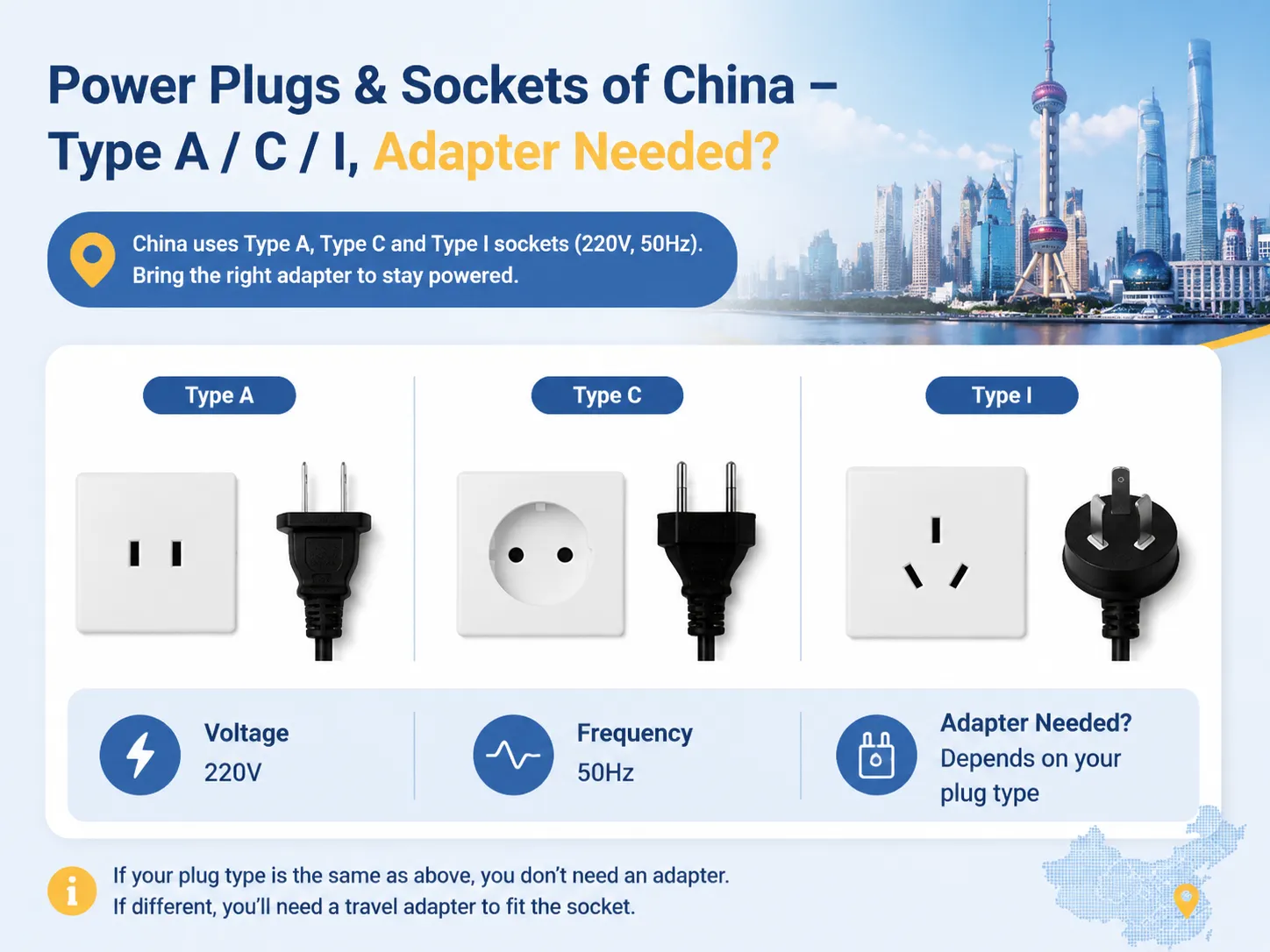
Instead, there is no uniform socket standards in China and thus it possesses multiple sockets categories. The typical varieties of white wall sockets in China are:
- Type A (US-style) – two flat parallel pins, ungrounded. This is common in older buildings and for low‑power devices.
- Type C (Euro-style) – two round pins, ungrounded. Widely used in modern construction and for many appliances.
- Type I (Australian-style) – three flat pins and one earth pin in a V‑formation. It is the accepted Chinese standard (GB 1002) of grounded connectors and is becoming more widely used in recent constructions.
Numerous outlets throughout China are able to accommodate the Type A and C plugs as well as occasionally the Type I plug. Nonetheless, it is still recommended to double-check when traveling across the country, particularly in rural regions and old hotels.
China has a mixed system of electrical outlets, as opposed to the UK, which uses Type G outlets, or Europe, where Type F outlets are used. Thus, if you are coming from the US with a Type A plug, it will fit in many outlets but not all, especially if the outlet has a recessed design or is designed for Type C only. A good safety measure is taking along a universal adaptor.
China Plug Type – What Does a China Power Plug Look Like?
A china power plug can take several forms, depending on the device and region:
- Type A plug – two flat parallel blades (like the US). No earth pin. Used for small electronics.
- Type C plug – two round pins (like the Europlug). No earth pin. Used for many chargers and small appliances.
- Type I plug – This is done through the use of 3 flat pins, two of which are angled (Live/Neutral) and the last one being vertical (Earth). The Chinese Standard used is known as GB 1002.
The United States plug (Type A) fits into the Type A socket but not the Type C socket. Conversely, the European plug (Type C) fits perfectly in the Type C socket, but it doesn’t work in the Type A socket. Devices that utilize Type I only fit into Type I sockets. Because of this peculiar situation, universal adapters to accommodate flat pins and round pins are a necessity when traveling to China.
Pro tip: A multitude of contemporary plug sockets in China are noted for being “universal” in that they accommodate both the plug’s flat pins and rounded pins; however, this is not assured. Thus, don’t forget to carry a small universal travel plug adapter which will work with Type A, Type C plugs at a minimum, and Type I adapter if available.
Voltage and Frequency in China
The standard voltage in China is 220 volts (with a margin of error of 220-240 volts) and the frequency is 50 Hz, which is the same as the majority of Europe, Asia and Australia.
If you are from North America (120V) or Japan (100V), you will require a step down converter as your appliances are not dual voltage (from 220V to 120V). For most of modern electronic devices, they are dual voltage (100-240V, 50/60Hz) and need only a plug adapter.
According to the fact, you will need a converter for devices that only work in 120 V like hairdryers and electric razors. In fact, many travelers prefer buying cheap local electronics.
Do I Need a Travel Adapter for China?
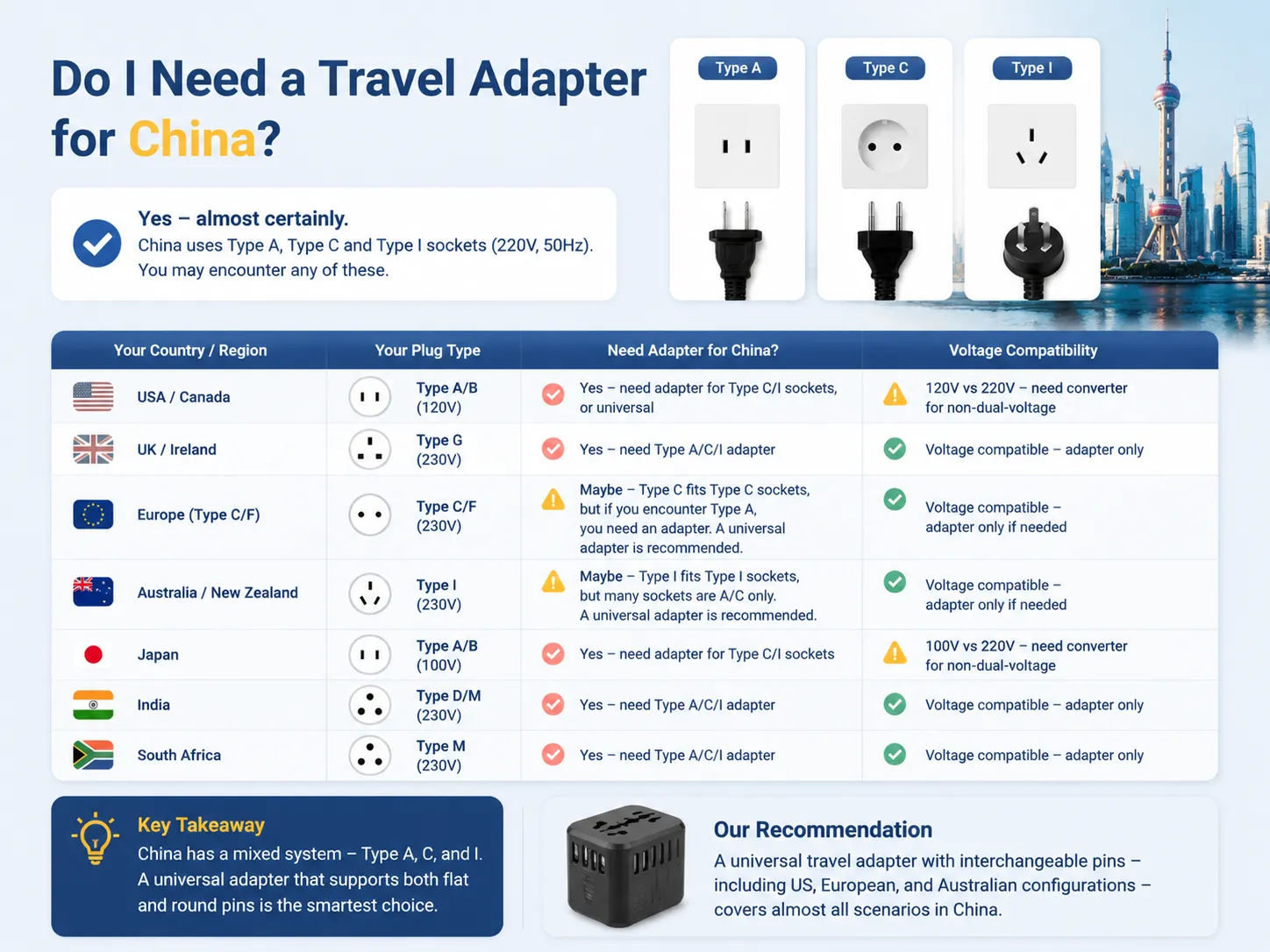
Yes – almost certainly. Even if your plug matches one type, you may encounter another. The table below gives a quick overview for travellers from different regions.
| Your Country / Region | Your Plug Type | Need Adapter for China? | Voltage Compatibility |
|---|---|---|---|
| USA / Canada | Type A/B (120V) | ✅ Yes – need adapter for Type C/I sockets, or universal | ⚠️ 120V vs 220V – need converter for non‑dual‑voltage |
| UK / Ireland | Type G (230V) | ✅ Yes – need Type A/C/I adapter | ✅ Voltage compatible – adapter only |
| Europe (Type C/F) | Type C/F (230V) | ⚠️ Maybe – Type C fits Type C sockets, but if you encounter Type A, you need an adapter. A universal adapter is recommended. | ✅ Voltage compatible – adapter only if needed |
| Australia / New Zealand | Type I (230V) | ⚠️ Maybe – Type I fits Type I sockets, but many sockets are A/C only. A universal adapter is recommended. | ✅ Voltage compatible – adapter only if needed |
| Japan | Type A/B (100V) | ✅ Yes – need adapter for Type C/I sockets | ⚠️ 100V vs 220V – need converter for non‑dual‑voltage |
| India | Type D/M (230V) | ✅ Yes – need Type A/C/I adapter | ✅ Voltage compatible – adapter only |
| South Africa | Type M (230V) | ✅ Yes – need Type A/C/I adapter | ✅ Voltage compatible – adapter only |
Key takeaway: China employs a hybrid plug system whereby plug types A, C, and I can all be found throughout the country. Therefore, the best solution is to use a universal plug adapter that can accept both types of plug pins. When dealing with voltage, if you are coming in from a country with an electrical system of 220-240V only an adapter is needed. If you are coming from a 120V area it is advisable to confirm whether your appliances are dual voltage.
For traveling purposes in China, having a global travel adapter can prove to be very beneficial. Look out for travel adapters that can have pins changed based on the countries being visited. One should definitely have a global travel adapter for use in China.
Frequently Asked Questions (FAQ)
Which plug type is used in China?
There are different types of plugs used in China and they include type A which has two flat pins, type C which has two rounded pins, and type I which has three flat pins arranged in a V shape. Type I is the standard grounded type plug used officially.
What does a China plug look like?
The power plug in China might be classified as Type A which has two flat parallel blades, Type C which has two round pins, or Type I with three flat pins given that two pins are in an angled position, while one is vertical. Sockets are different and accept different types of plugs.
Does China use 120 or 240V?
In China, the standard electrical voltage used is 220V, and the frequency utilized is 50Hz.
Are China adapters the same as US?
No. Though the Type A plugs are used in both countries, the power supply voltages are different (220V compared to 120V). Moreover, the Chinese sockets might also accept types C and I plugs, which are not standards in the US. Essentially, you need an adapter for China, unless your appliance’s plug is compatible with the socket.
What plug sockets are used in China?
The typical wall socket in China accepts different types of plugs including the type A that is characterized by flat pins and type C with round pins. There are also sockets that can accommodate type I with three pins. Most times, we see wall sockets that consist of two vertical flat slots and two round openings, or a single opening that accepts both types of plugs.
What wall plug do I need for China?
You are required to have a universal plug adapter that can work on Type A (flat pins), Type C (round pins), and preferably Type I (three‑pin) as well. A universal plug adapter that has US, European and Australian plugs is the best option.
Do I need a plug adapter for China from the USA?
Yes American plugs (Types A and B) do not work in all outlets in China. While a plug of Type A goes in a Type A outlet, several outlets utilized in China use Type C, which is circular, or Type I outlets. Therefore, one needs a universal adaptor that works with all types of plugs. Checking the voltage is also important.
What is the difference between US socket and Chinese socket?
The United States utilizes Type A/B sockets characterized by flat pins and an operating voltage of 120 volts while the Chinese utilize Type A, C, or I sockets that can take flat, round or both pins. The power supply voltage in China is 220 volts, which is twice the voltage in the US. Therefore, the socket may appear differently and has a different working voltage.
Travel Tips for Using Electronics in China
- Carry a universal adapter – one that covers Type A, C, and I (US/Euro/Australian) is ideal.
- Check voltage labels – look for “100‑240V” to know you only need an adapter.
- Power banks are essential – especially for long train journeys or days without easy access to sockets.
- Voltage fluctuations – Voltages in older buildings may not always be stable, and thus, using surge protectors to protect delicate equipment is advisable.
- Hotel outlets – Generally placed low, by the desk or on the floor. Have a power strip ready so you can power up more than one gadget at the same time.
- Adapter vs. converter – remember: adapter = shape, converter = voltage. Don’t confuse them.
Summary
In China, the electrical socket system comprises Type A, C, and I with a voltage of 220 volts and a frequency of 50 Hertz. Travellers from countries in the UK, Europe, and Australia, which use the same voltages, will need a universal travelling plug adapter to connect devices with either flat-pin or round-pin plugs. Travellers from the US, Canada, and Japan, where the standard voltage is 120 volts, will need a universal adapter and a voltage converter for appliances that do not support dual-voltage. Most electrical equipment in use these days supports dual voltage however; thus, a normal plug adapter is frequently sufficient. Travellers can make good use of their chance to stay powered while travelling throughout China by planning ahead.