

Power Plugs & Sockets of Sri Lanka – Type D/G, Adapter Needed?
Sri Lanka is a tropical paradise – from the golden beaches of the south coast to the lush tea plantations of the hill country. But before you plug in your devices, you’ll need to understand the local electrical system, which blends two British-influenced standards. This guide covers everything you need to know about power outlets in Sri Lanka, including plug shapes, voltage, frequency, and which adapter you’ll need. We’ve also answered the most common traveller questions about Sri Lankan power outlets.
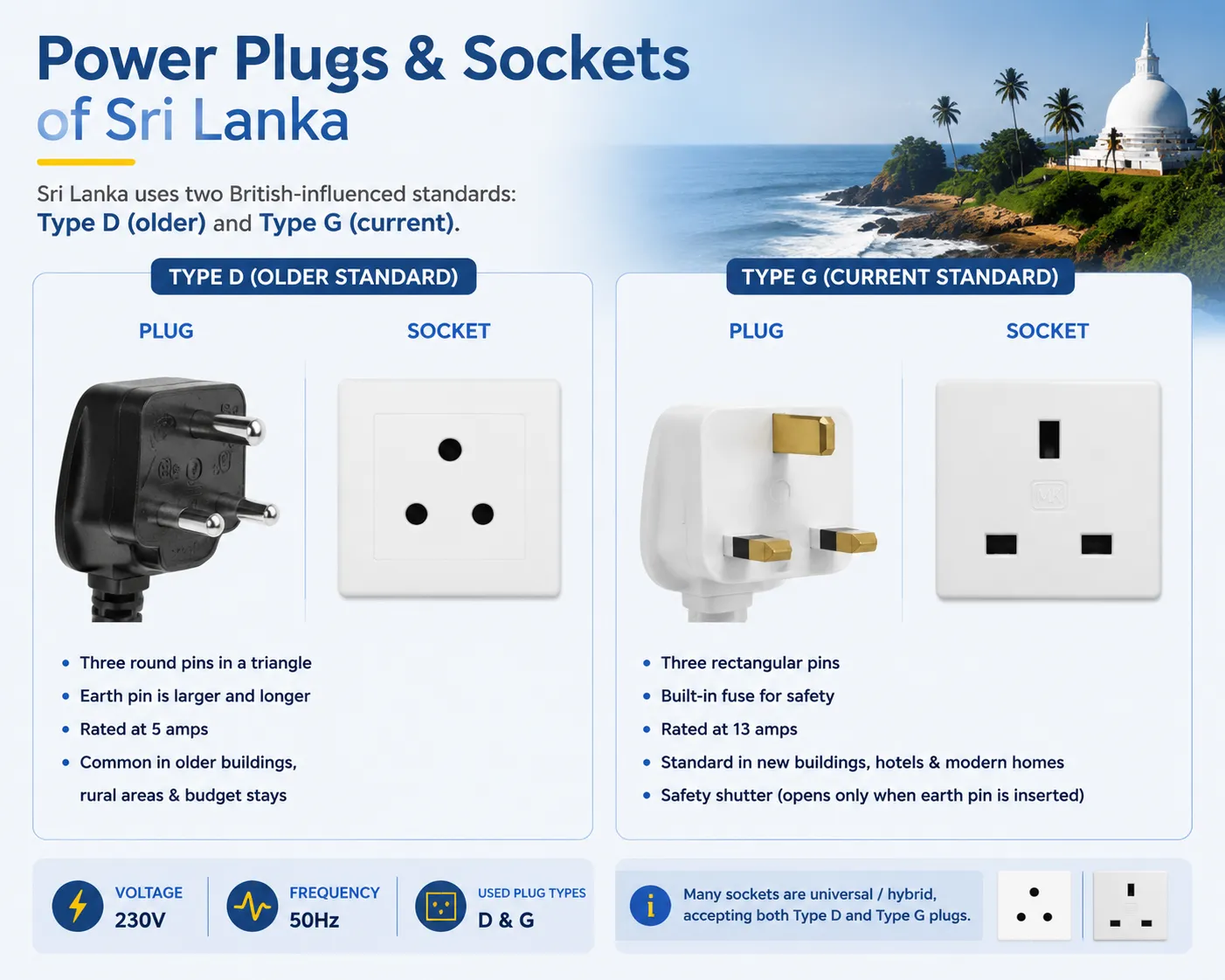
Sri Lanka Plug Point – Two Standards in Use
You may see a Type D (old British standard) or Type G (new British standard) Sri Lanka plug point. Both types are used in buildings, depending on the age and location of the building.
Type D – The Old British Standard
- Three round pins arranged in a triangle.
- The earth pin is larger and longer than the live and neutral pins.
- Rated at 5 amps – typically used for lighting and small appliances.
- Still common in older buildings, rural areas, and budget accommodations.
- Being gradually phased out in favour of Type G.
Type G – The Current British Standard
- The arrangement comprises three rectangular pins which consists of one vertical earth pin located at the upper end while two live/neutral pins are positioned at the bottom.
- Built‑in fuse for safety (typically 3A, 5A, or 13A).
- Rated at 13 amps – used for all modern appliances.
- Becoming the standard in new buildings, hotels, and modern homes.
- Features a safety shutter that only opens when the earth pin is inserted.
Most sri lanka wall socket installations in newer hotels and guesthouses are Type G. However, you’ll often find sockets that accept both Type D and Type G plugs – these are called universal or hybrid sockets. In older or more remote areas, you may encounter only Type D sockets.
Sri Lanka Power Plug – What Does It Look Like?
A sri lanka power plug can be one of two shapes, depending on the device’s origin:
- Type D plug – three circular pins (earth is broader). Used in antiquated equipment and devices in India, Nepal, and some African nations.
- Type G plug – The use of three rectangular pins equipped with an integrated fuse is a feature available in contemporary appliances manufactured in the UK, Ireland, Malaysia, Singapore, and Hong Kong.
A UK plug (Type G) can fit straight into a majority of modern Sri Lankan sockets without requiring any adapter. However, if you carry a European plug (Type C), a US plug (Type A/B), or an Australian plug (Type I), you will require an adapter since they cannot be connected with Type D or Type G sockets.
Pro tip: Type G sockets are available in most of the contemporary hotels in Sri Lanka. Moreover, numerous places also have universal outlet converters for American as well as European plugs. Nonetheless, it’s a prudent idea to carry along a universal travel adapter compatible with both type D and type G.
Voltage and Frequency
In Sri Lanka, a voltage of 230 V (with a tolerance of 220-240V) is applied and the frequency is 50 Hz. The voltage requirement is identical to that of the UK, Europe, Australia, and most of Asia.
In the event that you reside in North America (120V) or Japan (100V), you will not be able to operate your appliances that are not dual voltage without the use of a step down converter (230V to 120V). The majority of the newer electronic devices (cellphones, laptops, tablets) are dual voltage (100-240V, 50/60Hz) and will only require a plug adaptor to work. Check if the label states “Input: 100-240V, 50/60Hz.”
Do I Need a Travel Adapter for Sri Lanka?
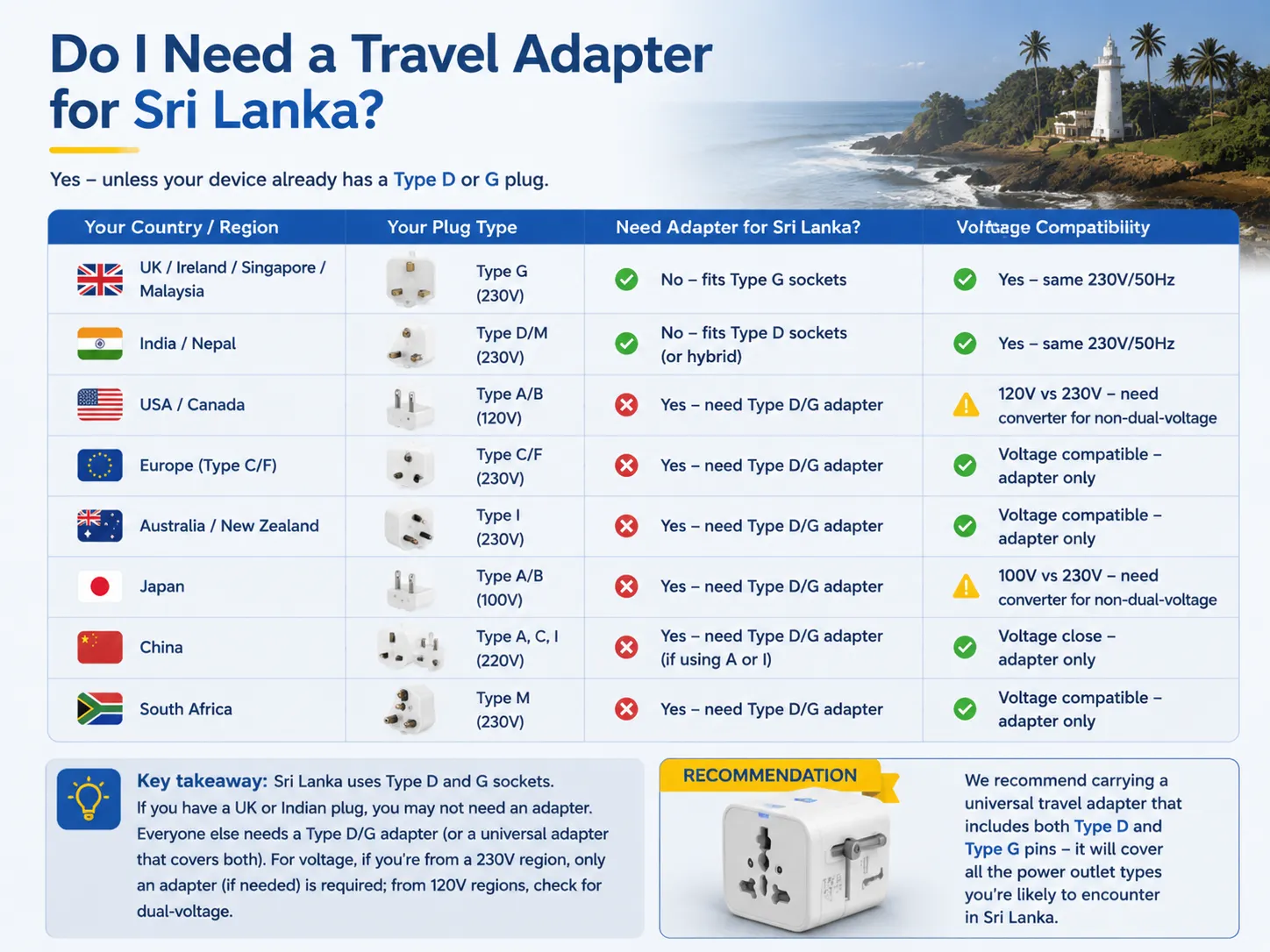
Yes – unless your device already has a Type D or G plug. The table below gives a quick overview for travellers from different regions.
| Your Country / Region | Your Plug Type | Need Adapter for Sri Lanka? | Voltage Compatibility |
|---|---|---|---|
| UK / Ireland / Singapore / Malaysia | Type G (230V) | ❌ No – fits Type G sockets | ✅ Yes – same 230V/50Hz |
| India / Nepal | Type D/M (230V) | ❌ No – fits Type D sockets (or hybrid) | ✅ Yes – same 230V/50Hz |
| USA / Canada | Type A/B (120V) | ✅ Yes – need Type D/G adapter | ⚠️ 120V vs 230V – need converter for non‑dual‑voltage |
| Europe (Type C/F) | Type C/F (230V) | ✅ Yes – need Type D/G adapter | ✅ Voltage compatible – adapter only |
| Australia / New Zealand | Type I (230V) | ✅ Yes – need Type D/G adapter | ✅ Voltage compatible – adapter only |
| Japan | Type A/B (100V) | ✅ Yes – need Type D/G adapter | ⚠️ 100V vs 230V – need converter for non‑dual‑voltage |
| China | Type A, C, I (220V) | ✅ Yes – need Type D/G adapter (if using A or I) | ✅ Voltage close – adapter only |
| South Africa | Type M (230V) | ✅ Yes – need Type D/G adapter | ✅ Voltage compatible – adapter only |
Key takeaway: Sockets of types D and G are in use in Sri Lanka. Travelers from the UK or India may not have to purchase additional plug adapters, as they can use their appliances straight away. All other travelers must carry a type D/G adapter, or, if necessary, a universal adapter. Voltage requirements are simple to follow, as all visitors from regions with voltages of 230V would only need an adapter. It is, however, important for travelers from areas with 120V current supply to check if their appliances are dual voltage.
We advise you to travel with a universal adapter that has both Type D and Type G pins; it will fit all the power outlets you will find in Sri Lanka.
Frequently Asked Questions (FAQ)
What plug is used in Sri Lanka?
Type D (three round pins, obsolete British standard) and Type G (three rectangular pins, modern British standard) are used in Sri Lanka. Type G is increasingly popular in current constructions.
What connector is used in Sri Lanka?
The prevalent power outlet in Sri Lanka is Type G, which is equivalent to the one in the UK. However, Type D is used in older buildings. It is advisable to have a universal adapter, which includes both types of connection.
Should I bring a power strip to Sri Lanka?
Yes, a power strip can be very useful. It is common for Sri Lankan outlets to be sparse, having only one or two for the entire room. The use of a compact surge protector and the Type G plug will help you power multiple devices effectively. In case you are from the US, check if your power strip has a support for 230V or is dual voltage.
What converter do I need for Sri Lanka?
In the event that your equipment is not dual voltage (that is, it only works with 120 volts), a step down converter is necessary (to convert the 230 volts to 120 volts). Luckily, most modern gadgets (smartphones, laptops, tablets) are dual voltage so that all they need is a plug adapter. You can check the specification of your device and confirm whether it needs a converter by looking at the writing “INPUT: 100-240V, 50/60Hz”.
Are plugs in Sri Lanka the same as Australia?
No. Australia employs type I, which consists of three flat pins arranged in a V shape. Sri Lanka employs type D (round pins) and type G (flat pins). They are incompatible, and you will need an adapter to plug an Australian device to a socket in Sri Lanka.
Travel Tips for Using Electronics in Sri Lanka
- Pack a universal adapter – one that covers both Type D (round pins) and Type G (rectangular pins).
- Check voltage labels – most devices are dual‑voltage, but always verify before plugging in.
- Bring a power bank – essential for long train journeys or day trips exploring the hill country.
- Voltage stability – The power supply in Sri Lanka is usually safe with very few fluctuations. It is advisable to use voltage surges to protect sensitive electronics.
- Hotel outlets – often located near the floor or desk; an extension cord or power strip can be very handy.
- Adapter vs. converter – remember: adapter changes shape; converter changes voltage. Don’t confuse them.
Summary
The voltage and sockets used in Sri Lanka are 230V/50Hz, Type D and Type G, respectively. Travellers from the UK and India will generally be able to plug in their appliances/chargers directly since they will have G and D-type plugs, respectively. Travellers coming from Europe, USA, Australia, Japan, and various other places will have to use a D/G plug adapter (in addition to using a voltage converter for non-dual-voltage appliances). Most of the gadgets now are dual-voltage gadgets, and so the adapter may be the only thing you need to prepare for.