
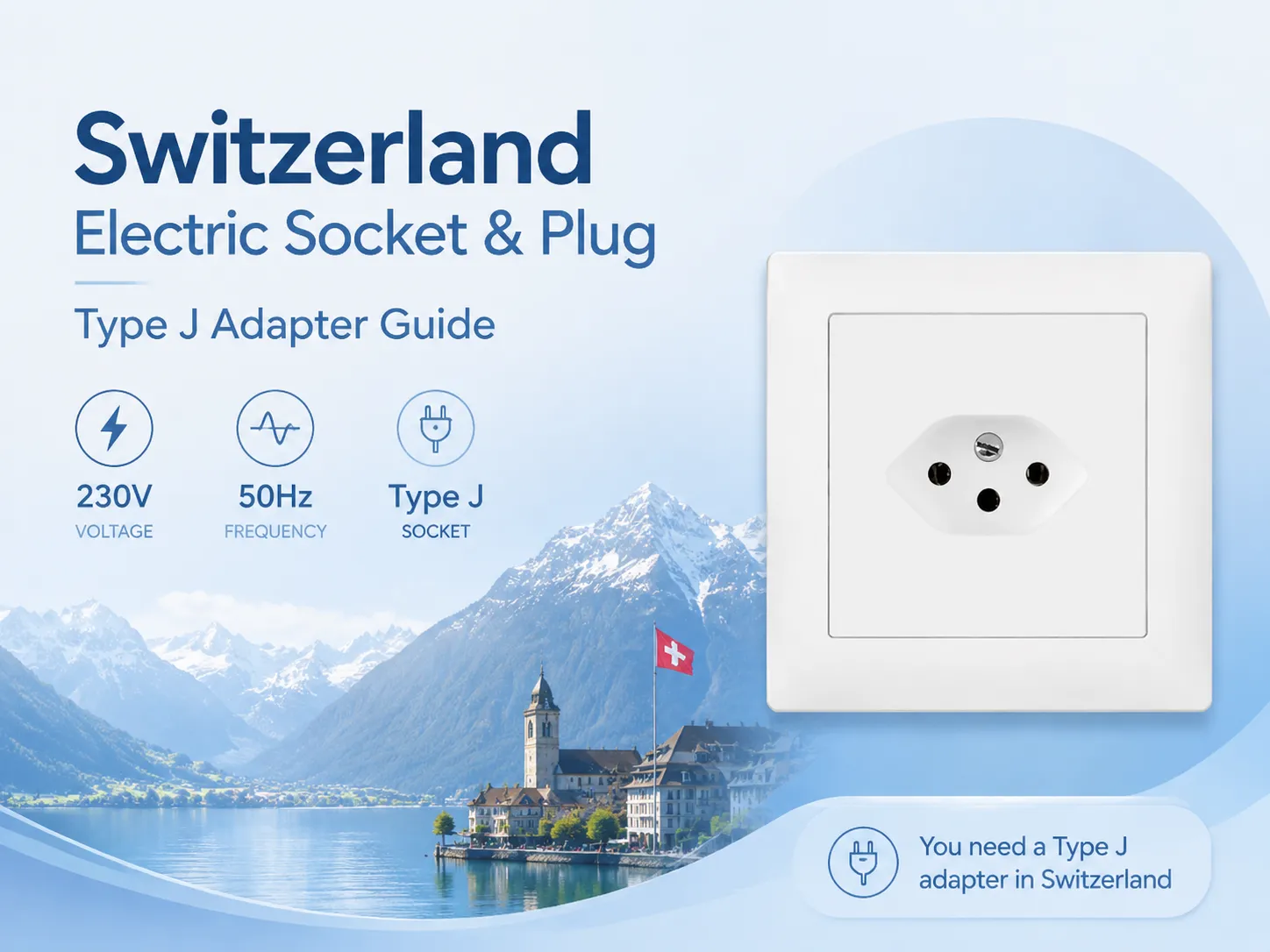
Switzerland Electric Socket & Plug Types – Type J Adapter Guide
Switzerland is a country of stunning Alps, pristine lakes, and efficient infrastructure – but its electrical sockets are uniquely different from much of Europe. While the country uses 230V/50Hz like its neighbours, the switzerland electric socket is a Type J standard, which is not compatible with standard Europlugs (Type C) without an adapter. This guide covers everything about electrical plugs for Switzerland, including what a switzerland plug point looks like, the voltage, frequency, and which electric adaptor for Switzerland you need. We’ve also answered the most common traveller questions about Swiss power outlets.
Switzerland Electric Socket Type – What Standard?
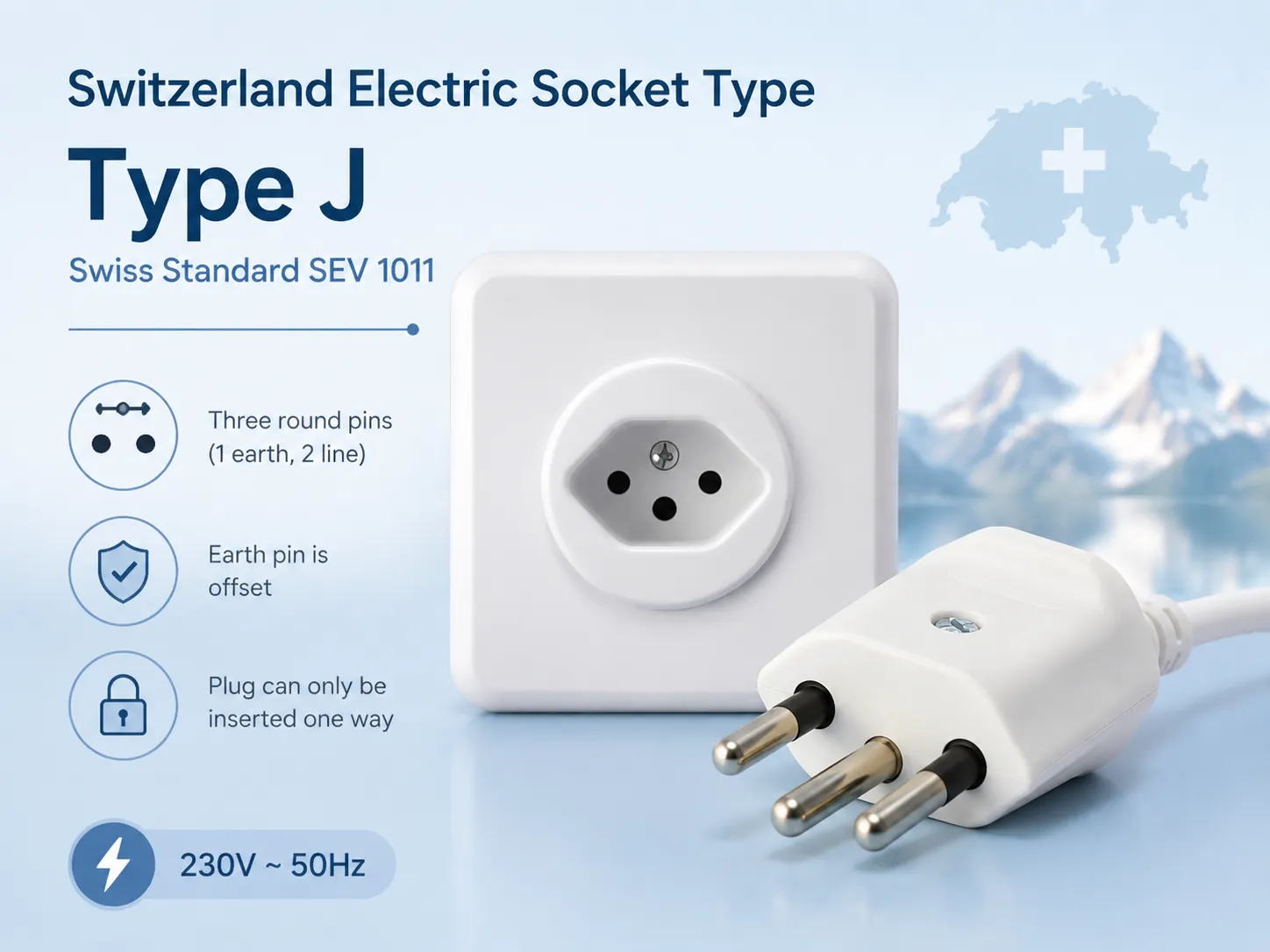
The official electric socket of Switzerland is known as Type J. It is also called as Swiss standard SEV 1011. This type of socket has three pins in round shape which are placed at equal length from each other but with a slight offset. However, this will cause incompatibility with Type C and Type F plugs.
- Type J – A plug is constructed with three cylindrical pins (live, neutral, and earth). The diameter of the pin is 4.0 mm for live and neutral, as well as 4.8 mm for earth. The earth pin is provided asymmetrically, which makes sure that the plug can be inserted in only one way.
- Type C – They are two non-grounded pins (4.0 mm). While these plugs can be inserted into the socket type J, they aren’t grounded and hence can’t open the socket if it has a shutter that is controlled by the grounding pin.
The Swiss socket, which is different from those of Germany (Type F) or France (Type E), is recessed and comes with a safety shutter that opens when the earth pin is inserted into the socket. Some sockets may accept Type C (Europlug) plugs, which do not have an earth pin, but this cannot be guaranteed as it means that grounding protection is lost. To avoid any inconvenience, it is better to use a proper Type J plug or adapter when using Swiss sockets.
Switzerland Plug Type – What Does a Swiss Power Plug Look Like?
A Switzerland power outlet accepts plugs which are specifically Swiss in design. The power connections for Switzerland comprise of the following:
- Type J plug The configuration consists of three circular pins that consist of two live/neutral pins, which have a diameter of 4.0 mm each, and an earth pin that is offset from the centre with a diameter of 4.8 mm, which is the longest, making sure that the grounding is done first.
- The plug body is typically compact, often with a recessed design to fit into the socket’s inset.
- The plugs that are used in Switzerland have a fixed polarity, meaning there are live and neutral pin that allows the use of the plug in a single way.
Even though a standard Europlug (Type C) with two rounded pins can be physically used with many switches in Switzerland, it does not ground itself and may not be able to operate the shutter. For heavier appliances, you should use the regular Type J plugs. Most universal plugs are supplied with the right Swiss Type J configuration.
Pro tip: The fact that a lot of Swiss sockets have a recessed design means that thick adapters won’t fit as they will definitely be too wide for it. It’s best to search for special slim adapters specifically made for Switzerland.
Voltage and Frequency in Switzerland
The standard voltage in Switzerland is 230 volts (with limits spanning from 220 V to 240 V) and the frequency is 50 Hz which is the same in most of Europe and the United Kingdom.
In case you belong to North America (120V) or Japan (100V), it can be inferred that your non- dual voltage devices will not be able to operate unless used with a step-down converter (water). A majority of electronic items (mobile phones, laptops, tablets) being used at present are dual voltage devices which can work well with just a plug adapter. In order to find out if an instrument has the dual voltage capability, look for the wordings IN input – 100-240V, 50/60 Hz on the label.
Travelers will need a converter if they want to use appliances that work solely at a voltage of 120V (like some shavers or hair dryers). On the other hand, they may present travelers with the possibility of simply purchasing cheap local appliances.
Do I Need an Electric Adapter for Switzerland?
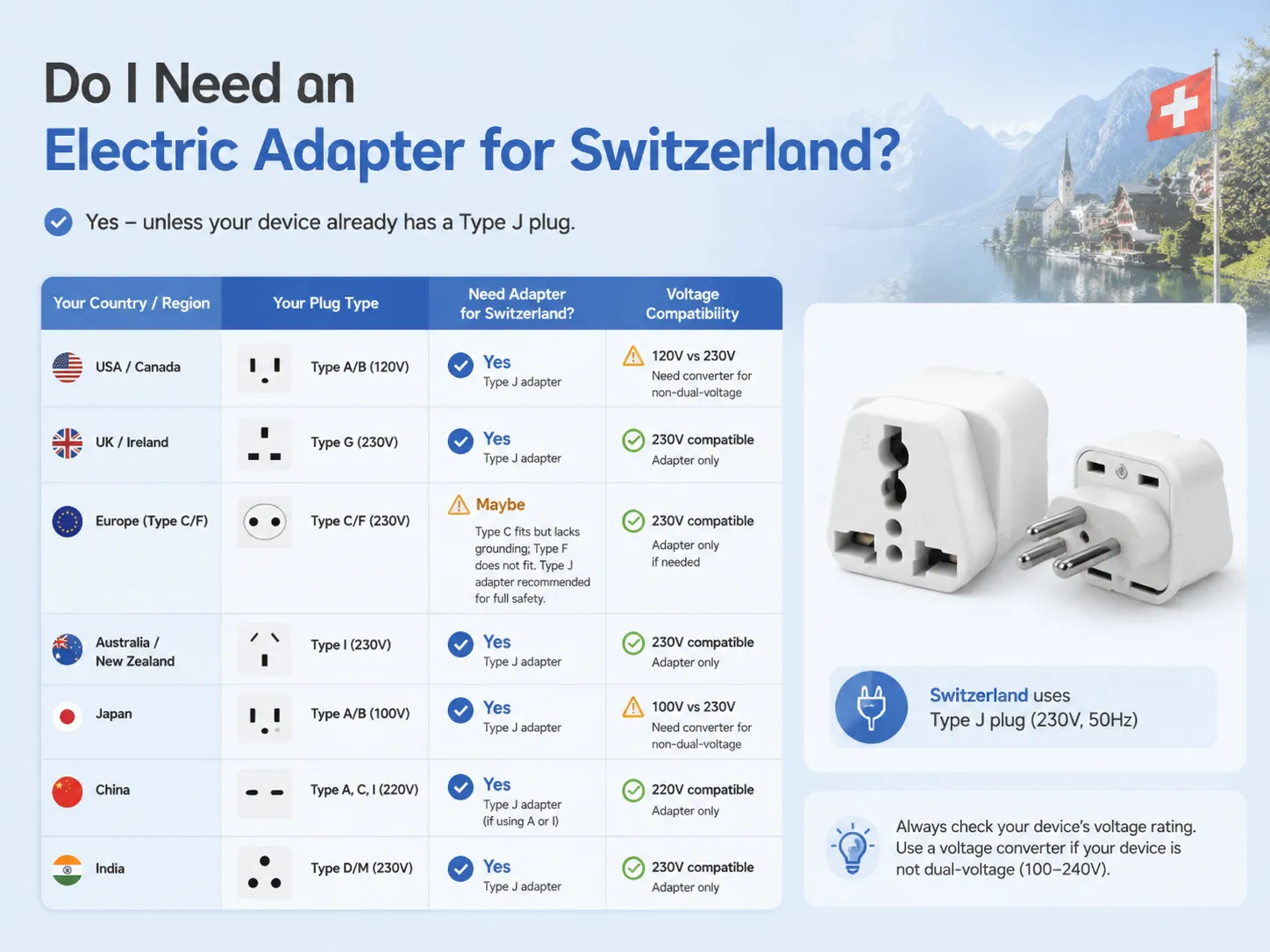
Yes – unless your device already has a Type J plug. The table below gives a quick overview for travellers from different regions, showing when you need an electric adaptor for Switzerland.
| Your Country / Region | Your Plug Type | Need Adapter for Switzerland? | Voltage Compatibility |
|---|---|---|---|
| USA / Canada | Type A/B (120V) | ✅ Yes – need Type J adapter | ⚠️ 120V vs 230V – need converter for non‑dual‑voltage |
| UK / Ireland | Type G (230V) | ✅ Yes – need Type J adapter | ✅ Voltage compatible – adapter only |
| Europe (Type C/F) | Type C/F (230V) | ⚠️ Maybe – Type C fits physically but lacks grounding; Type F does not fit. A Type J adapter is recommended for full safety. | ✅ Voltage compatible – adapter only if needed |
| Australia / New Zealand | Type I (230V) | ✅ Yes – need Type J adapter | ✅ Voltage compatible – adapter only |
| Japan | Type A/B (100V) | ✅ Yes – need Type J adapter | ⚠️ 100V vs 230V – need converter for non‑dual‑voltage |
| China | Type A, C, I (220V) | ✅ Yes – need Type J adapter (if using A or I) | ✅ Voltage close – adapter only |
| India | Type D/M (230V) | ✅ Yes – need Type J adapter | ✅ Voltage compatible – adapter only |
Key takeaway: In Switzerland, Type J sockets are utilized. You can also use a Europlug (Type C) in Switzerland, but it is safer to use a reliable type of power adaptor that will ensure grounding and properly fit. In relation to voltage, an adapter will suffice when coming from a 230V environment. When visiting from a 120V area, the device should be dual-voltage.
We suggest using a universal travel adapter that has Type J pins, as it is compatible with a Swiss plug that fits into recessed sockets.
Frequently Asked Questions (FAQ)
What plug adapter do I need for Switzerland?
You will require a Type J plug adapter which has three round pins with one pin being an earth pin. This adapter helps you to change the shape of your plug into the Swiss standard plug shape. A number of universal adapters feature a Swiss configuration too.
Is Switzerland the same plug as Europe?
No. The majority of the European countries employs the Type C/F plug (creates round and flat pin connection) whereas Switzerland applies the different variant of the plug – Type J which is used for plug-in devices and characterized by a unique pin placement and the different earthing pin position. Plug Type C does work physically with Type J but since electrical type C plug has no earthing it is unable to work appropriately.
Is Type C plug compatible with Type J?
Partially. Although a Type C (Europlug) can technically be plugged into a Type J socket, this does carry some risk. The pins are of the same diameter (4.0 mm), plus the distance between each pin is almost the same. However, Type C plugs are ungrounded, meaning that if you will try to plug it into a Swiss socket, the safety shutter will not operate, so make sure you do not use it with any devices that consume a lot of power.
What does a Swiss power plug look like?
The Swiss plug consists of three round pins in which two of them for the live and neutral pin (4.0 mm) while the remaining pin serves as the earth pin (4.8 mm) and is located slightly off center at the bottom. The pins form a triangular shape and the earth pin is of slightly longer dimension than the other two pins. The body of the plug is usually quite compact and is designed such that it can be fitted inside the socket easily.
Can I use my UK hairdryer in Switzerland?
The voltage of UK hairdryers is 230V, which is all right, but the Type G plug will not be compatible, and you will require an adapter from Type G to Type J. If you have a hairdryer from the USA with a voltage of 120V, you’ll have to get a converter and use an adapter.
Are USB ports common in Swiss hotels?
The presence of USB‑A and USB‑C ports in contemporary hotels is indeed common, while few smaller hotels or mountain cabins have these facilities. It is advisable to take a Type J plug charger with you.
Travel Tips for Using Electronics in Switzerland
- Pack a Type J adapter – even if you have a Europlug, a proper adapter ensures grounding and fits all sockets.
- Check voltage labels – most devices are dual‑voltage, but always verify.
- Bring a power bank – useful for long hikes or train journeys.
- Voltage stability – Swiss power is very stable, but a surge protector is still a good idea.
- Hotel outlets – often near beds or desks; an extension cord can be handy.
- Adapter vs. converter – know the difference.
Summary
Switzerland uses Type J sockets with 230V/50Hz. Travellers from most European countries with Type C plugs can physically plug in but should use an adapter for safety and grounding. Travellers from the UK, US, Australia, and other regions need a Type J plug adapter. For voltage, dual‑voltage devices are fine; 120V‑only devices need a converter. With the right preparation, you’ll keep your devices charged and enjoy the Swiss Alps and cities without electrical worries.