The term refers to the end of a lamp cord, notebook charger, desktop fan, television set and around four billion items. Hardly anyone gives it a thought so it is not surprising that very few people can tell what the letters mean or why one prong is wider than the other. The importance of the information about the gap becomes apparent when a cord should be replaced, the equipment should be adapted for export and when a plug appears to be heated and one needs to establish if it is normal.
The following section contains the information for those who need more than just a brief overview of the topic.
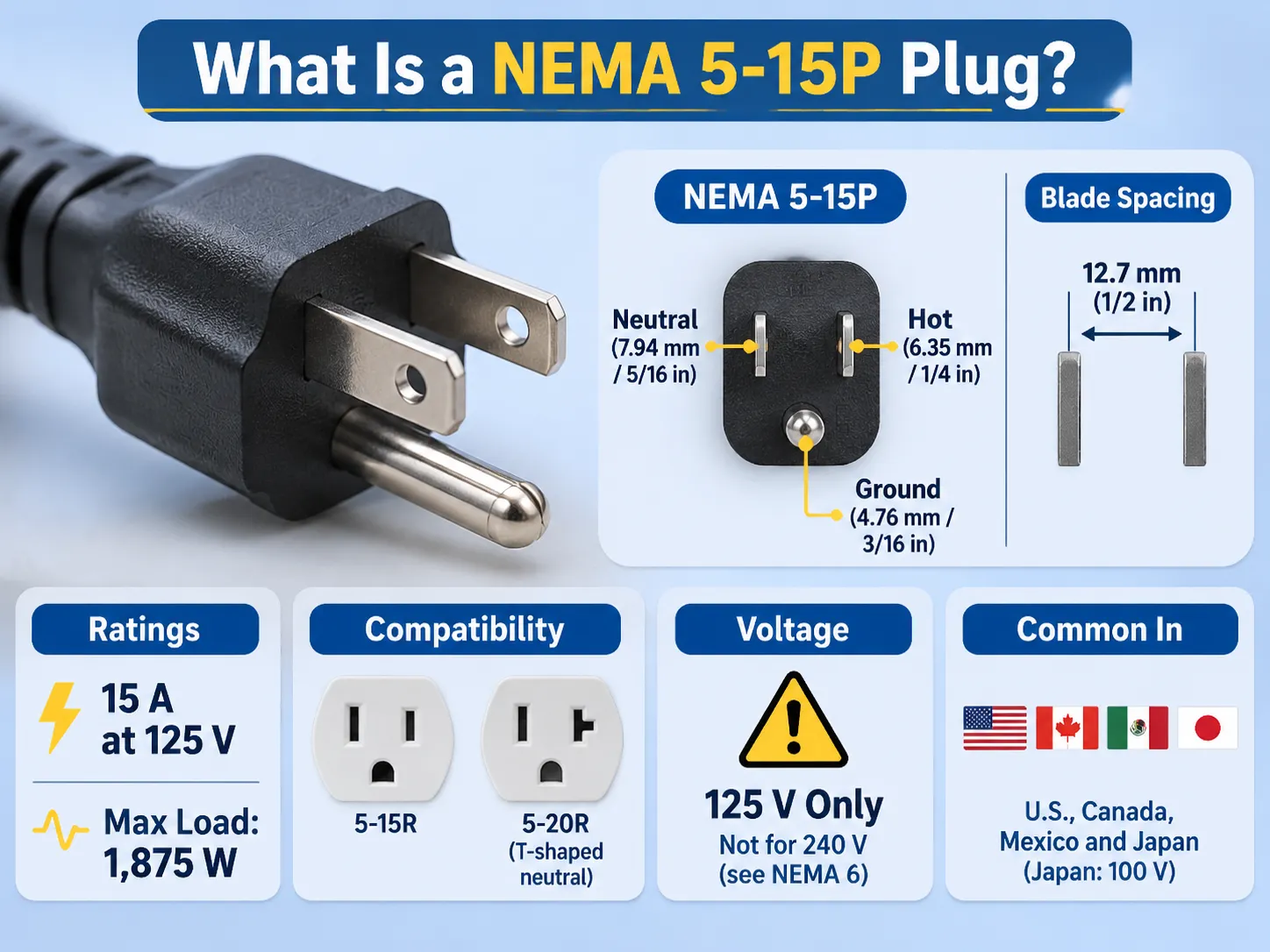
Short response: NEMA 5-15P is the commonly used North American plug with three pins and rated for 15 A at 125 V. The two pins are flat and parallel and one pin is grounding pin. NEMA 5-15P is designed according to ANSI/NEMA WD-6 standards and is approved by UL 498. It can be fitted into NEMA 5-15R socket and also suits NEMA 5-20R socket because both NEMA 5-15P and NEMA 5-20R plugs have different shapes for pin slots. The hot pin of NEMA 5-15P is 6.35 mm wide and neutral pin is 7.94 mm wide, so that it can enter the plug in just one direction. The distance between the two pins is 12.7 mm and the diameter of the grounding pin is 4.76 mm. NEMA 5-15P can handle maximum load of 1875 W and operates at 125 V. NEMA 5-15P cannot be used for 240 V circuits, but a completely different plug NEMA 6 series is designed for that purpose.
What the Name Actually Encodes
The names of the various connectors used by the NEMA follow an organized system, making them easy to remember. The first three digits before the hyphen are made up of three pieces of information: the series number, the number of contacts, and the number of wires. The number after the hyphen indicates the ampere rating. Finally, the letter at the end informs if the connector is a plug or a receptacle.
For instance, the 5-15P denotes an item in series 5 which is rated to 125V and has two contacts and three wires. Among other things, it includes two conductors along with ground wire and has a 15 ampere rating. The 5-15R receptacle is the same as a 5-15P plug with the difference that the 5-15R is a receptacle. In the same manner, if the user chooses to plug the L5-15P version which is known to be lockable, they will not have issues using the plug. While both types of connectors have the same ampere ratings, it is important to note that the L5-15P is different from the 5-15P in terms of structure.
Unfortunately, people tend to confuse the series numbers. The 5 finds its way into the 125 volts while the 6 belongs to the 250 volts. A connector with the code 6-15P can easily be confused with a 5-15P, but will not fit in a 5-15R due to the different shape.The full set of configurations is defined in ANSI/NEMA WD-6, and the overview of electrical socket types is useful for placing the 5-15 alongside the non-North-American families.
What a NEMA 5-15P Looks Like, Down to the Millimetre
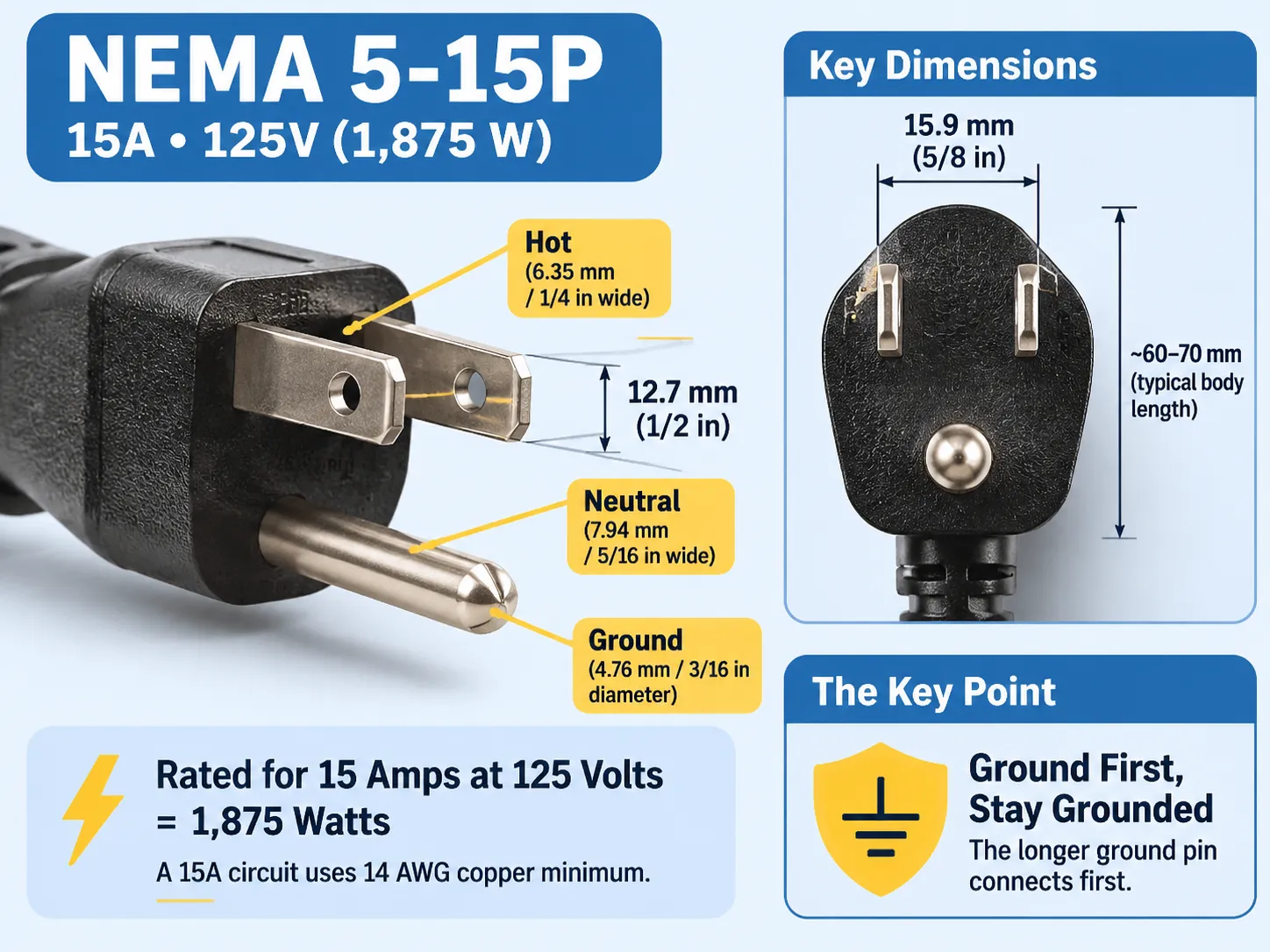
There are three conductors and three exposed metallic components. Two flat blades are arranged the same way and a round pin is located underneath them. The round pin is longer than the blades in such a way that it makes the contact before the blades do. Thus, the purpose of the longer ground pin is to ensure that the equipment is grounded before the power is switched on, and remains grounded until after the power is disconnected.
| Feature | Dimension | Why it is that size |
|---|---|---|
| Hot blade width | 6.35 mm (1/4 in) | Standard blade, mates with the narrow slot |
| Neutral blade width | 7.94 mm (5/16 in) | Wider blade forces one insertion orientation |
| Blade centres | 12.7 mm (1/2 in) | Fixes the geometry so no other series will fit |
| Blade length | 15.9 mm (5/8 in) nominal | Contact area plus engagement depth |
| Ground pin diameter | 4.76 mm (3/16 in) | Round pin, longer than the blades |
| Typical body length | 60 to 70 mm | Housing for the cord grip and terminations |
On certain types of plugs, a small opening can be found near the end of each terminal blade. This opening is an artifact of the manufacturing process; however, it is useful and therefore retained. The opening may be used to lock the plug. In addition, several receptacle designs utilize the opening for a latch. While its presence is not compulsory, its size is fixed in case of presence.
What It Is Rated For, and What That Means in Watts
Fifteen amperes at 125 volts gives 1,875 watts and that’s the limitation for anything on a 5-15P. The limits for the circuit are in the breaker, but not in the plug. In the case of 15 A branch circuit, if there is a plug in a normal situation, the breaking point for the circuit is 15 A.Every plug has to be adjusted to the breaking point, otherwise, if you connect a 5-15P into a 20 A circuit, the plug will become the weakest link where it is plugged in.
The power of a cable depends on the circuit and not on the plug. For a 15 A circuit it is necessary to have 14 AWG wire and for a 20 A circuit it is 12 AWG. A plug that is designed for 5-15P with a 16 AWG wire is completely suitable, as the appliance it feeds is limited. However, it is wrong to have a plug of 5-15P fitted on a cord that has a wire of such a gauge as 15 A circuit due to the presence of a 15 A receptacle.
The importance of the voltage used needs to be mentioned here because it causes a lot of confusion. The nominal voltage is 120 V but the standards of ANSI C84.1 provide steady-state range of approximately 114 V to 126 V. The name plates of the appliances mentioning about 115 V and 110 V are not talking about plugs but mean the capacity of the appliance for the voltage to be used.
Polarisation: Why the Neutral Blade Is Wider
The broader neutral blade does not represent any manufacturing defect. Its work is to make sure that the appliance’s internal switch interrupts the hot wire instead of the neutral wire.
Consider what would occur in the absence of that. If the plug could be inserted in both directions, then in half of the cases the internal switch would be linked to the neutral. The switching of the neutral wire interrupts the current flow which creates the illusion of the appliance being switched off while the wiring is still energized at 120V with respect to the earth. It puts anyone fixing the appliance and touching any of the damaged wires at risk of becoming part of the circuit. The polarization means that the switch controls only the hot wire and the appliance is actually turned off when it is disconnected from the power line.
That is why the cheat adapter which bypasses the ground pin and the polarization is not just a violation of the regulations, but a real danger as it removes two levels of protection. The same logic explains why a damaged wall socket with a cracked or loose neutral slot should be replaced, not tolerated: a worn slot lets the plug sit at an angle and defeats the geometry that keeps the polarity right.
Which Receptacle It Fits, and Which It Refuses
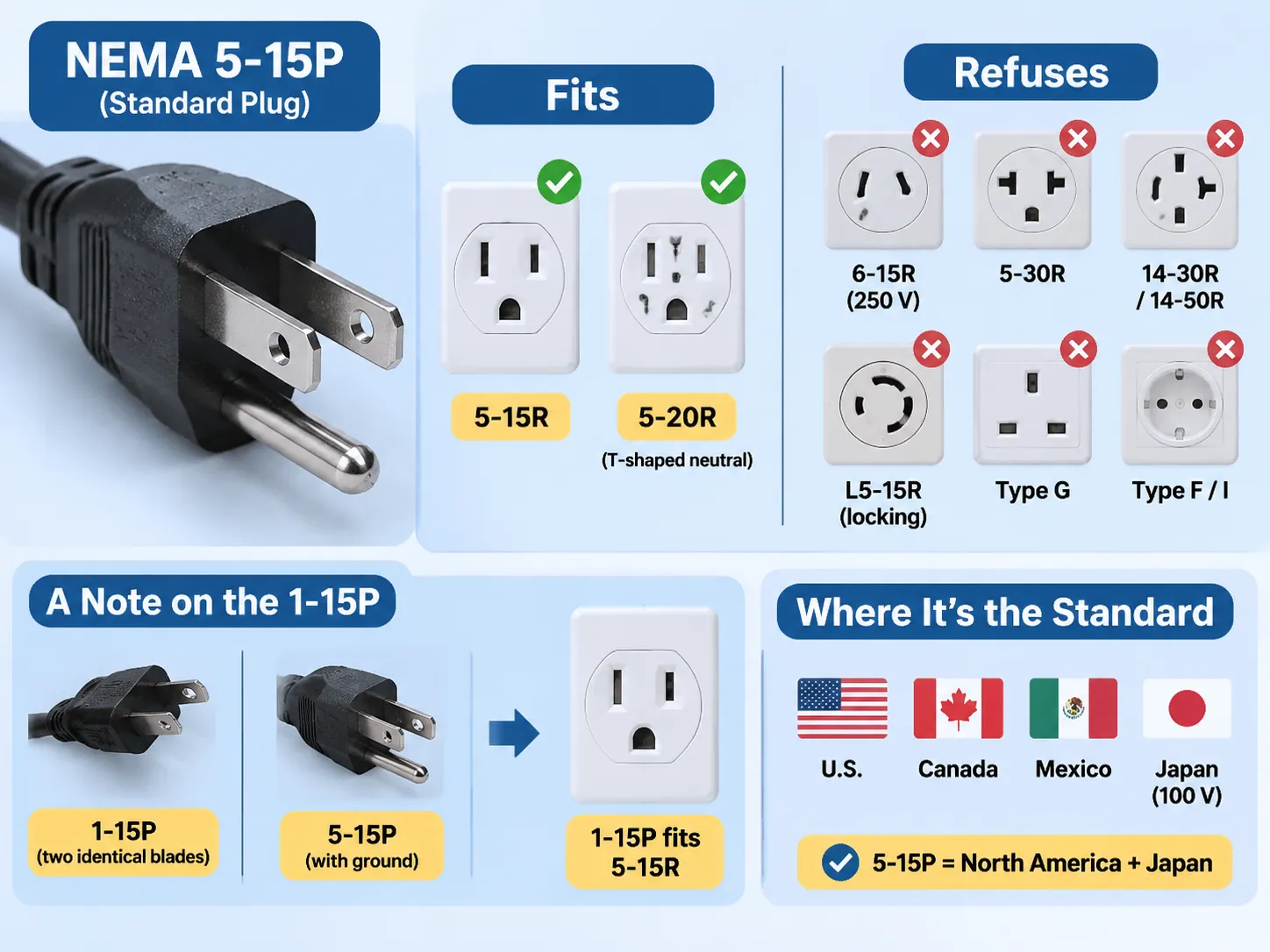
The 5-15P is indeed capable of fitting its companion 5-15R and also the 5-20R, since the 20-amp receptacle has the T shape neutral slot that can accommodate both the wide 5-15 neutral and the horizontal 5-20. But the compatibility only works one way. The plug 5-20P with its horizontal neutral cannot fit the 5-15R.
The compatibility fails for many others, and this helps in understanding the concept. For example, a receptacle type 6-15R does not fit as it needs 250V. The 5-30R will also not accept it as its blade spacing is different. Similarly, the 14-30R or 14-50R receptacle will not. Furthermore, a locking receptacle type of L5-15R, and Type G, Type F and Type I works the same and this is the entire reason for the travel adapters.
The confusion usually begins with the two-pin 1-15P plug which has two identical pins as its original version with no ground pin. The 1-15P fits the 5-15R due to the width of the neutral slot, but the conversely does not apply here. However, in case you intend on replacing a normal receptacle with an equivalent 5-15R with GFCI protection, the issue may be dealt separately with respect to the plug.
Where the NEMA 5-15P Is the Standard Plug
The U.S.A. certainly is the first thought that springs to mind, while Canada too follows the same system, namely CSA C22.2 No. 42, which is why you can use a device purchased in Toronto with no issues in Buffalo.Mexico follows the same pattern under NMX-J-163-ANCE, and the Canadian electrical socket type guide covers the details of that market including the 5-20 variants used in kitchens.
Japan offers an intriguing example. Both 100 V and 50 or 60 Hz (depending on the region) employ the same two-bladed design, and ungrounded 1-15 plugs can be found throughout Japanese houses, with the grounded 5-15 plug appearing only where necessary. Although a robust, 5-15P plug can fit into a grounded outlet in Japan, only a third of the power rating of a resistive load will be attained as a result of voltage issues. As a result, there may be a problem with motor speed and overheating. It is not a plug issue; it is only a question of voltage and plugs, as such questions must be answered separately.
In addition to Japan, some parts of Central America, the Caribbean, Colombia, Peru, Taiwan, and the Philippines have a mixture of plugs, with 5-15 sockets and plugs being used along with other types of plugs.
The Other NEMA Plugs People Confuse It With
Four examples explain the majority of practical situations.
- 1-15P. The plug has two blades, does not have a ground and is not polarized, amperage of 15 A at a voltage of 125 V. It is the plug for double-insulated cords and old lamps. It can fit into the 5-15R; the other plug cannot fit into the 1-15R plug.
- 5-20P. The same voltage of 125 V and higher amperage of 20 A with an additional neutral horizontal pin. It cannot fit into a 5-15R plug, while a 5-15P plug can fit a 5-20R socket. It is often seen in kitchens and workshops fitted with 20-ampere circuits.
- 6-15P. The plug comprises two blades as well as grounding and works at voltage of 250 V and 15 A. The specially designed plug can only fit into the right receptacle. The most common applications for this plug are air conditioners and other electrical devices which require 240 V.
- G type and F type plugs. The British rectangular plug and the European type Schuko plug. These two plugs have different configurations, different voltages and cannot be used together. In Britain, a plug with 13 A rating has a voltage of 250 V, while the other plug has a rating of 16 A at 250 V and requires a different socket.
Why Plugs Fail, and the Arithmetic Behind a Hot Prong
The contact resistance of a clean brass blade placed in a receptacle wiper is around 0.005 ohms and thus insignificant. Once the blade has bent, oxidized, or the wiper spring has worn out, the same contact can show resistance up to 0.5 ohms without changing its physical aspect.
Once 12.5 A is passing in each case, the difference in the heat dispersion is noticeable. 0.005 ohms mean that heat is 12.5 squared times 0.005 or 0.78 W that is harmlessly dispersed in brass. 0.5 ohms mean that heat would be concentrated at 78 W on the area smaller than a postage stamp inside an insulated plastic body. The body starts getting soft at more than 70 °C, the wiper loses spring force, resistance increases, and the process goes out of control which leads to scorching of the plug face and blackening of the receptacle.
The practical test does not cost anything: after the operation of the heavy appliance for twenty minutes, touch the plug with a hand. If it is warm, everything is fine. If it is hot, it means that there is a failure in the process that should be repaired not by pushing the plug stronger but by fixing the receptacle or the cord end. The contacts of the blades become corroded and discolored while the contact area is diminishing and need replacing.
Variants Worth Knowing: Hospital Grade, Watertight and Right Angle
Plugs and sockets used in hospitals are designed to comply with more stringent criteria than the industry standard for reliability against mechanical failure and grounding failure. The major difference in the specifications is in the retention force and ground contact integrity. The specification for medical plugs is of vital importance, as a plug that disconnects from a medical device would fall under a different category of failure from a lamp that goes out.
Water-resistant plugs are made to meet IP55 or higher standards as a result of utilizing a body with gasket and a cord entry and equipped with a matching firewall on the corresponding socket.The plug alone does nothing; both halves have to be the watertight type. A US three-pin socket in a switched plate assembly shows the receptacle side of the same standard in a residential format.
In instances where you have furniture items and televisions mounted on walls and in cases where you have limited clearance, both right-angle and low-profile plugs are available. The electrical rating stays the same; the only difference is the strain relief direction. You would want to specify these types of plugs if the cable is to be run flat against a wall, and people are often caught unaware until they try to move the furniture.
What to Check Before You Buy or Specify
In the case of an Original Equipment Manufacturer purchasing cord sets, there are five distinguishing features that set apart a compliant product from a convincing imitative product. The product marking must carry a proof marking from an established testing laboratory that is searchable with a testing laboratory’s file number. The dimensions of the blades must adhere to the WD-6 tolerances, which are precise enough to allow for minor errors in stamping. The cord grip should prevent the wire sheath from being pulled out of the plug during testing, compared to the terminals being pulled out. The terminal screws must be made with plated brass, which is necessary instead of using zinc-plated steel. Finally,the housing of the cord set must carry a flame rating, which is normally classified as UL 94 V-2 at the very minimum.
For the case of a product specifying receptacles there are also five comparable characteristics needed: interrupting capacity of the circuit, terminal capacity for wire gauge, mounting configuration, and whether or not a tamper resistant shut-off has to be used, which is now mandatory in every state for residential projects.
We build the plates and socket assemblies around these devices, not the plugs themselves, and the electrical socket manufacturing range covers the market-specific configurations that go with them: US, UK, European, Australian and the regional variants in between. If a project needs one plate standard across several markets with the correct device behind each, that is the conversation worth having before the drawings are frozen.
FAQ
Is NEMA 5-15P a normal plug?
Yes. It is the commonplace three-prong plug that can be found on virtually all household appliances, lamps, chargers and power strips in the USA and Canada. The terminology is technical but the object is well-known: two flat prongs and a round grounding pin, rated for 15 A at 125 V. If you see a plug that has three prongs with the two flat ones being parallel and the round one under them, it is surely a 5-15P.
Is NEMA 5-15R standard?
The 15 A receptacle is common in North American homes and light commercial buildings. It can be used for either the 5-15P or also for the older version of the receptacle without the ground, called the 1-15P. The 5-20R will accept the 5-15P plug because of the T-shaped neutral opening, which explains why the 20 A kitchen circuit can also be used with standard appliances. New electrical installations in almost all jurisdictions require that these receptacles have tamper-resistant shutters.
What does a NEMA 5-15 plug look like?
The two flat metal plates are positioned parallel at a distance of 12.7 mm from each other and a round pin is located at their centre slightly extending ahead of them. The right plate is the neutral one and is visibly wider than the left plate. The body is made of plastic, which is commonly between 60-70 mm long. The wire goes into the body through the strain relief point. Some plates have a tiny hole in the tip. The plug has no shield or a round body and there is no fuse, hence for the person accustomed to the British or the European plugs it is a very easy task to distinguish this type of plug.
Can NEMA 5-15 handle 240 V?
No, the 5 series is rated 125 volts and has a physical key that prohibits it from being plugged into a 250 volts outlet. The proper connectors for plugging in a 240-volt appliance in North America are in the 6 series (e.g., 6-15P or 6-20P), along with connectors from the 14 series for devices that use both 120-240 volt appliances. Using a 5-15 device with 240 volts creates the possibility of fire or electric shock, as well as damaging any appliance plugged in on the other end of the circuit.
Will a 5-15P fit a 5-20R outlet?
Yes. The 20 A socket contains a T-shaped neutral slot which allows for the insertion of the neutral blade of a 5-15P or 5-20P plug. However, the other way around is not true since a 5-20P cannot fit into a 5-15R socket. This one-way compatability is designed so that a 20 A device cannot work in a circuit rated for 15 A.
What is the difference between NEMA 5-15P and 1-15P?
The 1-15P consists of two matching blades and does not have a ground pin. It is also not polarised. The 5-15P has received a pin for grounding and a wider blade slot for neutral. It is thus both creating a fault path and ensuring that the polarity is correct. 1-15P devices can be used with 5-15R as the neutral slot is wide enough for both blades to fit into. However, the reverse is not true when 5-15P tries to fit the ungrounded 1-15R. Ungrounded sockets are not used anymore and GFCI protected sockets have replaced them.
References
- NEMA — ANSI/NEMA WD-6 Wiring Devices Dimensional Specifications
- Leviton — Straight Blade Plugs and Receptacles
- Hubbell — Wiring Device Configurations and Ratings
- Interpower — North American Cord Sets and Plug Standards
- UL Solutions — UL 498 Attachment Plugs and Receptacles
Conclusion
The design known as the 5-15P serves three functions simultaneously. It transmits 15A of current, connects the appliance to ground, and prevents incorrect orientation and insertion. This is the main reason why we cannot substitute an imitation or copy whose appearance is correct, but whose dimensions differ from these described above.
Most reported problems related to the 5-15P do not concern electricity, but rather mechanical failures like a bent blade, wear of the wiper or burning marks. Please remember that when such a problem occurs, it is enough to change the element instead of the whole appliance. Moreover, it is always necessary to make sure that the socket of your destination country is of the required design before making the mould, as there are design differences between models and various types of adaptors.