When you have a staircase light controlled via two different switches and you want it dimmed, you purchase a dimmer and go first to the box for the switch, only to find three wires with no obvious place to put them. You may have purchased a product tagged as a “3 way dimmer” and wonder if you need another one on the other end. More home project do-it-yourself enthusiasts are puzzled over 3-way dimmer compatibility than by almost any other electrical task because a 3-way dimmer doesn’t work like two ordinary dimmers or work like a single pole dimmer at all. Get it wrong and you find out that you can’t dim the light, can’t turn it off from both places, or get flickering and buzzing ruining the entire light in the room.
This guide will provide you with all the information you need on 3-way dimmer compatibility including how 3-way circuits function, which dimmers can be used with them, whether you need one on each end, how to properly wire them, which bulbs can be used, and how to choose the correct one without requiring an electrician.
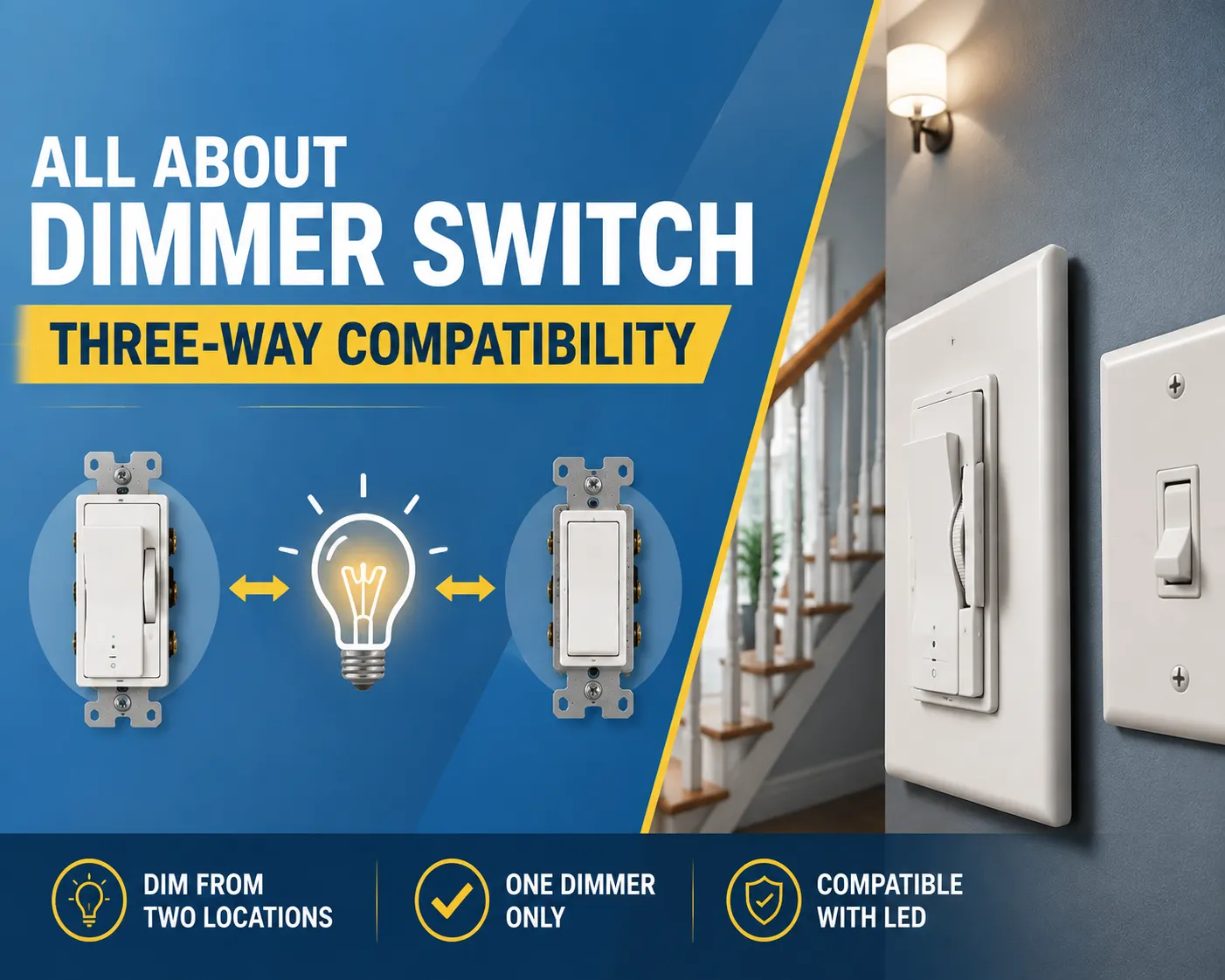
Answer in brief:Our dimmer switch works on a three-way circuit too and just requires one dimmer in one location while the final location must retain the standard mechanical three-way switch. Most 3-way dimmers are labeled “single-pole/3-way”, exactly the same way as every regular three-way switch in terms of wiring logic, meaning the dimmer common will be taking either line or load, while the two travelers are connecting the corresponding traveler terminals of the “companion” switch.
When it comes to compatibility, here’s the golden rule: one 3-way dimmer and one standard 3-way switch at the end – no need to have two dimmers in the same 3-way circuit.
How a 3-Way Circuit Works (Quick Refresher)
A 3-way switch circuit makes it possible to operate one light from two different locations. Each switch includes a common terminal and two traveling terminals. The hot wire connects to terminal common #1, the load wire to terminal common #2, and both traveling wires connect to both traveling terminals of the switches. In this way, switching either switches changes the connection path through one wire or another, thus turning the light on or off.
Essentially, this type of circuitry is used for 3-way switches as well, with the only difference that dimming machinery is incorporated into the circuit.
Can a Dimmer Be Used on a Three-Way Circuit?
It is possible to use a dimmer in a 3-way switch, however, this will only work if the dimmer you purchase has been specifically rated for 3-way applications. Look for wording on the packaging that states “single-pole/3-way” or “3-way capable.” A dimmer that is only rated for single-pole applications has only 2 wire connections and cannot replace any of the 3 switches in a 3-way switch system.
Why is it so important? A 3-way dimmer has an internal design that ensures that the dimmer still turns the light on and off no matter what the position of the second switch is, so the dimming function works no matter what position the second switch is in. Excellent brands like Lutron, Leviton, and others manufacture dimmers with 3-way features — most of the time, they can be easily recognized by the label “3-way” on the model number or by the label “SP/3W” on the packaging.
Do You Need a Dimmer on Both Sides?
No — with a 3-way circuit, you need only ONE dimmer. The other location has a simple, mechanical 3-way switch (or you can have the complimentary switch by the manufacturer if yours is a smart system). Here’s why:
- By using one dimmer with one ordinary 3-way switch, the dimmer controls lights from its location while the simple switch controls on/off actions from the other location, thus achieving a complete functionality.
- Never use two ordinary dimmers in a single 3-way circuit because they will compete with each other, causing flickering and buzzing and regulating the light incorrectly.
- The only exception to this rule is when a smart dimmer package contains two special products which are in a connection with each other (for example, a smart dimmer and its extra switch or two communicating smart dimmers.) Such products are made for work together.
The basic principle of using a conventional (non-smart) dimmer is one dimmer in combination with one plain switch.
3-Way Dimmer Wiring: Step by Step
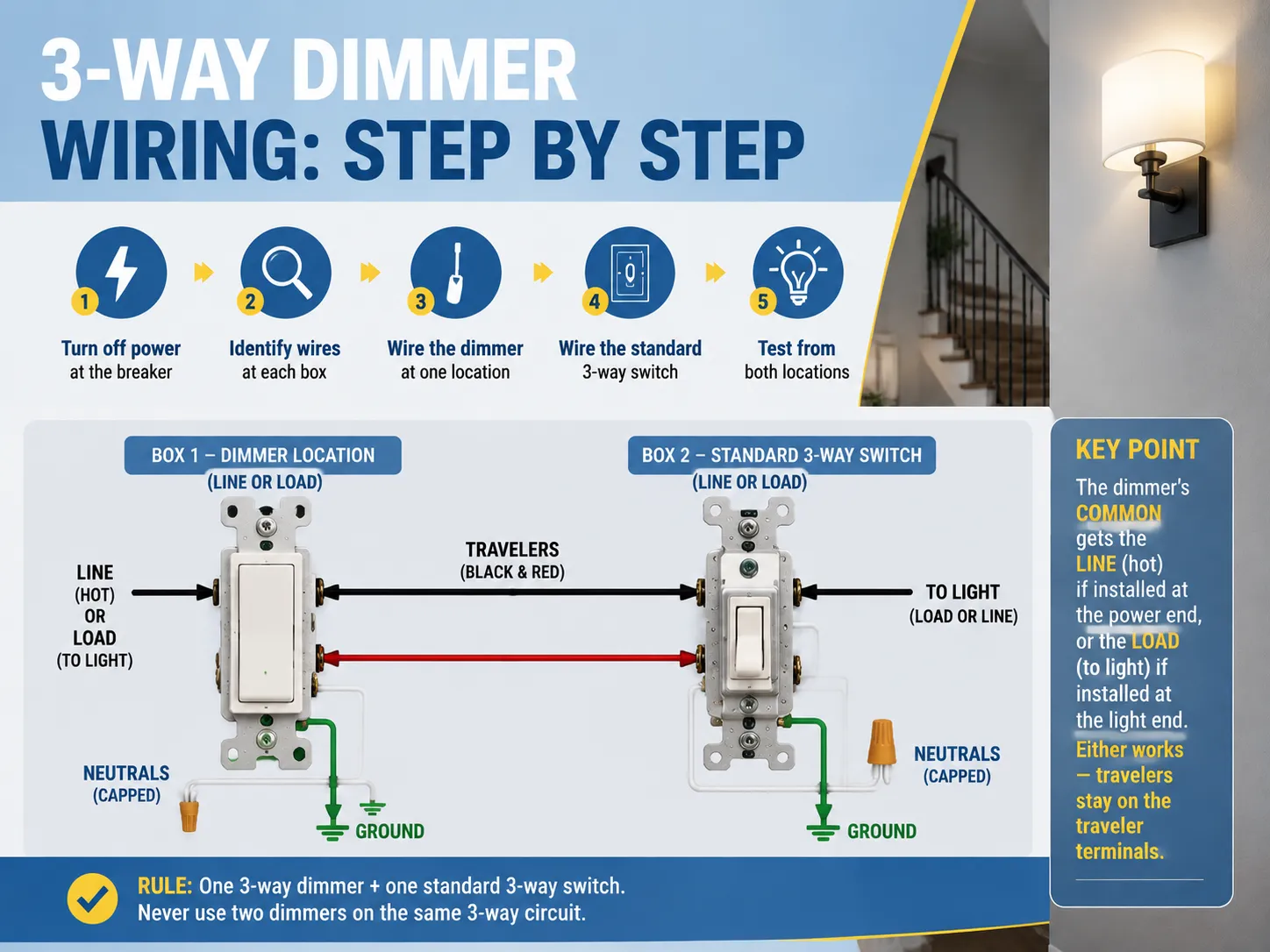
Wiring a 3-way dimmer is exactly the same as wiring any 3-way switch since the dimmer takes the place of one switch.
- Begin by turning the breaker off. Confirm this with a voltage tester that shows there is no current flowing. Know what wires you have at each box. At one box, you should have the line (hot), two traveler wires, and typically a bundle of neutral wires. At the other box, you should have the load-to-light, two traveler wires, and a bundle of neutral wires. It doesn’t matter which switch you choose to replace. However, make sure that the box matches the requirements for connecting the dimmer.
- For the dimmer, connect either the line or load to the common terminal of the dimmer. Connect the two travelers to either of the dimmer’s traveler terminals, which are usually indicated with different colors of screws. Make sure to connect all of the grounding wires and return the neutrals back into the box.
- From the other box, you will continue to use a standard 3-way switch that has both the common terminal, which can be either the line or load, and the two travelers’ wires.
- Make sure to match the travelers to each other from both boxes.
- Test the light switch from both locations — turning the lights on from either box should work. The dimmer should dim the light from the location where it is installed.
Important point to note: the wire that connects to the common terminal on the dimmer depends on the box in which it is installed. If the dimmer is at the line end of the box, then the common terminal will connect to the hot wire. If the dimmer is at the load end of the box, the common terminal will connect to the wire that leads to the light.
Dimmer Compatibility Checklist
Before buying, run this checklist:
| Check | Why It Matters |
|---|---|
| 3-way rated (“single-pole/3-way”) | A single-pole-only dimmer cannot control from two locations |
| Bulb type support | LED needs an LED-rated dimmer; CFL has specific requirements; incandescent/halogen work with most |
| Maximum wattage | Don’t exceed the dimmer’s rating (e.g., 150–300 W LED, 600 W incandescent) |
| Minimum load | LED dimmers often need a minimum load (5–10 W) — below it, lights flicker or won’t turn off |
| Neutral wire | Most mechanical dimmers don’t need neutral; most smart dimmers do |
| Voltage | Standard 120V (US) vs 230V (UK/EU) — buy the right standard |
| Box depth | Dimmer bodies are deeper than switches; confirm your box is deep enough (35mm+ recommended in UK) |
| Load type (MLV/ELV) | Magnetic low-voltage and electronic low-voltage transformers need specific dimmer types |
Bulb Compatibility: LED, Incandescent, CFL & More
Bulb compatibility is where most 3-way dimmer problems actually live. The dimmer isn’t wrong — the bulb and dimmer just aren’t matched. If you’re mixing dimmers and switches across a whole home, our guide to what a smart switch is and its benefits helps you decide between mechanical and smart dimming for each room.
| Bulb Type | Dimmer Requirement | Common Problem if Mismatched |
|---|---|---|
| LED | “LED-compatible” or “LED+” rated dimmer | Flicker, humming, lights not dimming below ~20%, dropouts at low level |
| Incandescent / halogen | Most standard dimmers | Few problems; most forgiving load |
| CFL | “Dimmable CFL” bulbs + compatible dimmer | Many CFLs aren’t dimmable at all; dimmable ones can flicker |
| Magnetic low-voltage (MLV) | MLV-rated dimmer (trailing-edge design for transformers) | Buzzing from transformer, reduced dimming range |
| Electronic low-voltage (ELV) | ELV-rated dimmer (requires neutral often) | Flicker, transformer noise, damage to dimmer |
The following steps must be followed before using an LED device: ensure that dimmable LED lighting is being employed, ensure the three-phase-dimmer is LEDs-rated, verify whether the minimum load of the dimmer is being achieved (the condition under which the LED bulbs will not have enough power to be effective), and if flickering is still an issue, check the manufacturer’s website for certified bulbs.
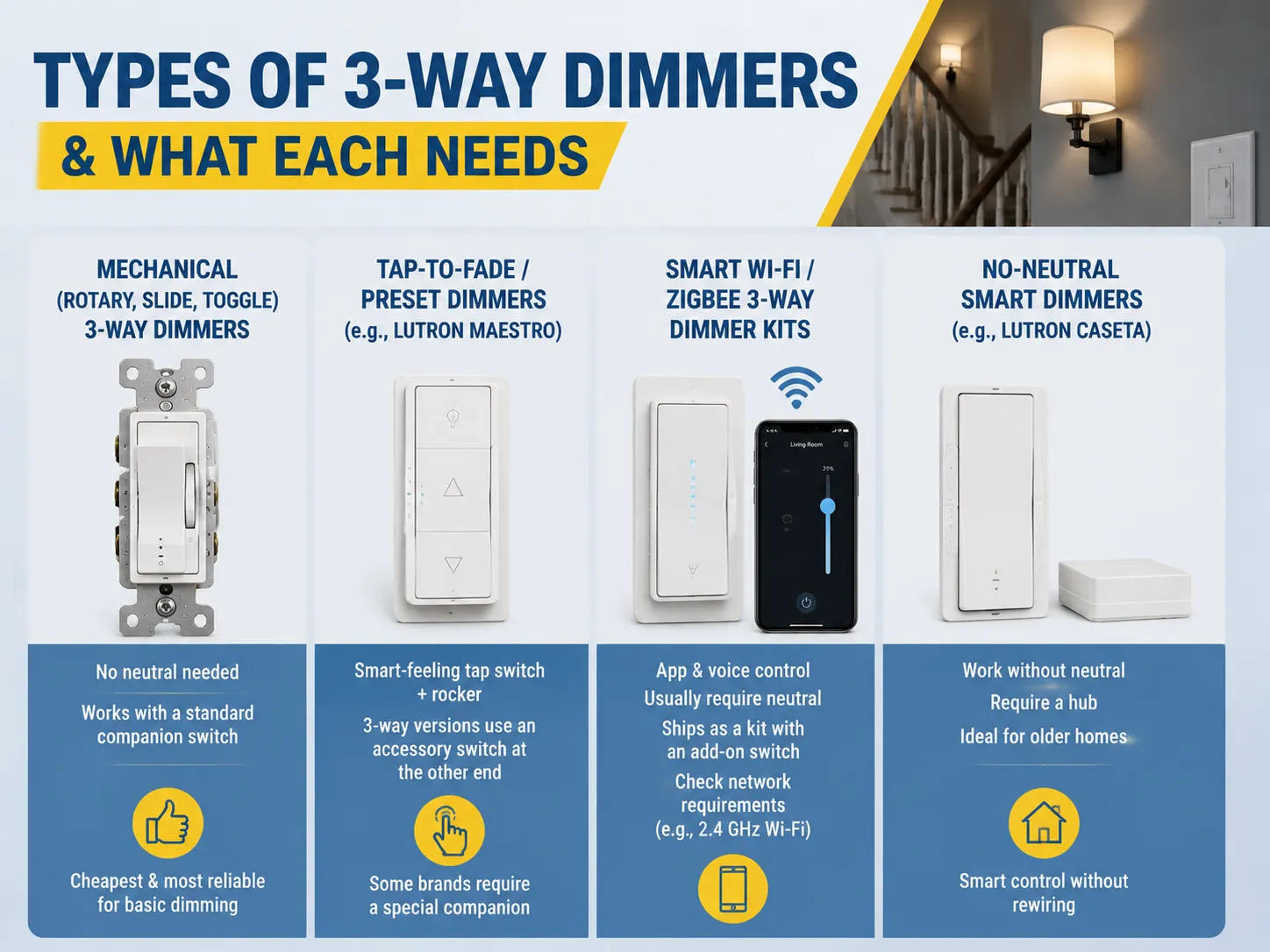
Types of 3-Way Dimmers & What Each Needs
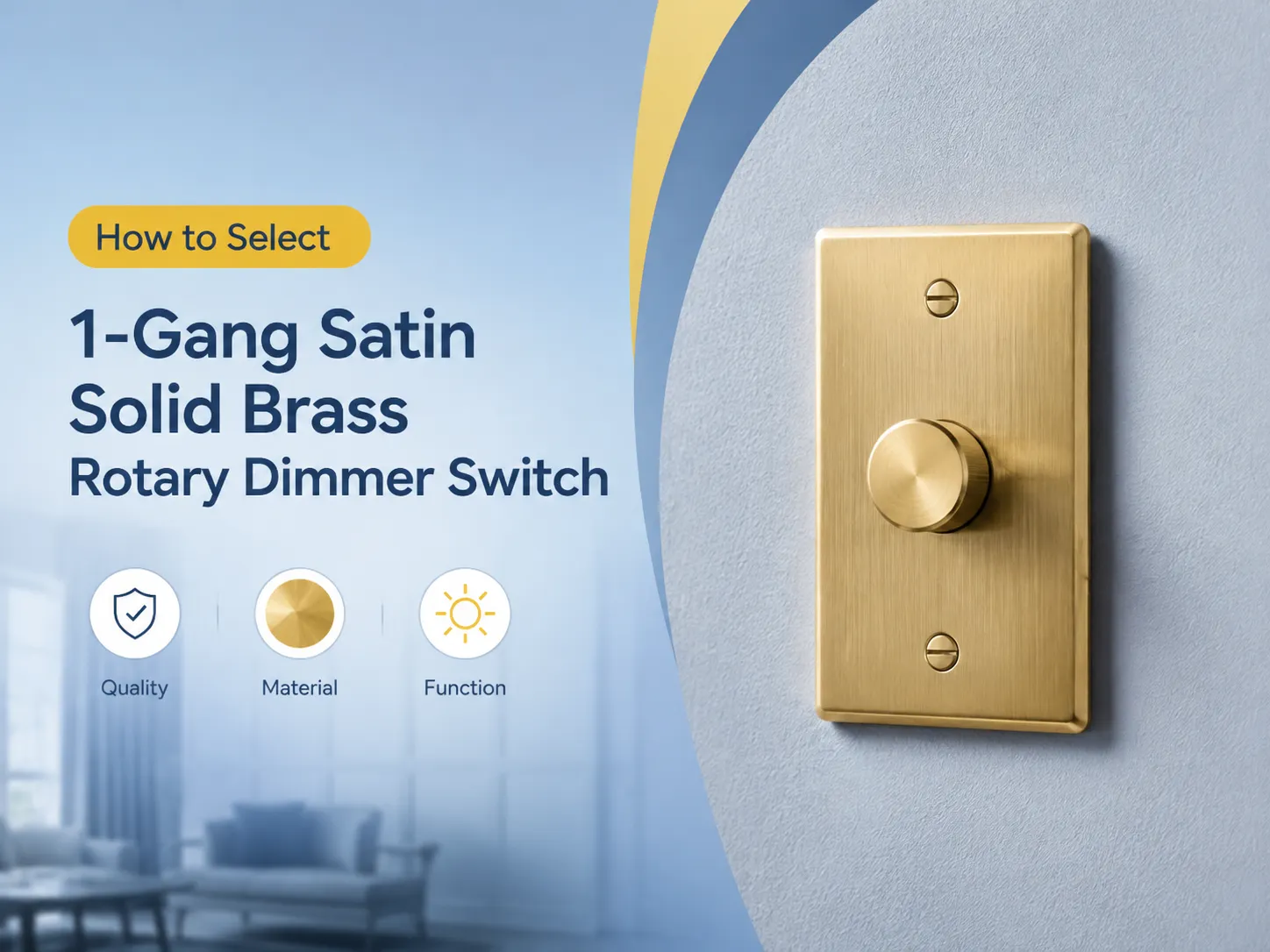
- Mechanical dimmers (rotary, slide, toggle): This is the traditional kind which does not require neutral wire and can use a companion switch; it is the cheapest and most effective method for dimming.
- Tap-to-fade and preset dimmers (such as Lutron Maestro): These are mechanical dimmers that provide a more modern experience with their tap-switch + rocker; if they are 3-way dimmers they must have a third-party switch at their other end (some brands may require a companion switch).
- Smart Wi-Fi / Zigbee dimmer kits: They work with the app and voice, usually require neutral wire, come as kit which may include a piggyback switch or two matched units.
- Smart dimmers that do not require neutral: Some such models (e.g. Lutron Caseta) work without neutral wire if there is a hub (it is especially effective in old houses).
Smart 3-Way Dimmers: Special Considerations
Convenience is a benefit of smart three-way dimmers, but they come with compatibility considerations:
- Neutral wire: Often, a neutral wire is needed at the smart dimmer site, a wire many homes, especially older ones, do not have. Make sure there is one ahead of purchasing.
- Companion/additional switch: Smart systems typically require a special companion switch to be installed, so a non-specific switch cannot be used.
- Some systems are a set of two matching smart devices (for example, a smart dimmer with a smart switch or two smart dimmers functioning together), so it is essential to follow the instructions included in the system.
- Network requirements: Whether a Wi-Fi network (2.4 GHz) or Z-Wave/Zigbee networks are required depends on the system at hand.
- Minimum load: Smart dimmers sometimes have a higher load, so low-efficiency LED lights might not work with them.
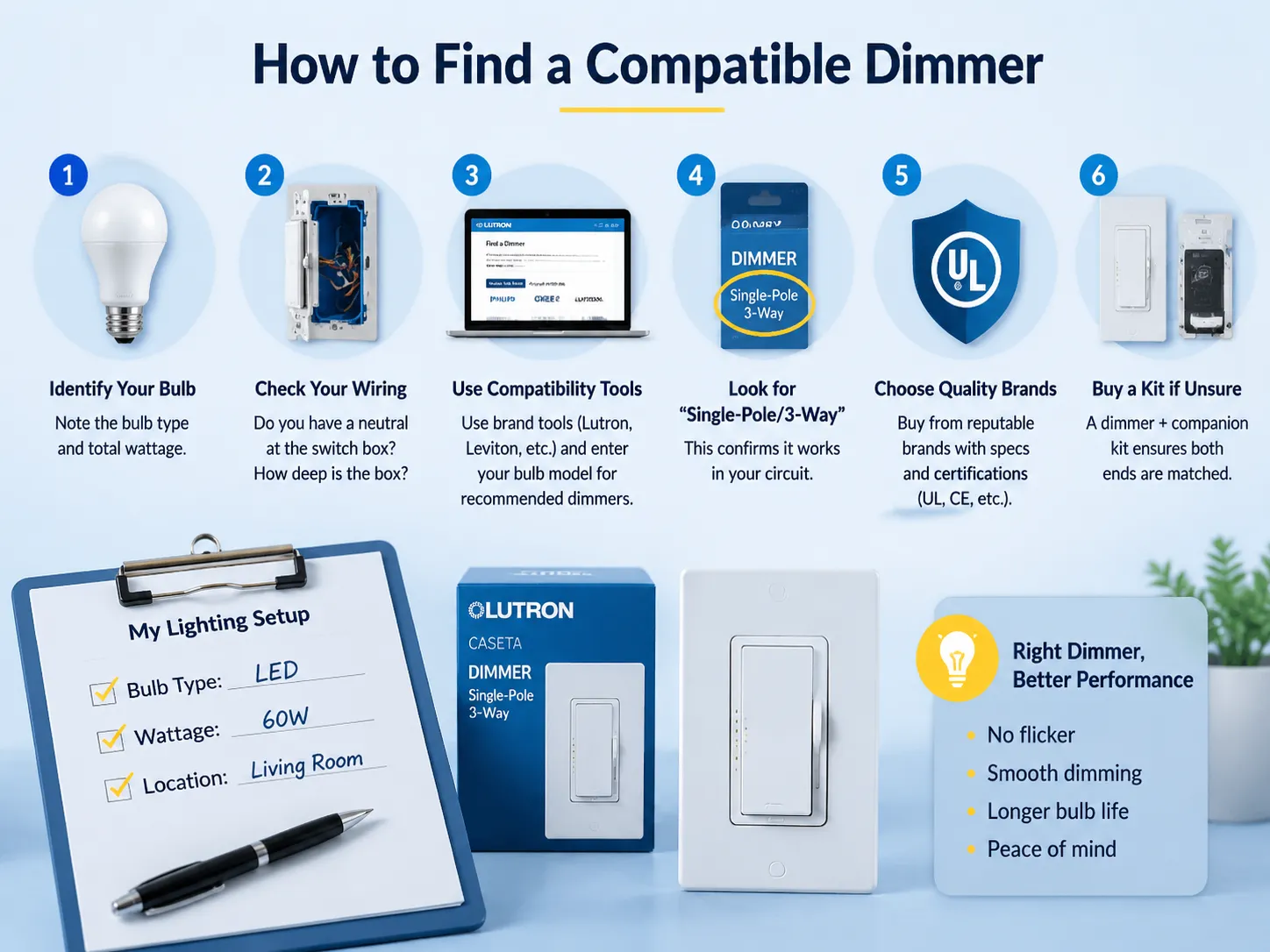
How to Find a Compatible Dimmer
Steps to take in selecting the right dimmer for use in a 3-way application.
- Determining the bulb type along with the power consumption in watts.
- Find out the details about the installation, e.g., does the outlet have a neutral wire?
- Use online tools provided by manufacturers in order to establish compatibility of the bulb type with the dimmer.
- Check for the information mentioned on packages of the dimmers, e.g., “used in one or three-way dimming” or “it is a combination of a dimmer and a dimmer companion.”
- Select a reliable manufacturer who has published product specifications on the internet and avoid use of unspecified cheap solutions in order to set up the system correctly.
- If in doubt select the dimmer kit sold by the manufacturer.
Troubleshooting Common Problems
| Problem | Likely Cause | Fix |
|---|---|---|
| Flickering at low dim levels | LED/dimmer mismatch, below minimum load | Check brand compatibility list; add a compatible bulb or change dimmer |
| Humming/buzzing | Dimmer incompatible with LED or transformer type | Use LED-rated dimmer; for MLV/ELV, use the correct dimmer type |
| Light only works from one location | Travelers wired wrong or dimmer not 3-way rated | Verify traveler-to-traveler matching; confirm dimmer is SP/3W |
| Lights won’t turn off at low setting | Minimum load exceeded downward; or LED leak current | Increase load or use a dimmer with lower minimum; some need minimum-load adapters |
| Two dimmers installed, weird behavior | Two conventional dimmers on one circuit | Replace one with a standard 3-way switch |
| Smart dimmer won’t pair | Wrong network, hub missing, neutral issue | Check 2.4 GHz Wi-Fi, hub pairing, and neutral presence |
Frequently Asked Questions
Can a dimmer switch be used on a three-way circuit?
In short, yes, but you will need to purchase a dimmer that is classified as a three-way dimmer (look for “single-pole/three-way” on the package). The dimmer will replace one of the two three-way switches in your electrical work. The dimmer uses the same traveler wiring. The other switch continues to operate as a three-way switch (toggle on/off or switch the light) from its location without a dimmer. A simple single-pole dimmer will not work in this configuration.
Do you need a dimmer on both sides of a 3-way switch?
In conventional dimmer setups, only one dimmer is necessary along with a typical 3-way switch for another location. Using two conventional dimmers in one circuit will create flickering and buzzing problems along with unreliable function. One exception to this is the use of specialized paired smart dimmer kits consisting of two interconnected devices (a smart dimmer switch and a remote switch) installed according to directions.
How to find a compatible dimmer switch?
In order to make sure that your dimmer and bulb can work together, identify the type of the bulb and its wattage, see whether you have a neutral wire in your switch box and if it is deep enough. After that, go to the websites of either Lutron or Leviton and find a visual compatibility guide. When making sure that you have a right dimmer, look for one that is “single-pole/3-way,” check for the possibility of using your respected bulb type (LED dimmers must be LED-compatible), check the maximum min wattage, and make the purchase of the certified product. If you are buying a smart dimmer, check for the same requirements that are needed for the dumb dimmer being installed.
Can you use 2-3 way dimmer switches together?
Normal dimmers cannot be used together on a 3-way circuit as they may interfere with each other and cause flickering or buzzing. It is advisable to use one dimmer together with a normal 3-way switch. However, smart dimmers are designed to be installed in pairs. They may include one smart dimmer together with its matching add-on switch, or two identical smart dimmers communicating with each other. If you bought a smart dimmer that indicates two installations, comply with the manual.
References
- NFPA 70 — National Electrical Code (NEC), Article 404: switches and dimmers
- UL — dimmer safety and compatibility standards (UL 1472)
- Lutron — 3-way dimmer compatibility tools and LED+ product documentation
- Leviton — dimmer compatibility charts and installation guides
- U.S. DOE — dimming and LED lighting guidance
- Trowbridge Electrical — Best 3-Way Switches With Dimmers (compatibility guide)
- 101 Generator — Best 3-Way Dimmer Switches for LED Lights
Conclusion
The compatibility of 3-way dimmers is relatively easy once you learn the basic principles: you need to buy a “single-pole / 3-way” dimmer, install one dimmer in conjunction with a standard 3-way switch on the other side of the circuit, ensure the dimmer matches the bulbs you are using, and double-check the wiring in terms of the system overall, and for future applications — the neutral (for smart dimmers), the depth (for the box), and the power (load).
The two common errors committed are getting a single-pole dimmer for a 3-way circuit and coupling modern LED load with the dated dimmer — both can be easily prevented by consulting the above checklist and compatibility tools for dimmers and lights in the project.