If you’ve completed a project and have a spare 3 way switch in your toolbox or if your local hardware store has only 3 way switches on their shelves, you can use that 3 way switch as a single pole switch. A 3 way switch is an SPDT (single pole double throw) device and can be used as a regular on/off switch to control lights from one location if you only connect two of the three terminals together. Here’s how to correctly connect the 3 way switch so that you can use it as a standard on/off switch, things to watch for, and reasons why your 3 way circuit may not be working properly if you incorrectly connected a regular single pole switch to the 3 way switch.
Understanding the 3‑Way Switch’s Extra Terminal
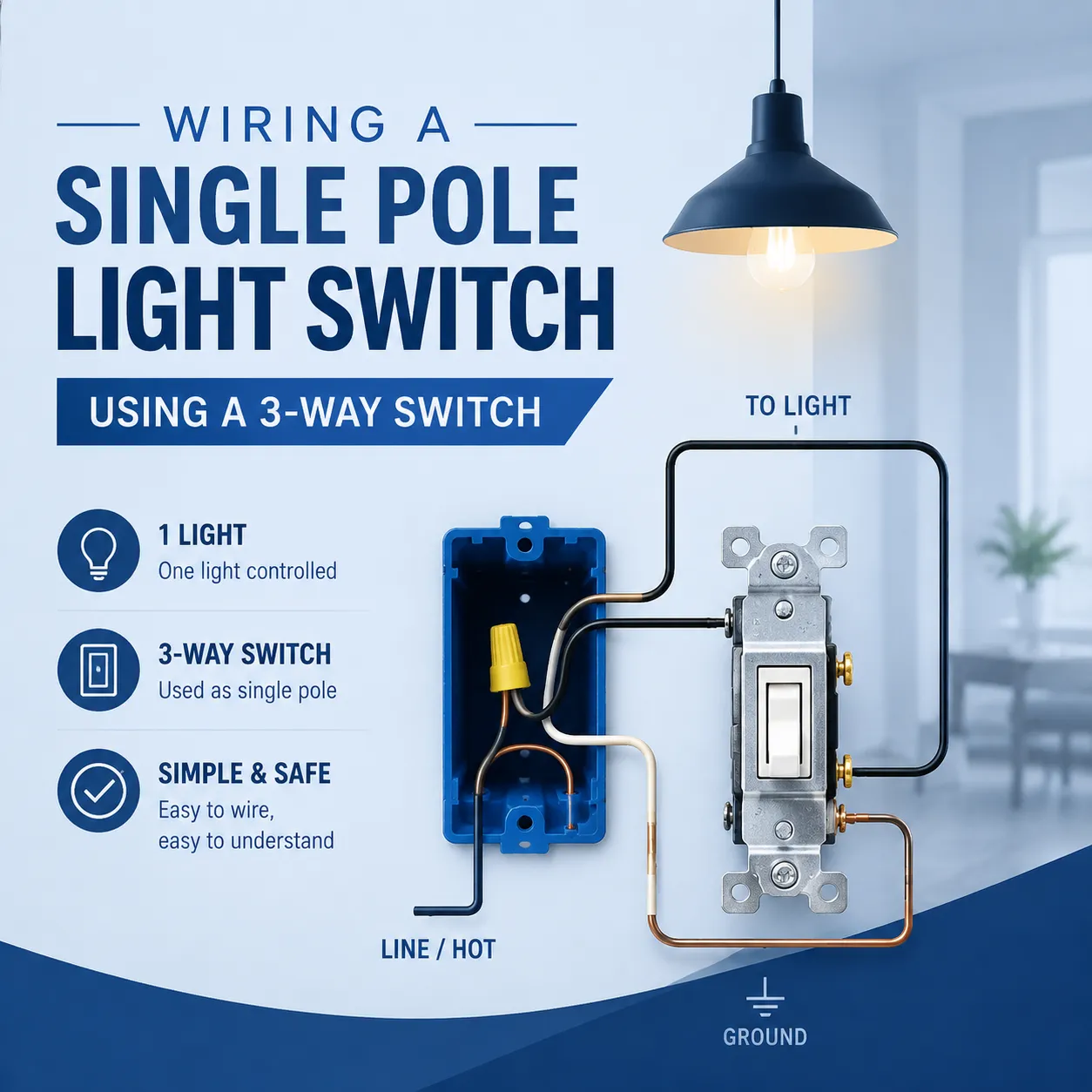
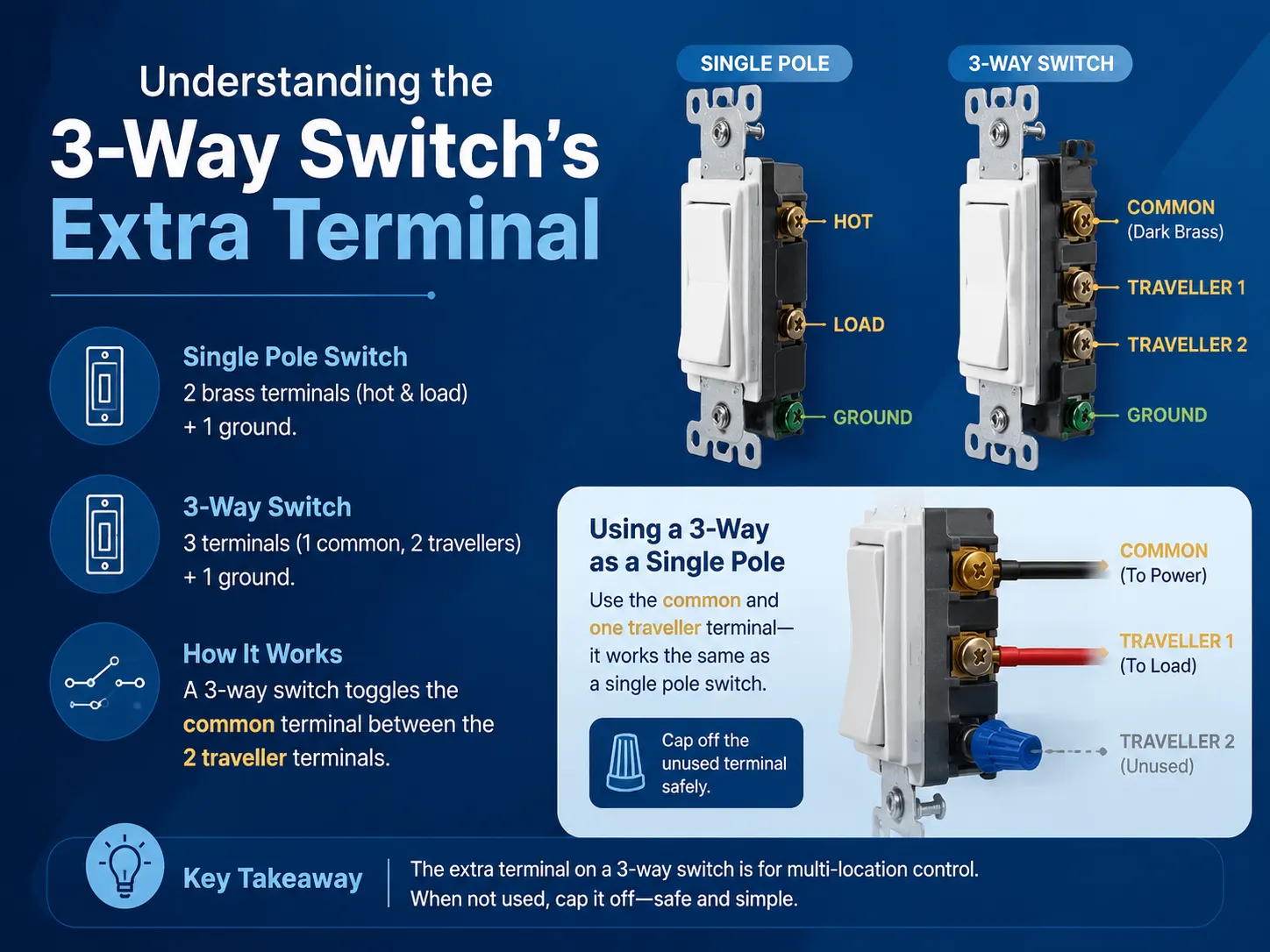
There are two types of switches for controlling power: A standard single pole and 3-way. A single pole only breaks or completes the hot wire with 2 brass screw terminals and 1 ground. A 3-way switch has 3 screw terminals (plus ground); there will be a dark brass “common” and 2 other brass “traveller” screw terminals. The actual operation of a 3-way switch is to toggle the common terminal between the 2 traveller terminals internally. If using a 3-way as a single pole, you will only be using 1 of the traveller terminals. Therefore, using the common and 1 traveller of the 3-way, it will work the same as a single pole switch. The only difference is there will be an unused 3-way terminal; you can safely cap it off.
How to Wire a 3‑Way Switch as a Single Pole Light Switch
Before commencing any procedures inside the enclosure, ensure the circuit is de‐energized by turning off the circuit breaker and checking for power with a non‐contact voltage tester. You will then need to follow these steps to successfully complete the install.
- Identify the terminals. On the back side of a three-way switch you have the common terminal which would be a darker color screw or marked “COM”. The two travelers are a lighter color brass. If not marked you could also look at the box or package or use a multimeter in continuity mode- when you flip the toggle only one of the travelers will beep when you are in one position and when you flip the toggle it will beep to the other side.
- Connect the ground wire. Attach the bare or green ground wire to the green ground screw on the switch.
- Connect the line and load wires. Connect the common terminal with the Black hot wire coming from your Power Source (Line) and connect either of the Traveler Terminals on the black wire going to the Light Fixture (Load).
- Cap the unused traveller. The other terminal on the traveler must be covered with either a wire nut or tightly wrapped in electrical tape around the screw. A bare wire should never be left exposed in the box.
- Mount the switch and restore power. With the wires moved into position and securely fastened, put the cover plate on and thoroughly check for operation by turning on the circuit breaker and testing for power.
That’s it. The switch will now turn the light on and off from a single location. If you’re more comfortable following a wiring diagram for a standard single pole, our guide on how to wire a single pole switch walks you through the same process with a dedicated two‑terminal device.
Can You Use a Single Pole Switch with a 3‑Way Switch?
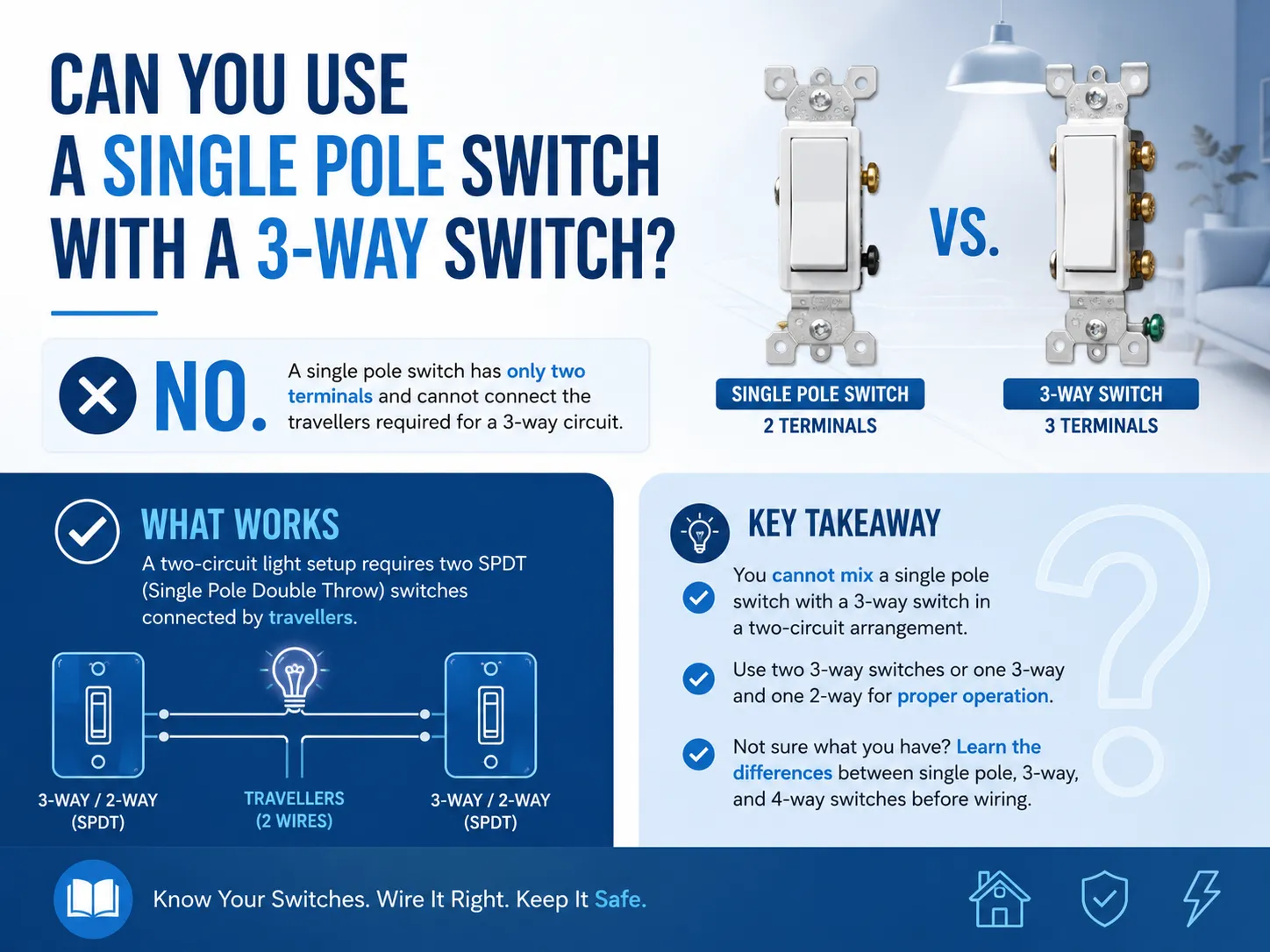
If you are wondering if it’s possible to mix a single pole switch and a 3-way switch in one two-circuit arrangement, the answer is no. A properly configured two-circuit light fixture would consist of 2 SPDT (Single Pole Double Throw) switches (either both 3-way, or one 3-way and one 2-way) wired by way of travellers (two wires connecting the two SPDT switches). The Single Pole Switch has only two terminals which prohibit proper connection of the travellers. So if you purchased a Single Pole Switch but already have the 3-Way Switch, this configuration should work. And if your home has a mix of switch types and you’re unsure what you’re looking at, our article on different types of light switches clarifies the visual differences between single pole, 3‑way, and 4‑way devices.
Why Does My 3‑Way Switch Only Work When One Switch Is On?
When one of two 3-way switch circuits fails, the dark screw of both switches should have the same wire. If one does not have a common wire, then the circuit completes at that switch only because of a swapped common and traveller wire. A circuit can be completed between both switches (light will work) without the switch that wasn’t completed at the first turn because the common terminated at the traveller terminal instead of at the common. To fix this problem: determine which terminal on each switch is the common (the dark screw of each switch), and make sure the power source or switched wire that goes to the light is terminated there; the traveller wires should only connect to the brass terminals.
What Happens If I Wire a 3‑Way Switch Wrong?
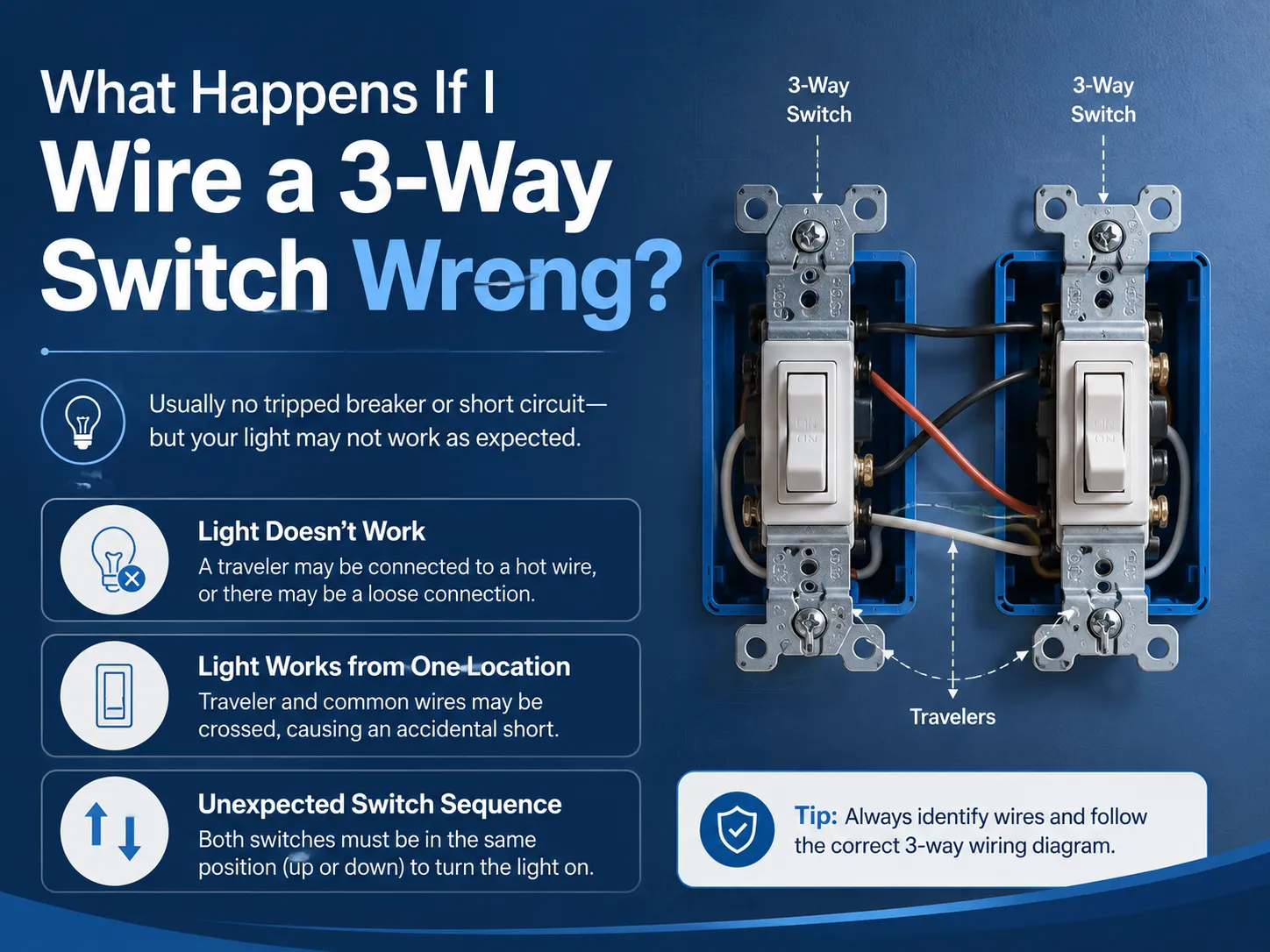
Wiring a three-way switch improperly does not generally result in a tripped breaker or short circuit, but rather causes one of the following:
- The light doesn’t work at all. Usually, this means a traveller is connected to a hot wire and it will never get constant continuity with the common wire, or that there can be a loose wire.
- The light only works from one location. One indication that the traveler and common wires are crossed is an accidental short circuit, which causes the two wires to connect.
- The switches work but in an unexpected sequence. In order for the lamp to work properly, both switches must be positioned in either an “up” or “down” setting. This remains a traveller-common switch reversal.
These problems will not cause damage to the switch or the wiring but can cause frustration. A systematic identification process can help with finding the common terminal. Also, if you are upgrading your home to a smart home and would rather simplify 3 way wiring, many smart switches offer an alternative way to accomplish this by using wireless communications between the smart switches. Our roundup of top‑rated smart light switches includes models that handle multi‑location control without traveller wires.
When to Use a True Single Pole Switch Instead
A single pole light switch is less expensive than a 3-way switch. The unmarked terminal on the 3-way switch can create confusion for future homeowners. Because they have an unused terminal, using 3-way switches may lead to questions. GOG Electric has a complete line of single pole switches, allowing you to choose the style and finish you like without resorting to workarounds; however, a 3-way switch can work perfectly fine if necessary.
Frequently Asked Questions
Can you use a single pole switch with a 3-way switch?
If you want to make a two-location lighting system using a single-pole and a three-way switch, there won’t be enough switches to do so. You can’t use a single-pole switch and a three-way switch to create a two-location lighting circuit. To achieve a two-location circuit, there will need to be two SPDT switches. However, you can take a three-way switch and use that by itself as a single-pole switch by capping off one of the traveller terminals.
How to rewire a 3-way switch to a single pole?
In order to convert a 3-way Switch into a Single Pole Switch, you need to do the following: First, connect your In Coming Hot Wire to the Common Terminal; Second, connect your Out Going Hot to either of the Traveller Terminals; And Lastly, cap off the unused Traveller, (the one that you did not connect your Out Going Hot to). The Ground Wire will be connected to it’s normal position on the Green Ground Screw.
Why does my 3-way switch only work when one switch is on?
Connecting the common wire to the traveller terminals rather than the common terminal is usually present on this type of installation. The result is that the circuit is now reliant on the position of both switches. You need to look for the black common screw on each of the 2 switches, then make sure that the always-hot wire (or the wire going to the light) is connected to the black common screw.
What happens if I wire a 3-way switch wrong?
A 3-way switch that has been miswired will generally cause the light to either be off, functional from only one switch, or only work when both switches are in certain positions. It is very uncommon for the switch to be miswired because of a short circuit. Simply identify the common and traveller terminals and re-connect the wires accordingly to properly wire a 3-way switch.
Using a 3‑way switch as a single pole light switch is a practical, code‑compliant solution when you need a switch and a 3‑way is what’s available. The key is capping the unused traveller and connecting the line and load wires to the common and one traveller terminal. If you run into confusion with traveller wires or multi‑location circuits, remember that the underlying principle is always the same: the common terminal is where the power or the load must land. With that rule in mind, you can adapt a 3‑way switch to single‑pole duty — or correctly wire a two‑location circuit — without guesswork.