Recently in Manchester, an electrician took on a kitchen remodeling project in a home from 1968. The first box he opened revealed a mix of both old and new electrical wiring. The first thing he noticed was that there was a piece of modern wire with blue/brown conductors attached to an older circuit with red/black pairings as well. It had apparently been extended to this location by a previous owner, but at no time did they mark the difference in the new and old cables. In addition, the electrician took an extra hour tracing all of the different conductor types back to their original source before proceeding; his caution was well-founded. The colours of electrical wires changed in the UK in one year (not multiple) — therefore it is likely that any electrical work that happens in a house built before/after that transition will contain at least two different types of colour schemes (and possibly more). Understanding how to handle these different types of wiring when they meet at a junction box is critical to perform safe electrical work in any UK home.
The Current UK Wiring Colour Standard: Harmonised Colours Since 2006
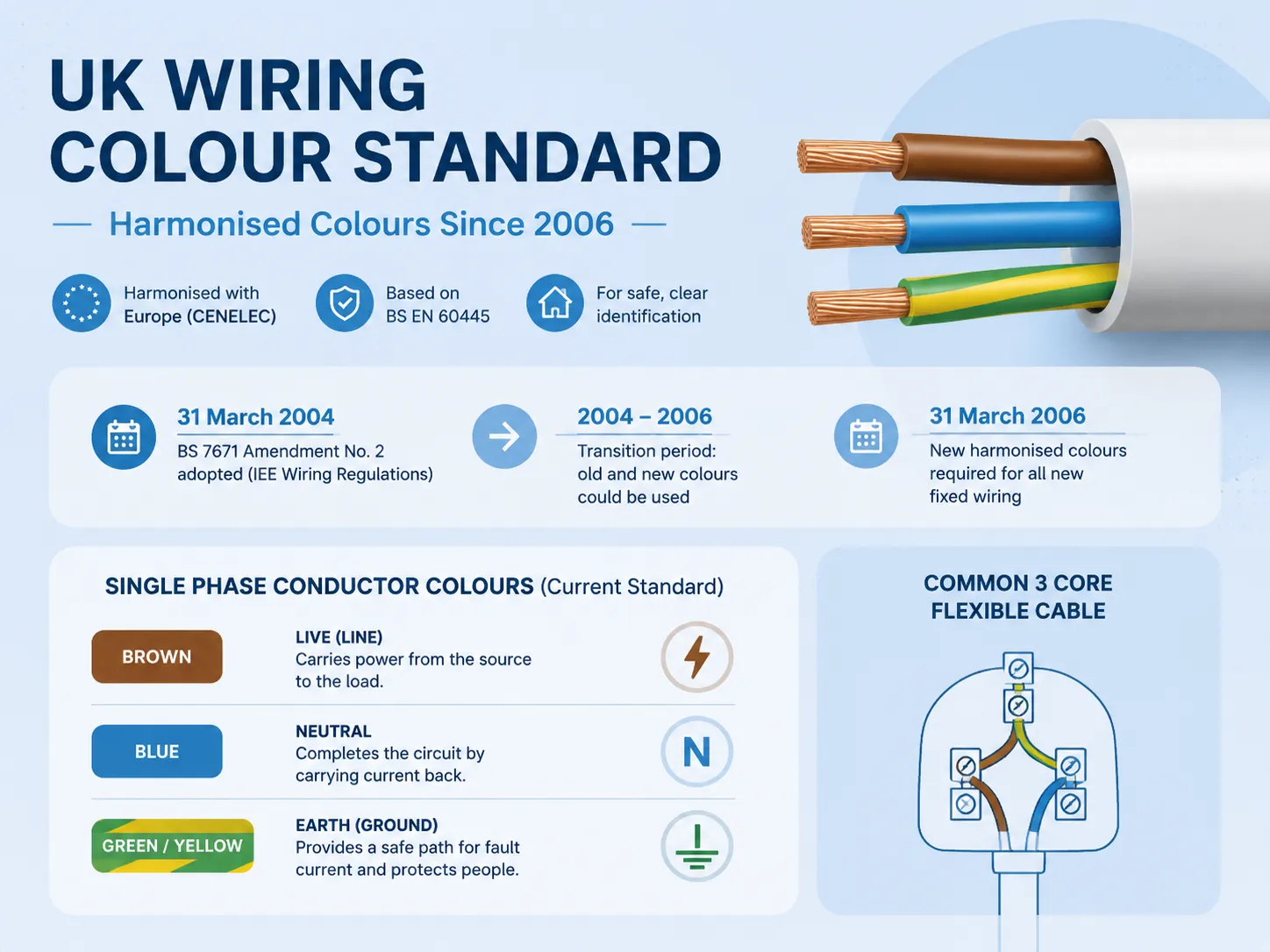
The harmonised wiring colour standard for Europe was taken on 31 March 2004 by The United Kingdom which was published as BS 7671 Amendment No. 2 (IEE Wiring Regulations). They were new colours for fixed wiring for buildings to bring them in line with European colours. A transition period of two years was given from 31 March 2004 through 31 March 2006 during which time both old and new colours on the same installation could be used. The new harmonised colours must be used for all new fixed wiring installed after 31 March 2006.
It is not an easy adjustment for an electrician with many years of experience matched up 2 colours of electrical wire with their respective terminals where red was used for line(s) and black used for neutral. They now have to reprogram their brain to match brown and blue respectively. This is due to a change agreement by CENELEC (European Committee for Electrotechnical Standardization) regarding harmonisation. The harmonisation is mandated within BS EN 60445 within the standard. These standards provide the proper way to identify conductors using either colour or numerical designation.
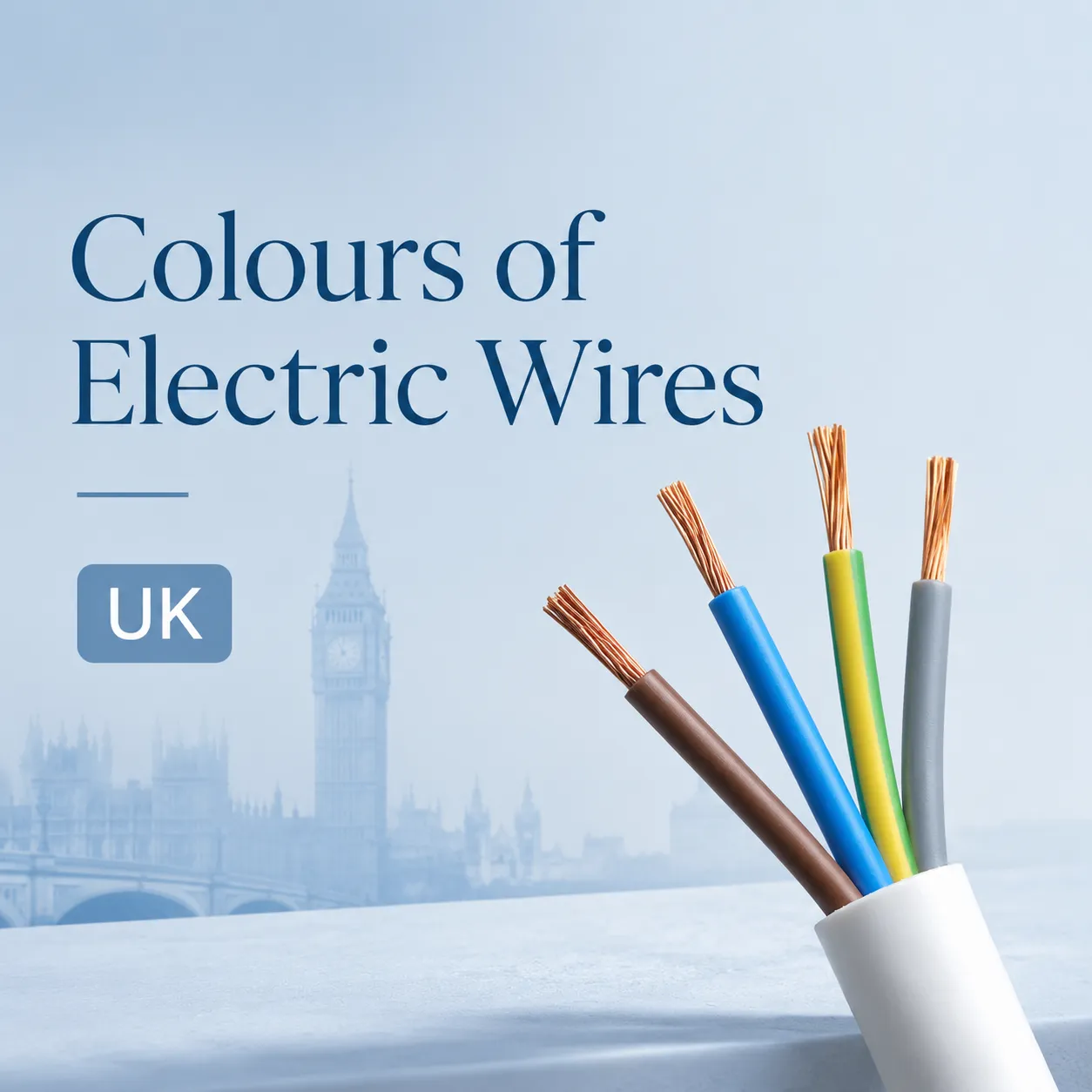
According to the currently harmonised British standard single phase electric wire colour codes are:
- Brown: Brown wire is referred to as a line conductor (also known as a live conductor), as it was previously associated with red. The brown conductor, as per the new wiring convention, carries power from the power source to the intended load.
- Blue: The neutral wire. Previously referred to as the ‘black wire’. The blue wire now completes the circuit by carrying the returning current back to the power source.
- Green and yellow striped: In the UK, since 1977 there has been a consistent standard for earth (ground) that was not altered during harmonising. The earth conductor provides a conductive path for any faults which occur, and is bonded to any exposed metallic objects.
The colours of conductors in a common three core flexible cable used in appliances and extension leads, will be assigned as follows: the live conductor will be coloured brown, the neutral conductor will be coloured blue and the earth (ground) conductor will be coloured green / yellow.
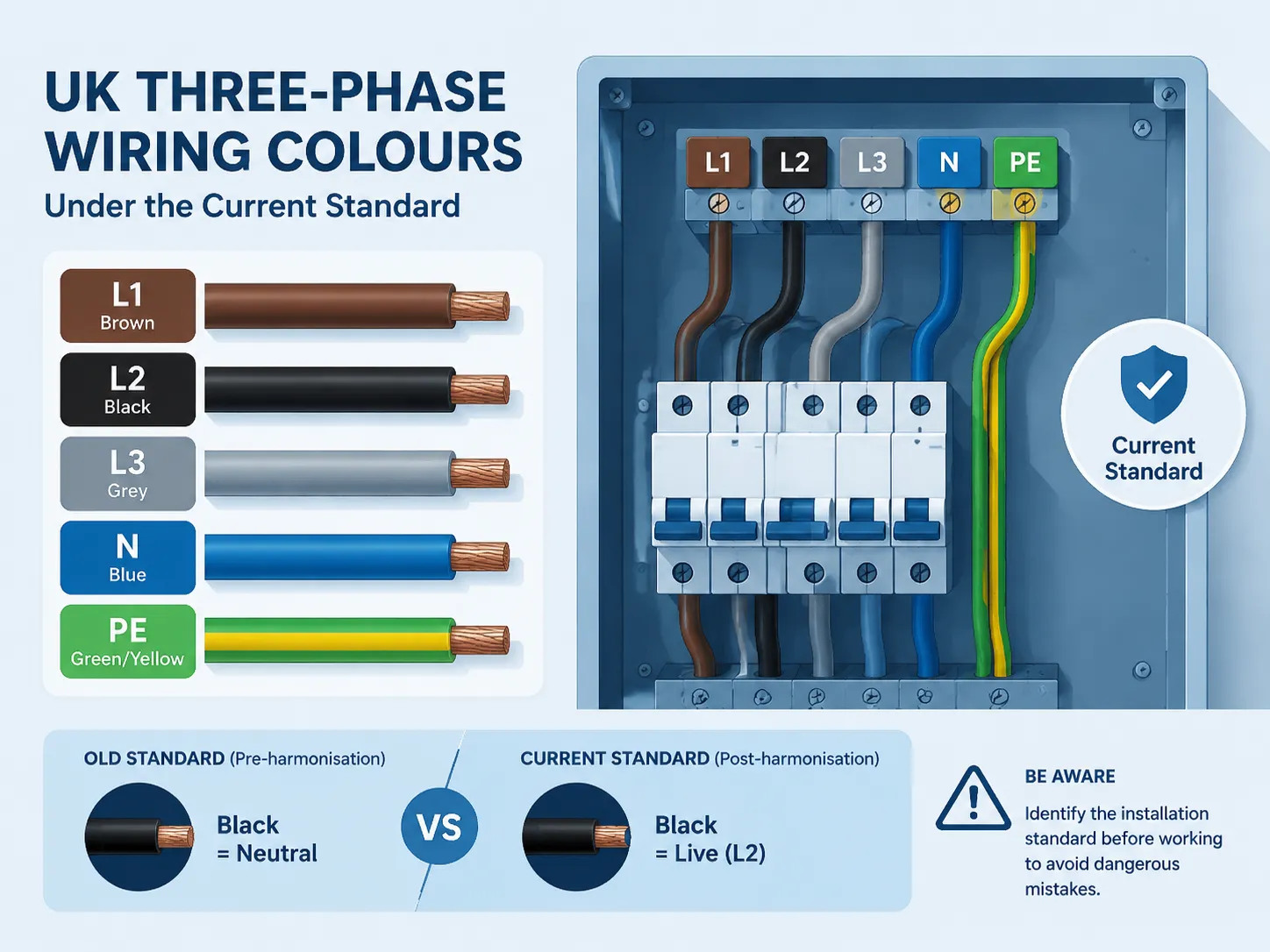
Three‑Phase Circuit Colours Under the Current Standard
For three‑phase installations, the current UK standard uses the following wire colours:
- Phase L1: Brown
- Phase L2: Black
- Phase L3: Grey
- Neutral: Blue
- Protective Earth: Green and yellow striped
The harmonisation of the wiring colour codes has created potential confusion because of the differences between these codes. Under the old standard, the colour black would represent the “neutral” wire, while the new (harmonised) colour code has changed black to represent “hot” in a three-phase electrical system. Therefore, an electrician must determine whether he is working on a pre- or post-harmonisation installation if he encounters a black wire in the three-phase electrical panel/providing electrical service to a three-phase system; otherwise, the electrician may mis-classify the black wire and mistakenly create a short circuit or energize the exposed metal work.
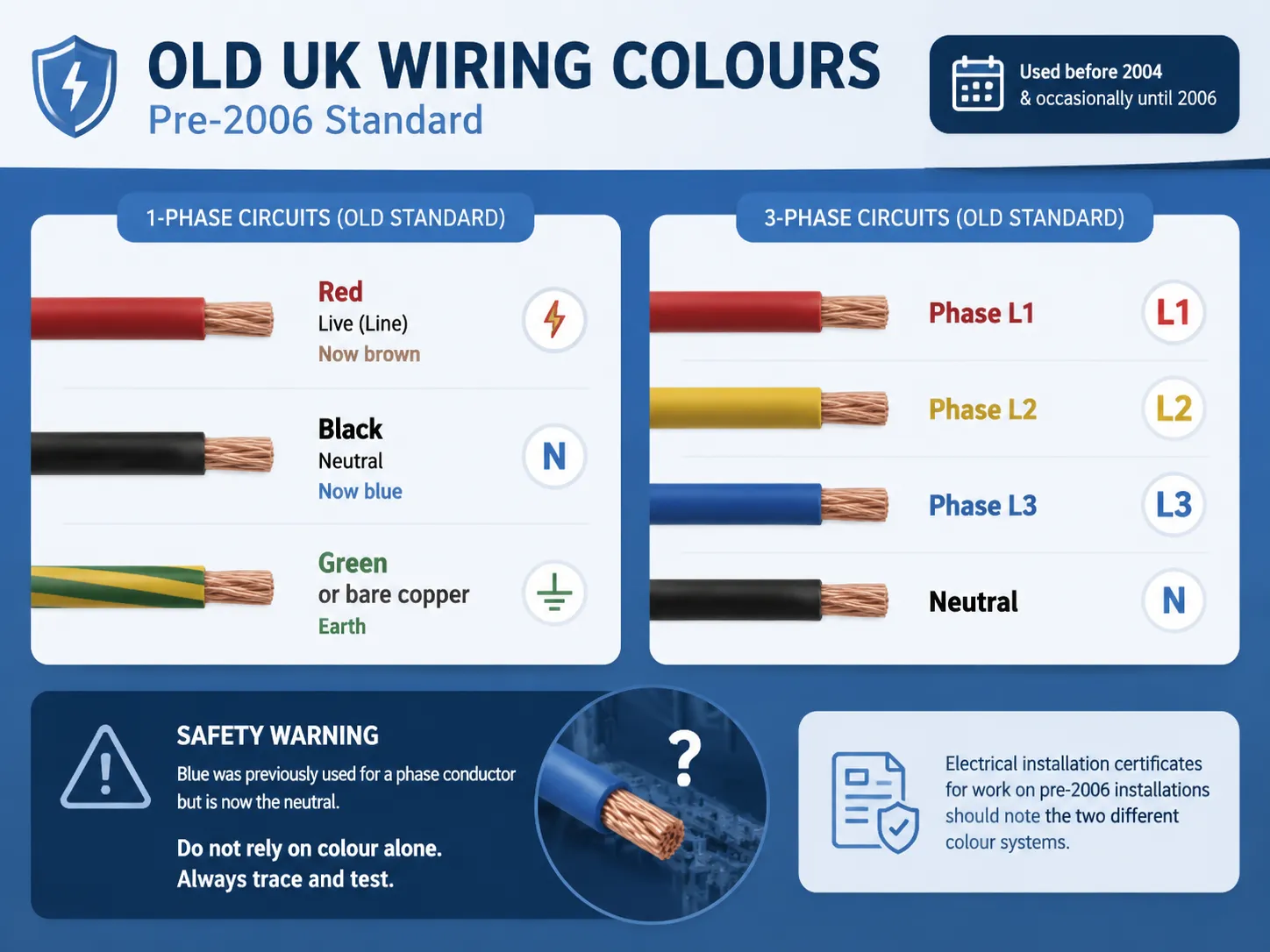
The Old UK Wiring Colours: Pre‑2006 Standard
Electric wires’ colours prior to 2004 and occasionally installed in the interim from 2004 until 2006 will follow the earlier British standard and will have this set of colours: 1-phase circuits previous colour standard:
- Red: Live (line). Now brown.
- Black: Neutral. Now blue.
- Green or bare copper: Since 1977, the universally accepted color scheme for earth conductors in Australia is green and yellow striped, but earlier installations may have used either only green or uninsulated earth conductors.
For three‑phase installations under the old standard, the phase colours were:
- Phase L1: Red
- Phase L2: Yellow
- Phase L3: Blue
- Neutral: Black
The old three-phase system poses a specific danger from the harmonised colours; the colour blue was previously assigned to the phase conductor but is now used as the colour for the neutral wire. Therefore you can’t identify a blue wire in a three-phase board by colour alone. It must be traced and tested. The Health and Safety Executive have issued guidance document containing information on the management of this particular risk; and any electrical installation certificate for work performed on an installation completed prior to 2006 should contain a note regarding the two different colour systems that exist.
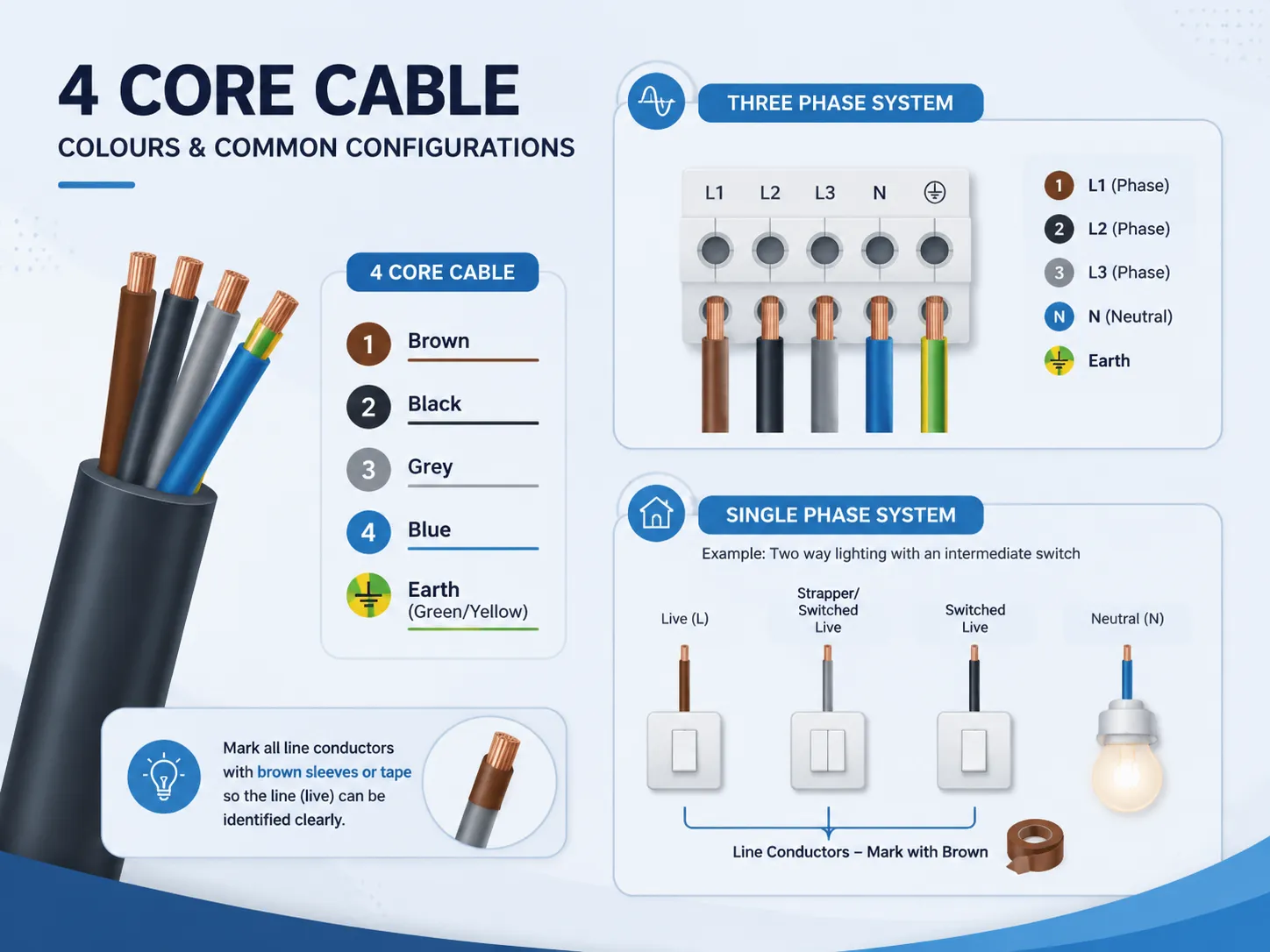
Four‑Core Cable Colours and Other Common Configurations
Generally speaking, a four core cable will consist of four insulated conductors, and one uninsulated earth, or alternatively, 1 green/yellow earth core. The four insulated conductors have the following colour coding as per the harmonised standard:
- Core 1: Brown
- Core 2: Black
- Core 3: Grey
- Core 4: Blue
In a three phase system, the Brown (B), the Black (B), and the Grey (B) are used as the 3 phase conductors while the Blue (B) is the neutral conductor. When using a four core cable in a single phase system (for instance, two way lighting with an intermediate switch), an electrician can assign these cores differently. The electrician is to mark all cores being used as a line conductor with brown sleeves or tape so that the line constant can be determined properly. In particular, the grey core is often marked because its function is not evident to the person using the core due to its colour.
The transition from the old to the new standards is easier to understand when comparing the old with the new standards of conductors performing the most common tasks.
| Conductor Function | Old UK Colour (Pre‑2004/2006) | Current Harmonised Colour |
|---|---|---|
| Single‑Phase Live (Line) | Red | Brown |
| Single‑Phase Neutral | Black | Blue |
| Three‑Phase L1 | Red | Brown |
| Three‑Phase L2 | Yellow | Black |
| Three‑Phase L3 | Blue | Grey |
| Protective Earth | Green or bare (green/yellow from 1977) | Green and yellow striped |
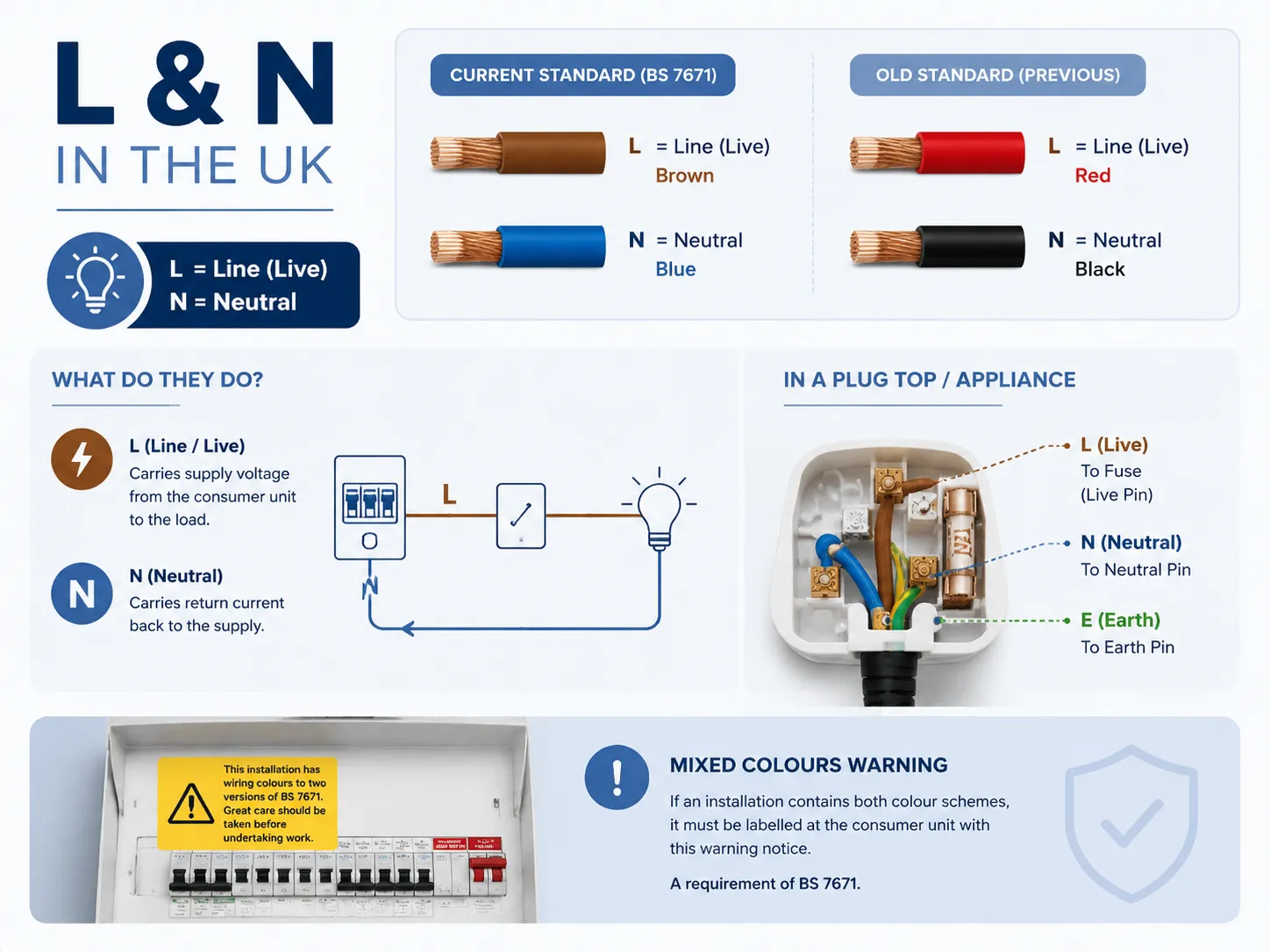
What Are the L and N Wires in the UK?
In the context of UK fixed wiring, L and N are the standard abbreviations for Line and Neutral. Under the current harmonised standard, L is brown and N is blue. The line conductor (brown) carries the supply voltage from the consumer unit to the switch, light, or socket. The neutral conductor (blue) carries the return current back to the supply. In a correctly wired plug‑top or appliance, the brown wire connects to the fuse (live pin), the blue wire connects to the neutral pin, and the green/yellow wire connects to the earth pin.
Under the old standard, L was red and N was black. An installation that contains both colour schemes must be clearly labelled at the consumer unit with a warning notice, typically reading: “This installation has wiring colours to two versions of BS 7671. Great care should be taken before undertaking work.” This warning label is a requirement under BS 7671 and is the first thing a responsible electrician looks for when opening an unfamiliar consumer unit.
Are Old UK Wire Colours Still Safe?
The old UK wire colours are not inherently unsafe. The red and black PVC insulation used in British cables from the 1960s through the early 2000s is generally durable and retains its insulating properties for decades, provided it has not been subjected to sustained overheating, physical damage, or chemical exposure. The safety concern is not the age of the insulation but the risk of misidentification when old and new colours coexist.
When an electrician encounters a red or black conductor in an installation that also contains brown and blue, the only safe approach is to test every conductor with a voltage tester and a continuity tester before making any connections. Colour alone cannot be trusted across the harmonisation divide. The IET Wiring Matters publication has addressed this topic in detail, and industry guidance from the Electrical Contractors’ Association (ECA) reinforces the need for clear labelling and testing on mixed‑colour installations.
If an old installation is being extended or modified, best practice is to use the current harmonised colours for the new work and to apply a durable warning label at the consumer unit. Sleeving any old conductors that are reused with the appropriate colour identification — brown sleeving on a red live, blue sleeving on a black neutral — helps bridge the visual gap and reduces the risk of future misidentification.
Practical Guidance for Homeowners and Electricians
For a homeowner replacing a damaged light switch or socket front, the colour of the electric wires in the back box is the first thing to note before disconnecting anything. A switch box containing brown and blue is a modern installation; one containing red and black is pre‑2006. If you find a mix of both, stop and call a qualified electrician. The presence of mixed colour schemes indicates that the circuit has been modified across the standard change, and the risk of a misconnected conductor is real.
For an electrician, the protocol is methodical: identify the installation age from the consumer unit and any available test certificates. Test every conductor. Apply appropriate sleeving where colours do not match modern expectations. Label the consumer unit. And record the presence of mixed wiring colours on the Electrical Installation Certificate or Minor Electrical Installation Works Certificate. This documentation protects not only the electrician who did the work but every electrician and homeowner who follows.
References
- BS EN 60445 — Basic and safety principles for man‑machine interface, marking and identification — Identification of conductors by colours or numerals. British Standards Institution.
- BS 7671 — Requirements for Electrical Installations (IET Wiring Regulations) — Institution of Engineering and Technology.
- Health and Safety Executive — Electrical Safety at Work — Guidance on managing electrical risks including mixed wiring colour installations.
- Electrical Contractors’ Association (ECA) — Industry guidance on safe electrical installation practices and wiring colour identification.
Frequently Asked Questions
Are old UK wire colors still safe?
The traditional UK wiring system used to be made of different-coloured wires. Those older wires — red and black — are not necessarily dangerous. The wire jacket on the old wiring is generally very durable. However, when wired with a mix of older and newer wires, it is possible to misidentify the wires, creating a potential safety issue. It is required to have any installation that uses both older (red and black) and newer (brown and blue) wired circuits clearly labelled at the consumer unit. All conductors must be verified prior to connection.
What color are the L and N wires in the UK?
The brown wire is line (L); blue wire is neutral (N) under the Harmonised Standard whereas under the old Pre-2006 Standard the line wire (L) was red and neutral wire (N) was black. Both have Green and Yellow striped as the earth (earthing conductor) but the older installations of earthing conductors may be plain green or bare.
What year did the UK change wiring colors?
On March 31, 2004, the UK officially implemented the standard electrical wiring colour code. There was a transitional period during which both the old and new wiring colours could be used until March 31, 2006. As of that date, all new electrical installations had to conform to the new wiring colour scheme of brown, blue, and green/yellow.
What are the 4 core cable colors UK?
According to the harmonised standards, 4-Core Cables are made with conductors that are coloured brown, black, grey, and blue. In addition to this, a 4-Core Cable will contain either a green/yellow Earth conductor or a Bare Earth conductor. In cases where the 4-Core Cable is used for a Three-Phase system; the three phase conductors are traditional brown, black and grey with the blue being the Neutral Conductor. In the case of presenting a single phase, all phase conductors must be identifiable with brown sleeving.
The colours of electric wires in the UK are not arbitrary. They follow a national standard, itself aligned with a European standard, that exists to protect electricians and homeowners from the consequences of a misconnected conductor. Whether you are replacing a socket front in a 1970s semi‑detached or wiring a new extension to current regulations, the colour of the wire tells a story — but it is a story that must be verified with a voltage tester, not taken on trust. At GOG Electric, we manufacture wiring accessories — switches, sockets, and smart home devices — that are designed to be connected safely and clearly, with terminal markings that correspond to the current UK wiring colours, because the connection between the wire and the device is where safety is either confirmed or compromised.